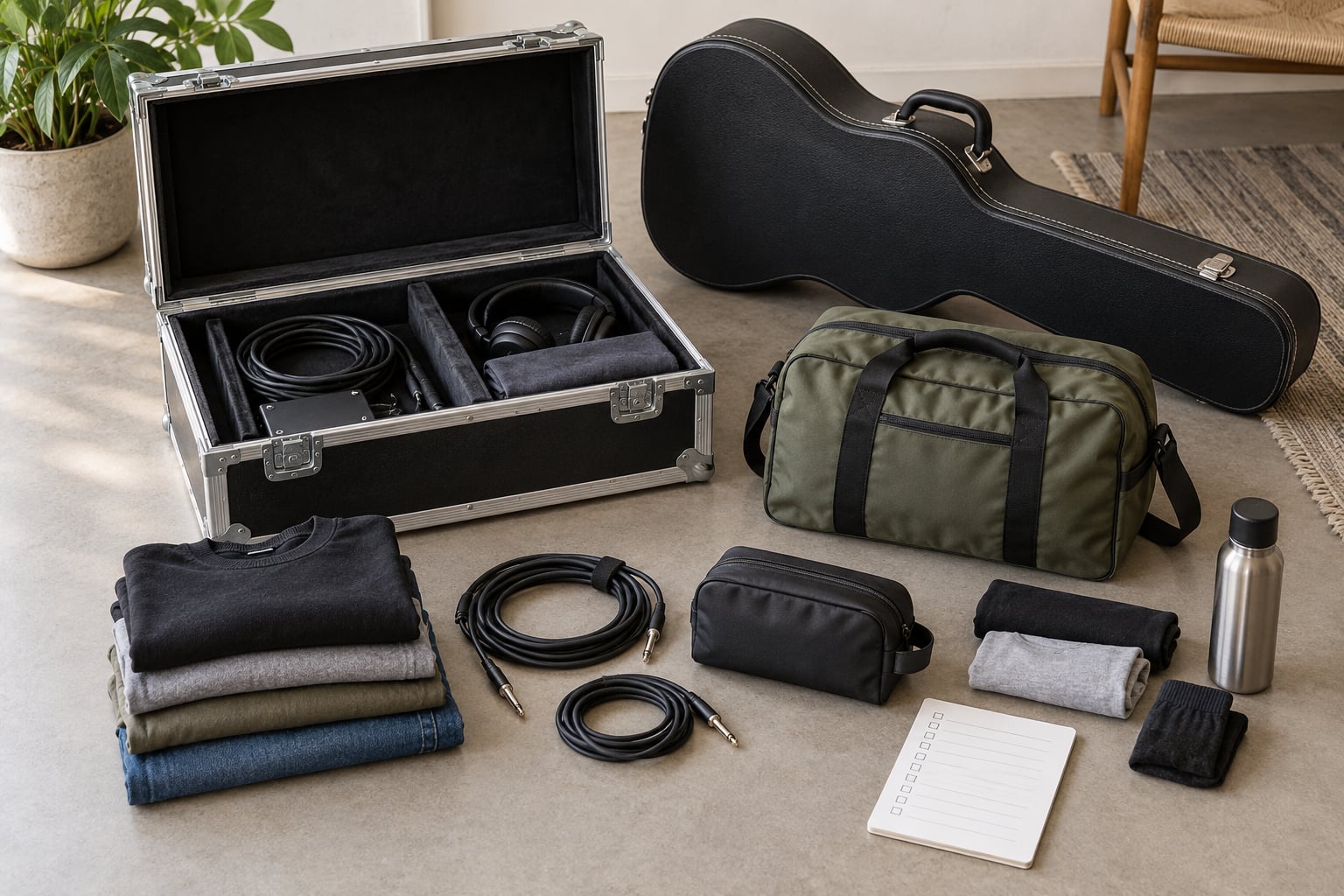
What to pack for a short tour follows one rule: pack by duration, not by destination, and split everything across what stays on your person, your day bag, and one suitcase. For two to seven days on the road, that means an outfit per day plus two spares, one durable pair of shoes and one casual pair, a health pouch that never leaves your body, and a copy of every document that could get you through a door.
A short run gives you no slack. There is no afternoon between shows to find a hardware store, and if the van or bus has no climate control, you are not fixing that in a parking lot after midnight. So the plan below moves in the order that actually works: work out the constraints first, then pack by bucket, then test everything before the doors close.
I have watched people overpack a six-day run with two suitcases, then spend the first two hours of every drive throwing things between bags. It is a rite of passage for new touring musicians, and it is entirely avoidable.
Table of Contents
- What You Need
- Step-by-Step: What to Pack for a Short Tour
- Start With the Tour Itinerary and Luggage Limits
- Pack Documents, Money, and Backup Plans
- Choose Clothes and Essentials for Repeated Wear
- Build a Performance Kit for Short Tours
- Pack Instruments and Critical Spare Parts
- Add Health, Sleep, and Personal-Care Items
- Use Cases and Packing Systems to Stay Organized
- Common Mistakes When Packing for a Short Tour
- Frequently Asked Questions
- Conclusion
What You Need
Before a single item goes in a bag, seven things have to be settled. Each one changes the list, and skipping any of them is what turns a two-bag pack into a problem.
The itinerary. Dates, cities, drive lengths, load-in times and where you sleep. A four-date run through three states is a different packing job from four dates in one state, because the routing decides whether you carry climate gear.
The transport mode. Van, tour bus or fly date. Each has a different volume ceiling and a different set of failure modes, covered in detail further down.
The luggage limits. If you fly, that is the airline’s carry-on dimensions and weight allowance for each leg, checked in advance. If you drive, it is the cubic feet you can actually reach in a van or the bunk space you have on a coach.
The weather range. Check the forecast for every city on the run, not the first one. Three states in a week can mean three different conditions, and a routing that swings from 40 degrees to 90 degrees needs layers, not a single heavy coat.
The show schedule. How many shows, how many soundchecks, and whether there are any press photos, video shoots or themed nights. A music video shoot changes the wardrobe count overnight.
Gear and instrument requirements. What you play, what you run, what the crew expects in the van, and what is irreplaceable. A pedal you can order online in three days is a different category from a custom part with a six-week lead time.
Emergency contacts. Venue production managers, the promoter, the tour manager, insurance provider, a doctor and someone at home who knows your schedule. One card, in the day bag, not in the suitcase.
These seven answers also give you your bucket system. Every item lands in one of four places: on your person, your day bag, your suitcase, or the instrument case. That split is the whole architecture of the rest of this guide.
Step-by-Step: What to Pack for a Short Tour
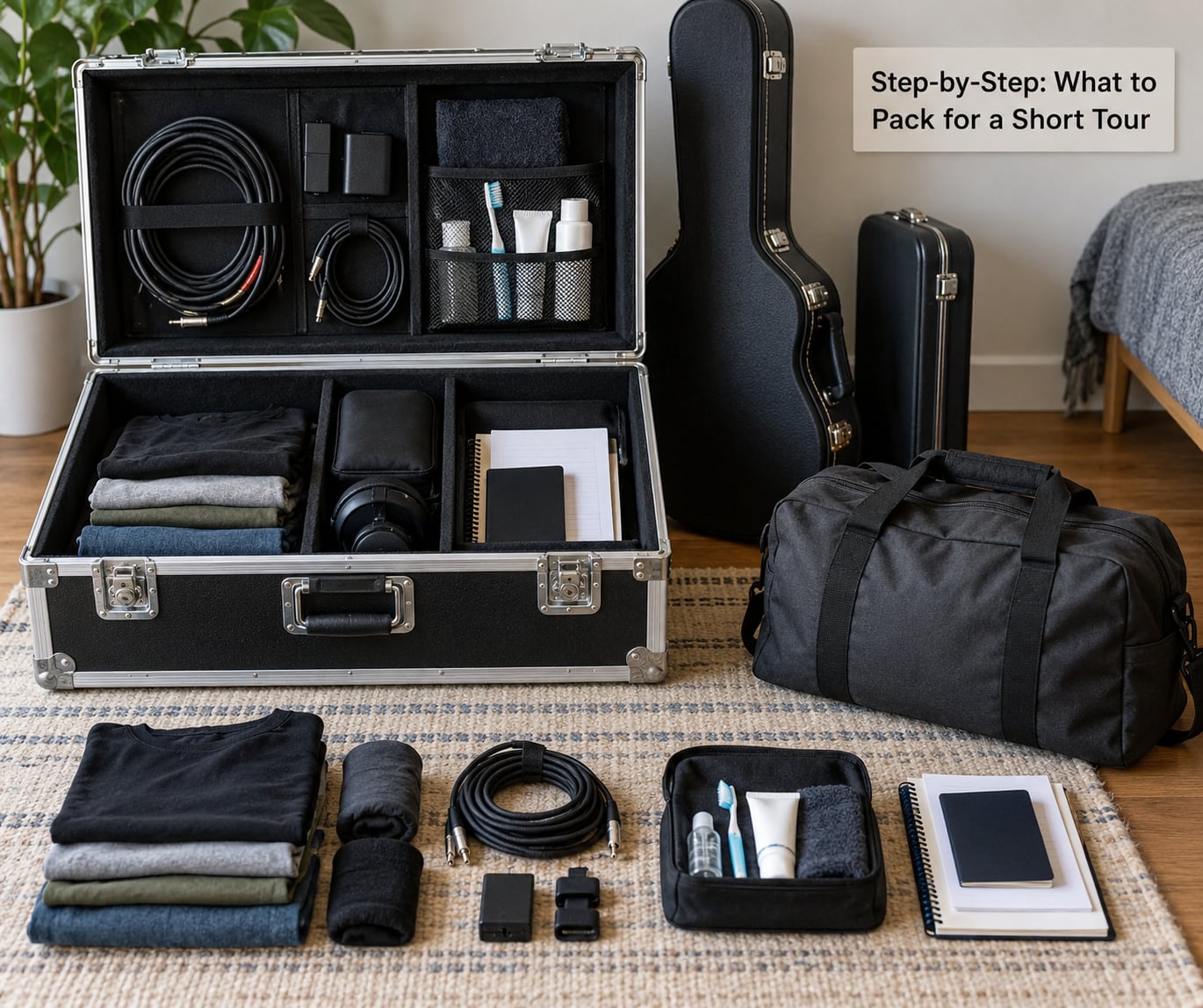
Start With the Tour Itinerary and Luggage Limits
Work out the volume before you work out the contents. Take the number of days on the road, subtract the days you are certain to have laundry access, and that gives you the number of outfit changes you actually need.
Here is the day-count formula I use, and it holds up for anything from a two-show weekend to a seven-day club run:
| Tour length | Tops | Socks and underwear | Shoes | Stagewear outfits | Show shirts for merch |
|---|---|---|---|---|---|
| 2 days | 2 | 2 | 1 pair plus 1 casual | 1 | 2 |
| 3 to 4 days | 4 | 4 | 1 pair plus 1 casual | 1 to 2 | 3 |
| 5 to 7 days | 6 | 6 | 1 pair plus 1 casual | 2 | 4 |
Add a laundry-in-the-sink option to any table if the run is five days or longer. That is the difference between six tops and ten, and it is the cheapest volume reduction available.
Then find the most demanding day on the itinerary. It is usually not the show, it is the transit day with the longest drive, the biggest load-in, or the worst weather. Pack for that day’s needs specifically rather than for an average that never happens.
Next, sort everything you want into three piles: replaceable, replaceable-but-annoying, and irreplaceable. Irreplaceable things stay with you or in the instrument case. Replaceable things go in the suitcase where they can be lost without consequence.
Pack Documents, Money, and Backup Plans
Documents are the fastest way to end a tour early, and they are the easiest group of items to protect. These ten go on your person or in the day bag, never in a suitcase:
- Photo ID, and a photocopy or a photo of it stored separately
- Passport and any visa or work permit needed for international legs
- Booking confirmations, advance and deposit paperwork
- Signed contracts or deal memos
- Insurance policy number and the provider’s 24-hour claims line
- Venue credentials, guest list passes, backstage lanyards
- Emergency contact card with the promoter, production manager and tour manager
- Card and a small amount of cash kept in separate places
- Boarding pass or tickets, downloaded offline before you leave signal
- Offline copies of the itinerary, contacts and setlists
If you fly anything, add the airline rules that actually bite: lithium battery and power bank carriage limits, liquids over 100ml in the cabin, and the working allowance for instruments in the hold. Check the airline’s own page rather than trusting a blog written two years ago.
Backups are the part people skip. Take a screenshot of every document and store it in a folder that works with no connection, then email the same folder to yourself and one other person. Paper copies of the contracts and the insurance details go in the instrument case, which is the bag most likely to arrive when the suitcase does not.
Choose Clothes and Essentials for Repeated Wear
The one-shoe-plus-one-casual rule handles footwear better than any list. One pair of durable shoes for load-ins and shows, one pair you can wear for ten hours of sitting in a van. A third pair is a luxury you will appreciate exactly once, on a laundry day.
For clothing, prioritize quick-dry and layerable pieces over cotton. Cotton holds water and dries slowly, which matters when you are doing three shows in two days in summer. Merino or synthetic base layers, one light jacket, one packable rain shell and a layer that works at 50 degrees at 8pm and 75 degrees at 2am covers most routing.
Keep stagewear separate from everyday clothes, and test the rule that every stage outfit fits in one carry-on. If a single look needs its own garment bag, it will not survive a bus bunk or a rental car seat. One good outfit for days off matters too, even though it never goes near a stage.
Two pairs of worn-in jeans or one pair plus black leggings covers more than most people think. Pack socks and underwear a day more than the formula says, because laundry days fail more often than they succeed.
Travel-sized toiletries go in the day bag in a clear pouch so they survive a security line without being repacked. Sunscreen, any prescription, contact lens supplies and a basic hygiene kit belong in that pouch rather than in a checked bag.
Build a Performance Kit for Short Tours
On a short run you carry the same small rig to every show, so reliability beats capability. A kit you can rebuild from memory at 2pm in a parking lot is worth more than a bigger one you cannot troubleshoot.
The core is microphones and cables. Pack one spare vocal mic and one spare of whatever instrument mic you depend on, plus two or three spare cables of each type you use. Adapters and converters are cheap and tiny, so bring every one you might need rather than assuming you can find one in the city. Add spare batteries for every wireless system, matched to the transmitters you actually own, not the ones you used two years ago.
Tuners, tuners’ batteries, a spare pedal, and any small signal chain item that takes ten minutes to repair should all travel in one labelled pouch. Stage lighting gets the same treatment: the fixture, the correct power supply, the remote and the spare bulb.
Data is where short tours quietly fail. If you run backing tracks or a backing track laptop, carry the media twice, on two separate drives, and keep a copy on a cloud account that you have already tested offline. Playback device, backup playback device, one power bank and one cable for each.
Then run the test. Lay every cable out on the floor and check each one end to end, then power every device from a full battery to a low battery. Nothing goes in the case until it has passed.
Pack Instruments and Critical Spare Parts
Instrument protection is a matter of case choice and padding. Hard cases take hits from loading and stairs, soft gig bags disappear into under-seat storage and vanish in a baggage system. If you fly, check the case’s dimensions against your carrier’s instrument policy before the run, because the fees are significant and the policies differ.
Padding matters more than most players expect. A support strap under the neck joint, a cushion under the floating bridge area, and a humidifier in the case during air travel all prevent the small, expensive failures that happen between shows.
Spare parts are the highest-return items in the whole kit. Strings, reeds, drumheads, sticks, fuses, screws, a fretboard file, a tuner, spare straps and spare instrument cables take almost no room. Add spare batteries for anything that uses them and a small multi-tool.
Know what happens when the primary instrument fails, because the decision is much cheaper to make in advance. Decide now whether you have a backup instrument, whether the venue has a house instrument and whether anyone on the tour plays, and put that number in your phone.
Keep a second set of strings and a spare cable in a different bag than the guitar. Two failures on the same night from the same case is the exact scenario spare parts are meant to prevent.
Add Health, Sleep, and Personal-Care Items
The health pouch is the item people miss and regret most. Daily medication goes in the day bag, not the suitcase, and you should have enough for the run plus two extra days. Prescription copies, a pharmacy phone number and your insurance details travel with it.
Musicians pack for joints and backs, not just for outfits. Across van-tour checklist threads on r/TouringMusicians, the recurring items were topical pain patches, ibuprofen, a portable heat pack for the lower back, a knee support for long load-ins, and vitamin D, which is a real issue on runs made of indoor shows and overnight drives. If you are packing for a body in its thirties or forties, add a lumbar support belt and an electrolyte mix to the same pouch.
Sleep is the other half of the problem. A travel pillow, a sleep mask, earplugs and a melatonin supply handle transit and daylight, and they take up less room than the bad night does. If anyone in the tour snores, earplugs with a filter solve a problem no one wants to raise on a bus.
A first-aid kit is non-negotiable even on a four-date run. Band-aids, blister plasters, antiseptic wipes, gauze, tape, tweezers, anti-diarrheal tablets, a cold or flu remedy, insect repellent, sunscreen and spare blister care fill out a solid kit. Anyone who packs their own medication should check the local rules for bringing it across a border, because some destinations restrict certain ingredients.
Personal care on the road is a volume problem more than a shopping problem. Dry shampoo, deodorant, travel-sized everything, a washcloth, a shower cap, spare contact lenses, a sewing kit and safety pins weigh nothing and solve the small emergencies that end up being the reason a load-in goes badly.
Climate failure is real and worth planning for. One thread in r/musicians describes a four-day van run in extreme heat with no working air conditioning, and the practical lessons were straightforward: bring more water than feels reasonable, pack a portable fan and cooling towels, keep food sealed or in a cooler rather than overnight in the vehicle, and expect to deal with stale air and insects in the morning.
Use Cases and Packing Systems to Stay Organized
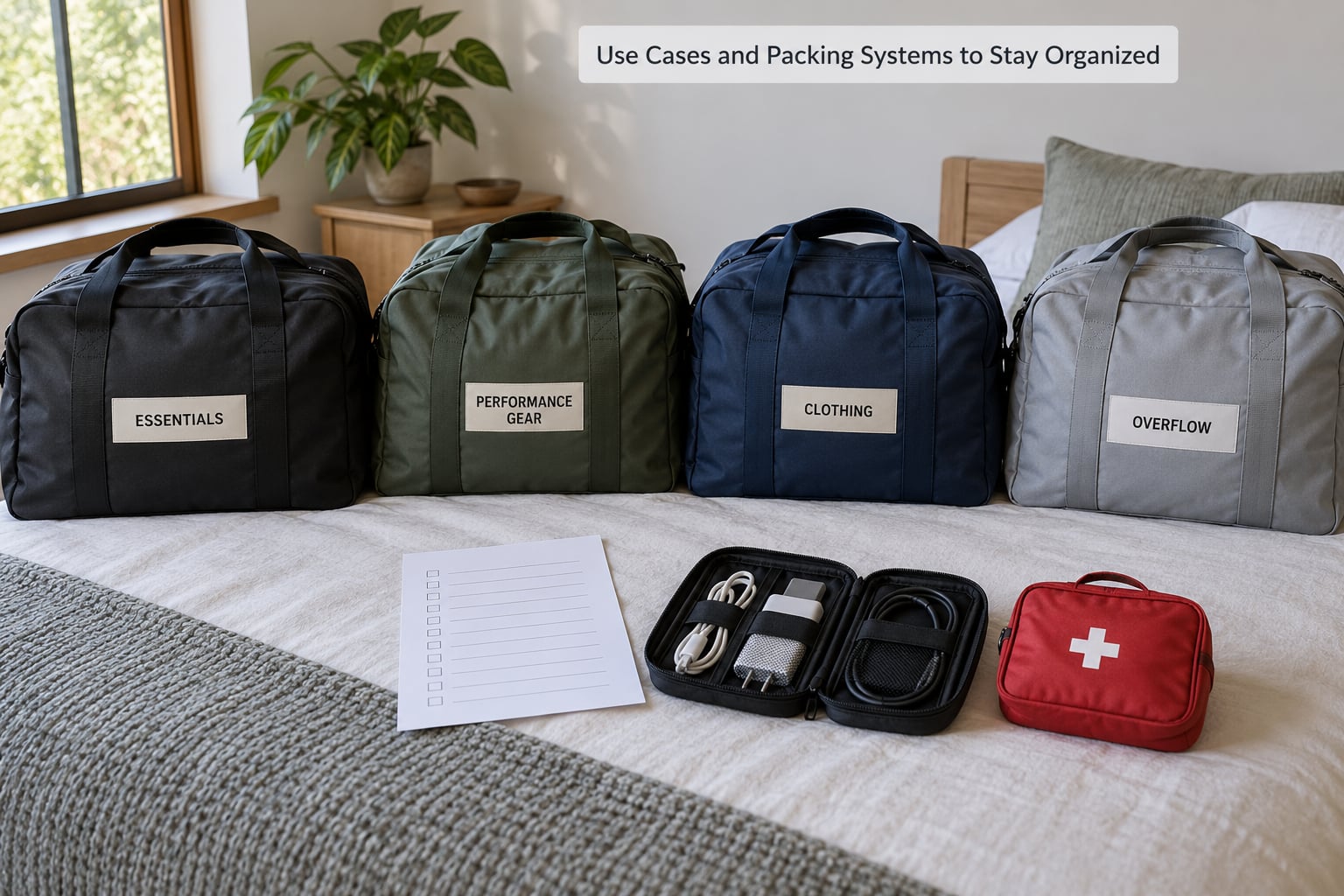
The four-bucket system keeps a short tour manageable. A day bag holds documents, health items, medication, electronics and one full change of clothes. A suitcase holds the rest of the clothing, toiletries and overflow. The instrument case holds irreplaceable spares, paperwork and the performance kit. The overflow bag holds laundry, the merch stack and anything that would be missed but not missed badly.
Label every one of them. A luggage tag on the outside and a printed inventory sheet inside means you can answer “is the mic cable in here” without unpacking a van at 1am.
Transport changes the balance. On a van tour, volume is generous but square footage is not, so heavy items go low and forward, cases go against the wall, and nothing important lives in the footwell. Add van-specific maintenance items to a shared kit: spare coolant, oil, washer fluid, a set of replacement bulbs and the tools to change them, plus a jump pack. No other single source covers van prep this well.
On a tour bus, space is measured in bunk volume, so a duffel that folds flat beats a rigid case. Bring a laundry bag that doubles as a dirty-clothes container, an extension lead, a small fan, a shower caddy and a bar of soap, since bus sinks are small and shared.
On a fly date, the instrument case is usually the only bag that gets checked, so it becomes the backup for the suitcase. Divide it deliberately: irreplaceable gear, cables, medication and one day’s clothing in the case, everything replaceable in the cabin bag.
Whichever mode you use, write the inventory out before you close anything. It takes ten minutes and it is the difference between a five-minute search and a panicked call to the tour manager.
Common Mistakes When Packing for a Short Tour
Packing for the destination instead of the duration. Two cities on the same routing do not require two wardrobes. Fix: use the day-count table and add layers, not duplicates.
Packing untested gear. The cable that has only worked in one room fails in a venue with a different power system. Fix: test every cable and power every device from the case itself the day before departure.
Putting fragile items where they get crushed. Glass bottles, the coffee grinder and the monitor interface belong wrapped, upright and near the top of the case, never under heavy clothing. Fix: use a small dedicated box for anything breakable and pack it last.
No second copy of anything critical. One set of strings, one playback device, one set of show files. Fix: split every critical item across two bags and put the copies in different containers.
Loose cables in a bag of loose cables. A tangle at load-in wastes more time than any other packing habit. Fix: a coil organizer or a small cable bag per function, labelled by what it is for rather than by what it connects to.
Ignoring delay days. A cancelled show, a missed connection or a mechanical failure adds a day nobody planned for. Fix: pack to the formula plus one extra day’s worth of socks, underwear and a top.
Wrong footwear. New shoes on a run mean blisters on day two, and sandals at a load-in mean a ruined ankle cable channel. Fix: wear your show shoes once before you leave, and bring the casual pair you can sit in.
Forgetting the house kit. People assume the venue has everything until the riser is too low for the kick drum. Fix: a printed one-page stage plot, plot requirements and a checklist of what you expect on site, plus the venue contacts.
Frequently Asked Questions
How do you pack for a short tour?
Pack by duration, not destination. For a three or four day run bring four tops, four pairs of socks and underwear, one durable shoe pair plus one casual pair, one or two stage outfits, and a day bag holding documents, medication, electronics and one full change of clothes. Split every critical item across two bags so a lost suitcase never takes your ID, your medication or your show gear with it.
What do you need to bring on a tour bus?
Bunk-space items earn their weight: a laundry bag, a small fan, an extension lead, a travel pillow, earplugs, a shower caddy, a sleep mask and a refillable water bottle. Keep documents, medication and electronics in a day bag you control rather than in luggage stowed in a hold you do not see until the end. One full outfit belongs with you in case the bags arrive late.
How many days of clothes should I pack for a week tour?
For five to seven days, pack six tops, six pairs of socks and underwear, two stage outfits, one durable shoe pair and one casual pair. If any leg of the run has reliable laundry access, drop to four tops. Stagewear should be counted separately from everyday clothes, and every stage outfit should fit in a carry-on. Add a day beyond your formula in case a delay turns a five-day run into six.
What is the 5-4-3-2-1 rule for packing?
The 5-4-3-2-1 rule is a container-based vacation rule: five tops, four bottoms, three pairs of underwear and socks, two pairs of shoes and one accessory per person. It is a reasonable sanity check for a short trip, but touring musicians usually swap the bottoms for stagewear and add a health pouch, which the rule was never designed to cover. Use it as a ceiling, not a target.
What is the 3-3-3 rule for travel packing?
The 3-3-3 rule suggests three days of underwear, three days of tops and three of whatever else needs laundering, on the assumption you will do laundry once during the trip. It works well for a long holiday and poorly for a short tour where nobody wants to wash clothes in a venue bathroom. On a short run, pack up to your full day count and treat laundry as the backup plan rather than the plan.
What do musicians most often forget on a short tour?
The four most commonly forgotten items are medication, spare cables, laundry supplies and insurance details. Medication is the only one that can end a run, so keep it in the day bag rather than the suitcase. Spare cables matter because a single failure during a load-in has no quick fix on the road. Forum threads about van runs also repeat the same lesson: the thing nobody packed is the one that makes the night in the van unbearable.
Conclusion
Getting what to pack for a short tour right starts with the itinerary, not the suitcase. Build one master list from the day-count formula, sort every item into the day bag, the suitcase or the instrument case, test the gear, split the critical items across two bags, and do it a day before you leave rather than the morning of. Get that right and a short run stops being a logistics problem and starts being the part of the month you look forward to. Updated for October 2026.