
How to make a tour budget is really one exercise: list every dollar that leaves the vehicle, list every dollar that comes back, and compare the two honestly before you sign anything. Most first-time touring artists do the reverse, booking dates on excitement and discovering the math in week two.
The process takes an afternoon with a spreadsheet and a map. The hard part is being conservative with income and generous with costs, which is the opposite of how optimism usually works.
Below is the full process, step by step, plus a worked ten-date example that comes out barely profitable, because that is what most regional runs actually do.
Table of Contents
- What You Need
- Step-by-Step: How to Make a Tour Budget
- Common Mistakes
- Frequently Asked Questions
- How much should I budget for a music tour?
- What costs should be included in a tour budget?
- How much contingency money should I reserve for touring?
- Should a tour budget include unpaid crew time?
- How do I know if a tour route is financially viable?
- How do I reduce tour costs without making the tour unsafe?
- Conclusion
What You Need

Gather these before you open a spreadsheet. Without them you are budgeting on feelings, and feelings are not a line item.
- Written deal terms from every venue you have contacted: guarantee amount, door split percentage, door split of gross or after expenses, and any kill fee.
- Route details with mileage between each stop, not straight-line distance. Driving routes add a surprising amount.
- Dates that are locked, meaning festivals, family commitments, a tour you are supporting, or a headline show.
- Rental quotes for the vehicle, plus its fuel economy rating and insurance cost.
- Current tax rate for self-employment income. In the US, self-employment tax applies to net earnings from touring, and it is the line most first-timers leave out.
- Number of people on the road, including unpaid friends. Every extra body eats the same amount of food and needs the same number of beds.
- Merch reorder history, so you know your real cost per shirt or record rather than the wholesale figure you hope for.
- A calculator and a spreadsheet, and about two hours nobody can book over.
Tickets on your phone are fine. Paper is better, because paper forces you to write down the deal terms instead of trusting that you will remember them at load-in.
Step-by-Step: How to Make a Tour Budget
Set the Tour’s Financial Target First
Decide what the tour has to cover before you add anything to it. Take every confirmed cost, total them, and that total is your break-even target. Add a figure for what the tour must net for you to take a smaller job afterward, and you have your real financial target.
Touring has two goals that pull against each other: the artistic one and the financial one. A run through three cities to press an album can be worth losing a few hundred dollars if it buys you real mailing-list growth and press. A 25-date run that loses money is a business problem, not a marketing expense.
Write the target as a number, not a feeling. A target of “at least break even” is not a number.
Create One Master Cost Sheet With Ten Categories
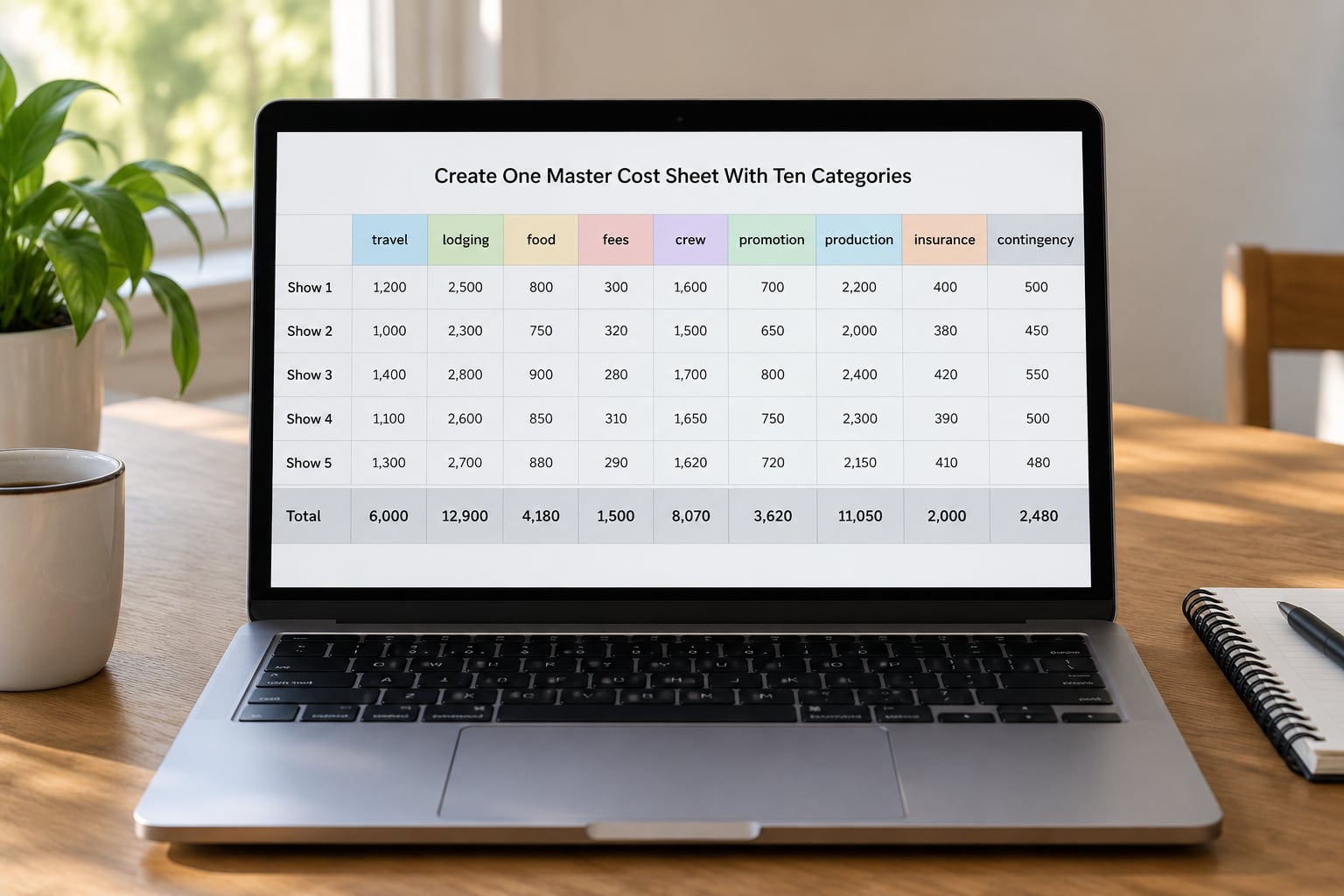
One sheet. Every expense gets a row and one of ten columns, and each show gets its own tab or its own block of rows. The categories below cover nearly every tour; add more only when something genuinely does not fit.
| Category | Typical line items | Fixed or variable |
|---|---|---|
| Transportation | Fuel, tolls, parking, vehicle rental, driver pay | Mixed |
| Lodging | Hotels, taxes, resort fees, cancellation fees | Variable |
| Food | Per diem, venue meals, groceries, coffee | Variable |
| Show costs | Support fees, sound and lighting, backline, video | Per show |
| Crew | Wages, per diems, travel, hotels for the crew | Mixed |
| Promotion | Posters, flyers, targeted ads, local press, video content | Upfront |
| Merch | Inventory, restock, card reader fees, display table, security | Mixed |
| Fees and insurance | Licensing, permits, event insurance, gear and liability coverage | Fixed |
| Taxes | Self-employment tax reserve, state and local taxes | On income |
| Contingency | The reserve for everything you did not think of | Reserve |
Split costs into fixed and variable because they behave differently. Van rental and insurance are fixed whether you play three shows or thirty. Food and fuel grow with every day on the road, and the marginal show in a ten-date run is the one that decides whether the tour made money.
Estimate Transportation and Fuel Costs
Map the full driving route, including the trip out and back, and add the per-show local mileage for load-in runs. A routing tool gives you the real distance; then divide total miles by the van’s fuel economy to get gallons, and multiply by the current average fuel price.
Add the costs people forget. Tolls, parking garages downtown, airport parking when you fly, and the rental company’s insurance, which can rival the rental itself. On a van tour, budget a service interval for every few thousand miles on the road, because the one thing that can end a run early is a failure no tour insurance covers well.
Now move one date and watch the number change. Dropping an out-of-the-way show might add four hundred miles of driving while removing a guarantee of two hundred. That single comparison kills more bad tours than anything else in the budgeting process.
Build the Lodging and Per Diem Plan
Count nights, not shows. A ten-date run with a rest day between is usually twelve or thirteen nights, and the nights either side of the tour are the ones most artists forget entirely.
Price lodging per person, not per room. Four people in two rooms costs twice what a solo artist pays for one. Look at the total per night including taxes and any destination or facility fee, because resort-style surcharges in tourist cities can add a quarter on top of the advertised rate.
Set a daily food allowance per person and treat it as a number, not a suggestion. Touring musicians commonly land between 10 and 20 dollars a day depending on how many shows they play and whether venues feed the band. Write the allowance into the sheet and adjust it once at the halfway point of the tour, not daily.
Two habits cut this column noticeably. Free breakfast at the hotel, and a food-heavy deal from the venue or a local promoter who buys dinner for the band. Both are normal to ask about and both are standard practice in the industry.
Add Show, Crew, and Promotion Costs
Each show has its own cost line beyond the guarantee. Venue production varies enormously: some clubs provide a house PA and lights, some cities bill backline rental at three to four times what the same gear costs elsewhere. Assume a support slot when you are opening, and put a number on what the tour makes on a support slot rather than treating it as free money.
Price crew properly. A paid tour manager on a regional run is often a flat daily rate plus per diem and lodging, and that person’s cost belongs on every show’s line, not in an envelope somewhere. If the people coming with you are unpaid, put a number next to their name anyway. It shows the true cost of the tour and it makes the conversation about paying them easier later.
Promotion is an upfront cost that should be spread across shows. Posters and flyers in a new market rarely pay for themselves, so treat early dates as customer acquisition and decide up front how much you’ll spend to fill a room you’ll never see again.
On the income side, model three deal types separately because they behave very differently.
| Deal type | How you get paid | The risk you take |
|---|---|---|
| Flat guarantee | A set amount whether 40 or 400 people show up | Low risk if the guarantee beats your break-even, high cost if the room would have earned more |
| Door split | A percentage of the door, often after venue expenses are taken out | All of it. A bad night pays nothing |
| Versus deal | Whichever is higher: the guarantee or the artist percentage | Lowest risk, and the venue’s least favorite structure to negotiate |
Add merch income last and model it conservatively. Print-on-demand shirts carry a real cost per piece and no inventory risk; pre-printed items cost more up front but more per sale. Merch is often the only profitable line on a first run, and touring musicians consistently say it saves more tours than door income does, so treat it as probable rather than hopeful while keeping the number modest.
Add a Realistic Contingency Fund
Ten percent of total costs is a defensible starting reserve. Fifteen percent if the route is long, mostly rural, or depends on a single vehicle, or if any date is a festival or outdoor show where weather is a factor.
Set it aside and stop looking at it. This is the money that covers a vehicle repair on a Tuesday, a cancelled show where the venue keeps a kill fee, a missed flight, a sick musician, or a hotel in a city that booked solid during a festival weekend. Artists who raid the contingency early end up financing the rest of the tour on a credit card.
Think about the failure modes artists actually report. Broken-down vehicles, venues that renegotiate a guarantee after the room sells out or fails to, and food costs that creep up in cities with nothing within walking distance. Every one of those is a line your reserve has to absorb.
Stress-Test the Tour Budget Before Booking
Take your finished budget and break it in three ways. First, cut all income that is not in writing and see whether the tour still stands. Second, reduce door income and merch by 20 percent, which is a plausible bad month, and check whether you end the run with a deficit or a small loss.
Third, build a second route. Move the two weakest dates and see whether the total improves. If the revised route breaks even and the original does not, you already know the fix before you spend a dollar on it.
Here is what the whole exercise looks like on a real shape of run: ten dates over twelve nights, two people on the road, a rented cargo van, one anchor date in a locked-out city.
| Line | Amount | Notes |
|---|---|---|
| Vehicle rental, fuel, tolls, parking | 1,290 | 2,450 miles driven, including the return trip |
| Lodging | 2,090 | 13 nights, two rooms, taxes included |
| Food | 390 | 15 per person per day, 26 days on the road |
| Crew wages and per diems | 1,200 | One paid crew member plus unpaid bandmates costed |
| Production and backline | 400 | Rental in the two expensive fly-in markets only |
| Promotion | 500 | Posters and flyers for all ten cities |
| Merch production | 900 | Restock from the last run plus card reader fees |
| Insurance and licensing | 370 | Event and gear coverage, performance licenses |
| Subtotal costs | 7,140 | Before contingency |
| Contingency at 10 percent | 714 | Held, not spent |
| Total costs | 7,854 | |
| Guarantees, two shows | 800 | Written, contracted |
| Door splits, eight shows | 2,080 | Modest rooms, artist share after expenses |
| Merch net margin | 4,800 | About 40 pieces per show at net 12 each |
| Sponsorship and local support | 500 | Two small local sponsorships |
| Total income | 8,180 | Before tax |
| Net before tax | 326 | About 33 per show, before the tax reserve |
That result is normal for a first regional run and it is a terrible one. After the self-employment tax reserve on net earnings, the run is roughly break even, which means the artist paid for the right to build an audience in three new cities and drove home with a mailing list.
Now stress it. A 20 percent drop in door income and merch sales turns the total to roughly 6,804 against costs of 7,854, a loss of just over a thousand dollars. That single line is why the contingency exists and why a run like this needs a second route comparison before the dates are locked.
For context, here is roughly what cost per show tends to look like at three levels, so you can tell whether your number is normal before you panic about it.
| Tier | Cost per show | Typical shape |
|---|---|---|
| Starter | 400 to 900 | Van run, house shows and clubs, mostly unpaid crew |
| Independent | 900 to 2,500 | Paid crew, club and theater dates, real merch restocking |
| Professional | 2,500 and up | Full crew with salaries, production riders, multiple trucks, support acts |
These are typical US ranges for a 10 to 15 date run and they move with season, region, and how far the routing stretches. A spring run in the Midwest sits below a summer festival run in the same band’s history, and prices in both have changed since the last time you read anything about touring costs.
Common Mistakes
Treating hoped-for income as money in the bank. A promoter who says the room will do 300 is not income until the night happens. Budget with the written guarantees and the lowest credible door, then treat anything better as a bonus rather than a plan.
Forgetting the tax reserve. Self-employment tax on touring earnings is real and it is not income you can spend. Reserve a percentage of gross net earnings as it comes in and treat it as a cost line that exists before the tour starts. Artists on r/WeAreTheMusicMakers and r/musicians mention this as the surprise that turns a good tour into a smaller one.
Ignoring cash flow between dates. A tour can be profitable across twelve nights and still fail on day six if guarantees arrive after the fuel bill is due. Ask in advance when each venue pays, and hold enough of your own money to cover roughly a week of expenses regardless of payment schedules.
Double-counting the same money. If you add a 15 percent tax reserve to costs and then subtract tax again from projected profit, you have understated the tour by the amount of both. Pick one place for it.
Booking the route first. Dates locked around convenience rather than break-even are the most common reason a run fails. Work the mileage and the guarantees together; if a date does not pay for the driving it creates, cut it.
Counting unpaid friends as free. They are not. Cost their food, their share of lodging, and their share of fuel, then decide deliberately whether to pay them anything.
Spending the contingency early. The reserve is not a comfort fund. If you tap it in week two, you have no plan for the van, and the van is the tour.
Frequently Asked Questions
How much should I budget for a music tour?
For a 10 to 15 date regional run in the US, expect roughly 400 to 900 per show on a starter van tour with unpaid crew, 900 to 2,500 on an independent run with paid crew and real merch restocking, and 2,500 or more with a full production rider. A 12-night example earlier in this guide landed at about 7,850 in total costs. These are typical ranges that shift with season, region and routing length.
What costs should be included in a tour budget?
Ten categories: transportation including fuel, tolls, parking and rental, lodging, food, per-show production costs, crew wages and their travel, promotion, merch production and card fees, insurance and licensing, and a self-employment tax reserve held back from income. Add a contingency line on top of all of it. Anything missing from that list gets missed on the road.
How much contingency money should I reserve for touring?
Ten percent of total costs is a defensible starting point. Go to fifteen percent for long rural routes, a single-vehicle tour, or any run built around outdoor and festival dates. Keep the reserve physically separate from your spending money. The common failure is tapping it for a repair in week two and having nothing left when the van has a real problem.
Should a tour budget include unpaid crew time?
Yes. Put a real number next to it, covering their food, their share of lodging and fuel, and any wage you decide to pay. Even with the number in the sheet, decide deliberately about payment rather than assuming it is off the table. Unpaid labor hides the true cost of a tour and makes it harder to see which dates actually pay.
How do I know if a tour route is financially viable?
Strip out every income source that is not contracted in writing, then cut door income and merch by 20 percent. If the tour still ends at or near break even, the route has a margin. If a 20 percent drop puts you more than your contingency under water, fix the route before booking: move the two weakest dates, add an anchor date in a locked city, and rebuild the mileage.
How do I reduce tour costs without making the tour unsafe?
Route tighter to cut dead miles, share lodging where it is safe and everyone gets a real night of rest, take free breakfasts and venue meals, use a rental with good fuel economy, and load merch as print-on-demand to avoid tying up cash in inventory. Do not cut the vehicle, the insurance, the rest days, or the contingency. Artists who track expenses daily in a shared spreadsheet also catch the drift early.
Conclusion
Open the sheet, enter every confirmed cost by category, and add conservative estimates for the ones still in negotiation. Hold back ten percent as contingency and a percentage of income for taxes, then compare the total against only the money you can count on.
Before booking anything, run the 20 percent test and build one alternative route. If the tour survives both, you have a real budget. If it does not, you have just saved yourself the cost of learning that on the road, and that is the entire point of learning how to make a tour budget before the van is loaded.