To pitch your music to blogs, you research a small number of publications that already cover your genre, put together a one-page press kit, and email the right editor a short personal message with a private streaming link. Send it two to four weeks before your release date, follow up once if you hear nothing, and track what happened so the next campaign is sharper than the last one.
That whole process takes a weekend to set up and about ten minutes per blog once you have a template. The part most artists skip is not the writing, it is the list-building and the follow-through.
Editors at small and mid-size music publications tell you how full their inbox really is. One editor’s own submission policy page describes receiving more than a hundred submissions on a busy day, which is exactly why a generic pitch disappears. The goal of this guide is to make sure yours does not.
Table of Contents
- What You Need
- How to Pitch Your Music to Blogs: Step-by-Step
- Step 1: Choose the Right Blogs for Your Music
- Step 2: Research the Blog and Find a Real Editorial Angle
- Step 3: Prepare a Complete but Lightweight Press Kit
- Step 4: How to Pitch Your Music to Blogs With a Short, Personal Email
- Step 5: Send Pitches at the Right Time
- Step 6: Handle a Rejection Without Damaging the Relationship
- Step 7: Follow Up Once, Then Stop
- Step 8: Track Results and Improve the Next Campaign
- Common Mistakes
- Frequently Asked Questions
- Conclusion
What You Need
Before you contact anyone, six things have to exist. If any of them is missing, the pitch stalls and you end up chasing a reply that never comes.
- One clear release story. A sentence you can say out loud without embellishing it: what the record is, why now, and what makes it different from the last thing you put out.
- A private streaming link. An unlisted or hidden SoundCloud, Bandcamp or private Spotify link. Never attach an MP3, and never send a public link that anyone could already have found.
- Press photos. At least one high-resolution horizontal shot, plus a square crop for anything that gets pulled into a social card.
- A one-page press kit (EPK). A single PDF or web page an editor can read in ninety seconds without opening another tab.
- Verified contact details. The correct editor’s name and address, checked against the publication’s own submissions page rather than guessed from a pattern.
- A pitch tracker. A spreadsheet with one row per outlet. Without it, follow-up turns into nagging and you cannot tell which part of your process is failing.
One more thing is worth having before you start: enough familiarity with each publication that you could name two recent pieces and why you liked them. That knowledge is the raw material for the rest of the article, and it is the only part a competitor cannot copy.
How to Pitch Your Music to Blogs: Step-by-Step
The campaign below runs in eight steps and works as a single focused push rather than a permanent habit. Most artists who get consistent coverage do one of these per release, not fifty at a time, and they start two to four weeks out so a blog has time to listen properly and schedule the post.
Step 1: Choose the Right Blogs for Your Music
Build a qualified list of 30 to 50 outlets instead of blasting a directory of 500. Score each one out of ten before you write a single word, because a scored list tells you honestly whether your campaign is built on outlets that actually read your genre.
| Criterion | 0 points | 5 points |
|---|---|---|
| Genre match | Covers a different genre entirely | Covers your sound most weeks |
| Recent activity | Nothing published in months | Published within the last week |
| Open submissions | No contact route listed | Submissions page with a clear email |
| Audience size | Under 1,000 readers | Strong niche readership |
| Engagement | Comments disabled, no shares | Readers debate in the comments |
| Similar artists covered | Never heard of your scene | Regularly reviews your peers |
Anything scoring under five is not a target. Ten or more is worth a carefully written pitch. Five to nine is worth sending only if you have a specific angle for that publication.
Where do the names come from? The most reliable source is the internet itself: check the “Fans also like” panel on Spotify and the similar-artist rails on Bandcamp, then look at who covered those artists. Follow the trail two or three hops out from your own genre and you will find publications no list would have told you about.
Community-run lists exist too, and r/musicmarketing threads trading compilations of blog contacts are valued precisely because they are current. Treat those lists as a starting point and vet every entry yourself, since contact details go stale fast. A blog that stopped answering submissions a year ago is not a prospect, it is a dead address.
Also check the submission guidelines before you score anything. Many publications state plainly what they will not review, and skipping that check is the fastest way to be ignored. Some review albums and EPs but never singles, which is a limitation artists complain about often in forums and worth knowing in advance.
How to tell a blog is worth targeting: it has published something in the last thirty days, it names a person who makes the final call, and at least three of the last ten pieces are artists you could plausibly send to the same audience.
Step 2: Research the Blog and Find a Real Editorial Angle
Open the publication and read three recent pieces. Not the homepage, the actual posts. You are looking for recurring themes, an unanswered question, or a gap they keep stepping over.
Most pitches fail because the artist describes their own career instead of offering the editor something to publish. A release is not a story. A story is a reason. The reframe usually takes thirty seconds once you know what the publication has already covered.
Some angles that consistently work: a first-listen reaction before anyone else has the record, a short interview with the producer or a band member, a list piece where the editor is assembling opinions on a scene or subgenre, a local or regional angle tied to a festival date, or a technical breakdown of how the record was made.
Give yourself one angle per outlet. Writing five different angles for five editors is normal, and it is the difference between a campaign and a mail merge.
Step 3: Prepare a Complete but Lightweight Press Kit
The press kit, sometimes called an electronic press kit or EPK, is the document that answers every question the editor would otherwise have to chase you for. Keep it to one page if you can, two at most, and make it a web page you can link to rather than an attachment that needs downloading.
| Asset | Format | Required | Common mistake |
|---|---|---|---|
| Headline | One line | Yes | A title no editor would use |
| Short bio | 50 to 80 words, third person | Yes | Writing it in first person |
| Release summary | 2 to 3 sentences | Yes | Repeating the press release verbatim |
| Story angle | 2 sentences on why now | Yes | Generic claims about authenticity |
| Credits | Producer, co-writers, label, mix engineer | Yes | Missing the mix engineer name |
| Quotes | One or two, attributed | Optional | Inventing a quote nobody said |
| Press photos | 3000px wide minimum, horizontal | Yes | Low-resolution phone snaps |
| Cover artwork | 3000 by 3000 JPG | Yes | Embedding art inside a PDF |
| Streaming links | Private link plus public link | Yes | Sending only the public link |
| Social profiles | Two or three live accounts | Optional | Pointing at an empty page |
| Prior coverage | Links to previous features | Optional | Padding with unrelated press |
| Contact details | One email that reaches you | Yes | Using an address you check rarely |
Open every single link on a phone before you start sending. Broken private links and dead art files cause more lost pitches than bad writing ever does, and you will not get a second chance on the first impression.
Keep a one-page press release for the outlets that insist on one, but do not assume it replaces the press kit. The press release is a broadcast document. The press kit is a reference document, and that difference is why the same material gets rewritten twice.
Step 4: How to Pitch Your Music to Blogs With a Short, Personal Email
A music blog pitch email should run roughly 100 to 150 words and get to the point in the first line. Write it in six parts: a specific opening reference, the release and its hook, why it fits that publication, one clear ask, the links, and a short sign-off.
Here is a working template. Change every bracket, delete any line you cannot fill in honestly, and do not leave a placeholder in.
Subject: [Song Title] for [Publication] — [one-line angle]
Hi [First name],
Your piece on [specific recent article] stuck with me because [specific reason].
I’ve got a new track called [Title] out on [date] — [the hook: recorded in one take, first release, etc.]. It sits closest to [two artists that publication covers].
Private link here: [link]. Press kit and photos: [link].
Would you consider an early listen for [premiere / review / short interview] on [date]?
Thanks for your time,
[Name] · [Artist] · [contact]
Four subject line patterns that work without sounding like a pitch machine:
- Angle plus release: “Bedroom pop from a converted [city] warehouse — out Friday”
- Timely: “For your [month] end-of-year list”
- Direct request: “Early listen for [title] — out [date]”
- Specific and short: “New single, fits your [genre] coverage”
Here is the same message written for an album review request, so you can see how the ask changes without the whole email changing:
Subject: [Album Title] review — [artist] out [date]
Hi [First name],
I saw your review of [album] and your comment about [specific point] has been stuck with me.
[Artist] is releasing [album title] on [date]. Twelve tracks, recorded over [context: two winters, one room]. Guests on two tracks. It sits in the [genre] lane your readers follow.
Private streaming link: [link]. Full press kit: [link].
Would you want a review copy ahead of release day? I’m glad to send any format you prefer.
Thanks,
[Name] · [contact]
Note what is missing. There is no claim that the music is authentic, no description of how hard you worked, no paragraph about your vision. The email is about the editor’s publication and the reader’s interest.
Step 5: Send Pitches at the Right Time
Start your campaign two to four weeks before release day. Editors plan features in advance, and a review written on release day is a review written in a hurry.
Two to three weeks out is the right window for a premiere or an interview request, because the editor needs lead time to write around it. Three to four weeks out works for review requests and playlist-style inclusions. Sending on release day itself is almost always too late for a considered piece.
Adjust the ask to the outlet. An exclusive premiere means the blog publishes first and it becomes a genuine story for them. A review is a straight request with no strings. An interview takes ten minutes of the artist’s time and needs a reason beyond “my record is out.”
One common request is an early listen with an embargo, so the artist can post the link the moment coverage goes live. Offer it in the first email rather than waiting to be asked, and put the embargo date in writing.
When a blog already covered you, or covered a band you play with often, skip the research step and send a much shorter note. Writers remember the artists they have written about, and re-pitching past supporters is the cheapest coverage available to an independent artist.
Asking fans and friends to forward your email works too, and it works better than cold outreach. Musicians trading this advice in forums consistently report that referral pitches outperform cold ones. Use it as a supplement to your campaign rather than a replacement.
Follow the publication’s channel. Some outlets have a submissions form instead of an email, some only accept pitches through a platform, and a few work best on Instagram. Pitching a form submission with an email pitch attached is fine; pitching around a stated no-email policy is not.
Step 6: Handle a Rejection Without Damaging the Relationship
Most pitches get no answer at all, and a few get a clear no. Both are normal outcomes of a campaign aimed at 40 outlets, not a judgement on the quality of your work.
Work out which of the three things happened before you react.
- Silence. Volume. Some editors simply do not reply to anything that is not a premiere. Nothing is broken and nothing needs fixing.
- A polite decline. A normal editorial decision, usually because the release is outside their current focus. Take it and move on.
- Specific criticism. A note that your links were broken, or that you ignored the submission guidelines, or that the genre is wrong for them. This is the only category worth acting on, because it points at a fixable problem in your process.
There is no good reply to a decline other than a short thank-you. Do not argue for coverage, do not send a counter-argument, and do not pitch the next release immediately. A gracious reply takes twenty seconds and keeps the door open for the next one.
Subject: Re: [original subject]
Thanks for letting me know, [First name] — completely understood. I’ll keep [genre or format] on your radar for something that fits better.
Best,
[Name]
If you were turned down for a fixable reason, correct it silently and move to the next name on your list. Do not request a second review of the same record.
Step 7: Follow Up Once, Then Stop
One polite follow-up after three to five business days is standard and expected. More than that crosses from professional into annoying, and writers in the music press describe the polite single nudge as the accepted norm.
Subject: Following up — [Song Title] / [Publication]
Hi [First name],
Bumping this once in case it got buried. [Song Title] is out [date] — private link and press kit below if useful.
No pressure if the timing is wrong; happy to pitch the next single.
Thanks,
[Name] · [contact]
A follow-up that works adds something the first email did not have: a release date that has firmed up, a new fact, a photo, a changed plan, or a shorter ask. Re-sending the same message with “just following up” attached is the version editors delete.
Stop conditions are simple. One follow-up gets nothing, so you stop. If an editor asks you not to contact them again, you never do. If your release happens while the follow-up is pending, let it go and try again with the next one.
Do not follow up on a premiere offer you extended. Having your own release passed over in favour of someone else is part of the deal, and the polite “no worries, good luck with it” is how you stay in the running next time.
Step 8: Track Results and Improve the Next Campaign
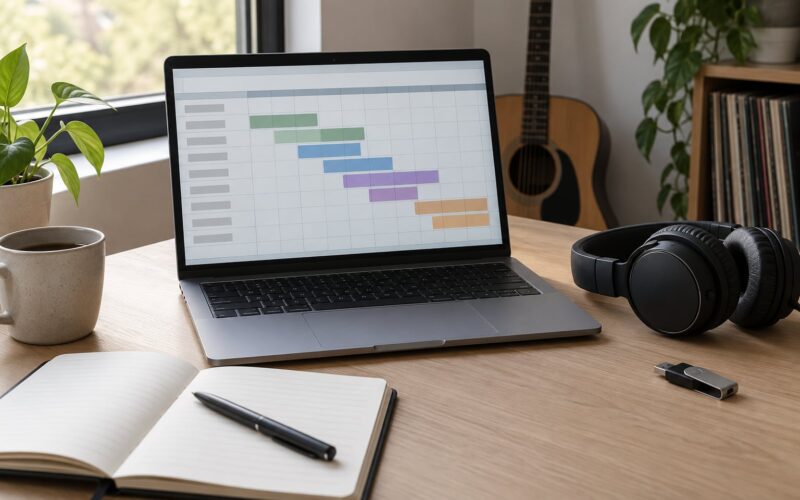
Run the campaign from a spreadsheet. It takes ten minutes to set up and it is the only way to know whether your outreach is working or whether you are just busy.
| Column | What to enter | Why it matters |
|---|---|---|
| Outlet | Publication name and URL | Prevents duplicate pitches |
| Tier | Niche zine, Hypemachine, magazine, local | Shows which tier actually replies |
| Contact | Editor name and address used | Useful on the second release |
| Date sent | Specific day | Basis for the follow-up schedule |
| Personalised line | Yes or no, plus which article | Links effort to replies |
| Follow-up | Date sent, or not sent | Keeps follow-up honest |
| Response | Reply, decline, silence | The real metric |
| Ask type | Premiere, review, interview, list | Shows which ask converts |
| Result | Live link and date, or nothing | Coverage count |
| Lesson | One sentence | The part that improves next time |
Read the columns in this order after a campaign: response rate first, coverage second. A campaign where eight of forty people replied is a working campaign even if only one piece ran.
The diagnosis follows from the pattern. Very few replies across high-scoring outlets usually means the framing is wrong, not the list. Plenty of replies but almost no published pieces means your asks do not match what the editors actually commission. Silence from one tier only, such as larger magazines, is normal and not worth fixing.
Most independent artists land somewhere in the low single digits for reply rate, and a low response rate across a targeted list of forty is not failure. Comparing your numbers against your own previous campaign is far more useful than comparing them to anyone’s.
Common Mistakes
These four account for most wasted campaigns. Each has a straightforward correction.
Mass Pitching Without Personalization
A pitch that opens with “I hope this email finds you well” and describes your career in three paragraphs is invisible, because it tells the editor nothing about why their readers should care. Replace the opening with one specific reference to something that publication actually published, and add one concrete reason you are writing to that editor rather than any other.
The test is simple: if you swap in a different publication’s name and the email still reads correctly, it is not personalized. Cut it and start again.
Making Every Message About the Artist
Most artists describe themselves. Readers of music blogs care about the music and the story around it, not your career trajectory. Reframe each pitch around what the publication’s readers get from it and what useful thing you can hand them: a first-listen reaction, an interview with a specific angle, a technical breakdown, or a track that fits a piece they are already assembling.
One question to run every email through: why would a reader of this specific publication click the link? If the answer takes more than a sentence, the email is not ready.
Sending Broken Links or Incomplete Materials
Run a pre-send check before every campaign and every follow-up. Test each private streaming link on a phone and a laptop in a private browser window with nothing logged in. Confirm artwork opens at full size and that press photos are at least 3000 pixels wide. Verify credits, especially the mix engineer and any featured artists. Open the press kit and read it as though you have never seen it.
Missing artwork dimensions, a credit left as a placeholder name, and an expired private link account for a lot of silence that has nothing to do with your music.
Following Up Too Often or Too Long
Set a hard limit of one follow-up, sent three to five business days after the original, and respect it. Useful new information is a new fact, a firmed-up date or a shorter ask. Repeating yourself with an extra polite word is nagging, and nagging is how you end up on a permanent no list.
Subject: Closing the loop — [Song Title]
Hi [First name],
Didn’t hear back, so I’ll leave it here. Thanks for listening either way — I’ll be in touch with something that fits your coverage better.
Best,
[Name]
Send that final note only when there is a real reason to close the loop, such as the release landing or your campaign ending. Otherwise, silence is the cleaner option.
Frequently Asked Questions
When should I pitch music to blogs before a release?
Start pitching two to four weeks before release day. Send premiere and interview requests two to three weeks out so an editor has time to plan a feature around it. Send review requests three to four weeks ahead, when a rushed review can still turn into a considered one. Pitches sent on release day are usually too late, because the editorial calendar is already set. Pick a target day, work backwards, and send in batches of ten to fifteen a day rather than the whole list at once.
Should I email a music blog a private demo link?
Yes, and send a link rather than an attachment. Every music publication accepts submissions through an unlisted SoundCloud page, a hidden Bandcamp embed or a private Spotify link, and most state this in their submission guidelines. Test the link in a private browser window on both phone and laptop before sending, because a link that asks for a login or has expired is the most common reason a pitch is silently dropped. Attachments get filtered, and some outlets treat unsolicited files as a serious breach of etiquette.
Do music blogs accept paid reviews or guest posts?
Some do, and the distinction matters. Paying for a submission platform buys consideration, feedback or a guaranteed reply, not coverage. Paying for placement itself is payola, which is illegal in many places because it is undisclosed payment for editorial content. Guest posts are a third category, usually unpaid and often editorial, and are worth trying if you can genuinely write something useful for that readership. Read the terms carefully, and never pay anyone who promises coverage without disclosing it.
What should I do if a music blog does not respond?
Follow up once, three to five business days later, and add something new rather than repeating yourself. A firmed-up release date, a photo or a shorter ask all work. If there is still no reply, stop and move on; most editors who are not interested do not respond, and that silence is a normal result rather than a rejection. Review your tracker afterwards to see whether silence clustered around one tier of outlets, one ask type, or one list quality problem.
What information should I include after a blog agrees to cover my song?
Confirm the format, the publication date and whether coverage is exclusive before anything goes live. Send a clean final pack with the approved streaming link, high-resolution press photos, artwork, credits, a short quote you have cleared, and any lyric text needed. Agree on an embargo time if you want the link posted the moment the piece runs. Afterwards, thank the writer, share the published link widely with a credit, and pitch that editor first on your next release.
Conclusion
To pitch your music to blogs, you need three things in order: a qualified list, a one-page press kit that opens cleanly, and a short email that names one specific reason this publication’s readers should care. Everything after that is discipline, because the follow-up and the tracker are what separate one lucky placement from a repeatable campaign.
Start with ten blogs you genuinely believe fit your sound. Score each one, research a distinct editorial angle for each, and only then start writing. Ten researched pitches will teach you more about how this works than fifty sent from a generic list, and the same research carries straight into the next release.