To pitch a song to a Spotify playlist, get your unreleased track into the Upcoming tab of Spotify for Artists through your distributor, then submit the pitch form at least 7 days before release day. That single submission puts your song in front of Spotify’s in-house editorial team for playlists like New Music Friday, Fresh Finds and the genre charts. Independent curators are a separate route with separate rules.
Two mistakes trip up most first-timers. They pitch after the song is already live, which makes it ineligible for editorial playlists entirely. And they treat the pitch form like paperwork to clear rather than a routing brief, so editors end up with nothing to match against.
This guide covers the whole process in order, from getting your release delivered to following up with a curator who did not answer.
Last checked October 2026. Spotify changes this process fairly often, so verify the dashboard yourself before you build a campaign around it.
Table of Contents
- What You Need
- How to Pitch a Song to a Spotify Playlist, Step by Step
- Quick Submission Checklist
- Frequently Asked Questions
- Can you pitch an unreleased song to Spotify playlists?
- How long should a Spotify playlist pitch email be?
- When should I pitch a song before its release?
- Do Spotify playlist curators charge to add songs?
- How long should I wait before following up?
- Does getting on a Spotify playlist increase streaming automatically?
- Conclusion
What You Need
Most pitch attempts fail on preparation, not on the writing. Gather these first and the form takes about ten minutes instead of an hour.
- Ownership and split confirmation. If a co-writer or producer is involved, have the percentages agreed in writing before an editor calls to verify credits.
- A delivered release. Your distributor (DistroKid, TuneCore, CD Baby, Amuse and the others) needs the track set to release in the future, not scheduled as already live.
- A claimed Spotify for Artists profile. Claim the artist page before the track is delivered so nothing has to be re-linked later.
- Artwork and credits. 3000 by 3000 pixel artwork, all writer and performer credits filled in, ISRC assigned, release date locked.
- A private link. Your Spotify for Artists URI, or a private playlist link for curators who will not accept an unreleased track in a public playlist yet.
- A written pitch of roughly 500 characters. Drafted offline, not improvised into the form while the cursor blinks.
- Metadata decisions. Primary genre, secondary genre, moods, instruments, and cultural or religious influence, chosen before you open the form.
- A tracking sheet. Playlist name, follower count, contact route, date sent, date followed up, response. Twenty rows beats trying to remember what you sent in March.
Order matters here more than people expect. Claim Spotify for Artists first, deliver second. Claim it after and you lose time to an ownership verification process you did not need.
How to Pitch a Song to a Spotify Playlist, Step by Step
Seven steps. The first three decide whether you are eligible at all, the fourth and fifth cover the independent side, and the last two keep your campaign clean.
1. Confirm That the Song Is Ready to Pitch
Open Spotify for Artists and go to the Music tab, then the Upcoming section. If your track appears there, your distributor delivered it successfully. Budget roughly 48 hours between delivery and appearance, which is the step that catches people who planned to pitch on release week.
If the song is already released, editorial pitching is closed and stays closed. That is the single most common timing failure. You keep algorithmic surfaces and independent curators, you lose editorial review and the Release Radar bump, and no amount of a well-written pitch changes it.
Before you write a word, confirm the record itself is finished: final master, uploaded artwork, complete credits, filed splits, assigned ISRC, locked release date. A record with a missing writer credit reads as an unfinished release, and curators treat it that way.
2. Research Playlists That Fit Your Music
A playlist that matches your genre but not your mood will not help you. Before any outreach, check six things: subgenre fit, mood and energy, listener age and geography, when tracks were last added, how many tracks the playlist holds, and whether the curator still updates it at all. A playlist with 40,000 followers that last added a track eight months ago is a dead address.
Two free methods work better than any paid database. First, search inside Spotify for playlists matching your genre or mood, then read the ten most recent additions on each one. If your song would sit comfortably between those tracks, you have a fit. Artists who feel this part too much tend to pitch everything and stand out nowhere.
Second, open the Spotify profile of three artists who sound like you and check the Discovered On sections on their releases. Those playlists are already trusted with that audience, which means the curator is primed to accept your genre. This costs nothing and regularly outperforms cold searches.
3. How to Pitch a Song to a Spotify Playlist: Build the Submission
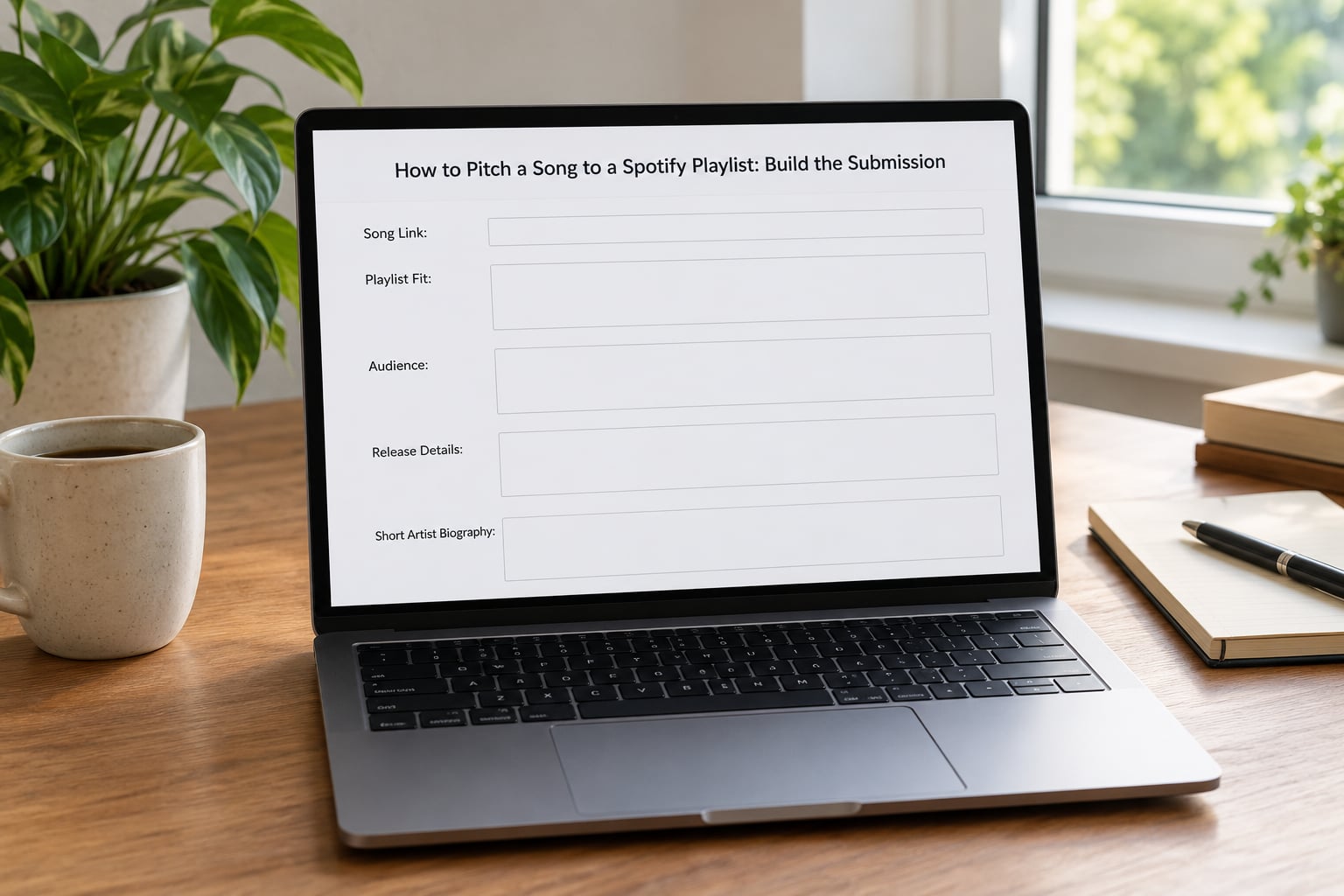
The Spotify for Artists pitch form is short. Every field still gets read, and the genre and mood fields drive the routing more than the prose does.
- Primary and secondary genre. Pick the two that describe the track honestly, not the two that sound biggest. Editors spot genre inflation immediately.
- Mood and energy. This is where you describe the actual listen, which is why mood-based playlists can find you when a genre playlist misses.
- Instruments. Useful for instrumental and production-led tracks, and for producers pitching library-adjacent material.
- Cultural or religious influence. Underused. Tagging this accurately opens doors to world, Latin, African, South Asian and diaspora editorial playlists that would never have guessed at you.
- Description, about 500 characters. The pitch itself. See the structure below.
- Marketing plan. What you are actually doing: a pre-save campaign, a live date, a mailing list, a label partnership. Real plans get read, vague ones get skimmed.
A workable 500-character pitch gives the editor the artist, the track, the fit, and the moment. Something like this, trimmed to fit:
“Maya Okonjo is a Chicago-based producer singing her second EP, Late Transit, out on her own label. Title track ‘Four Stops’ is a mid-tempo Afrobeats-soul cut about the last week before a move, with pedal steel, log drums and a four-part harmony stack. It sits between Burna Boy’s Afrobeats and Yebba’s orchestral pop. Pre-save is live, we have a 12-date US tour in October and a mailing list of 9,000. Released October 24.”
Note what that does not do. It never says future classic, undeniable, or sonic journey. Editors have read a few hundred thousand of those.
4. Find and Verify the Right Curator or Contact
There are four legitimate routes, and they are not equal. An official submission form on a playlist’s page or site is the cleanest. A published business email beats a personal one. A label or manager route works when they handle your submissions. A direct message on social works fine when the curator posts about new music, which many small curators do.
If a playlist lists no contact at all, do not guess an address. Look for the curator’s name in the playlist description, search that name plus the playlist title, and check their socials or website. Artists often say this is where cold email stops working and a short, specific social message does not.
Pay attention to red flags. Anyone promising a specific placement, a guaranteed slot on a named editorial playlist, or thousands of streams in a fixed window is selling something other than a curation service. Legitimate curators may charge a fee for a guaranteed review, never for a guaranteed result.
5. Send a Short, Specific Pitch
Curators read these on phones between other work. Aim for 100 to 150 words, and put the song name and your artist name in the first two lines so they know what they opened.
The structure that works: who you are in one line, what the song is and where it fits in one or two, one concrete piece of proof, one link, one line on the release plan. That is it.
Compare the two versions below. The second one is not longer or better written, it is just specific, which is the whole difference.
- Generic: “Hi, I am an independent artist and I think my new song would be a great fit for your playlist. It has a beautiful melody and I have a growing following. Please listen and let me know.”
- Personalized: “Hi Ren, your Night Drive Hours playlist has been running a lot of Khruangbin and Apollo 9 this month and the sequencing is close to where my track sits. ‘Four Stops’ is mid-tempo Afrobeats-soul with pedal steel, out October 24. Private link below. No rush either way.”
Send these one at a time. Ten individually written notes beat two hundred merged ones, and curators can tell the difference from the first line.
6. Follow Up Once Without Being Pushy
One follow-up, ten to fourteen days after the first message, is acceptable. Anything more reads as pressure and works against you. Keep it shorter than the original and add something new, such as a playlist stat, a tour announcement, or a detail you forgot.
Silence is an answer. If the second message gets nothing, close the row in your tracking sheet and move on. Chasing further does not create interest, it only creates a memory of you as a nuisance.
Log the outcome either way. After a campaign you should be able to say which playlists replied, which stayed silent, and which genres your music actually landed in. That record is what makes the next pitch sharper than the last one.
7. Common Mistakes
These are the errors that show up again and again in artist communities, and each one has a straightforward fix.
- Pitching after release. Fix: treat 7 days out as the absolute deadline and 3 to 4 weeks out as the working target.
- Sending unreleased or region-blocked links. A link the curator cannot play is a dead pitch. Fix: send the private link you tested on a second device.
- Attaching large files. Nobody opens a 90 MB attachment. Fix: link the track and keep the file out of it.
- Blasting the same text to dozens of curators. Fix: one note per curator, referencing something real in their playlist.
- Claiming relationships you do not have. Mentioning a friend who works in radio or a manager with a contact reads as bluffing. Fix: state only what you can prove.
- Guessing at genre tags to reach bigger playlists. Fix: tag honestly, then let mood and instrument fields do the routing work.
- Paying for guaranteed placement. Fix: walk away, and report suspicious playlists that appear without your submission, since unsolicited additions can affect how your streams are counted.
- Reading rejection as personal. Most rejections are routing decisions, not verdicts on quality. Fix: keep the metadata work and pitch the next release.
Quick Submission Checklist
Run this before you hit send, on every pitch.
- Track is unreleased and visible in the Upcoming tab of Spotify for Artists.
- Pitch submitted at least 7 days out, ideally 3 to 4 weeks.
- Artwork uploaded, credits complete, splits filed, ISRC assigned.
- Private link tested and plays without a region block.
- Genre, mood, instrument and cultural influence fields filled in accurately.
- Pitch under 500 characters and inside 100 to 150 words for curator emails.
- Song name and artist name appear in the opening two lines.
- One sentence ties the song to that specific playlist.
- Recipient route is official, published, or a warm social contact.
- Tracking sheet row created before sending, with a follow-up date ten to fourteen days out.
- No price paid, no guarantee promised, no second follow-up queued.
Frequently Asked Questions
Can you pitch an unreleased song to Spotify playlists?
Yes, and unreleased is the only way in through the editorial route. Spotify for Artists lets you pitch one unreleased track per release, submitted at least 7 days before release day. Once a song is live, that option closes permanently for editorial playlists. You can still reach independent user-generated curators afterward, and the track stays eligible for algorithmic surfaces such as Discover Weekly and Daily Mix.
How long should a Spotify playlist pitch email be?
Keep curator emails to 100 to 150 words. Name the artist and song in the first two lines, explain the fit with that playlist in a sentence, add one piece of concrete proof, include your link, and stop. The Spotify for Artists pitch field is separate and capped at about 500 characters. Editors read fast, and a short message reads as professional rather than hungry.
When should I pitch a song before its release?
Seven days before release is the hard minimum for eligibility, including Release Radar exposure for your followers. Three to four weeks out is the working target because editors plan playlists ahead of time rather than reacting to submissions. Remember the delivery lag: your track usually appears in the Upcoming tab roughly 48 hours after your distributor delivers it, so build that buffer into your calendar.
Do Spotify playlist curators charge to add songs?
Most independent curators do not charge, and many do not accept submissions at all. Some paid services sell guaranteed review rather than guaranteed placement, which is a different and honest proposition. Walk away from anyone promising a named editorial playlist slot, a specific follower-driven spike, or a fixed number of streams. Those offers usually deliver bots, and fake streams can lead to track removal or penalties on your artist profile.
How long should I wait before following up?
Ten to fourteen days after your first message, and once only. Keep the follow-up shorter than the original and add something new rather than asking again. If the second message goes unanswered, treat that as a no and record it in your tracking sheet. Repeated chasing does not change a curator’s mind, it only makes your name memorable in the wrong way.
Does getting on a Spotify playlist increase streaming automatically?
Not by a fixed amount. A placement mostly introduces your track to listeners who have never heard you, so the real effect shows up in new followers, saves, and playlist adds from people outside your existing audience. That early engagement is what helps the algorithm pick the track up further, including Discover Weekly and Daily Mix. Judge a placement on new listeners and save rate rather than a single-day stream spike.
Conclusion
Learning how to pitch a song to a Spotify playlist comes down to three things: submit unreleased, submit early, and submit specifically. Everything else in this guide is detail on one of those.
Start small. Pick one playlist where your track genuinely belongs, read its ten most recent additions, and write one honest message about why it fits there. Then repeat that with the next one. Ten careful pitches will always outperform two hundred merged ones, and the tracking sheet will make the tenth better than the first.