To perform your songs live as a rapper, you need a finished setlist, a showmix prepared with your vocals removed from the beat, a microphone you’re comfortable holding, and a rehearsal process that simulates show conditions rather than bedroom listening. Most first-time performers can get through the lyrics. The ones who hold a room spend their rehearsal time on breath control, transitions and reading the audience.
This guide covers how to perform your songs live as a rapper, in order, from choosing songs to reviewing the night afterward. Most of it can be done at home before you ever book a room.
Table of Contents
- What You Need
- Step-by-Step
- 1. Choose the right songs and order your set
- 2. Prepare your backing tracks and performance arrangement
- 3. Rehearse the full performance repeatedly
- 4. Check the venue and complete the soundcheck
- 5. Learn the stagecraft that fits your style
- 6. Perform with control and connect with the crowd
- 7. Review the show and improve the next one
- Common Mistakes
- Frequently Asked Questions
- Conclusion
What You Need
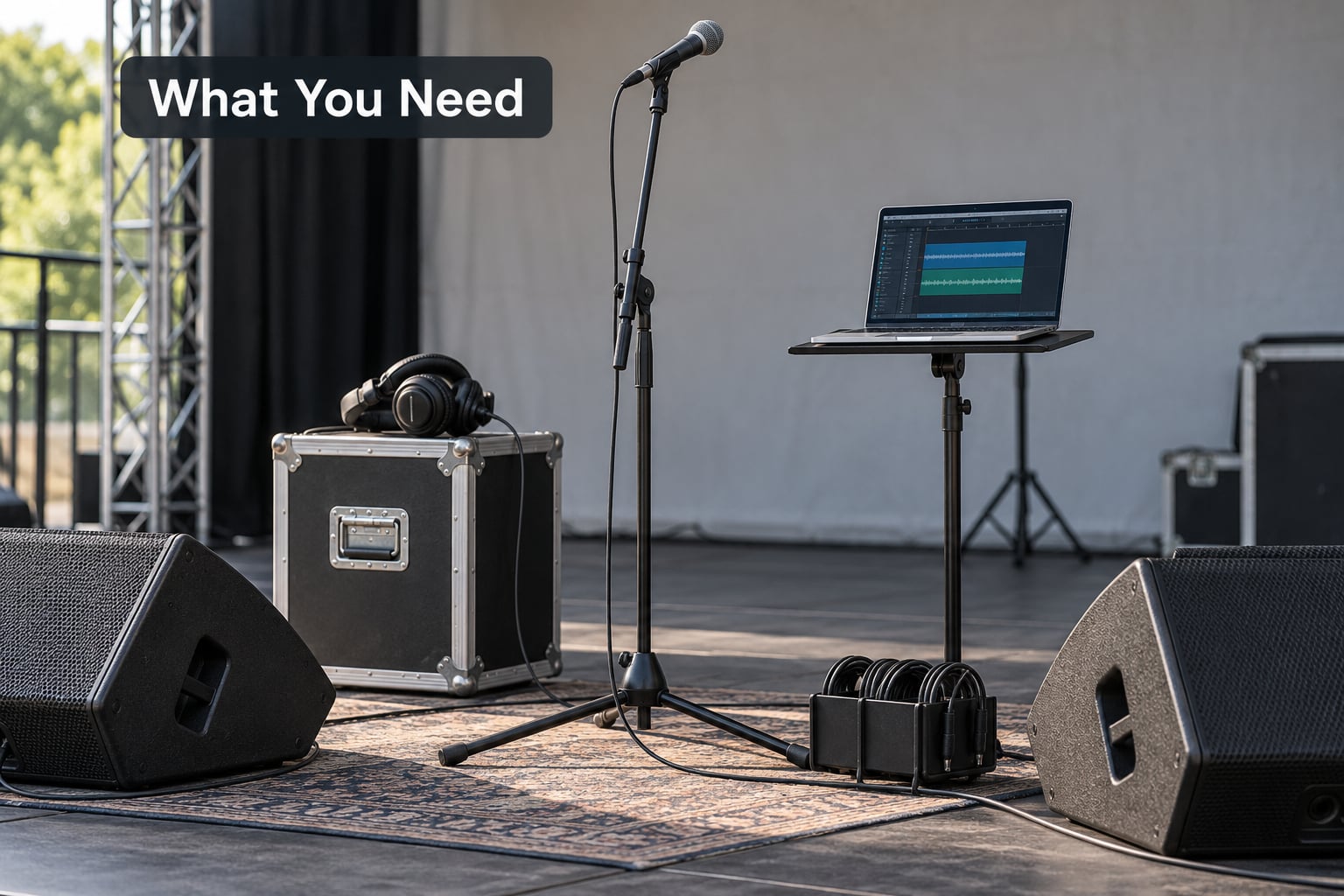
Before you think about stage presence, get the boring foundation in place. Six things do most of the work:
- A finished setlist with timings. Know the total minutes per song, not just the order. A support slot is often 20 minutes and a headline set 45.
- A showmix for every song. Instrumental or, better, a version with your guide vocal muted. Rapping over a track that already has your voice on it leaves you fighting yourself.
- A microphone you’re used to. Dynamic mics such as an SM58 or an equivalent handle a room better than condenser mics. Bring your own if the venue allows it, and know whether you’ll use a corded or wireless model.
- Two ways to play the music. A laptop with your showmix and a second copy on a backup drive or another laptop. Plug-and-play laptops fail, and a dead laptop ends the set.
- Playback software tested on that machine. If your showmix auto-transitions between tracks, confirm it works on the laptop you’ll actually bring, not the one at home.
- A monitor or in-ear setup. Without one, you are guessing at your vocal volume. A floor wedge angled toward your toes is enough for most rooms.
- Water, a towel, and spare batteries. Cold water, not room temperature. If your mic is wireless, treat spare batteries as part of the microphone.
- A show plan. Who introduces you, how long the set is, where you stand, what happens if a track dies mid-song.
Step-by-Step
1. Choose the right songs and order your set
Pick songs you can deliver live, not songs you wish you could cut. A 12-bar verse nobody has to think about is worth more on a small stage than a complex hook you are still chasing on night one.
Order the set by energy. Strong opener, controlled middle, a lift when the room starts drifting, then the song people came for at the end. Beginners tend to front-load everything loud and arrive with nothing left for the close.
Leave air between songs. Thirty seconds to two minutes of talking, ad-libs or a beat switch is normal. If you pack 30 minutes of music into a 30-minute slot, the set will run over.
2. Prepare your backing tracks and performance arrangement
Build a showmix, not just an instrumental. Standard versions run from full instrumental through muted guide vocal to full stems, and the middle option is the one most beginners should use.
Export every track from the same mastering pass at the same loudness so nothing jumps between songs. Leave a two-second gap at the start of each track for the DJ or player to trigger, and let the last beat ring out rather than cutting it dead.
Decide what stays live. Backing tracks handle the beat, the melody and the backing vocals. Your voice, your presence and any live element you can actually execute stay yours. Trying to add live drums you have never rehearsed with is how sets fall apart.
3. Rehearse the full performance repeatedly
Rapping along to an instrumental in your room is not rehearsing. The skill that separates a bedroom rapper from a stage-ready one is performing the full set, start to finish, at performance volume, several times.
Run the whole set without stopping. Practice the talk pieces and transitions too, because those are where sets usually fall apart. Record at least one run and watch it back. Video shows you pacing in circles, standing still through a whole hook, or turning your back to the audience during the loudest bar, and none of that registers while you are performing.
Drill breath control separately. Use a low, steady inhale before every 16 bars, exhale hard through the mouth on fast sections, and practice your longest verse until the last line arrives on time with air left over. Performers who blank on lyrics usually have a memory gap, not a talent gap, and repeated full-set runs close that gap faster than reviewing bars.
4. Check the venue and complete the soundcheck
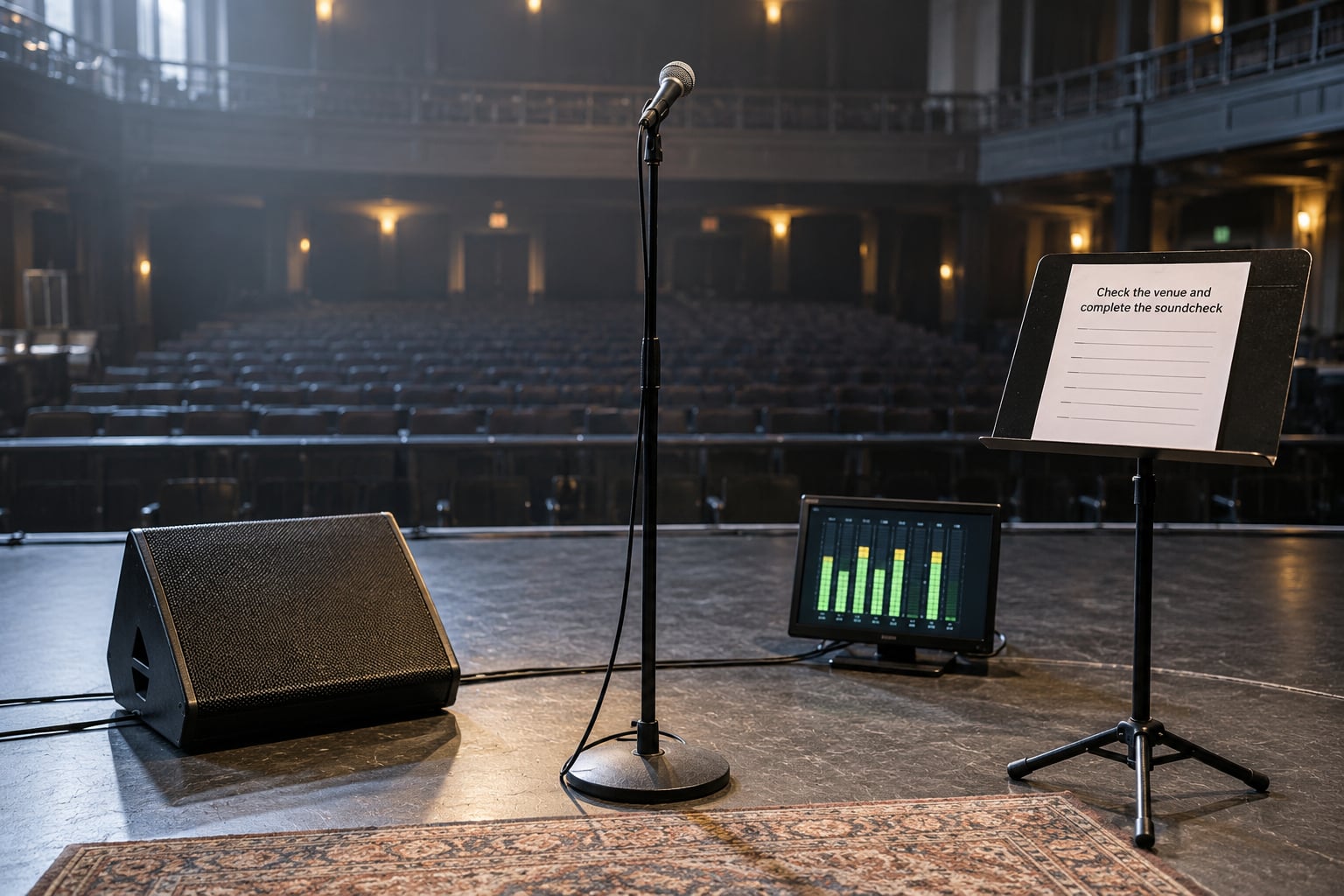
The soundcheck is where a set is saved or lost. Arrive early, give yourself time, and treat it as a checklist rather than a quick hello.
- Play every track in order, out of order once, and confirm the levels match from the front of the room.
- Ask for your mic volume against a known reference. Rap vocals sit around 3 to 6 dB below the instrumental peak in most show mixes; ask the engineer to bring it up until it sits right, then stop.
- Check the monitor. Rap to it for a full verse. If you cannot hear yourself clearly, your delivery changes whether you know it or not.
- Walk to the front and back of the stage and check that your vocal is still intelligible from both.
- Test the click, the pause between tracks, and the moment you plan to speak.
- Confirm the backup laptop and a second cable for the mic.
- Find out who the DJ is and give them a printed setlist with song names and any stop points.
Bring a small notebook. Sound notes written at soundcheck are the difference between fixing a problem in twenty seconds and asking for the whole show to start over.
5. Learn the stagecraft that fits your style
Stagecraft is not personality. Movement should support the song, not fight it.
Find your default spot, usually downstage center or slightly off from dead center, and treat that as home. Move when the music opens up or when you want to pull energy forward, then come back to your mark. Big movements during a dense verse waste breath you need for the lyrics.
Hold the mic near your mouth with your fingers away from the grille. If your mic is corded, keep the cable loose and let it hang, which stops you winding yourself in it while you move. Speakers on stage amplify whatever movement you make, so a swinging mic is an audible mistake.
Use your hands, but keep gestures that repeat on every word out of the performance. Pick two or three movements that suit you and let the rest of the energy live in your face and your voice.
6. Perform with control and connect with the crowd
Walk out with a purpose. Look at the room, find three faces, and nod before the first beat. That pause reads as confidence.
Keep your delivery clear first. Clear diction beats volume every time, and the audience can forgive a rough edge far more easily than a verse they cannot make out.
Look at the room while you rap. Pick a section, front or side, and give it a few lines, then move to another. Reading the crowd means noticing where they are reacting and giving that section more, and noticing where they are quiet and slowing down or pulling energy back into the track.
Call and response works when you have the room. Use a hook the audience can answer, take a count, and do it early while they’re still listening. Silence between songs reads as failure, so fill it with a line, an ad-lib or a beat switch rather than looking down at your shoes.
If your mind blanks, do not freeze and do not apologize. Keep moving, take a sip of water, jump to the next line you remember, or go into the ad-lib section. Almost nobody in the crowd notices; they notice a panic face more than a missed bar.
Finish deliberately. Every set needs a closing moment: a line into the mic, a held note, a nod to the DJ, and then you are off. Cutting off mid-bar loses energy you already earned.
7. Review the show and improve the next one
Do the review within a day, while you still remember what happened. Talk to whoever filmed it first, then watch it once at full speed and once in slow motion.
Write down three things that worked and three that did not. Keep them concrete: not “I was stiff” but “I stood still through the entire second verse of my second song.” Fix the technical problems first, since vocal level, monitor mix and track transitions affect every single show.
Then look at the parts that were not technical. Which lines hit? Where did the room come alive? Which song made people move and which one made them check their phone?
Turn that into your next rehearsal plan, then go back to step one. Consistency across several shows is far more valuable than one night that went well.
Common Mistakes
Rapping over tracks that still have your vocals on them
You end up competing with your own voice for clarity. Mute the guide vocal or use stems, and export every track at the same level.
Ignoring the monitor
Singers use monitors to check themselves. Rappers do too. If your vocals are backing off the beat in your ears, your timing will drift and your delivery will get quieter as the song goes on.
Practicing songs but never the whole set
Knowing each song is not the same as performing fifteen of them in order. Full-set run-throughs build the stamina and the transitions.
Standing in one spot, or moving constantly
Statue syndrome reads as no energy. Constant pacing reads as nervous and steals breath. Pick a mark, move with intention, come back to it.
Skipping or rushing the soundcheck
A bad monitor mix will undo weeks of rehearsal. Give it the time it needs, even on a bad day.
No backup plan
Two laptops, a spare cable, spare batteries and a version of the set with one song removed if you lose time. Decide it in advance, not during the show.
Performing at full volume in the practice room
Full-volume set runs build the endurance you need. Anything else is a rehearsal of the songs, not of the performance.
Missing the warm-up
Ten minutes of quiet breathing, some gentle humming and a couple of low-volume verses protect your voice more than any mint or tea. Cold rooms tighten everything up, so warm up longer when the venue is chilly.
Frequently Asked Questions
How do I perform live if I don’t have a band?
Most rappers start with backing tracks. Build a showmix from your beats with your guide vocal muted, export every song at the same level, and bring a second copy on a separate laptop or drive. Playback software with automatic transitions is helpful, but test it on the exact machine you’ll carry. A DJ who knows your set is a good upgrade once you’ve played a few shows.
How do I stop running out of breath when rapping fast on stage?
Take a low, quiet inhale before every sixteen bars rather than a big gasp mid-verse, and exhale hard through the mouth on the fast sections so your breath doesn’t spike. Practice the longest verse in your set on its own until the final line lands with air left over. Movement costs breath too, so keep busy sections still and move during breaks instead.
What should I do if I forget my lyrics on stage?
Keep moving, stay calm, and get to the next part you know. Ad-libs, repeats and a beat switch all buy you time. Looking down or stopping to apologize is what an audience actually notices, not the missed line. If you blank twice, take a sip of water and jump to the next song. Practicing your full set start to finish is what actually prevents this.
Should I use a DJ or play my own backing tracks?
Playing your own tracks gives you full control over timing, transitions and version, and it costs nothing, so it’s the better choice for your first shows. A DJ who knows your material feels more live and handles the room when something fails. Whichever you pick, send a printed setlist with song names and any stop points, and decide before show day, not on stage.
How should I prepare for my first live rap show?
Lock a short setlist, build the showmix, and run the whole set at performance volume at least three times before the show. Arrive early enough to do a proper soundcheck rather than a quick mic check. Bring water, a towel, spare batteries and a second copy of your tracks. Open mic nights are useful rehearsal with a real audience, and a small room is a better place to make mistakes than a big one.
Conclusion
Start with one job this week: lock the setlist and decide the total minutes. That single habit is where learning how to perform your songs live as a rapper actually begins, because everything after it depends on knowing what the set is.
Keep performing, and keep writing down what happened. In 2026 and every year after it, the artists who last are the ones who treated every show as a rehearsal for the next one.