Regional hip hop styles developed because the music was made locally. Each city brought its own cultural roots, party infrastructure, radio, slang and affordable gear, then took the same four-on-the-floor format and rebuilt it in its own image. New York pushed complexity. Los Angeles added funk synths and car culture. The South rebuilt the beat around heavy 808 bass and club energy. The Midwest pushed speed.
Updated for October 2026.
That is the short answer. The longer version involves migration, records travelling in cars, borrowed equipment, church and club music, and a lot of people making decisions in rooms you will never see. The argument is still live: listeners on forums and comment sections argue about whether region means anything at all in an era of playlist algorithms and cross-country collaborations. Most of them keep coming back to the same point once the trading stops. You can usually hear where somebody is from.
What follows is an explanation rather than a ranking. There is no best coast here, and the four-region map you have seen before is far too coarse to cover what actually happened. Houston is not the same as Memphis. The Bay Area is not the same as Los Angeles. Detroit is not Chicago. Those distinctions are the interesting part, and they are exactly what the four-coast version throws away.
Table of Contents
- How Regional Hip Hop Styles Developed
- What Was Hip Hop Like Before Regional Styles Emerged?
- How Did Migration and Local Music Shape Regional Sound?
- The South: Country, Soul, and Southern Identity
- The West Coast: Funk, Jazz, and a Distinctive California Aesthetic
- The East Coast: The Bronx Blueprint and Multiracial New York Styles
- The Midwest and Southwest: Industry Change and Local Innovation
- How Regional Scenes Interact Instead of Developing Alone
- Why Language, Politics, and Everyday Life Matter
- What Makes a Style Regional Rather Than Just a Trend?
- How Can Listeners Explore the History of Regional Hip Hop?
- Frequently Asked Questions
- Conclusion
How Regional Hip Hop Styles Developed
Regional hip hop styles developed through four forces acting at once: the musical traditions a city already had, the DIY infrastructure someone built to spread music locally, the language and lived experience of the people making it, and the equipment they could get their hands on. Add a period before the internet, when your audience was mostly the people in your own zip code, and regional differences had room to harden into something you could identify in three seconds.
Migration is the engine underneath all four. The Great Migration moved Black families from the rural South into Detroit, Chicago, New York, Los Angeles and Philadelphia between roughly 1916 and 1970. That reshaped the blues, gospel, jazz and R&B those cities produced, and hip hop grew out of the music they made afterward. Later waves brought different sounds again: Caribbean immigration into New York brought dub, reggae and sound system competition; the outflow of Southerners into LA and Chicago carried country, blues and funk with it.
Records did the rest. Before streaming, discovery meant a cousin’s car stereo, a local radio spin, or a hand-to-hand dub of a tape. A DJ in Atlanta who had only ever heard a handful of New York records would build something that was recognizably hip hop and unmistakably Atlanta, because that was the only set of inputs available.
What Was Hip Hop Like Before Regional Styles Emerged?
Hip hop began in the Bronx in the 1970s as a culture with four elements: DJing, MCing, breaking and graffiti. The sound came from extending the funk and soul records that Black and Latino DJ crews in the neighborhood already loved, digging into drum breaks and stretching them out long enough for someone to talk or dance over them.
The lineage matters because hip hop did not begin blank. DJ Kool Herc’s 1973 party is usually treated as the starting point, but Herc was a Jamaican-American DJ raised around sound system culture, where a big speaker rig and a MC who hyped the crowd were the whole show. That idea traveled from Kingston to the Bronx, and it arrived in a neighborhood that already had a deep funk, soul and Latin record collection. Herc broke the record; Afrika Bambaataa, Grandmaster Flash and the Sugarhill Gang pushed the format into recorded music, and Grand Wizzard Theodore and the Bronx-born crews built the visual language alongside it.
So even at the origin the culture was plural. Black and Latino teenagers, Jamaican heritage, Puerto Rican and other Caribbean connections, and funk and disco from the same block parties. That mix was never one sound, which is precisely why it broke into regional variants so fast once it left the borough.
Two structural facts about the 1970s and early 1980s set the pattern. First, local rather than national success: a record could be enormous in one city and completely unknown two hundred miles away. Second, the tools were scarce and specific. A Technics 1100 turntable, a SP-1200 sampler, a 808 drum machine, a cheap keyboard. Whatever gear a city got its hands on first shaped its records for years afterward.
How Did Migration and Local Music Shape Regional Sound?
Migration carried people, records, DJ technique and vocabulary between regions, and each city bent what it received to fit the music that was already there. Funk became G-funk in Los Angeles because the city had P-Funk and doo-wop in its ears. Soul records chopped into boom bap in New York because the Bronx had spent a decade learning to dig. The same break, played by a Houston DJ slowed down to about 60 to 75 beats per minute, became chopped and screwed.
Here is the shape of it by region, with a note on what gets said about each place that is not true.
| Region | Major influences | Representative developments | Caution against stereotypes |
|---|---|---|---|
| New York City | Funk, soul, disco, dub, reggae, sound system culture, salsa and other Latin records | Disco mixing and break cutting, block party circuit, graffiti crews, golden age MC technique, later boom bap and the borough networks | Not every New York record is dense or literary, and the city holds borough scenes that disagree with each other |
| Los Angeles | P-Funk, doo-wop, jazz-funk, Talking Head and the WattStax era, later electro | Electro-funk, gangsta rap, G-funk, lowrider and sideshow imagery, later West Coast synth revival | Not all West Coast rap is relaxed or car-themed, and Oakland and Long Beach have their own histories |
| The South | Country, blues, soul, funk, gospel, go-go, Miami bass, club music, Tejano | Miami bass, New Orleans bounce, Memphis horrorcore and crunk, Houston chopped and screwed, Atlanta trap | The South is not one scene, and calling Southern rap mumbly or lazy skips two decades of innovation |
| The Midwest | Blues, gospel, funk, Chicago house, Detroit techno and Motown | Chopper flow, battle rap, Chicago drill, Dilla-influenced beat music, Milwaukee lowend, Detroit and Flint micro-scenes | Chicago and Detroit do not sound alike, and neither one is interchangeable with the whole region |
| Bay Area | Funk, Bay Area soul, Miami bass imports, club edits | Horrorcore and hyphy, sideshow culture, MC Hammer-era pop crossover | E-40’s label and vocabulary are Bay Area specific, not generic West Coast |
| Mid-Atlantic and Baltimore | Go-go, funk, gospel, Baltimore’s rowhouse club scene | DMV flow, go-go’s bass tradition, Baltimore club and neighborhood-level rap | The DMV is a corridor, not a single city, and its sound borrows from Washington, Baltimore and Philadelphia |
Keep one thing in mind while reading that table. These are starting points, not rules. A New York producer chopping up a 1970s soul record in 1994 was doing something Pan Afrikan Peoples Sound System had done years earlier in Los Angeles. Techniques travelled faster than the labels did, and the places that get credited with an invention are often the places that made it most visible.
The South: Country, Soul, and Southern Identity
The South produced regional rap long before the South had a national moment, and it happened in at least five separate places. 2 Live Crew out of Miami made the first nationally notorious records, built on Miami bass and its obsession with low end. The DJ Screw movement in Houston slowed and chopped existing records in the early 1990s, creating a sound and a distribution system that never looked like anything out of New York. New Orleans bounce put a specific kick and snare feel underneath call-and-response shout vocals. Memphis horrorcore went somewhere stranger and darker with detuned synths and horror-film imagery.
What unified those cities was not a single sound but a set of resources. The South had gospel, which is where the call-and-response vocal style came from. It had the deepest recorded blues and country traditions in the country, and musicians who grew up hearing both. It had church and high school marching band percussion, and drummers who could move a kick and a snare in ways New York break loops did not teach them.
Atlanta became the hinge. OutKast winning Best New Rap Group at the 1995 Source Awards was the moment a lot of people north of Atlanta registered that the South had arrived, and the label infrastructure that followed gave other Southern cities a route out. Lil Wayne and the Cash Money catalogue, UGK out of Port Arthur, Three 6 Mafia in Memphis and the crunk of Lil Jon all used Atlanta’s distribution without copying Atlanta’s sound. When trap producers started treating 808s the way Southern producers always had, the centre of gravity in American rap had quietly moved south.
Houston deserves its own line because it is often folded in as a footnote. DJ Screw’s mixtape method, slowed to roughly 60 to 75 beats per minute, was both a sound and a business: a distribution system built for a car culture where a month’s worth of music got burned onto discs and traded at the parking lot. The Screwed Up Click mixtape tapes and the later slowed-and-reverb effect all trace back to that practice.
The West Coast: Funk, Jazz, and a Distinctive California Aesthetic
Los Angeles built its early identity out of records Los Angeles had been making for years. P-Funk’s bass-heavy funk, doo-wop still ringing out of high school gyms, and the electronic experiments of the early 1980s produced electro-funk, which is the bridge between the Bronx and everything that came later. Ruthless Records, Eazy-E, N.W.A. and 1988’s Straight Outta Compton turned that funk into something blunt and funny and frightening, and gangsta rap became the first major national argument that Los Angeles had its own story to tell.
G-funk arrived a few years later through a very specific set of choices. Dr. Dre on The Chronic, 1992, dropped the kick drum so low it became almost a separate instrument, layered synth leads that lived in the same register as the bass, kept the vocals cold and flat, and let the drums and the synth do the moving. Snoop Dogg and Ice Cube made it a voice, and the lowrider circuit gave it a visual: a slow cruise, chrome, bass you feel in the seat.
Long Beach mattered on its own terms. Its own scene fed into 2Pac, whose work moves between Los Angeles, Oakland and the Bay Area rather than sitting neatly inside any one of them. Further north, E-40 and B-Legit built the hyphy movement in the mid-2000s out of Bay Area club music, a deliberately chopped-and-screwed vocal style and sideshow culture, and it influenced pop rap far more than its chart numbers suggest.
One thing gets ignored here. California also had jazz in the mix, and a lot of West Coast producers started out playing horn and keys before they ever touched a sampler. That is not a detail; it is part of why the region’s production leans melodic in a way New York production often does not.
The East Coast: The Bronx Blueprint and Multiracial New York Styles
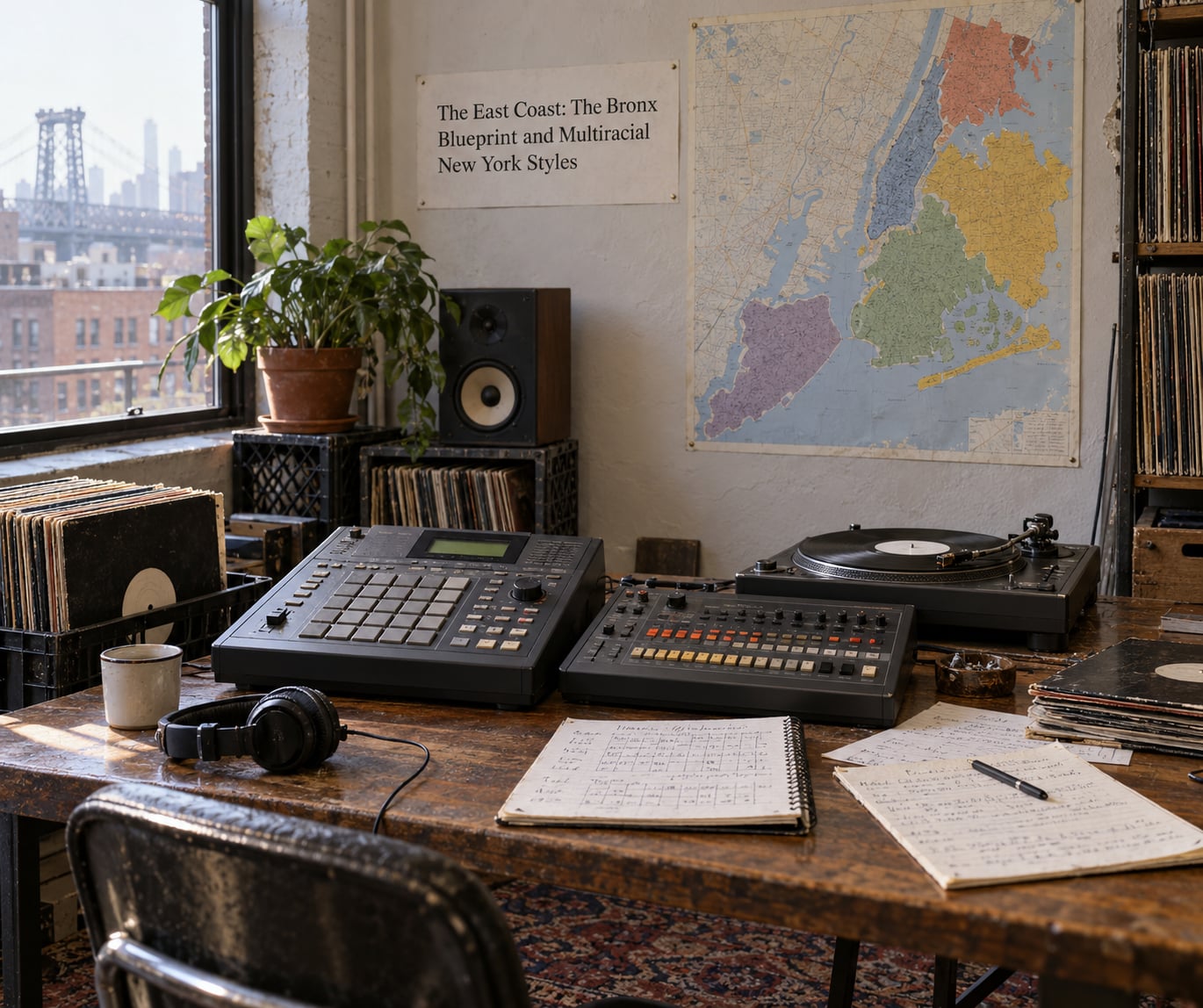
New York hip hop is the origin story, so it is usually described as one thing. It was never one thing. The Bronx, and the wider borough network built around it, developed as a set of connected scenes that traded equipment and MCs constantly while sounding different from each other. The South Bronx and Harlem gave the early crew lineage; Brooklyn’s block parties and club circuit gave the next wave of infrastructure; Queens and the Bronx carried the Caribbean and Latino networks that had been there from the start.
The sonic signature of the golden age came from a choice to stay lean. Instead of layering more instruments, producers like DJ Premier, Pete Rock and EPMD sampled a handful of sources and let the drums breathe. Grandmaster Flash and the Furious Five and Grandmaster Caz tightened the delivery; Rakim’s 1986 verse on Eric B. and Rakim, with its internal rhymes and controlled tone, reset what an MC could be expected to do. Afrika Bambaataa and Arthur Baker had already been pulling in electro and European synths years before the culture was ready to call it a sound.
Bad Boy, EPMD and Def Jam turned a scene into a business in the 1990s, and the paperwork mattered as much as the records. The Notorious B.I.G., Nas on Illmatic in 1994, Wu-Tang Clan and Public Enemy each pulled the city in a visibly different direction, which is one more piece of evidence against treating New York as a single sound.
Graffiti deserves its place here too. Writing crews and DJ crews shared the same blocks, the same supplies and the same competition, and a borough could be claimed in a way that had nothing to do with how a record sounded.
The Midwest and Southwest: Industry Change and Local Innovation
The Midwest’s story is usually told through speed. Bone Thugs-n-Harmony’s 1993 EP, Twista, and later Chicago drill all come out of a region where the headline technical question was how fast a voice could move without losing the lyric. Detroit adds a different lineage: Motown, the Motown bass sound, techno and, crucially, J Dilla’s drum programming, which put a whole vocabulary of swung, off-grid hi-hats and dusty soul samples into production worldwide.
Industry decline is part of that story. Detroit and St. Louis lost population and industry in the decades when rap was forming, and Kansas City and Milwaukee built scenes with very little label money behind them. Milwaukee’s lowend and the Detroit and Flint micro-scenes of recent years are less about a signature sound than about local producers taking house, club and Memphis-style drum programming and running it through their own infrastructure.
Call the Southwest Texas and Oklahoma, and Houston is the anchor for a reason. The chopped and screwed tradition, a large Mexican American and Tejano cultural base, country and blues records in every car, and a scene that spent two decades building itself outside the major label system are all in play there. The later spread of Atlanta trap, and then Houston-flavoured production, into the wider South and the West Coast is a migration story running in the opposite direction from the Great Migration, which is worth sitting with for a minute.
Kansas City, St. Louis and Oklahoma City each have their own scenes and their own audiences. Anyone using the four-region map will keep missing them.
How Regional Scenes Interact Instead of Developing Alone
Regions never developed alone. They were in constant contact, and the interesting shifts happened when somebody carried a technique across a border. The question is what carried the music, and how far it could reach, in each era.
| Era | What carried the music | What stayed local |
|---|---|---|
| 1970s | Block parties, neighborhood sound systems, vinyl traded in person | Almost everything. A record could be a local hit and unknown fifty miles away |
| 1980s | Local radio, college radio, music video, cassette trading, small indie labels | Regional slang, local record shops, and which crews knew which block |
| 1990s | MTV, The Source charts, regional radio formats, the mixtape as a chart of its own | Local identity became a public argument, most visibly through the East versus West beef |
| 2000s | Boutique labels, MySpace, ringtone and iPod sales, mixtape culture as an industry | Sub-regional sounds stayed local enough that outsiders needed a guide to hear them |
| 2010s and streaming | Streaming playlists, social clips, cross-country features, sample clearance databases | Reference to a hometown, a slang word, a dance, a club night |
Look at that table as a trend line and something stands out. The reach of the music keeps growing while the amount of locally specific material does not shrink. A record from the 2020s can be produced in two countries, on a beat cleared from a library, and still spend its hook saying a word only three neighborhoods use.
Why Language, Politics, and Everyday Life Matter
Regional identity shows up in accent, slang, wordplay, themes, vocal tone and what producers leave in the mix. Chicago drill, Baltimore club and go-go all carry go-go’s bass and drum lineage, and go-go is a Washington music tradition that spread through the corridor. A Southern MC who stretches a word across four syllables is doing something different from a New York MC who stacks internal rhymes, and neither is performing an accent as a gimmick.
Politics enters through subject matter rather than slogans. Police encounters, the crack epidemic, codeine and lean culture, housing, factory closures, immigration, and the specific politics of a city all fed directly into what got recorded. The academic work on this topic keeps making the same point in different language: the sound is downstream of the social conditions, and the conditions were regional.
What is not fair is assigning fixed traits to residents. Nobody from Detroit is a certain kind of rapper, nobody from Atlanta grew up in a house without gospel in it, and treating dialect as a gimmick turns a real cultural history into a costume. The slang is evidence of a place, not a personality type.
What Makes a Style Regional Rather Than Just a Trend?
A style becomes regional rather than merely fashionable when five things line up. Recurring musical traits that show up across dozens of artists, not one hit. A working local network of MCs, producers, DJs, venues and labels. References specific enough that outsiders miss them. Sustained local recognition over years, which is the test that separates a scene from a moment. And influence that travels, where other regions borrow the technique rather than just the record.
Compare that with a trend, which is usually a producer, a song and about eighteen months of attention. A trend can be regional. A tradition has to be regional before it is anything else.
Worth saying plainly, because the four-coast listicle quietly implies otherwise: these are not ranks. There is no region where the rapping is better. The comparison fans want is about history, geography and technique, and the moment it turns into a scoreboard everybody starts losing the thread. Scene, sound and sub-genre are also different things. The DMV is a place, drill is a sound, and trap is a period label that has outlived its era.
How Can Listeners Explore the History of Regional Hip Hop?
Start with a scene overview, then go back in time within it. Pick a region, learn who the foundational artists were, and play their earliest records before the ones everybody cites. The gap between those two points of a career usually teaches more than any amount of reading, because you can hear the scene handing the artist a vocabulary.
Then train the ear deliberately. Four cues are enough to place most records. Kick and bass weight: is the low end a deep sustained 808, or a punchy kick under a sampled bassline? Source material: do you hear a chopped record, a synthesized tone, or a live player? Drums: a heavy snare with a long decay, a layered clap, a sharp programmed hit, or swung programmed hats? And vocal delivery: stacked internal rhymes, rapid triplets, a shouted hook, a melodic sing-song line? Two or three of those together will get you most of the way.
Compare eras side by side. Put a New York record from the late 1980s next to one from 2001, then next to one from 2019. Do the same across three regions. The differences that survive that test are real, and the ones that dissolve were a phase.
Starter points by region, roughly in the order they emerged. New York: Grandmaster Flash and the Furious Five, then Eric B. and Rakim, then Illmatic. Los Angeles: Straight Outta Compton, then The Chronic. The South: 2 Live Crew for Miami, Screwed Up Chronic for Houston, OutKast for Atlanta. Mid-Atlantic: Meek Mill for Philadelphia, or a Baltimore club record. Midwest: Bone Thugs-n-Harmony, then anything J Dilla produced, then a Chicago drill record. Bay Area: an E-40 or B-Legit record from the hyphy years.
Two habits that pay off. Read the production credits, because the beat maker is usually the one carrying the regional technique. And read interviews and criticism from the year, not retrospectives, since a 1995 local piece will describe what that scene was trying to do far better than a retrospective written decades later.
Frequently Asked Questions
What is regional hip hop?
Regional hip hop is rap music defined by where it was made rather than only by when. A region develops a sound through the music it already has, the local party and radio infrastructure, the slang people speak, and the equipment available. New York, Los Angeles, the South, the Midwest, the Bay Area and the Mid-Atlantic each developed distinct traits, and the four-coast map is still too coarse to describe most of them.
Why did different cities develop different styles of hip hop?
Because hip hop arrived in each city with a different set of inputs. A city that already had P-Funk in its record shops bent the format toward funk synths and heavy bass. A city with a gospel and marching band tradition pushed call-and-response vocals and drum programming. Local radio, mixtape circuits and record shops decided which records a DJ had actually heard, and that limit is what made a regional style instead of a copy.
How did sampling help regional hip hop styles develop?
Sampling gave regional scenes a way to answer the same question differently. Chopping a soul break, slowing it, gating a snare or layering synths all reworked the same source, and the available tools differed by city. The SP-1200 and the 808 pushed two quite different production languages. Sampling also let a region import an influence it could never have grown locally, which is why a Bronx format reached Houston and came back as chopped and screwed.
Is regional hip hop still relevant in the streaming era?
Partly less, partly more. Playlists and constant collaborations flattened some of what made regions distinct, which is a fair complaint. At the same time, listeners increasingly treat place as a thing worth identifying rather than a limitation, and city-level scenes from the DMV to Milwaukee to Flint are being researched and discussed in detail. The four-coast version is outdated; the regional instinct is not.
What is the difference between a regional hip hop scene and a genre?
A scene is a place with people in it: MCs, producers, DJs, venues, labels and a local audience that knows each other. A genre is a sound that travels without needing those people. A genre can be built in one city and still be a genre everywhere, which is why trap and drill are genres. That is also why regional hip hop styles are better understood as local practices that feed genres, rather than as genres themselves.
Conclusion
Regional hip hop styles are the record of people adapting a shared format to the music, language and conditions of a specific place. Migration supplied the people, local traditions supplied the sound, and local infrastructure decided how far it could travel.
Start by doing one comparison. Play one foundational record, then a regional response to it twenty years later, then the same pair from a different region. Put the kick drum in your head, listen for the source of the sample, and follow the production credits from there. That is the fastest way to hear how regional hip hop styles developed, and the credits will take you further than any listicle.