To write an album review, listen to the record at least three times with a different job each pass, verify the release details, write one sentence that states your verdict, and build everything else around specific moments from the music. Two or three focused hours will get you a solid 800-word review with a score you can defend.
The reason most album reviews fall flat is not a lack of taste. It is that the writer never made notes, so the finished piece is built on whatever feeling survived the third listen. By the time they sit down, the record has blurred into a mood.
This guide covers the whole process, from setting up your listening session to revising the draft. It works for a blog post, a class essay, a community listing, or a review you’re pitching to an editor. You do not need music theory, and you never need to like the album to review it well. The people writing about music on the Album of the Year community lists and the professional critics posting on independent music blogs all start from the same place: an album, a notebook, and enough time to listen properly.
Table of Contents
- What You Need
- Step-by-Step: How to Write an Album Review
- 1. Listen Before You Research
- 2. Gather Reliable Album Details
- 3. Write a One-Sentence Critical Thesis
- 4. Listen for Songs, Sequences, and Details
- 5. Support Every Claim With Evidence
- 6. Build a Clear Review Structure
- 7. Revise for Fairness, Clarity, and Voice
- Common Mistakes to Avoid
- Tips for a Strong Album Review
- Frequently Asked Questions
- How long should an album review be?
- How do you write a negative album review fairly?
- Should an album review include a rating or score?
- Is a track-by-track review a good way to review an album?
- How do I review an album when you are friends with the artist?
- What details should I include when reviewing an album?
- Conclusion: Start With Your Listening Thesis
What You Need
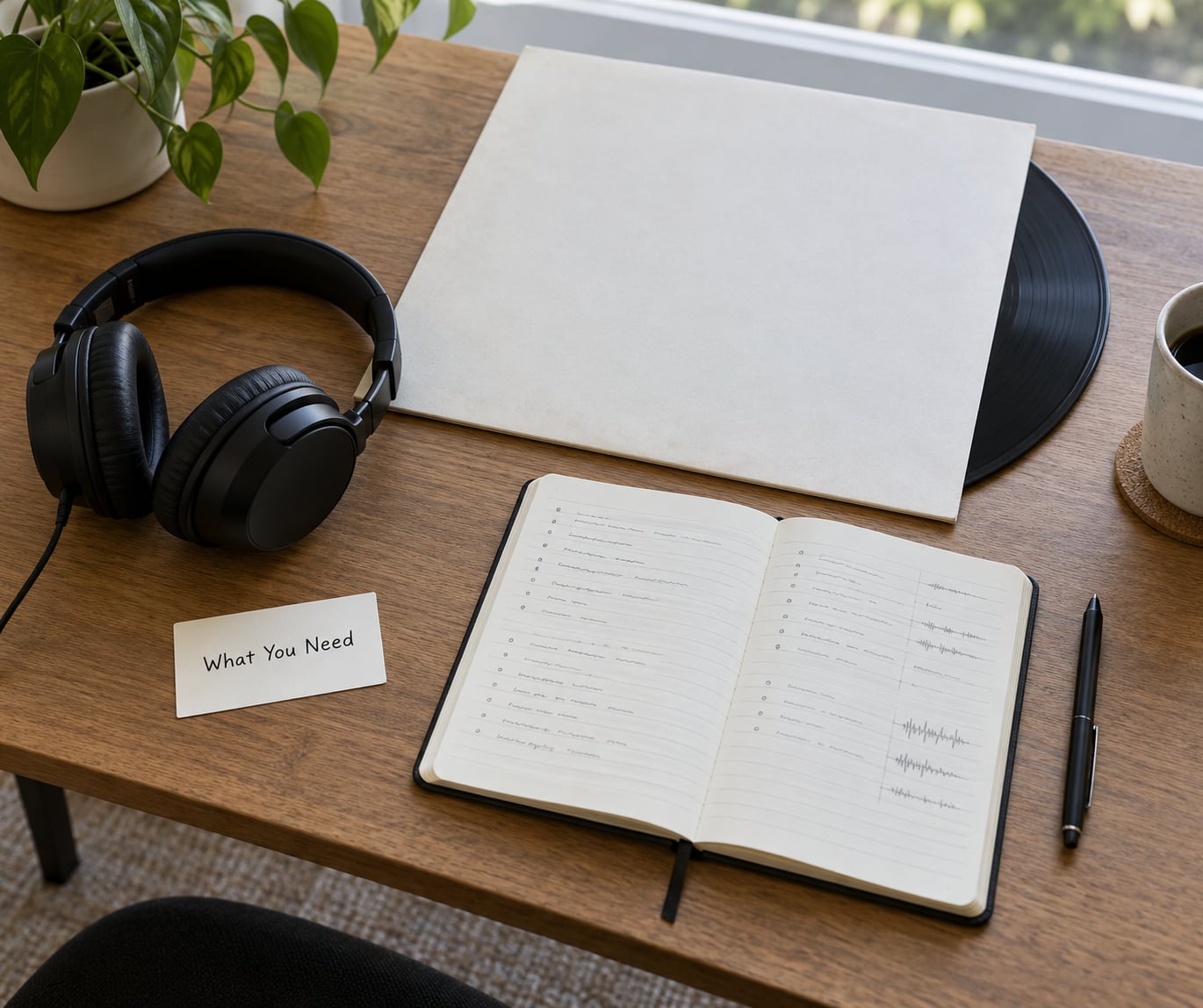
Most of the “equipment” is free or already in your house. What matters is that nothing interrupts the listening and that your notes survive the week before you write.
- The album, uninterrupted. Two or three full plays without a phone, notifications, or a second tab. Streaming, downloaded, or vinyl all work; the format is not part of the review unless the format itself is the story.
- Verified release details. Artist name, album title, release date, label, track list, running time, and official credits for producer, writers, and featured performers. Liner notes or the credits page on a streaming service usually beats a fan wiki page.
- A note-taking method that survives days. A phone voice memo works if you speak in full sentences. A notebook works if you can find it again. A shared doc works best, because you can drop a timestamp and a thought in ten seconds.
- Something to write with. Draft in a document, not in your head and not in the search bar.
- Optional research. Interviews, the artist’s own posts, a producer’s credits, and a prior album to compare against. This is context, not evidence, and you should read it after your first pass, not before.
If you are reviewing a record you have not heard yet, add one more item: a way to return to a specific moment later. Type the timestamp the first time it matters, because you will not remember the number.
Step-by-Step: How to Write an Album Review
Seven steps, in order. The first three decide what you are going to say. The last three decide how clearly you say it.
1. Listen Before You Research
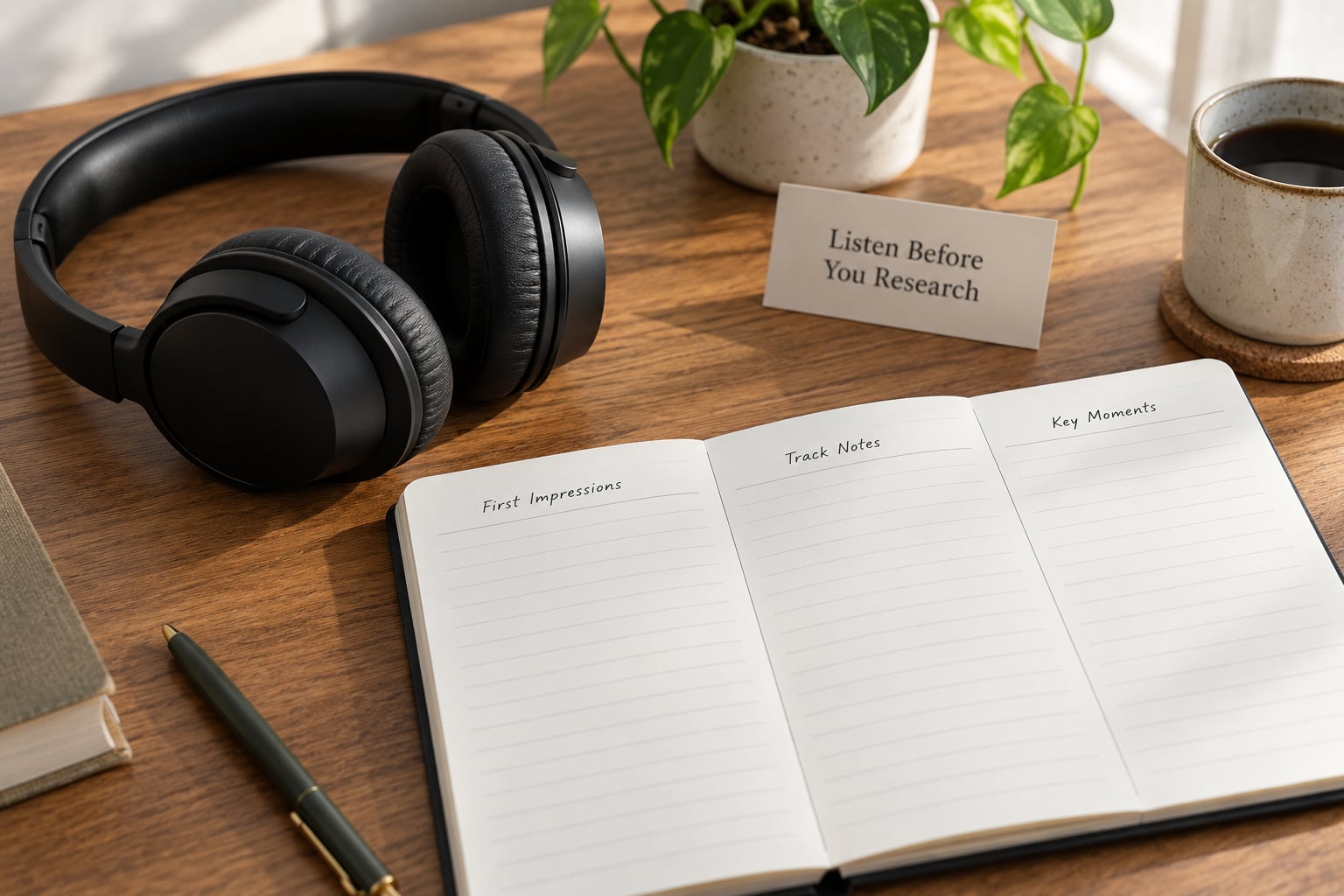
Your first pass is for feeling. Do not pause, do not skip, and do not look anything up. Write down the plainest response you have: where you drifted, which track made you look up, which one you would cut. That unfiltered note is worth more three days later than a polished paragraph, and it is the version nobody else can write for you.
The second pass is for notes. Track by track, capture the melody, the rhyme pattern, the instrument that carries the hook, the transition that surprised you, and any lyric line you want to quote later. The third pass is for craft: how the vocals sit against the mix, how loudness shifts between tracks, whether the sequencing builds or repeats.
This is the framework that shows up in almost every piece of advice worth following, and it exists for a reason. Once you have read a press release or three other reviews, your notes change. The most repeated community advice is to write down what the record did to you before you find out what it was supposed to do, then compare notes afterward. Some writers build an entire review on the gap between those two things.
2. Gather Reliable Album Details
Facts are the part readers trust most and check first, so get them right. Confirm the artist name as it is styled, the album title, the release date, the label, the running time, and the track order. Pull the producer and songwriting credits from the official credits listing rather than from a press release, which is written to flatter rather than to inform.
Separate what you confirmed from what you were told. A label bio saying an album was “recorded in a single take” is a claim until the artist or producer says it on the record. You can write “the label says”, or you can leave it out. What you must not do is present promotional framing as analysis, which is the fastest way to make a review read like an advert and lose the reader.
Background research is useful in a narrow way: it tells you what the artist was trying to do, so you can judge whether they got there. Two hours of reading a decade of interviews to explain a 2026 release is a waste of the reading time you needed for listening.
3. Write a One-Sentence Critical Thesis
Before drafting, write the sentence you want a reader to remember if they forget everything else. Not “a great album” and not “worth a listen”. Something closer to “the production is immaculate and the writing can’t keep up with it” or “a debut that treats restraint as a personality”.
That sentence is your filter. Every paragraph either supports it, complicates it, or gets cut. If you cannot write the sentence, you have not listened enough yet, and the honest answer is another play rather than a draft.
Keep the sentence in a visible place while you write. The beginner’s complaint that the record stopped being interesting after two or three plays is usually a sign that the writer had no thesis to test the third listen against.
4. Listen for Songs, Sequences, and Details
An album is a running order, not a folder of singles. Listen for how tracks sit next to each other. Does the opener earn the second track? Is the best song buried at position nine? Does the sequencing repeat a shape it has already used? Producers and A&R people think in order, and listeners feel the order even when they cannot name it.
You do not need technical vocabulary to do this well. Plain language covers most of it: how loud the drums are, whether the bass and bass guitar crowd each other, whether a vocal sits in front of the rest, whether the drums disappear when the guitars come in, whether the recording feels close or distant. If a term is the clearest word available, use it and define it in passing.
Then check the songs themselves. Song structure terms are worth knowing because they are shared language: an intro, a verse, a chorus, a bridge, an outro. Most listeners already use chorus without calling it a chorus. Naming the section you’re talking about makes your point checkable.
5. Support Every Claim With Evidence
The sentence “the vocals sound great” is worthless. The sentence “the lead vocal sits about an inch behind the kick drum, so the hooks feel sung rather than performed” gives a reader something to hear for themselves.
Replace adjectives with what produced the feeling. Instead of saying a record is atmospheric, say the guitars are drenched in reverb and the drums are barely there. Instead of saying the lyrics are honest, quote one line and explain what it admits. Name the track, use a timestamp when the moment matters, and be specific about the instrument, the phrase, the transition, or the mix decision you’re responding to.
Comparisons help when they are about sound and unhelpful when they are about importance. “This recalls the way the artist handled a similar mood on their previous record” tells a listener what to expect. “This is better than anything in the genre” is an opinion with nothing underneath it.
6. Build a Clear Review Structure
Most working reviewers use a shape that flexes by album but rarely changes in order. Fill this in as a skeleton and adapt it to your outlet’s length:
- Opening verdict and thesis. Two or three sentences. Say what the record is and what your judgment of it is.
- Essential context. Only what a listener needs: the artist’s position in their career, the genre, the circumstances of the release.
- The strongest evidence for your thesis. Two or three paragraphs on sound, lyrics, and sequencing, with named tracks.
- The strongest evidence against it. The same standard of detail. If there is nothing against it, you may not have listened closely enough, or you may be writing a fan note rather than a review.
- Who it’s for. A sentence on the listener most likely to enjoy it, and one on who won’t.
- Rating, if you use one. It must match the paragraphs above it.
- Conclusion. Two sentences restating the thesis, not a summary of every paragraph.
A full album rarely gets a track-by-track treatment in a piece this length. If the format you are writing for is a track-by-song review, use the same skeleton once, then give each song two or three sentences using the same questions: what the song does well, what it does not, and what it contributes to the running order.
7. Revise for Fairness, Clarity, and Voice
Read the draft aloud. Sentences you stumble over are usually sentences carrying a clause they do not need, and readers stumble at the same place. Cut hype words, since they take up space and prove nothing. Cut insults aimed at the artist, which make the criticism weaker rather than sharper, and the standard the community keeps repeating is the empathy test: write the review you would be content to read if the roles were reversed.
Then verify every credit, date, and track title against your source list, and check that your conclusion says the same thing as your opening. If the intro calls the record generous and the verdict calls it guarded, one of them is wrong and it is usually the intro.
Do the empathy test once more from the artist’s side. Is there anything in here they could not act on? Criticism that names a specific weakness is usable. Criticism that says the album is mid is not, because there is no fix attached to it.
Common Mistakes to Avoid
- Writing track-by-track recaps. Fix: cover two or three tracks in depth and treat the rest as a running order. Recaps describe a record’s contents instead of judging it.
- Praise with nothing underneath. Fix: every compliment gets a named track, a line, or a production detail behind it.
- Being cruel to be interesting. Fix: hold the work to the standard, never the person. Name the limitation, not the maker’s intelligence.
- Holding the album to promises it never made. Fix: check what the artist said about the intent, then judge whether the record reaches it. Expecting a folk record to be a dance record is not criticism.
- Treating facts as opinion. Fix: release dates, credits, and genre labels are context. Put them in a sentence, then spend your words on what the record does.
- Spoilers without warning. Fix: flag a lyric reveal before you quote it, or describe it as “the third track turns on a line about leaving” and let the reader find it.
- Confusing dislike with failure. Fix: separate the two questions. You can find an album weak and still write that its second half works, and both sentences belong in the review.
- Letting a score outrun the copy. Fix: write the paragraphs first, read them again, and let them choose the number.
Tips for a Strong Album Review
- Do a final full listen with only your notes open, before you read your draft again. Fresh ears catch things the drafting stage made invisible.
- Quote sparingly. Two short fragments are usually enough, and a full verse is a copyright problem and a pacing problem.
- Use timestamps when the reader can scrub, such as in a video essay or a long-form blog post. Skip them in a print column.
- Write “I” when you are describing your own reaction, and keep it out of the sentences where you are describing the record. The line between the two is where arguments quietly turn into taste reports.
- Make the first paragraph and the last paragraph say the same thing. Readers who scroll straight to the verdict should land on your actual judgment, not a warm-up.
- Keep your score consistent across platforms, and change old ratings if your taste moves. Most people revise; very few say so.
Frequently Asked Questions
How long should an album review be?
Most reviews land between 400 and 800 words, and that range suits a blog post or a community listing. A class essay or a long-form feature usually runs 1,200 to 2,000 words. Print columns and video scripts are shorter, around 300 to 500 words, because the format limits the space. Length should follow the material: a record with one strong idea does not need 2,000 words, and a complex one cannot be judged in 300.
How do you write a negative album review fairly?
Judge the record against the intention the artist states, then describe the gap with specifics. Name the tracks where the writing stalls and the production choice that undercuts the mood. Hold every song to the same standard, including the ones you like, so praise reads as credible. Community reviewers on Album of the Year suggest finding what genuinely works and saying so plainly, which makes the criticism harder to dismiss.
Should an album review include a rating or score?
Include one only if your platform expects it. A ten-point score is the norm on user-rating sites such as Rate Your Music and Album of the Year, while five stars work for quick community posts and letter grades suit print columns. Whatever scale you pick, write the body first and choose the number afterward. A score your paragraphs do not support is the fastest way to lose a reader’s trust.
Is a track-by-track review a good way to review an album?
It suits listeners building a guide to a catalogue, and it works for a long record with distinct, self-contained songs. It fails for records built around a single mood or a concept, where the interesting material is in how tracks sit next to each other. If you do write one, ask the same questions of every song: what it does well, what it does not, and what it adds to the running order.
How do I review an album when you are friends with the artist?
Say the relationship plainly at the top, then write to the same standard you would use for anyone else. Disclose it, set aside your notes for a few days, and ask someone who does not know the artist to read the draft cold, because they will catch the softening you cannot. An honest 6 out of 10 costs a friendship less than a kind review that leaves the artist guessing.
What details should I include when reviewing an album?
Cover the release details first: artist, title, release date, label, track count, and running time. Then give the sound, the lyrics and themes, the sequencing, the standout tracks with timestamps where useful, the production choices you can actually hear, and how it sits against the artist’s earlier work. Close with who the record suits, a verdict, and a score if your format calls for one.
Conclusion: Start With Your Listening Thesis
Write the review from one specific sentence about the record, then make every paragraph earn its place in support of it. The listening notes come first, the press release comes after, and the verdict comes last.
Put the headphones on, take the first pass with nothing but a pen, and write down what happened before you can shape it into prose. Everything after that is craft, and craft is learnable. A review earns its reader when it hands someone who has never heard the album a way into it, and when it hands the artist a criticism specific enough to act on.