An album credit is one person or company listed for a specific contribution, and the whole system runs on a fixed hierarchy: songwriting and composition first, then performance, then production and engineering, then ownership and label, visual and artwork, legal and business, and special thanks last. Every release format presents that same stack in its own way.
The messy part is not knowing who did what. It is that credits live at two levels at once, travel through metadata systems that flatten detail, and were usually negotiated months before anyone typed them into a form. Understanding the structure is what separates a credit page that pays everyone correctly from one that merely looks impressive.
Table of Contents
- What Is an Album Credit?
- How Album Credits Are Organized on a Release
- Common Album Credit Categories and Roles
- How Album Credits Differ by Release Format
- What Determines Credit Order and Wording?
- How Album Credits Connect to Royalties and Metadata
- How to Read and Verify Album Credits
- Frequently Asked Questions
- How do you properly credit a song?
- Who decides the order of album credits?
- Who gets producer credit when several people produce a track?
- Should songwriter credits use a legal name or a stage name?
- How do you fix wrong credits on a released track?
- Do streaming platforms show every credit from the liner notes?
- Conclusion
What Is an Album Credit?
An album credit is a named contribution attached to a release, a track, or the record as a whole, written as a role plus a name. A credit line such as “Lead vocals — Maya Ortiz” is the format a booklet uses, “Produced by Dev Ramires” is a production line, and “Mastered at Hilltop Mastering” or “Art direction — Cole Fisheries” cover the studio and visual blocks. Those names are illustrative, but the structure they show is standard practice.
Credits exist for three separate reasons, and conflating them causes most of the confusion in album-credit arguments. The first is recognition: listeners use credits to find session players, engineers and producers the way they used to dig through a booklet. The second is administration: labels, distributors, publishers and performing rights organizations need to know exactly who performed what on which track in order to route money. The third is evidence: when a royalty dispute or a sampling claim appears years later, the credit list is often the first document anybody looks at.
Those three functions sit in different places. The printed credit page in the liner notes is a human-readable summary. The split sheet, the copyright registration and the publishing administration agreement are the documents that actually move money. The metadata record delivered to streaming services is a third artifact again, and it is built from role fields rather than from prose.
A visible credit tells you who deserves thanks. The paperwork behind it tells you who gets paid. They are not the same thing, and they fail differently.
So when someone asks how album credits are organized, the honest answer has two halves: there is a conventional order that almost every release follows, and behind that order sits a parallel stack of rights registrations that most listeners never see.
How Album Credits Are Organized on a Release
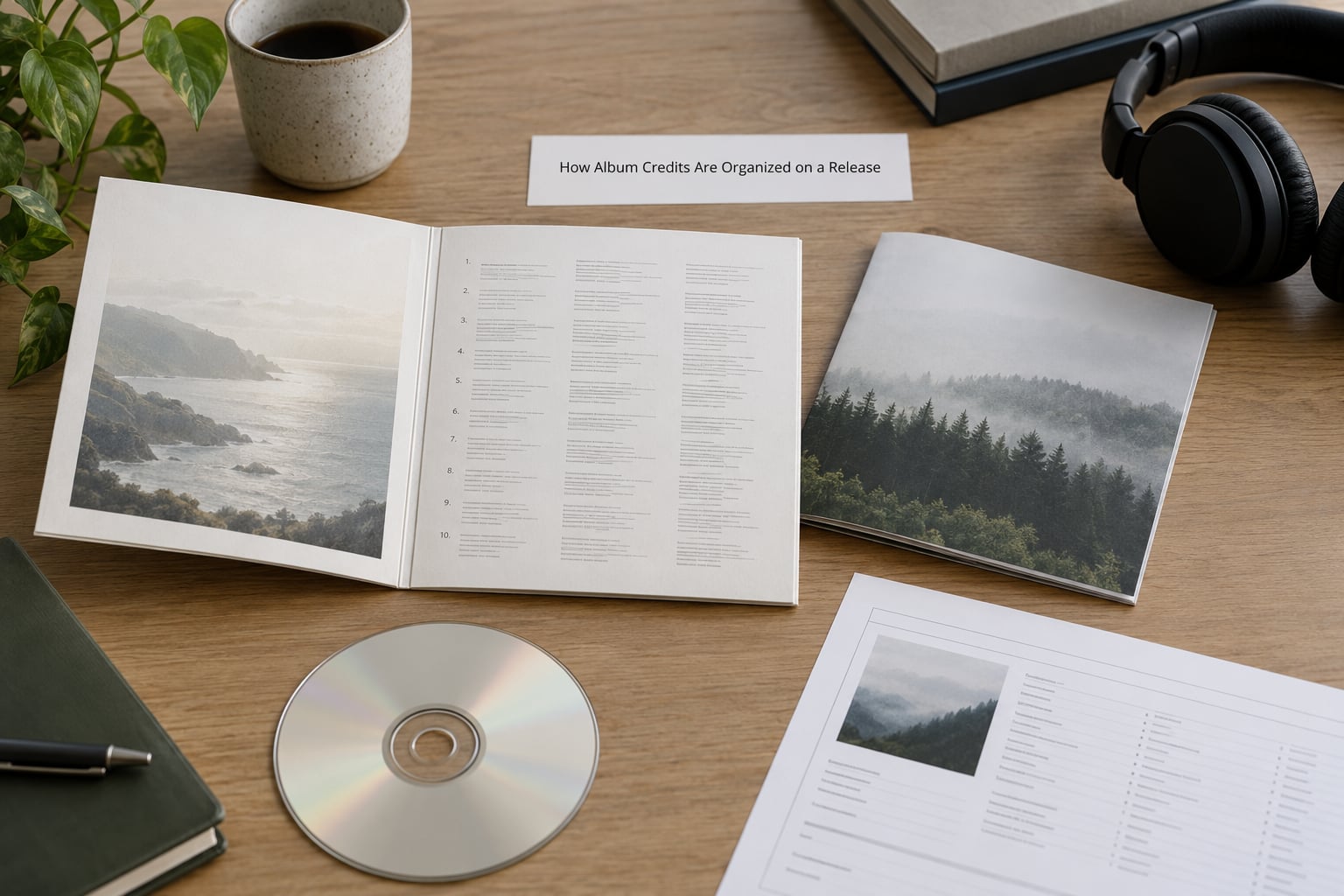
Read an album’s credits from the outside in, and the order is remarkably consistent. Front cover carries the artist name and usually the title. Back cover lists the label, the copyright line, the format and the barcode. The inside sleeve or booklet holds the real personnel list, track by track.
The first block is the primary artist, then any featured or co-billed artists on the specific tracks where they appear, then the songwriters and composers for each song. Performance credits follow, naming the lead vocalist, backing vocalists and every named instrumentalist, usually in the order they appear in the arrangement rather than alphabetically.
Production and engineering sit next: producer, co-producer, executive producer, then recording engineer, mixing engineer and mastering engineer. Some releases add a vocal producer or an additional engineer for a single song. Below that comes the ownership block, with the label, distributor and any rights language.
The last blocks are where a lot of the craft shows. Artwork credits cover cover design, photography, art direction, layout and illustration. Business credits cover management, legal, publishing administration and the label staff who funded the record. Special thanks and dedications close the page.
Albums that share track-level notes with album-level ones save space. Instead of repeating the same engineer on every song, a well-organized booklet prints a personnel list once and then flags who changed from track to track. That format is much easier to read and much easier to import into a database later.
How album credits are organized on an individual track
Track-level credit is the smallest unit and the one that matters most for payment. A producer who worked on three songs out of twelve gets credited on those three, not on the album. This is the single most common place where an intuitive assumption turns out to be wrong, and it is why an artist who paid for the whole record does not automatically appear on every track’s producer line.
Common Album Credit Categories and Roles

Every album credit page resolves into seven categories, usually in this sequence. It is a convention rather than a law, but it is followed closely enough that you can use it as a template.
- Songwriting and composition. Songwriters, composers and lyricists, often followed by the publishing company and its administrator.
- Performance. Lead performer, featured artists, backing vocalists, instrumentalists, and in classical credits a conductor, concertmaster or principal player.
- Production and engineering. Executive producer, producer, co-producer, vocal producer, recording engineer, assistant engineer, mixing engineer, mastering engineer, editor and programmer.
- Ownership and label. The master rights holder, the record label, the distributor and the copyright and phonographic copyright lines.
- Visual and artwork. Art direction, cover design, photography, illustration, layout design, stylist and motion graphics.
- Legal and business. Manager, business affairs, attorney, publishing administrator, royalty accountant.
- Special thanks and dedications. Thank-yous, dedications and informal acknowledgements.
| Category | Typical roles | What the credit covers |
|---|---|---|
| Songwriting and composition | Songwriter, composer, lyricist, arranger | The underlying song, not the recording of it |
| Performance | Lead performer, featured artist, backing vocalist, instrumentalist | The sound captured on that specific track |
| Production and engineering | Producer, executive producer, recording, mixing and mastering engineers | Creative and technical shaping of the recording |
| Ownership and label | Master rights holder, label, distributor | Who owns and releases the recording |
| Visual and artwork | Art direction, cover design, photography, layout | Everything printed or displayed for the release |
| Legal and business | Manager, attorney, business affairs, publisher | Deals and paperwork behind the release |
| Special thanks | Dedications, informal acknowledgements | Goodwill only, with no contractual weight |
How the production roles divide
Producer is the title that causes the most friction. The executive producer is usually the person who funded or greenlit the project and answered for it commercially. The producer shapes the song, chooses the takes and makes the record. A co-producer contributed to that on a specific track rather than across the album. In hip-hop and electronic production the split is frequently blurred, and the title is often negotiated by direct agreement rather than by any rule.
Engineering credits are more factual. A recording engineer captured the sessions, a mixing engineer balanced the final balance, and a mastering engineer prepared the release for distribution. Vocal production is a separate credit where someone shaped vocal performances rather than the whole track. Programmer and additional production appear on records made largely in a digital audio workstation.
How publishing credits are worded
Songwriting credits are usually followed by a publishing line in parentheses, for example a publisher name or an administrator’s name. That line tells you who administers the composition, not who wrote it. Performing rights organizations match on songwriter names and identifiers, which is why legal names appear in publishing documentation even when the artist record shows a stage name.
How Album Credits Differ by Release Format
The same credit list arrives in a different shape depending on where the listener meets it. Physical formats have room and tradition; streaming platforms have role fields and character limits; databases alphabetize.
| Format | How credits appear | What tends to be lost |
|---|---|---|
| Vinyl | Full credit page in the gatefold or on the inner sleeve, plus run-out etching and spine text | Little, though small type and low-contrast printing hurt legibility |
| CD | Multi-page booklet with front cover, back cover, spine and inside-sleeve credits | Space for full legal and business credits |
| Digital download | Credits in a credits field, plus any PDF booklet included | Artwork credits if no booklet was supplied |
| Streaming | A roles-based credit screen on the track or album page | Long descriptions, informal thanks, some artwork and business credits |
| Credit databases | Structured release, recording and work entries with relationships | Original order; most databases sort alphabetically |
| Official artist or label pages | Hand-written credits, sometimes richest of all | Consistency; the format changes site to site |
Streaming deserves a closer look because it is where most people now check. Platforms separate contributors into roles such as primary artist, featured artist, contributor, remixer, songwriter, producer and engineer, and each role renders in a fixed place on the page. The order you chose in your liner notes is not preserved; the platform re-sorts by role. Two services will therefore show the same album with different arrangements, and neither is wrong.
Digital databases take a different approach. Discogs presents credits in a client-facing format but largely alphabetizes them. MusicBrainz models them as typed relationships attached to a release, a recording or a work, and its style guide pushes contributors toward the most specific relationship type available. Both are more useful for research than for reproducing the sequence an artist intended.
What Determines Credit Order and Wording?
Credit order is a negotiation, not a calculation. The parties who arrive at the credit page with the most leverage are the ones who define the sequence.
Top billing usually follows commercial reality. An artist with a publishing share on every track tends to appear first; a featured guest with one appearance usually appears on the song they are on rather than on the album cover. Where two artists are genuinely co-heads, the arrangement is a negotiated agreement that may vary by territory and by format, and it can even differ between the physical sleeve and the digital delivery.
Co-writers are normally listed in an agreed sequence too. Order does not change the percentage split, which is documented separately, but it does affect how the credit is perceived and how some organizations aggregate awards and reporting. In practice, lead-writer-first is the default and the exception requires an explicit agreement.
Role wording is more standardized than people expect. Most releases settle on a small vocabulary, and words like “produced by” or “recorded by” mean the same thing across labels. The variation comes from genre. Classical releases credit an orchestrator, a conductor and a principal performer; hip-hop records routinely split production across beatmakers and engineers; jazz records often credit the band leader first and the sidemen as a section.
Informal contributors are the awkward case. Someone who gave notes in a group chat or sat in on a session has usually not contracted for a credit. The common practice is to place them under additional thanks rather than in a professional role, unless the contribution was substantial and agreed in advance.
How Album Credits Connect to Royalties and Metadata
Displayed credits and paid royalties are connected through documents, not through the liner notes themselves. A printed credit tells you a role exists. The split sheet, the copyright registration, the publisher’s catalogue entry and the performing rights organization record tell you who owns what and in what proportion.
| Aspect | Master rights | Composition rights |
|---|---|---|
| What is owned | The recording itself | The underlying song |
| Who typically holds it | Artist, label or producer | Songwriters and their publisher |
| Registered as | Phonographic copyright, commonly a sound recording | Copyright on the musical work |
| Identifier used | ISRC for the recording | ISWC for the work, plus writer identifiers |
| Paid through | Master use and distribution income | Performance, mechanical and sync income |
The identifiers matter more than most listeners expect. An ISRC stays with a specific recording across every service; an ISWC identifies the underlying composition no matter who records it. Once a track is delivered, those codes and the attached role fields are how a streaming platform, a royalty collector and a database all agree that the song played is the song they think it is.
That is the job of the RIN, the Recording Information Notification, a standard that packages credits with delivery metadata, and of DDEX, the standards body behind it. Producers supply structured credit information, distributors map it into their own fields, and delivery partners pass it on. Where a role field has no match on the receiving side, the credit can be dropped or flattened, which is one reason a producer will sometimes insist on a separate delivery rather than trusting an automatic import.
General point worth keeping in mind: royalty rules differ by country and change over time, and nobody should treat a credit list as financial or legal advice. Artists who want the specifics covered should talk to a manager, an attorney or their publisher.
How to Read and Verify Album Credits
Checking credits is a routine, not an investigation. Start with the album’s own booklet or credited digital booklet, then compare it against what the platform and the databases actually show.
Confirm the name spellings first, especially for co-writers and featured artists, because a misspelled name breaks the match to a rights database more often than anything else does. Check the role wording next, so “co-producer” on the sleeve has not quietly become “producer” on the streaming page.
Then work track by track. Look for tracks where the personnel differ from the album-wide list and confirm those changes were captured. Finally, check identifiers: a missing or duplicated ISRC on a release usually signals that the metadata needs correcting before anything else will behave properly.
| Where credits live | Album-level fields | Track-level fields |
|---|---|---|
| Printed liner notes | Label, artwork, business credits, dedications | Songwriters, performers, producer, engineers |
| Digital delivery | Release-level contributors and rights | Recording- and work-level roles |
| Streaming platform | Album artist, label, release date | Role-based contributor list per track |
| Credit database | Release entry, label, formats | Recording and work entries with relationships |
If something is wrong after release, the correction path runs through whoever delivered the music. Artists using a distributor generally change names and roles in their dashboard, and those changes re-propagate to the services that use that distributor’s feeds, though updates take time to appear everywhere. Details that were never delivered, such as a missing artwork credit or a thank-you list, have to go to the platform directly. Requests routed through label management or a publisher are usually faster for catalog releases.
For independent releases, a short checklist covers most problems before the music ships. Confirm every contributor’s legal name, publishing identifier and email before the delivery deadline, because after that point changes cost time. Write the split sheet for every track, including zero-play and removed tracks. Get agreements in writing from producers, engineers and featured artists before recording, not after. Keep a per-track personnel sheet that lists who played what, since reconstructing a session from memory three weeks later rarely works. Finally, supply the artwork and business credits as metadata rather than only inside a PDF booklet, or they will be lost on streaming.
Frequently Asked Questions
How do you properly credit a song?
List every contributor by role in a consistent order: songwriters, then performers, then producer and engineers, then ownership, then artwork and business. Credit people only on the tracks they actually worked on, not across the whole album. Confirm each contributor’s legal name and publishing identifier, get agreements in writing beforehand, and deliver the credits as structured metadata rather than only as artwork.
Who decides the order of album credits?
The artist or label sets the sequence, usually with input from whoever manages the release, and producers and co-writers can negotiate their own position before anything is printed. Order is a convention rather than a fixed standard, so it is agreed rather than inherited. Once agreed, the sequence appears in the liner notes, while streaming platforms re-sort credits by role regardless of the original order.
Who gets producer credit when several people produce a track?
Producer credit is allocated by agreement between the people involved, not by any industry rule. One person usually holds the main producer credit, with co-producer added for significant contributors on that track, and an executive producer credited for funding the overall project. Because the credit is negotiable, agree it before delivery. Producers who also wrote the song hold both a songwriter credit and a production credit, which are separate lines.
Should songwriter credits use a legal name or a stage name?
Use the legal name for publishing and royalty registration, because performing rights organizations match writers on legal names and identifiers such as the IPI number. The stage name is what listeners see on the streaming credit screen and can be displayed alongside it. When a writer performs under a different name entirely, register the legal name and map the performing name to the same work so the two records connect.
How do you fix wrong credits on a released track?
Correct the record in the distributor dashboard where the release was delivered, since that feed usually updates the services using it, though changes take time to appear across every platform. Details that were never submitted, such as artwork credits or informal thank-yous, need to go to the platform or label directly. Catalog releases usually move faster through label management or a publisher. Fix identifiers first, since a wrong or duplicated ISRC blocks everything else.
Do streaming platforms show every credit from the liner notes?
Rarely. Platforms display credits through a fixed set of role fields, which covers artists, songwriters, producers and engineers well but leaves no place for long thank-you lists, dedications, business contacts or most artwork credits. They also re-sort everything by role, so the sequence from the booklet is not preserved. For full personnel detail, the album’s own booklet and structured credit databases are still the better sources.
Conclusion
Album credits follow a stable hierarchy: songwriting, performance, production and engineering, ownership and label, artwork, business, then thanks. That order is a convention you can rely on, while the specific names, roles and sequences inside each block are negotiated track by track.
Start by putting the printed booklet and the streaming credit page side by side for one album you love. You will usually find a discrepancy within a minute, and knowing which one to trust for which purpose is the whole skill.