Ask how turntablism became an art form and the honest answer has four parts: a machine that could be played instead of only listened to, a record that yielded a usable piece of raw material, a vocabulary of techniques that treated the platter as a voice, and a competition structure that turned private practice into public craft.
No single person declared it art, and no single evening made it art. The change took about a decade of parties and arguments, and it kept developing long after the first battles were over. What follows is the route those four conditions took, and who pushed each one.
Table of Contents
- How Turntablism Became an Art Form
- What Is Turntablism?
- Who Helped Establish Turntablism as an Art?
- How DJs Turned the Turntable into an Instrument
- Why DJ Battles Changed Turntablism
- How Records and Radio Spread Turntablism’s Ideas
- How Turntablism Influenced Music and Global Culture
- Why Turntablism Is Recognized Today
- Frequently Asked Questions
- Conclusion: Why Turntablism Still Matters
How Turntablism Became an Art Form
Look at how turntablism became an art form as a chain of four links, not a sequence of famous names.
- A device that could be played. Before the 1970s, a turntable reproduced sound. Once a direct-drive deck with a usable pitch control and a slipmat reached American DJs, a hand could push the record around while the needle stayed in the groove. That is the whole trick in one sentence: the disc stopped being a medium and became an actuator.
- Raw material with a beginning and an end. A drum break is a short passage that is built to stand alone. Isolated from a long record and repeated on demand, it becomes something a performer can arrange.
- A technique vocabulary. Cutting, backspinning, phasing, needle dropping, beat juggling, scratching. Naming a move is the moment a practice stops being a party trick and becomes a skill you can teach, practise badly and pass on.
- An institution. Battles, and specifically the Disco Mix Club, gave the skill a canon, a standard of difficulty and a way for someone with no band to be recognised on the strength of what they could do in six minutes.
One honest footnote. The idea of treating a record as an instrument is much older than hip-hop. In the 1930s composers in Berlin worked with gramophone records as scored instruments, and later Cage, the musique concrete studio in Paris and Fluxus artists all treated the player as a component to be misbehaving. That lineage is real, and it is a legitimate answer to anyone who says nobody thought of it before the Bronx. What the Bronx did was take the same idea out of a composer or art-school context and give it to a teenager with two decks, a block party and a hundred people watching.
What Is Turntablism?
Turntablism is the practice of treating the turntable as a musical instrument rather than a playback device, using scratching, cutting, beat juggling and mixing to compose and perform original music in real time.
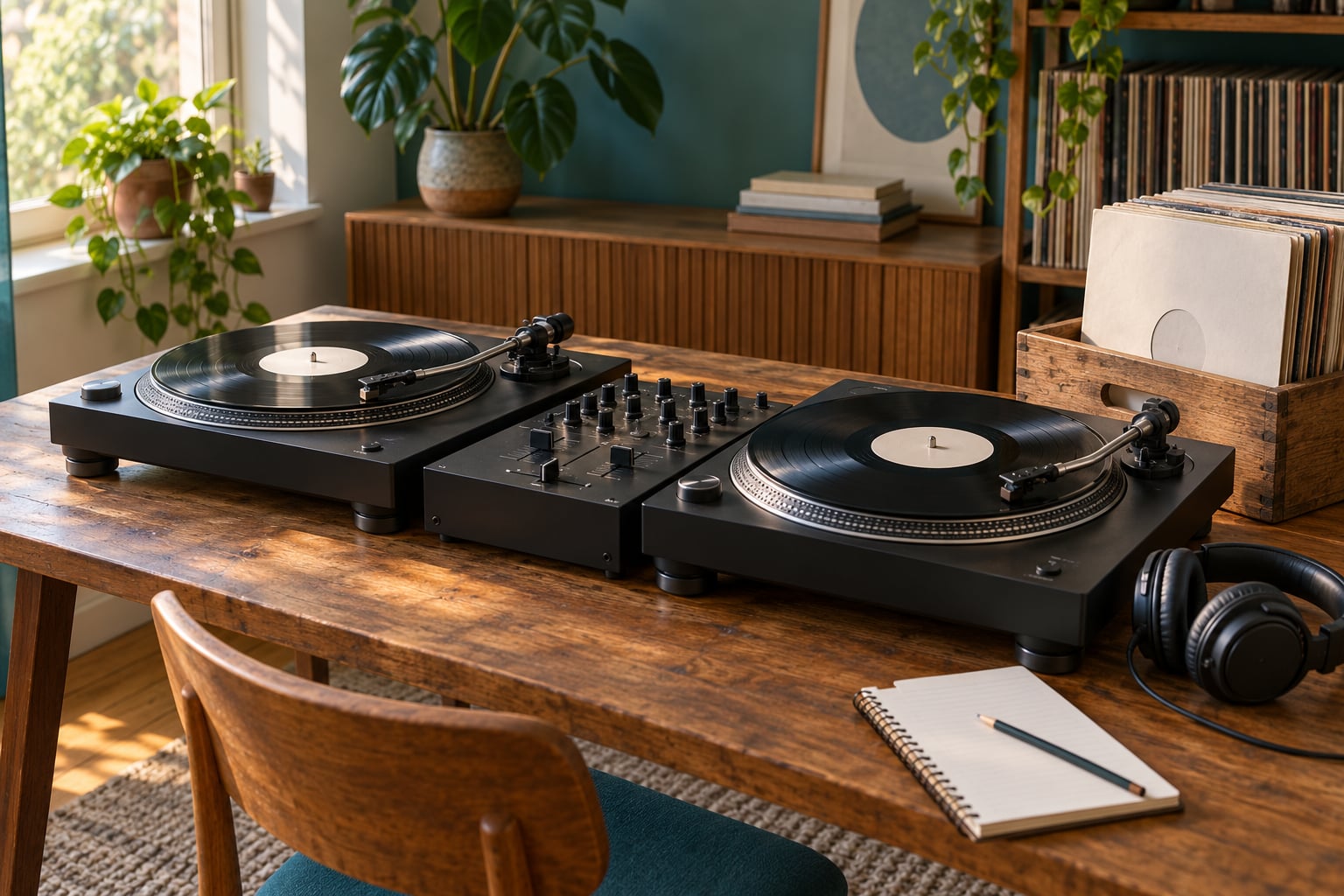
The physics are worth understanding once, because everything else follows from it. A turntablist holds the record in one hand and the crossfader in the other, pushes the disc forward a few millimetres under the stylus, and the needle re-reads a fraction of a second of audio. Move it back and the same fraction plays in reverse. Ride the fader while you do it and each re-read becomes a separate, pitched note. That note is a scratch, and it is the smallest unit of expression in the practice.
Stretch that to a break lasting several seconds and you can arrange it, chop it, layer two copies against each other, or drop a second record on the beat underneath it. What comes out is not longer music, it is new music that has never been recorded anywhere, produced by a person in front of you in about six minutes.
That last part is the dividing line from club DJing. A club DJ’s job is continuous coverage: match the tempo, keep the room moving, blend record into record so nobody notices the join. A turntablist builds a self-contained piece and finishes it.
How Turntablism Became an Art Form in the 1970s
Extended disco mixes in the early 1970s had already changed what a crowd expected from a party, because clubs had begun handing the microphone over to the DJ. A record could be twenty minutes long. What moved turntablism forward was somebody cutting to the part that mattered, playing it again, and playing it again until the dancers decided it was a hook.
The party that everybody points to is the one Kool DJ Herc played on 11 August 1973 at 1520 Sedgwick Avenue in the Bronx. Chosen because the record’s drum and bass passages were strong on their own, the two records went back to back, extended, and the crowd recognised something happening before anyone could name it.
That is the moment the material separated from the object. Before Herc, the record was the song. After Herc, the record was a supply of usable sound with a song somewhere inside it. A teenager with a crate of vinyl had, for the first time, a raw material.
What is turntablism becomes clear once you see that shift. The record stopped being the performance and started being the instrument, and hip-hop, which is built on the reuse and rearrangement of recorded sound, got a performance practice built on exactly the same idea.
Who Helped Establish Turntablism as an Art?
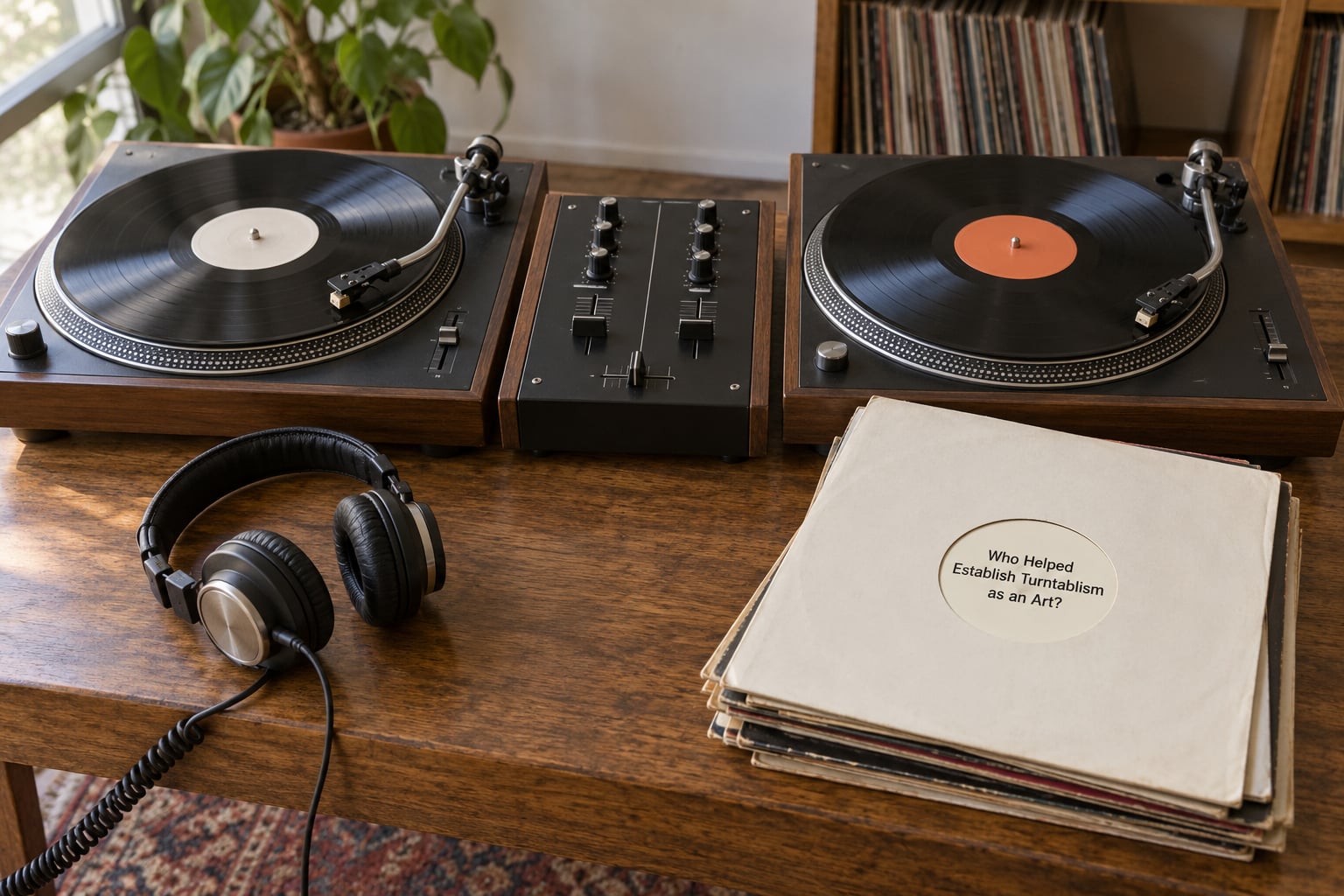
The honest answer is that turntablism was established by a scene, and any list of names is a list of someone’s contribution to it rather than a founding document.
Kool DJ Herc gave it the break and the idea of a DJ as the party’s musical lead. He also supplied the two things a scene needs to spread: an equipment setup others could copy, and records worth hunting for.
Grand Wizzard Theodore is usually credited with the accidental scratch, discovered while moving a record by hand to find the next part of a track. Grandmaster Flash, who was in the same circle, made it into technique, and his crew’s Adventures on the Wheels of Steel in 1981 was the first commercially released piece built entirely from a DJ’s performance. It is a single continuous mix with no songs in it, which was genuinely strange in 1981 and is now simply how a lot of music is made.
Afrika Bambaataa connected the DJ to a producer and a rapper, and the record that came out of that, “Planet Rock” in 1982, put a drum machine next to the breakbeat. Disco King Mario brought the extended-mix habit to the clubs downtown. Steve Dee, working with the X-Men in the Bronx, is credited with taking juggling into the set itself.
Where the credit lies gets argued, and that argument is part of the record now. Herc supplied the idea, Theodore supplied the accident, Flash supplied the control, Bambaataa supplied the studio context. Take any one of them out and the next decade looks different.
How DJs Turned the Turntable into an Instrument
Making a turntable an instrument meant finding ways to make the record do something a record is not supposed to do. These are the moves that became the vocabulary.
| Technique | What it does | Credited to |
|---|---|---|
| Extended break | Plays a drum passage far longer than its original length by looping it | Kool DJ Herc, 1973 |
| Cutting | Stops and restarts the record with the hand so a phrase repeats in a new pattern | Grand Wizzard Theodore and Grandmaster Flash, early 1980s |
| Phasing | Holds two identical records against each other so the same beat drifts in and out of alignment | Grandmaster Flash, early 1980s |
| Needle drop | Places the stylus precisely on a chosen word or hit and lets the record run forward | Turntablists, early 1980s |
| Beat juggling | Arranges short pieces of several records as a repeating pattern, swapping segments in and out | Steve Dee and the X-Men, then Rob Swift and Babu in the 1990s |
| Scratch | Short pitched notes made by moving the record under the needle while riding the fader | Outgrowth of cutting, early 1980s |
| Transitions, flares, transforms | Judged elaborations on the scratch that arrived with competition circuits | 1980s and 1990s battle scene |
The decisive detail in that table is not any single move. It is the credit column, because naming a technique is what turns a trick into a skill. A cut you can teach, practise and grade is a different kind of object from a cut you happen to be able to do.
Equipment followed the vocabulary. Technics released the SL-1200 in 1972, and its direct drive, high torque and later pitch fader made hand manipulation reliable instead of a gamble. The slipmat mattered just as much: it gave a hand something to grip. Mixers followed, with crossfader curves tuned specifically for scratching rather than for blending.
Here is the milestone sequence in one view, which is the part most guides skip.
| Year | Event | Why it mattered |
|---|---|---|
| 1972 | Technics SL-1200 released | Direct drive and torque make hand control predictable |
| 1973 | Kool DJ Herc’s Sedgwick Avenue party | The break is isolated and extended for a dancing crowd |
| Late 1970s | Cutting, phasing, needle drop | The record becomes a controllable performance surface |
| 1981 | Adventures on the Wheels of Steel | First commercially released DJ-built record |
| 1982 | “Planet Rock”; The Message | DJ practice meets drum machines, sampling and rap |
| 1983 | Disco Mix Club founded by Tony and Christine Prince | A competition, a rulebook and a judging standard |
| 1983 | Herbie Hancock’s “Rockit” | Scratching reaches a pop audience |
| 1987 | First DMC World DJ Championships finals in London | A world canon and national scenes form around it |
| 1995 | The word turntablism is coined, credited to DJ Babu | DJ splits into two jobs with two names |
| 2000s | Timecode vinyl and DVS systems | The same techniques, decoupled from pressing a record |
Read that table and the argument makes itself. Each row removes a limit imposed by the previous one.
Why DJ Battles Changed Turntablism
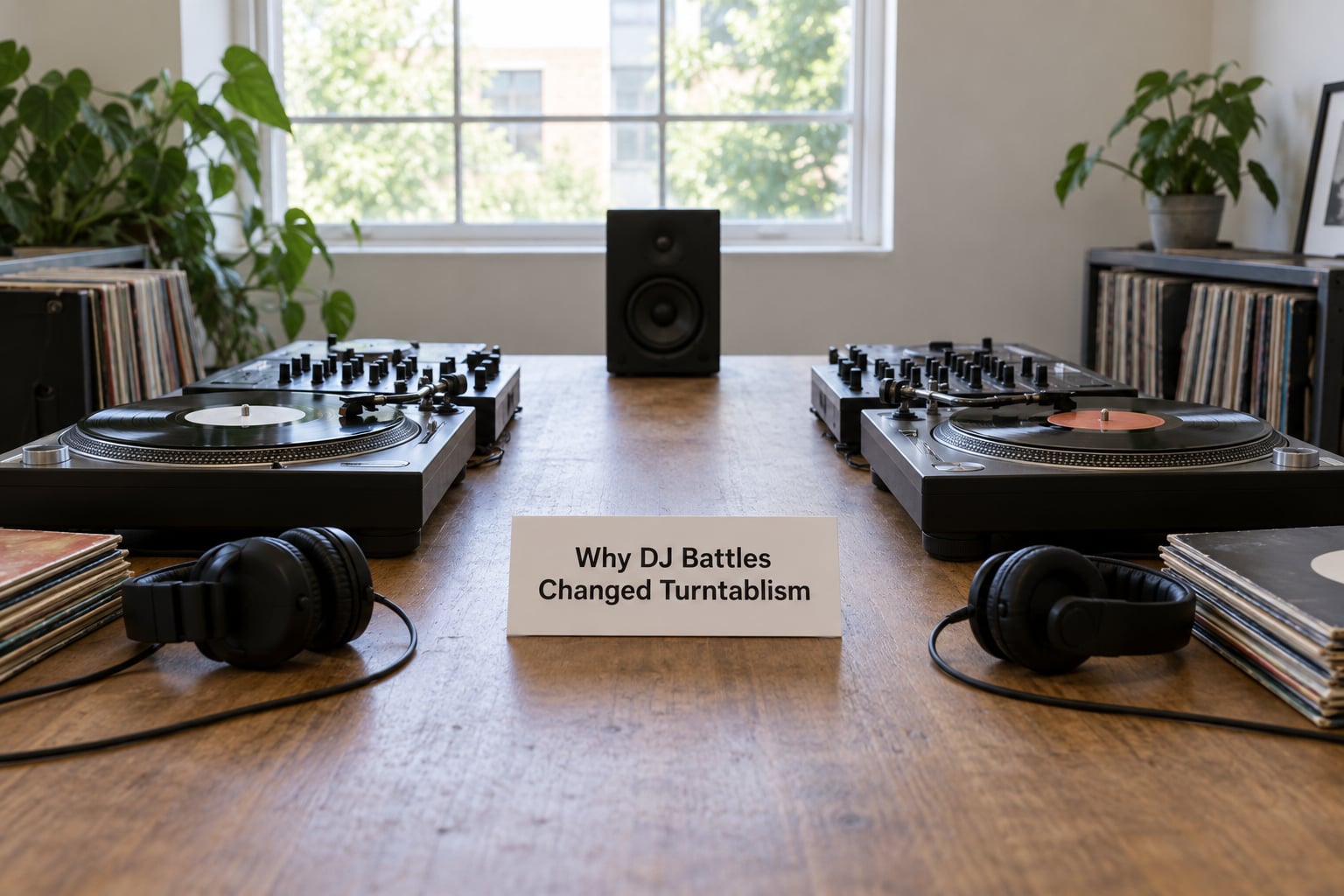
Before battles, a good DJ got work by being reliable and having good records. A battle replaced that with a scoreable question: can this person hold a room and hold a standard of difficulty at the same time?
The format is simple and still mostly unchanged. Two turntablists set up facing each other, a host introduces them, and each gets a set of roughly six minutes, judged on how the set is put together, the difficulty of the techniques and how the crowd responds. Categories exist for solo routines, tag teams and crews, which is how the team formats like the X-ecutioners and the Beat Junkies built their reputations.
The effects of that structure are larger than they look. A six-minute set is a composition with a beginning, middle and end, and the pressure of a clock is what forces turntablists to stop showing off tricks and start arranging. A crowd in front of you turns private practice into a feedback loop, because the room tells you immediately whether your idea landed.
Then in 1983 Tony and Christine Prince founded the Disco Mix Club, and battles acquired a rulebook, a season and a world final, the first of which was held in London in 1987. Competitors now arrive representing a country, which is why a French crew winning the world championship in 2004 was treated as an event rather than a curiosity. It also means national scenes, schools, studios and sponsors form to produce contenders. That is institution-building, and it is the last reason this counts as art rather than as a party trick.
How Records and Radio Spread Turntablism’s Ideas
Techniques travel badly and records travel well. A scratch is close to unteachable from a paragraph of text, but a mix record can be heard a hundred thousand times, copied onto a cassette and handed to somebody the next morning. That is the channel, and it is why the practice spread at all.
Mixtapes were the original carrier, then radio, then the twelve-inch single, which in the 1980s existed largely so a DJ could mix an album track. The golden era of hip-hop, roughly the mid-1980s to mid-1990s, is the period when the DJ was most visible on record, cutting breaks for rappers and building records almost entirely out of other people’s music.
Then the channel narrowed. Samplers and digital recording studios meant a producer could build a track from a loop in an afternoon rather than a crate in a fortnight, and DAT tapes let artists carry finished backing beats to a venue instead of hiring a DJ. The DJ was quietly removed from the middle of the process. On mainstream records, turntablism declined for years.
The answer came from underneath rather than from the industry. Crews like the X-ecutioners, the Beat Junkies and the Invisibl Skratch Piklz kept the practice demanding in the 1990s and released showcase records doing it, which is also when the name turntablism spread far enough to be useful. The scene that everybody associates with scratching had, for a stretch, to argue for its own survival.
How Turntablism Influenced Music and Global Culture
Turntablism’s biggest effect on other music is one step removed from performance. Once a break could be isolated, repeated and rearranged by hand, sampling followed. The idea that a piece of somebody else’s record could become the raw material of a new song is now just how much of popular music is made.
Vocabulary travelled further than technique for a while. The language of battles, crate digging and routine construction entered rap lyrics, which gave the whole culture a vocabulary for skill and showmanship that it still uses.
Regional scenes formed fast, and each added something. Philadelphia gave it Jazzy Jeff and Cash Money, and the vinyl-surgery routine that broke the idea that a battle could only be for records. The San Francisco Bay Area produced Q-Bert, Mix Master Mike, Shortkut and DJ Disk, with a crew-battle tradition that still shapes the competitive format today. In France, C2C and Birdy Nam Nam took break-based performance into European festival circuits and won a world championship, which proved the format was exportable rather than a New York custom.
It also moved outside hip-hop. Christian Marclay built visual art out of records, DJ Spooky has treated the DJ as a kind of archivist of sound, and turntablism sits comfortably inside experimental and electronic composition. The same principle a Bronx teenager used to stretch a drum break has been picked up by people writing for gallery spaces.
Why Turntablism Is Recognized Today
Recognition came from practice first and institutions afterwards, and it never arrived as a single ruling.
The Disco Mix Club is the clearest case. It has run for decades, produces judges, publishes the standard that people argue about, and is ordinary enough that nobody treats it as a big deal, which is exactly what a working institution looks like. Grandmaster Flash and the Furious Five went into the Rock and Roll Hall of Fame in 2007, the first DJ act to do so, and museum and academic programmes now treat turntablism as a subject rather than a footnote.
The technology argument is the live one. Timecode vinyl and DVS systems let anyone practise scratching with the same results on a laptop controller, and controller-based setups have brought a lot of people in. The objection from longtime vinyl players is about touch and reading the record rather than a waveform, and it is a real argument rather than gatekeeping. Practitioners generally advise learning hand and fader independence on a single deck before adding anything electronic, which is a sensible piece of advice that costs nothing.
There is also an access problem worth naming honestly, because people argue about it. A first serious setup has got considerably more expensive, and on r/Turntablists people who came in later point at exactly that as a reason participation dropped. Cheap practice systems have answered part of it. Nobody has answered all of it.
What has not changed is the standard. Whether the deck is pressed vinyl or a control surface, a six-minute routine still has to build, surprise and land, and that standard has survived every change of hardware.
Frequently Asked Questions
Who invented turntablism?
Nobody invented it in a single moment, and the person usually credited with the starting point is Kool DJ Herc. His 11 August 1973 party at 1520 Sedgwick Avenue in the Bronx is treated as the moment a record was first broken, extended and repeated purely for a dancing crowd. Grand Wizzard Theodore then added the accidental scratch, Grandmaster Flash turned that into controlled technique, and Steve Dee and others developed juggling. The practice was established by a scene over about a decade, not by one originator.
Is DJ Kool Herc the inventor of turntablism?
He is the closest thing to it, and the description is accurate as long as you understand what he did. Herc did not invent the turntable, the mixer or the idea of a DJ leading a party. He identified a drum passage that worked on its own, played it far longer than the record ran it, and made the crowd treat that passage as the song. That extraction of usable raw material is the move everything after him is built on.
When did scratching become part of turntablism?
Roughly the early 1980s. Grand Wizzard Theodore is usually credited with discovering the scratch by accident while moving a record by hand to find the next part of a track, and Grandmaster Flash developed it into a controlled, repeatable technique with cutting and backspinning. Herbie Hancock’s Rockit in 1983 carried it far beyond New York, and by the middle of the decade the scratch was a scored skill in battle routines rather than a party effect.
What skills make someone a good turntablist?
Break knowledge first, then hand control. A strong turntablist knows a large catalogue of usable breaks and can find or recognise the right one under pressure, which is why crate digging counts as practice rather than nostalgia. On top of that sit needle placement, fader control and timing, the ability to arrange ideas into a set with a shape, and the judgement to know when a technique is worth the risk. Battle experience sharpens all of it faster than private practice does.
How is turntablism different from regular DJing?
A club DJ provides continuous coverage. The job is to match tempo, blend record into record and keep the floor moving for an hour or two without the join being noticeable. A turntablist builds a self-contained piece in about six minutes, uses cutting, scratching and beat juggling as expressive material, and finishes it. The word turntablism, credited to DJ Babu around 1995, spread largely to mark that split. Club play and turntablism overlap constantly and the skills reinforce each other.
Conclusion: Why Turntablism Still Matters
How turntablism became an art form is the answer to four questions rather than one. A machine could be played, a record could be broken open, the resulting pieces could be arranged with named techniques, and other people could judge whether the arrangement was good. None of those four were necessary on their own, and together they turned two decks and a crate of records into a form with a history, a canon and something to learn.
The first step is cheap. Put on Adventures on the Wheels of Steel all the way through without switching tracks, and listen to what the record is doing. Then find one break you like and learn where it starts, because that is the exact thing Kool DJ Herc did, and it is still the foundation of everything that came after.