A review earns its place only when it tells you something you could not get by pressing play for ten seconds. To review a song without just describing it, convert every observation into an effect: name the musical choice, say what it does to the listener, point at the exact moment it happens, then give a verdict that names an audience.
Most weak song reviews fail in the same place. They stack adjectives, warm synths, thumping bass, honest lyrics and call it insight. Nobody disputes that the bass thumps. The reader still has no idea whether the song works.
The fix takes about forty minutes of careful listening plus the six steps below, and it works whether you write for a blog, hand notes to a bandmate, or post feedback into a songwriting forum.
Table of Contents
- What You Need
- Step-by-Step: How to Review a Song Without Just Describing It
- Common Mistakes
- Frequently Asked Questions
- How do I leave useful feedback on someone’s song?
- How can I effectively analyze a song?
- Can you give me an example of music analysis?
- What is the best way to listen to music before writing a review?
- How do I critique a song I dislike without being rude?
- How long should a music review be, and should it include a score?
- Conclusion
What You Need
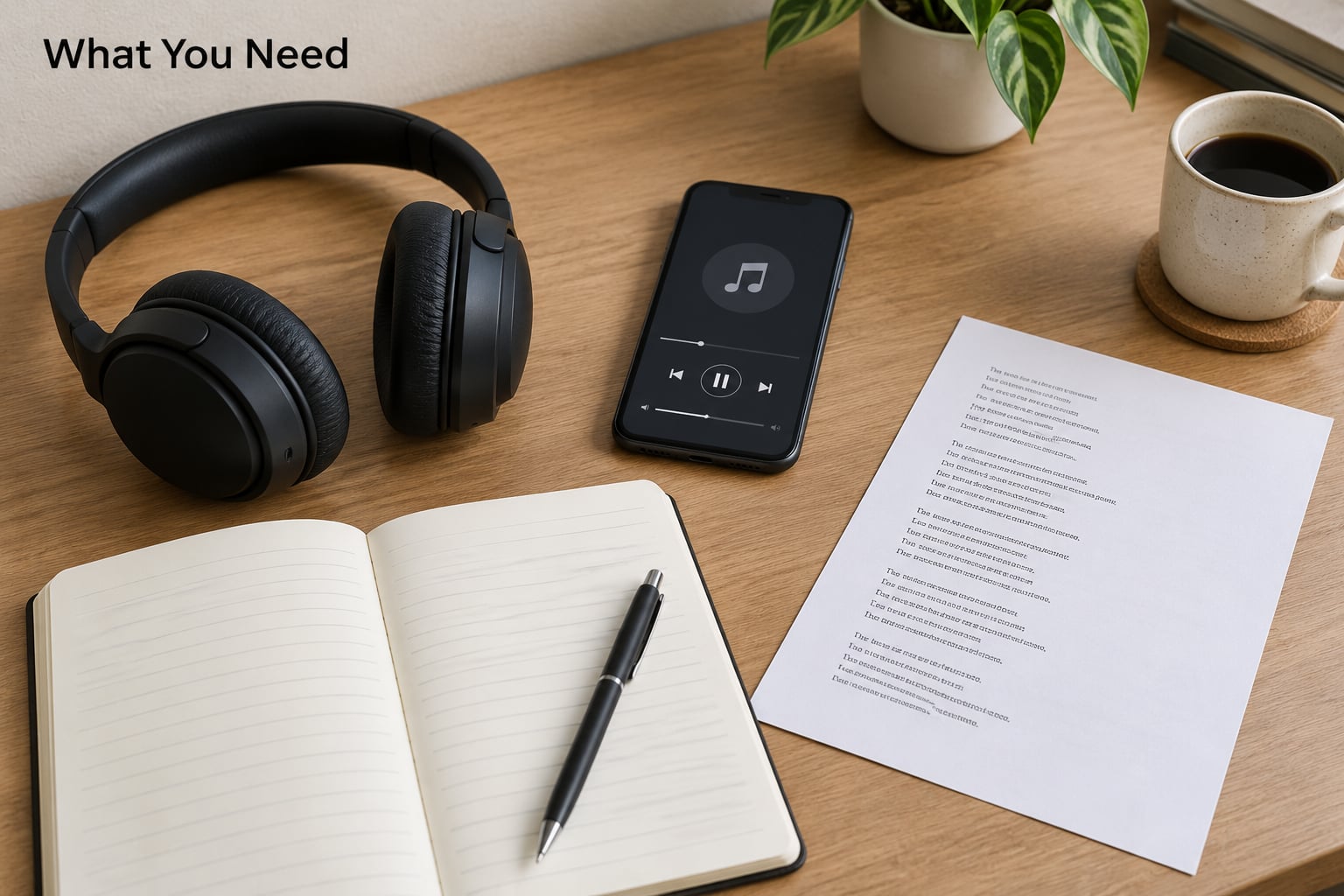
You need four things, and none of them are expensive. The listening setup matters most, because a review written from laptop speakers will describe a different record than the one the artist mixed.
- Headphones and a quiet room. Wired or wireless, closed-back is the safest default for reviewing. You are hunting for detail in the low end and the space around a vocal, and small speakers hide both.
- A neutral player with a level control. Turn loudness normalisation off if your software offers it, and match the level you would normally listen at. Half your “the mix sounds harsh” reactions come from cranking the volume.
- The lyrics. Print them or keep them in a second window. You cannot analyse a line you cannot read, and rereading while the track plays is where themes surface.
- A notes app and a pen. Type helps with words; pen helps with arrows, timestamps and scribbled chord shapes. Either way, capture reactions on the first listen before your memory tidies itself up.
You also need a little vocabulary, but far less than most guides insist. Five terms cover the vast majority of useful review writing: hook, verse, chorus, bridge, and tempo. Add melody, harmony, arrangement and dynamics when you get comfortable, and unpack each one in plain English the moment you use it.
Step-by-Step: How to Review a Song Without Just Describing It
- Listen once, hands off, before you research anything.
- Name what the song is trying to say.
- Pick the three elements doing the most work.
- Turn each observation into a stated effect.
- Anchor every claim to a moment you can point at.
- Give one strength, one priority fix, and a verdict.
Here is what each step looks like in practice.
Listen Before You Research
Complete one uninterrupted listen before you read a single thing about the artist. Research first, and you start hunting for confirmation of what you already half-assumed.
On that first listen, note three things and nothing else: your physical reaction, the moment you looked up from the screen, and the phrase or line that stayed. Those three entries are your raw material. A feeling you could not place in thirty seconds is often more honest than a paragraph written to sound informed.
Then listen twice more, one thing at a time. Second listen, structure only. Third listen, the mix. Resisting full analysis on the first pass is what keeps the review from being a plot summary.
Identify the Song’s Central Idea
Before you judge how a song says something, work out what it is saying. Put one sentence to it, using your own words rather than the artist’s press release.
Then check whether the song keeps that promise. Plenty of tracks open intimate and small, then bury the payoff under three choruses of the same hook. Plenty of others spend two minutes on atmosphere and never arrive. Naming the intent turns a vague impression into a claim you can test against the arrangement, the vocal performance and the words.
Context helps here, but read it after. A single, an EP track and an album closer get judged against different expectations, and knowing which one you are holding stops you from calling a 40-second outro a failure.
Analyze the Music Instead of Repeating the Lyrics
Pick three elements doing the heavy lifting and go deep on each. Melody, rhythm, arrangement, vocal delivery and mix are the usual candidates. Structure is worth adding when a track twists somewhere unexpected.
The move that separates analysis from description is the second sentence. You name the element, then you say what it does. “The chorus lifts an octave” is naming. “The chorus lifts an octave, which is why the second one lands harder than the first” is analysis, because it explains the effect and implies a verdict.
That is the whole trick, and it applies everywhere. A chorus that adds a harmony stack in the final eight bars makes the ending feel earned instead of tired. A kick drum pushed up in the low end makes the track exciting on headphones and woolly on a phone speaker, which is a real production trade-off worth naming in a review.
Lyrics get the same treatment. Quoting a line and explaining why that specific word choice is doing work beats summarising the story. “She swaps the weather for traffic” is an observation; the writer can point at it and see exactly what you meant.
How to Support Every Judgment with Evidence
A claim without a moment attached is an opinion with good posture. Anchor each one to something a reader can hear: a lyric, a chord change, a transition, a mix choice, a specific structural beat.
You do not need timestamps, though they help in long-form reviews. Naming the moment works fine: “about forty seconds in, when the drums drop out for two bars,” or “the last chorus, where the vocal doubles and the reverb tails out.” Two or three anchors in a 600-word review is plenty.
Ask one question before you publish each paragraph: could a reader who has never heard the track picture what I am describing? If not, you have written a mood, not a review.
Balance Strengths with Constructive Criticism
One specific strength, one or two prioritised weaknesses, and one fix an artist could act on this week. That is the pattern music critique communities pushed years ago, and it still holds up better than most advice floating around online.
Songwriters ask for the same thing constantly on songwriting forums: “I like the melody” is not feedback, because there is nothing to do with it. “The melody sits in a narrow range, which makes the verses memorable but leaves the chorus with nowhere to go” gives them something to work with.
Prioritise ruthlessly. Artists tell you a laundry list of eleven problems is worse than two ordered ones, so rank yours. Fix the recording first, then the mix, then the polish, is a useful default order when you are handing notes to a demo musician.
Be careful with taste and with intentional oddity. Some choices that sound wrong are decisions: a track that never resolves, a vocal buried on purpose, a loop that repeats deliberately. Ask whether it is a constraint or a choice before you file it under mistake. A reviewer who flags “this sounds unlooped” should find out first whether the artist works that way on purpose.
Write a Clear, Original Verdict
Pick one argument and build toward it. “The strongest thing here is the writing and the production wastes it,” or “an ordinary song rescued by one extraordinary arrangement decision.” A review that argues nothing becomes a list.
Keep the shape simple: a short intro that states your angle, two or three body paragraphs carrying the evidence, and a verdict that names the audience. Who is this for? Fans of the slow, harmony-heavy side of the genre? Listeners who want an upbeat track? Say it, and the review has a purpose beyond reporting.
Length follows the argument. Around 400 to 800 words suits a single song. Track-by-track breakdowns work when each track genuinely needs its own paragraph, and micro-reviews of a line or two work fine for a newsletter. Scores are optional and, honestly, less useful than a clear sentence about who should spend their time.
Common Mistakes
Writing the track summary. If a reader could produce your paragraph by skimming the lyrics and a genre tag, it is description. Fix: delete the plot and keep the moment that mattered.
Stacking adjectives. Warm, dreamy, atmospheric, intimate says nothing testable. Fix: swap each one for a cause. Instead of atmospheric, name the reverb and what it hides.
Unsupported verdicts. “The drop at 2:40 is weak” needs a reason. Fix: name what the drop borrows from earlier and what it changes.
Jargon without unpacking. If a beginner cannot follow the sentence, it is decoration. Fix: one plain-English clause after the technical term, every time.
Laundry-list criticism. Eleven negatives and no positives reads as a grudge. Fix: lead with one real strength, then the two things that matter most.
Comparing to a rival instead of reviewing the track. Half a review spent explaining why someone else is better tells the reader nothing about this song. Fix: one line of context, then back to the evidence.
Copying the press release. Publicity is written to flatter. Fix: check the artist’s own description against what you actually heard, and go with your ears.
Frequently Asked Questions
How do I leave useful feedback on someone’s song?
Name one thing that works and say why it works, then name one specific change and say what it would improve. Keep the fix small enough to try in an afternoon. That pattern, borrowed from long-running music critique communities, is why some notes get acted on and other notes sit unread. ‘The intro is nice’ gives an artist nothing to do. ‘The intro stays soft and builds, which sets up the chorus well, but the first guitar phrase is buried under the bass’ does.
How can I effectively analyze a song?
Work in layers across three listens. Listen one for structure: intro, verses, chorus, bridge, where the energy rises. Listen two for melody, harmony and rhythm, noting where a hook repeats or changes. Listen three for arrangement and mix: what enters, what leaves, where the low end sits. Write your observations as you listen, then convert each into a stated effect. If you cannot say what a choice does for the listener, you have only named it.
Can you give me an example of music analysis?
Here is the before and after. Descriptive: ‘The chorus has a catchy melody and warm synths over a thumping bass.’ Analytical: ‘The chorus lifts four notes above the verse, and the synth sits underneath instead of doubling the vocal, so the melody carries the lift and the low end stays out of the way. The result is a chorus that sounds bigger without sounding louder.’ Same facts, but the second version tells you what the writer did and whether it worked.
What is the best way to listen to music before writing a review?
Use decent headphones in a quiet room at a normal volume, with loudness normalisation off if your player offers it. Listen once with no notes for form, once following the lyrics on paper, and once more for the mix alone. Skipping on the first pass trains you to judge fragments, and fragment judging is how reviews end up describing a song that does not exist.
How do I critique a song I dislike without being rude?
Critique the execution and keep taste out of it. Saying the chorus melody is too plain for the style is a craft note; saying the whole thing is boring is a preference dressed as a note. Separate the two in your head before you write, and ask whether the choice is deliberate. A song can be badly built and still worth someone’s attention, and saying so plainly is fairer than inventing praise you do not hear.
How long should a music review be, and should it include a score?
Roughly 400 to 800 words for a single song, more only if you are covering several tracks or an album. Length should follow the evidence, not a target. Scores are optional and mean different things to different readers, so state yours plainly or leave it out. A written verdict that names who the track suits travels better than a number, and it is easier to disagree with.
Conclusion
To review a song without just describing it, run one loop: name the choice, state the effect, anchor it to a moment you can point at. Three of those per review is usually enough.
Start small. Pick one claim about the track you have been circling, find the moment that proves it, and write those two sentences before you write anything else. If you need the vocabulary to do it, our production notes cover it in context.
Everything else in a review is framing.