How drum machines changed popular music is really a story about control. A programmed beat gave a singer, a songwriter or a bedroom producer something no session drummer ever offered: the same drums, in the same pocket, on every take, for as long as the record needed. That one shift collapsed the cost of making a record, standardized the backbeat, and handed the genre-defining sound of hip-hop, house, techno, pop and trap to people who had never touched a drum in a studio.
When people ask this question, they sometimes mean a single record or a single style rather than the instrument itself. What follows is the whole arc, from a tone generator built in 1931 to the plug-ins and controllers running inside a laptop today.
Table of Contents
- When Did Drum Machines Change Pop and Hip-Hop Music?
- What Changed When Music Moved Away from Live Drummers?
- How Did Drum Machines Change Songwriting and Production?
- How Disco and Early Electronic Music Established the Machine Groove
- How the Roland TR-808 Changed Hip-Hop Production
- How Sampling Turned Drum Machines Into Rhythm Foundations
- How Drum Machines Expanded the Boundaries of Pop and R&B
- What Is the Difference Between a Drum Machine, Sampler, and Sequencer?
- What Changed About Drumming, Bass, and Melody?
- Why Do Drum Machines Still Matter in Modern Music?
- Frequently Asked Questions
- Did drum machines replace live drummers?
- Which drum machine had the biggest impact on popular music?
- How did the Roland TR-808 influence hip-hop?
- Why are sampled drum loops different from ordinary drum-machine beats?
- Did drum machines make music less creative?
- Can modern producers use drum machines without sounding like everyone else?
- Conclusion
When Did Drum Machines Change Pop and Hip-Hop Music?
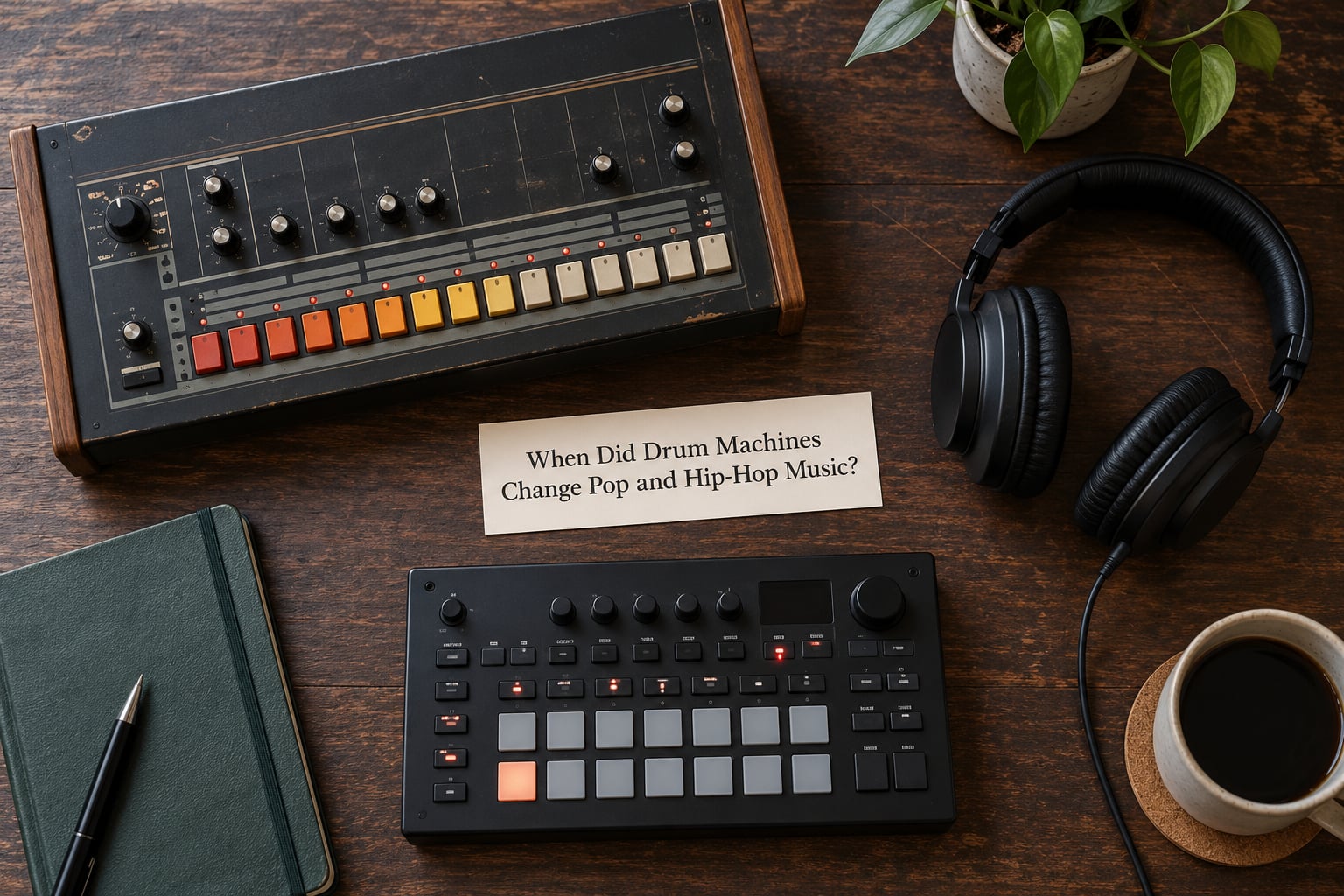
The short version: rhythm machines appeared in the late 1950s, programmable machines arrived in 1978, programmed drums took over pop between 1980 and 1984, sampling turned them into beat-making tools in the mid-to-late 1980s, and they have shaped every genre that uses a grid since.
Key milestones, in order:
- 1931 to 1932 — Leon Theremin builds the Rhythmicon for composer Henry Cowell, generating sixteen repeating rhythms from an overtone series.
- 1959 — Wurlitzer releases the Sideman, an electro-mechanical box with a handful of fixed patterns.
- Late 1960s — Ace Tone, Farfisa and Korg bring preset rhythm boxes into reach of bedroom musicians and small bands.
- 1978 — Roland ships the CR-78, the first machine most musicians accept as user-programmable.
- 1980 — Roland TR-808 and Linn LM-1 arrive within months of each other and split into two rival sound families.
- 1981 — Oberheim DMX, Roland TR-606 and Boss DR-55 broaden the market, and the TR-909 arrives in 1984.
- 1985 to 1988 — E-mu SP-1200 and Akai MPC-60 add user sampling, turning a drum machine into a sampling workstation.
- Late 1980s onward — The Linn 9000 and digital workstations absorb the standalone category into software.
- 2010s to today — The 808 returns as a bass instrument under trap, and every DAW ships a better drum machine than any hardware box ever did.
The distinction that matters for any “when were they popularized” question is that invention and popularity are decades apart. The machines existed from the 1930s. They changed records in the 1980s. That gap is the whole story of how long technology takes to reach a bedroom.
What Changed When Music Moved Away from Live Drummers?
Live drumming is a negotiation. Every hit is a judgement call about time, and the pocket drifts slightly from one verse to the next. That drift is what we call feel, and it is also a logistical problem when you are trying to record a chorus six times and like the fifth take best.
A programmed pattern removes the negotiation. The kick lands where it was put, every loop, and the arranger can change the arrangement for one bar without anyone losing their place. Once the beat is a file, it can be copied into a song, a film cue, an advertisement, and forty other records without booking a session.
Consistency is only half of it
The more interesting change was musical. When timing is fixed, groove stops being a physical accident and becomes a decision. You can swing a hi-hat pattern against a straight kick, place a snare on the offbeat, leave a bar of near-silence before the drop, or push the whole pattern a hair behind the click and let it breathe.
Those are the choices drummers used to make with sticks, by feel, in real time. Once they became choices you could dial in and revisit, a much wider set of people got to make them.
Silence became usable
A programmed pattern can hold a bar back. Live bands tend to fill space, because silence reads as a mistake or a breakdown. Machines made deliberate space easy to keep, which opened room for vocals and atmosphere to sit at the front of a record.
How Did Drum Machines Change Songwriting and Production?
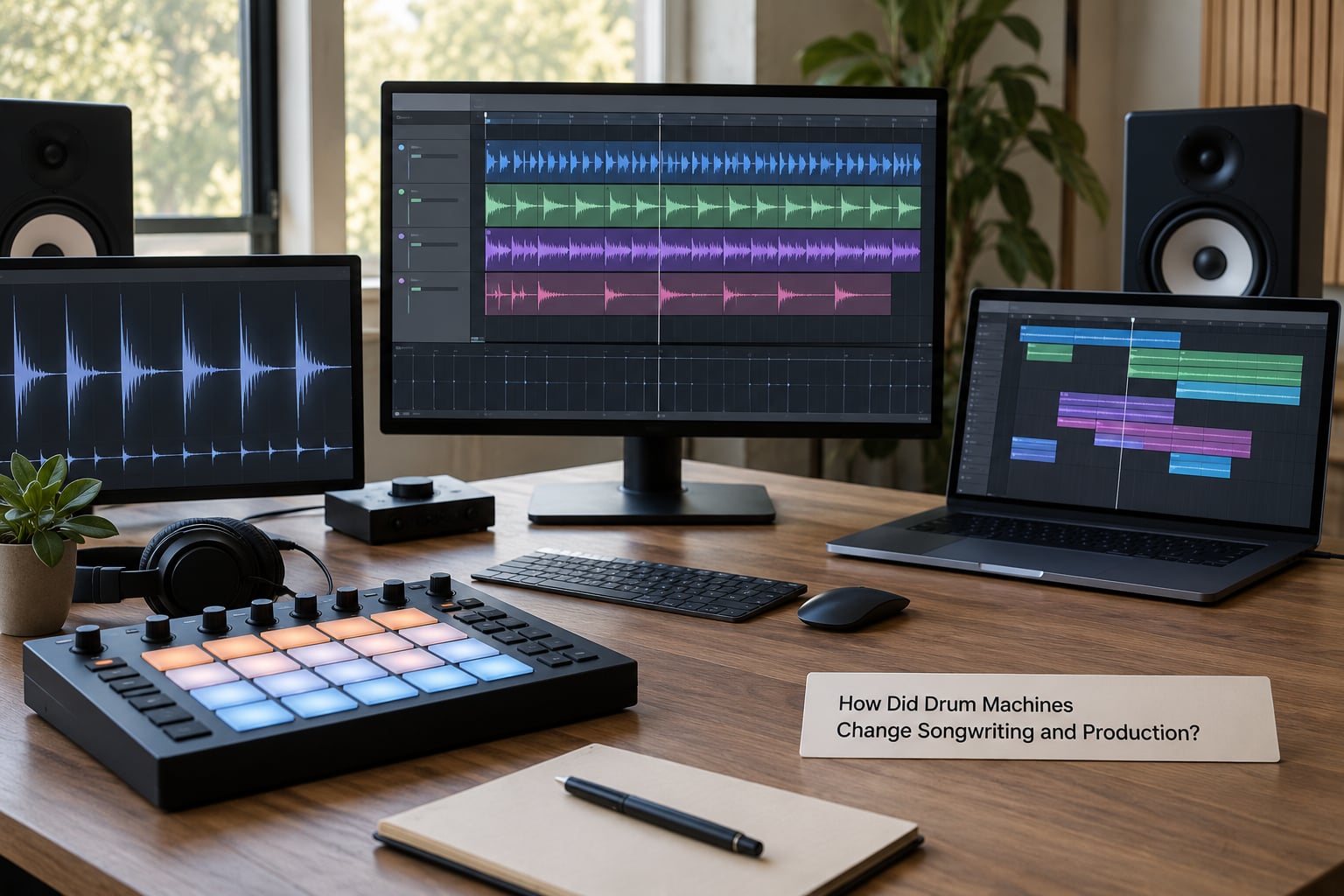
It gave writers a steady pulse to write over. That sounds small until you remember that before it, a song arriving with a lyric often arrived with a tape of a drummer playing something, or with nothing at all. A loop meant you could try a new chorus over the same groove in ninety seconds.
The consequences ran through most of the record rather than just the rhythm track.
Arrangement stopped being a one-shot decision
With a stable rhythmic bed, sections could be added and removed without the track falling apart. A verse could keep drums while the chorus added them, and the difference could be a new fill rather than a new performance. That made the verse-chorus contrast a production choice instead of a session outcome.
Tempo and form became adjustable
Devices that sequenced together let one machine control another, so a tempo change mid-song or a time signature switch between sections became a production decision. Some of the most recognisable electronic records are essentially a stable grid with a changing arrangement on top of it.
Drummers did not disappear, they changed jobs
The honest version of this history is that session drummers lost volume first and adapted second. Programming became part of the job, drum triggers and hybrid kits followed, and a lot of records that sound like a machine are actually a drummer triggering loops live. The machine took over the parts of the kit that were about time, and left the parts about feel.
How Disco and Early Electronic Music Established the Machine Groove
Disco is where the four-on-the-floor pattern stopped being an experiment and became a genre convention. A kick on every beat, a snare or clap on two and four, open hats on the offbeats, and a tempo that lets a room move together without any single person leading it. You can dance to it because the pattern tells you when to move.
The sound came from machines that could not imitate a drummer accurately. Preset rhythm boxes built their patterns from analog circuits and diode matrices, so a kick was a pitched thump, a snare was a filtered burst of noise, and a clave was a dry click. None of it sat near a real kit in the room. That is exactly why it sounded like a new instrument rather than a worse drummer.
Affordability is what made it a genre
The Farfisa Rhythm 10 landed in West Germany at a price point that put a preset rhythm pattern in the hands of a hobbyist, and the same generation of musicians built Kraftwerk’s rigid, mechanical records around it. When a rhythm device is cheap enough to own, it stops being a studio tool and becomes a practice. Disco and early electronic music are the two genres that grew up in that gap.
Synth-pop and new wave inherited the grid
By the early 1980s, programmed drums were the default for records built around synthesizers. Blondie, the Human League, Prince and their contemporaries used the machine less as a replacement drummer than as a rhythmic framework that could sit under a vocal and leave the arrangement spare.
How the Roland TR-808 Changed Hip-Hop Production
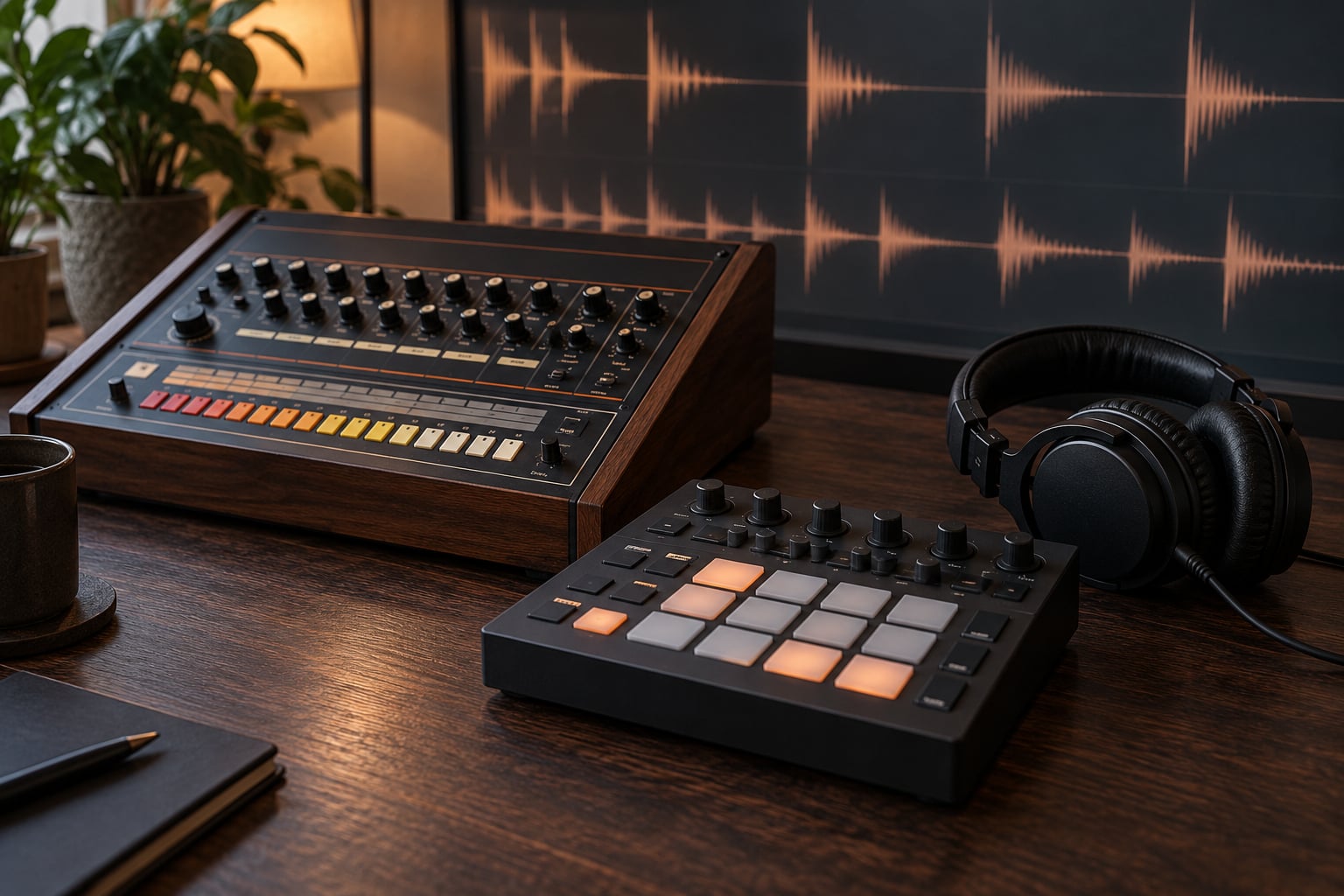
The 808 mattered less as a drum machine than as a set of raw materials. Its kick was long, tuned down far below a normal kick drum, and generated with an analogue circuit rather than a sample. Its snare was metallic and noisy. Its handclap, cowbell, conga and clave were short, tuned percussion sounds that could not have come from a kit.
That combination did three things for hip-hop.
It became the low end
The 808 kick is not a drum so much as a bass note with a click on the front of it. Producers tuned it against the sub-bass line, which is why it still anchors nearly every trap record made since. Its length also meant a kick could overlap the bass rather than fight it.
It gave programmers recognisable pieces
Every early beat was built from the same short list of sounds. Once a producer had the 808 kick, the 808 clap and a hi-hat in the sampler, they had enough to make a record, and other producers recognised those sounds instantly. Repetition across thousands of records is what turned a machine’s character into a genre’s identity.
It was a sample source
The 808 was never popular as a drum machine. It was popular because it could be recorded, chopped and layered. Producers pulled single hits out of it, pitched them, and used them as instruments, so the machine’s influence outlasted its sales by decades and shows up in genres its designers never imagined.
How Sampling Turned Drum Machines Into Rhythm Foundations
Sampling changed what a drum machine was for. Until the mid-1980s, the machine chose the sounds and the programmer arranged them. Once you could load your own samples, the machine became a player for your sounds instead of a catalogue of its own.
The E-mu SP-1200 in 1985 and the Akai MPC-60 in 1988 made that shift concrete. Chopped funk and soul drum breaks, the kind played by Clyde Stubblefield and others, could be sliced, reversed, re-pitched and looped into a groove that nobody had played. Instead of imitating a drummer, a producer started with a specific performance and rearranged it.
One-shot and sample modes are different instruments
Many machines of the era had two ways of working. Sample mode played a loop at a fixed speed, which meant time-stretching came with artefacts but the loop stayed intact. One-shot mode gave every pad its own trigger, which meant a chopped break could be played like an instrument and rearranged in bars.
That second mode is closer to how most people conceive of making beats today.
The legal question came with it
Chopping a record is using part of it, so clearance became a practical production problem rather than an academic one. Labels and publishers started issuing sample-clearance deals, and the cost and paperwork of clearing a break pushed some producers toward synthesised or drum-machine sounds. The legal side of sampling shaped the music as much as the technology did.
How Drum Machines Expanded the Boundaries of Pop and R&B
The machine did not invent the sparse vocal record, but it made that record cheap. An artist could build a track with programmed drums, bass and synths, and spend the session budget on the voice instead of on players. Solo performers and vocalists gained a rhythm section they controlled, which changed who could make a finished song.
One-mall and off-kick patterns broke the expected downbeat
A backbeat on two and four is a convention, not a law. Patterns that dodge the kick on the one, or that put the snare where the kick usually sits, create tension against the grid and give vocal phrases somewhere unusual to sit. Those patterns came out of programming, where the drummer is the producer and every placement is deliberate.
Genres borrowed from each other
House and techno patterns migrated into pop in the late 1980s and 1990s, and programmed drum sounds turned up in country, rock and R&B records long after anyone expected. Machine drums did not cause every one of those crossovers, but they made them cheaper to try, because the same kit could be re-programmed for a different feel in a few minutes.
Women and solo artists got the most out of it
Robin Gibb’s late-1960s singles, Kate Bush’s 1980 work and Prince’s records are all built around programmed percussion as a structural element rather than a shortcut. For artists whose appeal was melodic and vocal, a machine that supplied the pulse without demanding a band was not a compromise. It was a tool that matched what they were already doing.
What Is the Difference Between a Drum Machine, Sampler, and Sequencer?
A drum machine is an instrument that plays drum sounds from a pattern. A sampler stores recorded audio and plays it back at a chosen pitch and speed. A sequencer is the part that decides when things happen: which sound, on which step, at what tempo.
In plain terms
- Drum machine — makes or holds percussion sounds and plays them in a repeating pattern. The TR-808 and a modern pad controller are both drum machines.
- Sampler — stores sounds you give it. The SP-1200 and MPC-60 were both samplers that came with excellent drum sounds, which is why they read as drum machines.
- Sequencer — the step or timeline grid that stores your arrangement. Most drum machines contain one; a few early preset boxes had a fixed pattern and no sequencer at all.
Why the labels blur now
A laptop DAW contains all three at once: a sampler for your loops and one-shots, a step sequencer for your programming, and drum-machine plugins that supply the voices. Modern dedicated hardware does the same thing. Distinguishing the three still helps when you read an old manual, but the categories are more marketing language than practical boundaries these days.
What Changed About Drumming, Bass, and Melody?
Drums and bass stopped fighting each other. A live kick and an upright bass player in a small room will often disagree about where the beat is, and engineers end up choosing one. A programmed kick sits exactly on top of a sub or electric bass, which cleared space for a bass part that had weight, and that in turn left more room in the low end for the melody.
MIDI timing tightened everything
Once instruments could be played against a common clock, quantization became an option. Loose human feel could be tightened, or left loose deliberately inside a tight grid. Both choices became available in a way they never were on tape with a drummer playing in the same room as the bassist.
Genre contrast sharpened
A record with programmed drums can make a live-band record sound enormous by comparison, and a live-band record can sound raw next to a machine record. Producers reached for that contrast on purpose, pairing programmed drums with real guitars, or triggering samples from an acoustic kit, to get a specific middle ground.
Melody had somewhere to go
When the drums are not competing for attention in the midrange, synth leads and vocal hooks come forward. That is a large part of why the most melody-forward records of the 1980s were also the most programmed ones.
Why Do Drum Machines Still Matter in Modern Music?
Because the arguments in the forums are still live. Gear communities still argue about whether programmed drums have feel, and the answers usually land in the same place: what matters is the programming, not the origin of the sound. Which machine is this on that record is one of the most common questions in those circles, and producers still spend weekends hunting for one.
Trap turned the 808 into a bass instrument
The 808 revival is the clearest example of a machine sound outliving its era by decades. Long, tuned kicks under sparse hi-hat rolls became the backbone of a genre that treats sub-bass as the lead instrument, and the same machine that sat in a rack in 1980 is now the signature of records made in 2026.
Software absorbed the category
The standalone drum machine effectively disappeared as a product category and reappeared as a plugin. Any DAW now ships with sampled kits that are better, cheaper and more editable than the 1980s hardware, and dedicated controllers moved the pads and knobs into the same software. That shift is also why the vintage units became collector objects: they stopped competing on features and started competing on character.
Hybrid workflows are the norm
Modern production is rarely machine or drummer. A typical session might have a producer laying programmed drums and low-end, a drummer triggering one-shots from an acoustic kit, and an engineer moving hits around after the fact. Each of those steps used to be a different discipline on a different machine with its own tape.
Anyone can finish a record
The practical change from the 1980s is access. A laptop with a good drum-machine plugin has more capability than a LinnDrum ever had, and it costs less than an afternoon’s studio time. That is why a producer who never took a drum lesson can hand you a finished beat in an evening, which is the single biggest shift in how popular music gets made.
Frequently Asked Questions
Did drum machines replace live drummers?
They replaced the drummer in the studio first, mostly because programmed drums were cheaper, faster and repeatable, and they did not require anyone to be in the room. Drumming itself survived. Session players moved into programming, drum triggers and hybrid kits, and plenty of records that read as electronic are a drummer triggering loops live. What changed was the volume of the drummer’s job, not the job itself.
Which drum machine had the biggest impact on popular music?
The Roland TR-808, and for a specific reason: it was used less as a drum machine than as a sample source. Its long tuned kick, metallic snare and short tuned percussion sounds were chopped, layered and re-pitched by hip-hop producers, and that sound became the foundation for later trap. The Linn LM-1 mattered more to song structure in the early 1980s, but the 808 shaped far more genres.
How did the Roland TR-808 influence hip-hop?
It gave programmers a small set of sounds that were instantly recognisable and easy to layer. The kick doubles as a bass note, the clap and cowbell work as rhythm accents, and each hit could be chopped and re-pitched once sampling arrived in the mid-1980s. That made it the most sampled instrument in music history and a lasting reference point for how programmed drums are mixed.
Why are sampled drum loops different from ordinary drum-machine beats?
A drum machine plays sounds chosen by its manufacturer, in a pattern the programmer arranges. A sampled loop starts as a recorded performance and is sliced, reordered and re-pitched, so it keeps timing and dynamics that nobody played into a grid. That difference in feel is why loop-based beats tend to sound looser and more human than programmed ones, even when both are quantised.
Did drum machines make music less creative?
The opposite case is easier to support. A limited palette forces decisions: with a handful of sounds, a producer has to invent arrangement, rhythm and dynamics instead of adding tracks. Plenty of distinctive records came out of machines whose sounds were widely considered thin at the time. The honest answer is that a machine narrows the options and widens the access, and how that balances out depends on the person using it.
Can modern producers use drum machines without sounding like everyone else?
Yes, though the default sounds are crowded. What separates a record is usually what happens after the beat is made: the swing, the room, the tuning against the bass, the arrangement around it, and the processing. Plugins with velocity variation and alternate hits matter too. Starting from a sampled source rather than a stock kit also moves you away from the most recognisable presets.
Conclusion
Every genre above came out of the same trade. A machine could not play with expression, so it played with precision, and precision turned out to be the thing songwriters, vocalists and bedroom producers actually needed. The rhythm box of the 1950s, the programmable machines of 1980, the samplers of 1988 and the plugins running today are the same idea getting cheaper and more precise each decade.
So here is what to listen for first on any record. Find the kick, count where it lands relative to the words, and notice how much of the song is built on that one repeating pattern. Then check whether the drums feel like a performance or a decision. That answer tells you most of the history of how drum machines changed popular music, and it takes about four seconds.