To credit everyone on a song, give every contributor a named line with the correct role, and put that same line everywhere the track appears: the composition credit for writers, the production credit for the people who built the recording, and the performance credit for everyone playing or singing on it. Do it before release day from a single verified credit sheet, because distributor metadata reaches every streaming service and royalty society within days and is miserable to unpick afterwards. For a single with two or three collaborators, set aside an afternoon.
Most of that afternoon goes to chasing legal names and signatures, not typing. That part is the price of getting it right once.
Table of Contents
- What You Need
- How to Credit Everyone on a Song: Step-by-Step
- 1. Create a Complete Contributor List
- 2. Separate Songwriting Credits from Production and Performance Credits
- 3. Confirm Names, Roles, and Ownership Splits
- 4. Decide the Credit Order and Billing Format
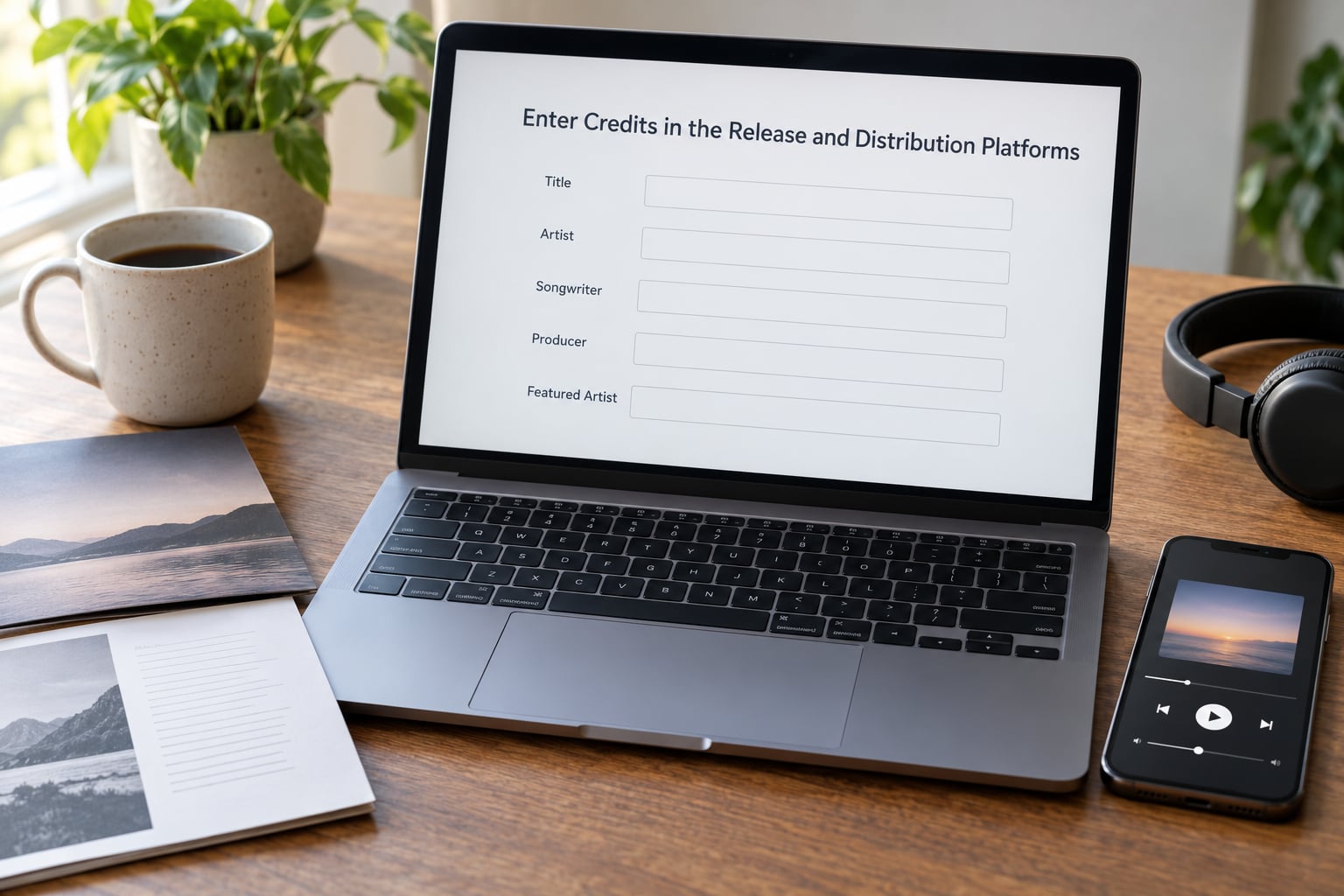
- 5. Enter Credits in the Release and Distribution Platforms
- 6. Review the Final Credit Sheet Before Release
- Common Mistakes
- Frequently Asked Questions
- Do I need a legal name to get songwriter credits on a song?
- How do I credit a producer who is not a co-writer?
- How do I get my name added to a song that is already out?
- Do session musicians and engineers get credited on a song?
- Can I use a copyrighted song if I give credit?
- What should a featured artist’s credit line say?
- Conclusion
What You Need
Here is the working set. If you gather these before the release form is open, nothing on it is a surprise later.
- The final mix or master, plus any alternate version you are also releasing
- Drafts, session notes, voice memos and demos that show who wrote what
- Each contributor’s preferred professional name and the legal name on their publishing registration
- Signed split sheets for writers, and any producer fee or points agreement
- Publisher name, performing rights organization and IPI number for every writer
- Cover art, release date, and the distributor account the release is delivered through
- A one-page credit sheet that fits on a phone screen
The credit sheet is the document everything else follows from. When a distributor asks the same question in four different fields and a rights organization asks it in another form, you want one source you trust rather than four answers typed from memory.
How to Credit Everyone on a Song: Step-by-Step
Six steps, in the order that avoids rework. Start with the name list because it drives everything after it.
1. Create a Complete Contributor List
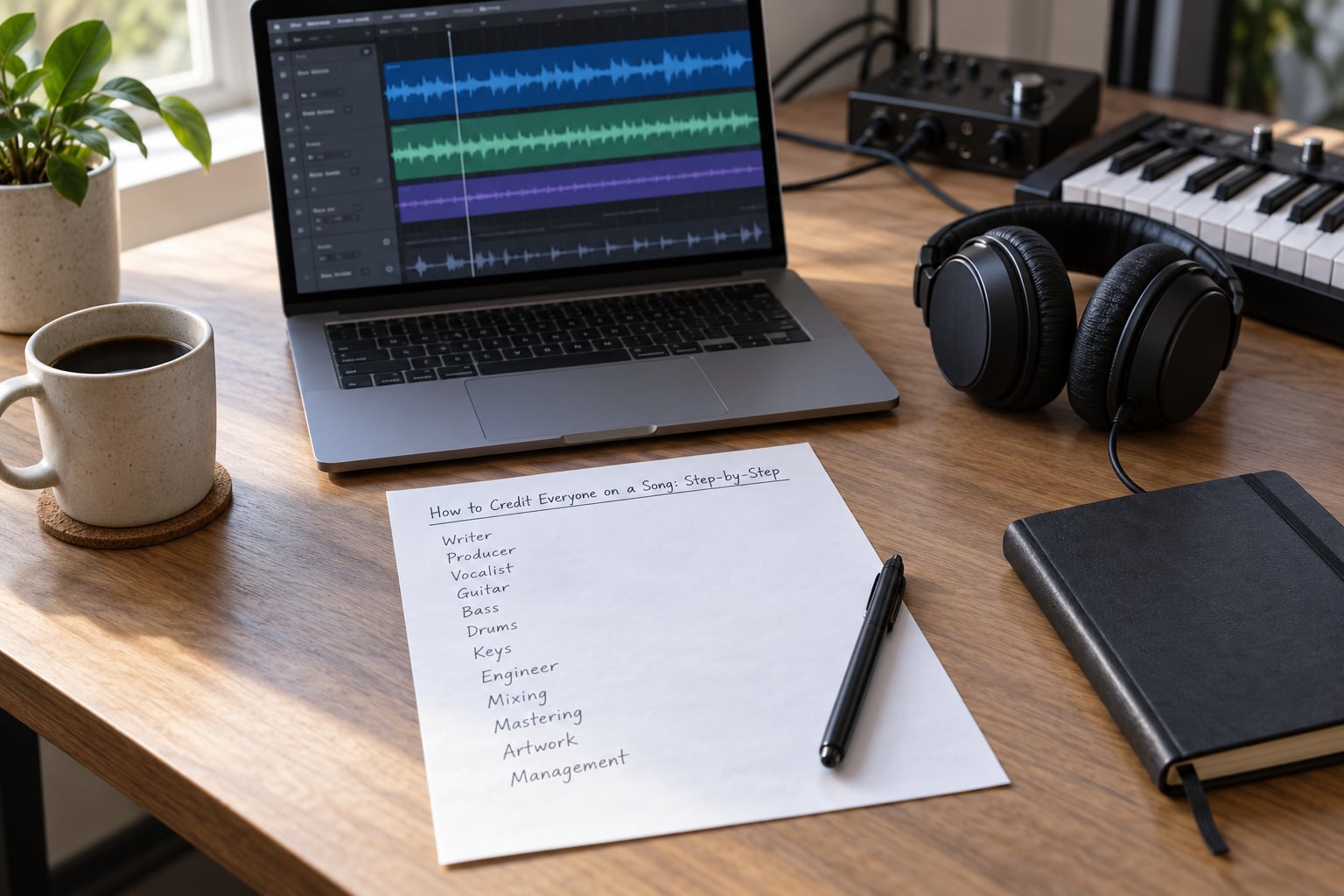
Write down every person who touched the song before you write anything else, because the credit list is only as good as the names in it. That includes the obvious names and the easy-to-forget ones: the co-writer who sent a hook by voice memo, the string arranger, the engineer who tracked the demo, the assistant who managed the session.
Record three things per person: the name they want displayed, the legal name their publisher or society holds, and the role in their own words. Where those three disagree, both names matter. The display name is what listeners see, and the legal name is what a royalty payment can be matched to.
If a whole band wrote a song, list each member individually as a writer rather than crediting the band name. This rule gets repeated constantly in songwriting communities and it is the correct one: a band name on a writer field is a single unresolvable entry instead of three people who can each be paid.
2. Separate Songwriting Credits from Production and Performance Credits
A song carries three credit systems that never talk to each other. Confusing them is the single biggest source of arguments and split-sheet errors, so name them separately before you start filling fields.
- Writing credit describes the composition: composer, lyricist, co-writer, and arranger only where they wrote the parts. This is the only credit that earns publishing royalties.
- Production credit describes the recording: record producer, co-producer, executive producer, vocal producer. How this is paid is whatever you agreed, not what a rule says.
- Performance credit describes who plays or sings on the track: primary artist, featured artist, session musicians, additional players.
- Technical credit covers the recording, mixing and mastering engineers, usually shown in liner notes and often carried into the streaming credits panel.
A producer who helped rewrite the hook holds two separate credits: a writing credit for the words or melody that actually went in, and a production credit for the record. A producer who only shaped the drums gets the production credit and nothing else. Same person, same session, two different facts, two different lines.
3. Confirm Names, Roles, and Ownership Splits
Compare what you have against the paper: session notes, split sheets, publisher confirmations, contracts and contributor messages. Where two sources disagree, the signed document wins over a text message, and the credit sheet is where the resolved version lives.
Credit answers who made the record. A royalty split answers who gets paid. They are related and they are not the same thing. A producer can hold a 20% publishing share alongside a flat production fee, and a featured artist can be paid a flat fee while taking no writing share at all.
Check every legal name against a public repertory such as Songview before you deliver. Search the legal name, confirm the writer and publisher pairing, and note the IPI number. Stage names are the most common cause of unmatched publishing royalties in independent releases, because a rights organization cannot match a name that was never registered against it.
4. Decide the Credit Order and Billing Format
Order carries meaning in music, though the convention is looser than it is in film. The usual running order is: primary artist, featured artist, writer line, publisher line, production line, technical line, then special thanks last.
A standard block reads: Written by A. Reyes and J. Okafor. Produced by A. Reyes. Recorded and mixed by L. Mbeki. Mastered by D. Halloran. Featuring N. Silva on vocals. That is the shape to copy, with your own names in it.
Special thanks sits at the bottom for a reason. It is for people who helped but hold no claim on the song. If someone played a part, mixed the track or wrote a line that made the cut, a real credit is the accurate description, and a thank-you note is a smaller promise than the work they did.
5. Enter Credits in the Release and Distribution Platforms
Metadata is delivered, not typed by the listener. Whatever your distributor accepts on the release form is what the streaming credits panel gets built from, which is why a credit fixed there travels everywhere at once.
The surfaces to cover, in rough order of importance: the distributor release form with its composer, lyricist, producer, featured artist and ISRC fields; your rights organization and The MLC registrations; the streaming credits panel; the liner notes or digital booklet; the YouTube description; the digital press kit or one-sheet; and the sync clearance sheet if a film or ad is involved.
On Spotify, open any track, use the three-dot menu, and choose Show credits. That panel is read from delivered metadata, and Spotify for Artists has no credits editor, so a change there does nothing. The fix has to go through the party that delivered the release.
How to credit a song on YouTube in four steps:
- Open YouTube Studio, select the video, and edit the description.
- Put the song title, primary artist and the full credit block at the top of the description.
- Attach the release as the YouTube Music audio track so the artist and ISRC match the distributed version.
- Update the distributor metadata too, since the description and the delivered credits are separate systems.
Watch capitalization and spelling. Featuring, feat. and ft. render three different ways, and a name typed as DJ Kayo in one field and Kayo in another becomes two contributors on your own release page.
6. Review the Final Credit Sheet Before Release
Quality control takes about twenty minutes. Print the sheet, read it against the signed split sheets, and look specifically for five things: a contributor who worked on the track but is missing from the list, a role that says producer where the person only engineered, a duplicated name created by inconsistent spelling, a writer field left empty, and a publisher missing while writers are present.
Then get written approval. A short message asking each contributor to confirm their line, with the line visible, creates the record you will need if anyone disputes the credit years later. Check a private or unlisted link on the platforms before release day, because that is when a typo still costs nothing.
After that, lock the metadata and stop editing. A change made the week before delivery can reach listeners within days. A change made after release starts a correction process that can run for weeks.
Common Mistakes
- Treating performance as ownership. A featured artist who sings on the track is not automatically a writer. Write a separate line for each fact instead of collapsing them.
- Omitting engineers and co-writers. These are the credits people search for years later. Check the session invoice list against your sheet.
- Working from memory. Session notes, invoices, stems and file histories settle arguments that recollection never will.
- Changing names after approval. Collect approval of the final sheet, not of a draft, and freeze the spellings.
- Inconsistent capitalization across surfaces. Pick one spelling per person, paste it everywhere, and do not retype it.
- Assuming distributor fields create legal splits. A metadata field is a statement of a split. The signed split sheet is the document that creates it.
- Releasing with an empty songwriter field. An empty field blocks matching silently and is one of the most common errors found in catalog audits.
- Waiting for the correction window. Everything on this list is cheap before release and expensive afterwards.
Frequently Asked Questions
Do I need a legal name to get songwriter credits on a song?
Yes, for royalty purposes you do. The display name on a track can be a stage name, but performing rights organizations and The MLC match payments to the legal name on a registration, paired with an IPI number. List both wherever the form allows it, confirm the legal name in a public repertory such as Songview before delivery, and never guess at a co-writer’s spelling.
How do I credit a producer who is not a co-writer?
A production credit is enough on its own and does not need to be tied to a writing share. Write Produced by with the producer’s display name, then handle the money in a signed agreement: a flat fee, a percentage of the master, or producer points. A producer earns a writing credit only when their own words or melody end up in the composition. A points deal does not grant one automatically.
How do I get my name added to a song that is already out?
Start with whoever delivered the release. Send the artist or label the credit sheet and the exact line you want, then send the identical request to your distributor, which is usually the only party able to edit delivered metadata. If the song is registered, send a duplicate registration to The MLC and your performing rights organization with the correct writer and share. Most corrections land within about a week of a metadata redelivery. A flat refusal is a contractual question, not a metadata one.
Do session musicians and engineers get credited on a song?
Yes, and it costs you nothing to credit them. Session players, the recording, mixing and mastering engineers, and any additional musicians are listed in liner notes and, depending on what your distributor delivers, in the streaming credits panel. A session player paid a flat fee does not earn a royalty share from that session, but a credit is recognition of work performed, and musicians remember who remembered.
Can I use a copyrighted song if I give credit?
No. Crediting a sample or a cover is a courtesy, not permission. To use an existing recording you need a master use licence from the master owner, and to use the underlying composition you need a mechanical licence, administered in the US by The MLC. Some publishers and sample-clearance companies charge a fee for the service, so ask early and get the sample cleared before release rather than after a takedown notice.
What should a featured artist’s credit line say?
Use the name the featured artist releases under, spelled the same way on every surface. Most releases place the featured name both in the artist field and in the track title, and streaming and social pages pull from those fields rather than from the credits panel. Confirm whether they want the credit on the title, on the artist line, or inside the credit block, and record the answer on the credit sheet so nobody has to guess on release day.
Conclusion
To credit everyone on a song, build one verified contributor list, turn it into one credit sheet, get every contributor to approve that sheet in writing, and then reproduce the same information across the distributor form, the streaming metadata, the liner notes and your rights registrations. Everything after that is maintenance: a new featured artist on a remix, a sample owner surfacing years later, a name corrected in one place and not the other.
The credit sheet is the part that costs an afternoon. Every fix after release costs a month.