A song hook that sticks is short, repeatable, and carries one clear feeling. Learning how to write a hook that sticks takes eight steps, about an hour for a first draft and a few days of testing before you commit to a full production. It is craft you can practice, not luck.
If you came here looking for the opening line of an essay, this is the other thing. Everything below is about the melodic and lyrical hook in a song.
A song hook is the one short, repeating element in a track — a melodic phrase, a lyric line, a rhythmic figure, or some combination — that a listener can sing or hum back after a single play, and that keeps returning at the song’s structural anchor points so it sticks in memory on its own, apart from the chorus it usually sits inside. Hooks are usually shorter than a chorus, though the two words get used interchangeably in conversation.
Most hooks fail for boring reasons. The writer had nine syllables where four would do, or a chorus that summarizes the whole song instead of answering it, or a melody that never repeats. The steps below fix those specific problems in order.
Table of Contents
- What You Need
- Step-by-Step
- 1. Define the Hook’s One Job
- 2. Write the Core Idea in Plain Language
- 3. Find a Phrase With Natural Rhythmic Stress
- 4. Build a Melody or Rhythmic Pattern
- 5. Use How to Write a Hook That Sticks as a Revision Filter
- 6. Make Every Repetition Earn Its Place
- 7. Test It Without Over-Explaining
- 8. Polish Without Losing the Original Spark
- Common Mistakes
- Frequently Asked Questions
- Conclusion
What You Need
You need less than most people think. Four things, and one of them is already in your head.
A core emotion or message
One feeling, one sentence. Not a topic, not a theme, an emotion you could describe to a stranger in five words. “Anger at someone who already moved on” works. “Love” does not. If you cannot name the feeling, you will not be able to cut the hook down later.
A repeatable shape
One melodic phrase or one rhythmic figure you can tap with your hand. It does not need to be finished. A four-note contour hummed into your phone is enough to start. If you have nothing yet, write the words first and hum them — the shape usually appears once you say the line out loud a few times.
A defined listener
One person, or one specific group. A hook written for “everyone” drifts toward the safest possible phrase, and safe phrases do not get remembered. Pick the actual fan you are writing for and write the words you would say to them in a kitchen.
A rough sketch
A phone voice memo or a session in your DAW. Both work; neither is required. Voice memos are underrated for early hooks because the timing you capture is the timing you will want later, before you start cleaning it up. A DAW is better the moment you need to try a second contour or hear the hook over drums.
Writers who have no instrument can still do this whole process. Chant the hook in a rhythm you like, record it, and check whether the stress falls in the right places. That is step three, and step three is where most hooks are won.
Step-by-Step
Run these in order. Each one produces something the next step needs, and skipping ahead is what leaves you with a chorus that is clever but unmemorable. If you are working through how to write a hook that sticks for a specific song, do not polish anything until step seven.
1. Define the Hook’s One Job
Every strong hook does one job: state the central feeling, set the song’s attitude, or carry the single most repeatable phrase. Pick one. The moment you allow a hook to do all three, it starts summarising the song instead of landing it.
Take a breakup song. The verses describe the relationship in detail. If the hook’s job is to summarise, you get a line like “I can’t believe our summer finally ended” — accurate, forgettable, and about as interesting as a weather report. If the hook’s job is refusal, you get something much shorter and much harder to argue with. The second one survives when the verses are stripped out.
You will know step one worked if someone can point at the chorus in a session and say that is the part, with the verses gone.
2. Write the Core Idea in Plain Language
Reduce the song to a single emotional claim, then say it the way you would actually say it out loud. Abstract words are the enemy here. “I feel bad about what happened” is a note to yourself. “I still keep your shirt in the back of my car” is a hook, because the listener can see the shirt.
Concrete detail does the work that clever wordplay cannot. A line can be technically brilliant and still vanish after one listen, because there is nothing in it to hold. A plain line with one sharp image stays.
Step two is done when you can say the hook’s meaning out loud without quoting the lyrics at the person.
3. Find a Phrase With Natural Rhythmic Stress
Say your draft out loud at a comfortable tempo and mark the syllables that naturally carry weight. English speakers do this instinctively in speech and forget to do it in lyrics. If every syllable gets the same emphasis, the line has no pulse and nothing for the listener to move to.
Mix your word lengths. Long word, short word, long word. That unevenness is what makes a phrase feel like it is going somewhere rather than sitting still. Then put the emotional word on the strong beat, not the weak one.
A weak line: “And I just don’t know what we are anymore.” Nine syllables, and the emotional word (“don’t know”) lands early with nothing after it to push. Revised: “I don’t know what we are, and I stopped asking.” Longer, but “stopped asking” is the payoff and it lands at the end where you want weight.
The test is whether the line survives being spoken rather than sung, and whether you can say it at that tempo without running out of air before the last word. If the listener has to breathe mid-phrase, cut it. Strong hooks rarely go past ten syllables in a single phrase.
4. Build a Melody or Rhythmic Pattern
Now give the phrase a container. For a melodic hook, that means contour, cadence, and repetition — and a narrow range. A melody that moves in steps or small thirds is easier to hold in the head than one that jumps. Four notes inside a minor third will outlive a twelve-note line that leaps an octave.
For a rhythmic hook, the container is the pattern itself: a drum figure, a guitar riff, a chant in half-time. In rap and trap the hook is often rhythmic rather than melodic, and the shape carries it just as well.
A four-phrase chorus is a good place to work. Keep the same rhythmic idea across all four lines but let the melody move within it — line one lands on the root, line two steps up, line three holds, line four falls back. The listener hears one thing repeating with changes inside it, which is what makes a chorus feel alive rather than stuck.
Step four worked if someone who has heard it once or twice can hum it, or move to it, without being prompted.
5. Use How to Write a Hook That Sticks as a Revision Filter
Run every line through five checks in order. This is the mechanical filter most writers ask for, and it takes about ten minutes per draft.
Clarity. Can you state what the line means without hedging? If it needs a setup line to make sense, it is a verse line sitting in the wrong section.
Emotional force. Is the strongest word in the line the one you emphasised when you said it? Move it if not.
Singability. Say it aloud at tempo. Does the vowel on the last syllable of each phrase stay open? Lines that force you to sing on a closed “u” or “m” get mumbled by every singer who tries them, including you.
Originality. Is there a word in there you could swap for a cliché without losing anything? If so, swap it.
Memorability. Could someone repeat it back after one play? If not, something is too long.
Generic version: “I really don’t want to see you anymore, and I know that I am better off this way.” The meaning is clear and nothing lands. Sharper: “You can keep the ring. I’ll keep the ringtone off.” Same feeling, one image, and the second half is the part people quote.
One warning: do not force a rhyme onto every line. End rhymes that arrive on schedule are the fastest way to make a hook sound like a slogan, and slogans do not get hummed in the car.
A good revision keeps your voice. If the sharpened version sounds like a songwriter wrote it, you have gone too far and traded your personality for polish.
6. Make Every Repetition Earn Its Place
Repeat it three times, the same way. That is not lazy, and it is worth being firm about it, because a lot of writers panic at the third chorus and change a word to be interesting. Every change resets the pattern recognition that was building.
Two repeats feel accidental. Four or more without any shift starts to wear. Three clean repeats is the sweet spot for most songs, then you change something on the way back in — not the words, but the delivery.
Compare a static chorus with one that escalates. The static version sings the hook four times identically and the listener’s attention drifts by the last pass. The escalating version keeps the melody identical and changes the arrangement: the drums drop out on the final repeat, the vocal goes half-whisper, or the last line of the lyric is swapped for something that resolves what the verses set up. Same words, more weight.
You will know it worked if the final chorus makes you feel more than the first one did, using the same hook.
7. Test It Without Over-Explaining
Four tests, each under a minute. Most writers skip them because showing a hook feels like showing a child a drawing you are unsure about. That feeling is normal and it is also why you need other ears.
Sing-once test. Play the rough hook for someone who has not heard it and let them listen once. Then ask them to sing it back. If they sing back a different line from your chorus, that line is your real hook. This is the single most useful test on this list.
Hum test. Ask them to hum it without you singing. If they can only hum the rhythm and not the melody, your contour is doing nothing.
24-hour test. Come back the next day before you touch the session and play it once. Repetition feels wrong while you are building it and only reveals itself as correct once you step away. If the hook still annoys you on day two and you cannot say why, the problem is real, not nerves.
Context test. Play it between two other songs, the way it would appear on an album or a playlist. Hooks that only work in isolation often turn out to depend on a production trick that will not survive.
Ask questions that do not invite parroting. Never say “do you remember that line about the car?” Instead: “What was that song about?” and “Was there a part you liked?” If they come back to you tomorrow quoting a phrase you did not push, the hook is working.
8. Polish Without Losing the Original Spark
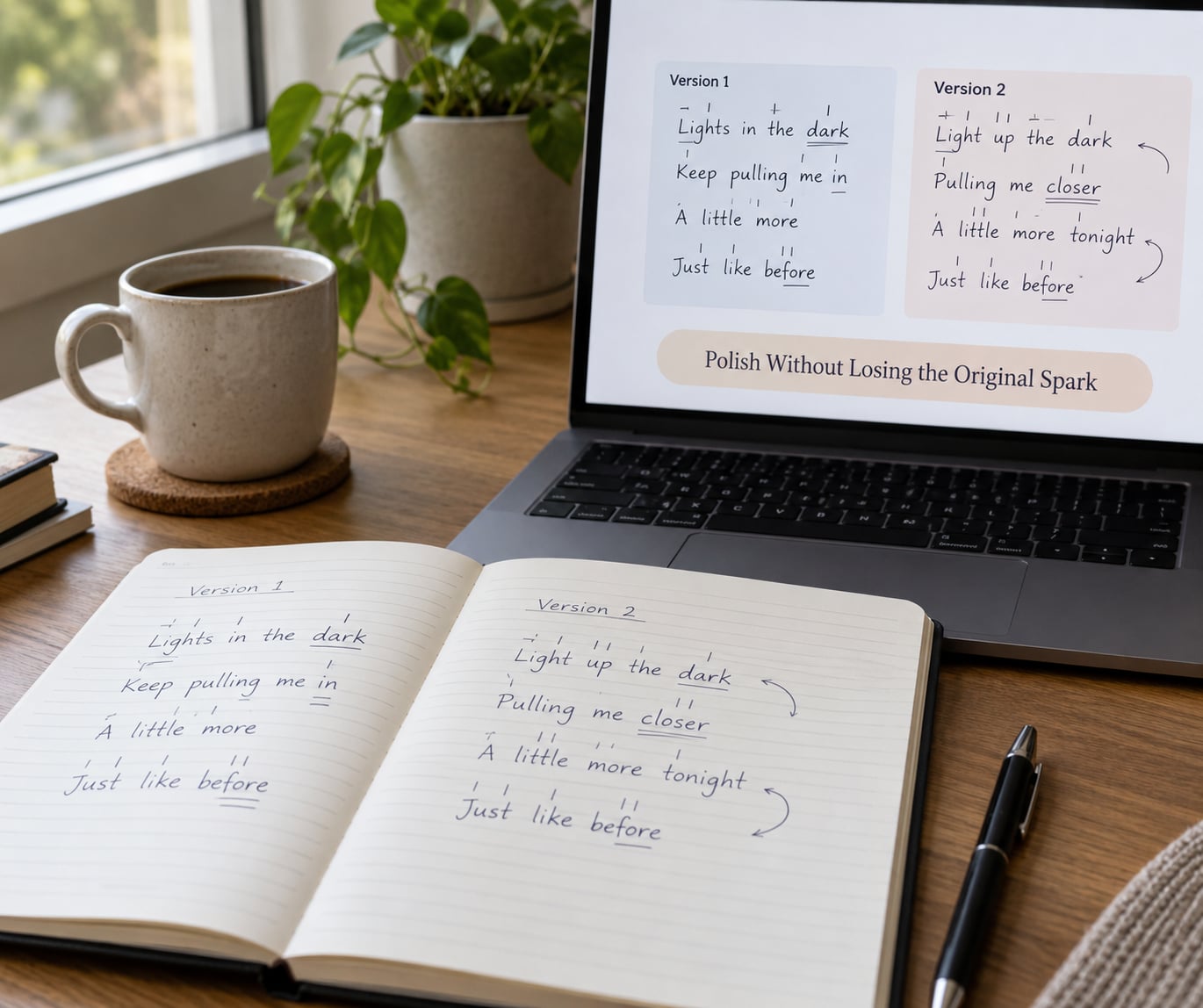
There is a version in every project that worked before anything was fixed. Find it and keep it.
Save dated drafts and label them. Draft 1, Draft 2, and a note about what changed and why. When you are three weeks into a revision loop and cannot tell whether the hook got better or just different, put the first draft and the current one back to back and listen. The answer is usually obvious, and it is almost never the version you have been staring at longest.
Polish in this order: diction, timing, register, transitions, arrangement. Fix one layer at a time. The moment you rewrite the words while adjusting the drums, you lose the ability to tell which change caused the problem.
You are finished when the hook sounds finished but still contains the one phrase, rhythm, or attitude that made you stop the first time you heard it. If everything has been smoothed into something correct, you have polished the spark out.
Common Mistakes
These are the six failures that come up again and again, with the fix for each. How to write a hook that sticks is mostly the absence of these problems.
Relying on a stock phrase. Clichés are not forbidden, they are just invisible. If your hook could slide into any song, it belongs to all of them and therefore sticks to none. Fix: replace the one abstract noun in the line with a physical detail you can picture.
Writing a chorus that summarises the song. The verses already did that job. A chorus that repeats the song’s plot leaves the listener with nothing new. Fix: make the hook the answer to a question the verses asked, not a recap of what they described.
Running too long. Once a phrase passes about ten syllables, the listener has to hold more than they can carry and the melody stops being repeatable. Fix: split it into two phrases and check that each one lands on a beat.
Repeating without change. Three identical returns and the pattern is set; the fourth and beyond is where listeners tune out. Fix: keep the words and melody identical on the fourth pass and change the arrangement instead — drop the drums, go half-volume, add a harmony.
Overwriting it into anonymity. The cleverest line in your notebook is usually the weakest hook, because it rewards hearing it once. Fix: keep it as a verse line where its cleverness has time to land, and write a plainer chorus.
Revising until it is smooth and dead. This is the page-versus-ear problem, and it is the one most writers cannot diagnose alone. A line can read beautifully and be impossible for anyone else to sing. The self-check is quick: sing it out loud by yourself, then sing it to one person once and see what comes back. If they paraphrase it, the line is not singable yet, no matter how good it looks.
Two habits prevent most of this. Test only one major change at a time, so you always know what fixed it. And write ten hooks, keep one. Volume beats inspiration for this particular job, because a hook is found by discarding far more often than it is invented.
Frequently Asked Questions
What makes a song hook easy to remember?
A memorable hook usually combines a clear emotional message, a repeatable melodic or rhythmic pattern, and language easy to follow on the first listen. A distinctive rhythm does the most work, because the body locks onto a pulse before the brain has finished parsing words. A narrow melodic contour comes second, then one idea in as few words as possible. Repetition only amplifies what is already there; repeating a busy line just makes the busyness familiar.
Should a hook be the same in every verse and chorus?
The central phrase or melodic identity should stay recognizable on every return, because changing it resets the pattern the listener has built. But the delivery around it can change: vocal tone, arrangement, dynamics, or a few meaningful words on the final chorus. A good rule is three identical returns followed by one that is musically identical and emotionally escalated, so the listener hears the same hook while feeling something has shifted.
How long should a song hook be?
Length matters far less than clarity, but the useful numbers are these: most strong hooks run four to ten syllables per phrase, the hook section usually sits between four and eight bars, and the whole phrase should be singable on one breath. If a listener has to breathe mid-phrase, the line is too long. Shorter than a full chorus is normal, though some hooks are simply one repeated line rather than a section.
How do I know if my hook is too complicated?
Play the rough version after a break, then try to describe its main emotion without singing it. If listeners debate the words, lose the beat, ask you to replay the recording, or sing back a different line, the hook is too complicated. A second sign is a chorus that needs its verse to make sense. A hook should survive standing alone, and a listener should be able to hum it after hearing it once or twice.
Should the song title be in the hook?
Often, and there are three places to put it: the first line, the last line, or both. Pop and dance records tend to bury the title early so it registers before the listener settles in. Country and narrative songs usually land it at the end as a payoff. Whichever slot you choose, the title word should fall on the longest, highest, or loudest moment in the phrase, because that is where memory holds on to it.
What is the rule of 3 in songwriting?
In hook writing, the rule of three means presenting a short idea three times so it locks in, rather than stating it once and moving on. Two exposures can sound like an accident, and four or more without any change begins to feel like a loop. Three clean repeats, then a fourth that escalates musically rather than rewording the lyric, is the most common working answer.
Conclusion
Here is tonight’s exercise. Write your core idea as one plain sentence, put a repeatable rhythm under it, record two versions an hour apart, and ask one person what they remember about it the following day. Whatever they hand back is closer to your hook than anything you produced this week.
The first thing to fix in learning how to write a hook that sticks is rarely the melody. It is deciding that the hook has one job, cutting every line to the fewest words that still carry the feeling, and revising for clarity before you reach for complexity. Do those three things and the rest is detail.