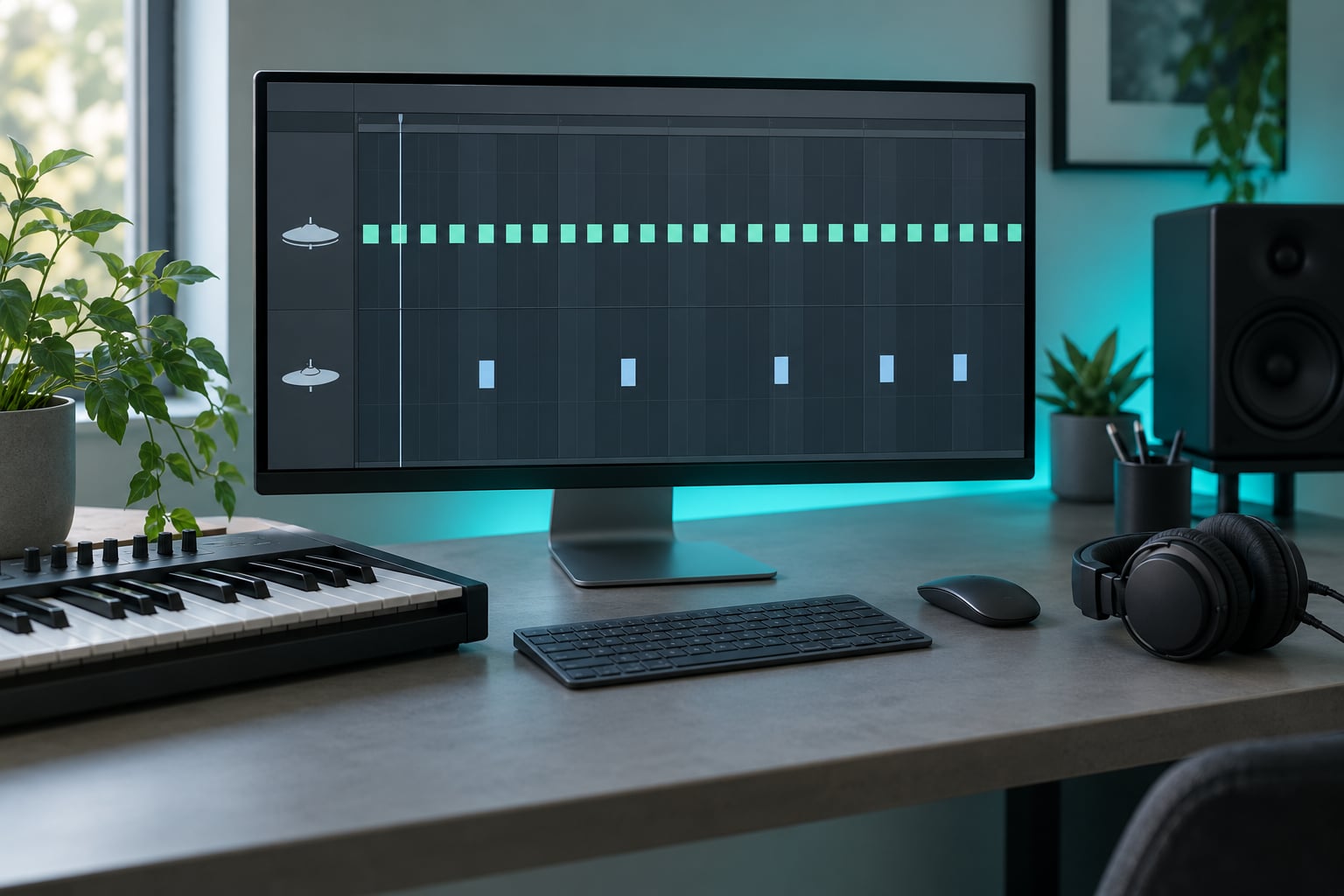
Hi-hats sound robotic when every hit lands dead on the grid at the same velocity using the same sample. To program hi hats that groove, you fix four things: timing, velocity, sound variation, and how open hats get choked. Pick one of those and the part improves immediately. Pick all four and it stops sounding like a metronome with hats on it.
This is the part almost every producer gets wrong first, and the fix takes maybe twenty minutes on an existing beat. You are not chasing perfection. You are introducing controlled inconsistency: a downbeat backbone first, subdivisions added underneath it at lower volume, hats landing a hair late, and open hats cut off the moment the next closed hat lands.
Two terms worth defining before the steps. Groove is the felt relationship between kick, snare and hats — not literal grid alignment. Micro-timing means moving individual notes a few ticks early or late relative to the grid, usually by less than the width of a grid line. Producers on the Ableton forum and the GearSpace hip-hop engineering boards describe the same principle in different words: drums that groove are never locked into each other the way full quantize locks them.
What You Need
Nothing exotic. The tool list for programming drums that move is short, and most of it is already inside the DAW you have open.
- One closed hi-hat sample with a short, tight decay. Long, washy hats hide timing mistakes instead of revealing them.
- One open hi-hat sample, ideally the same kit so the timbre matches when you alternate closed and open.
- A drum rack or sampler — Ableton Drum Rack, FL Studio FPC, Logic Step Sequencer, Maschine, or an MPC program.
- A piano roll, because per-note editing of velocity and position is the whole technique. The step sequencer grid is fine for laying down a pattern, not for finishing it.
- Swing and quantize-strength controls. Ableton calls the partial quantize setting Q-strength on the Groove Pool, FL Studio calls it the swing knob plus Strength, Maschine calls it Q-strength too.
- A velocity lane and a nudge control for micro-timing.
- Optional processing: a transient shaper, an EQ, and a short delay for depth. None of it comes before the groove.
If you are working on hardware, my preference is still to load the sampler into the DAW as a plugin and edit there. Maschine users on GearSpace recommend exactly this: use the hardware for playing ideas, then open the pattern in Cubase, Pro Tools or Ableton for the quantize and timing work, because the hardware grid fights you when you want notes deliberately off the line.
Step-by-Step
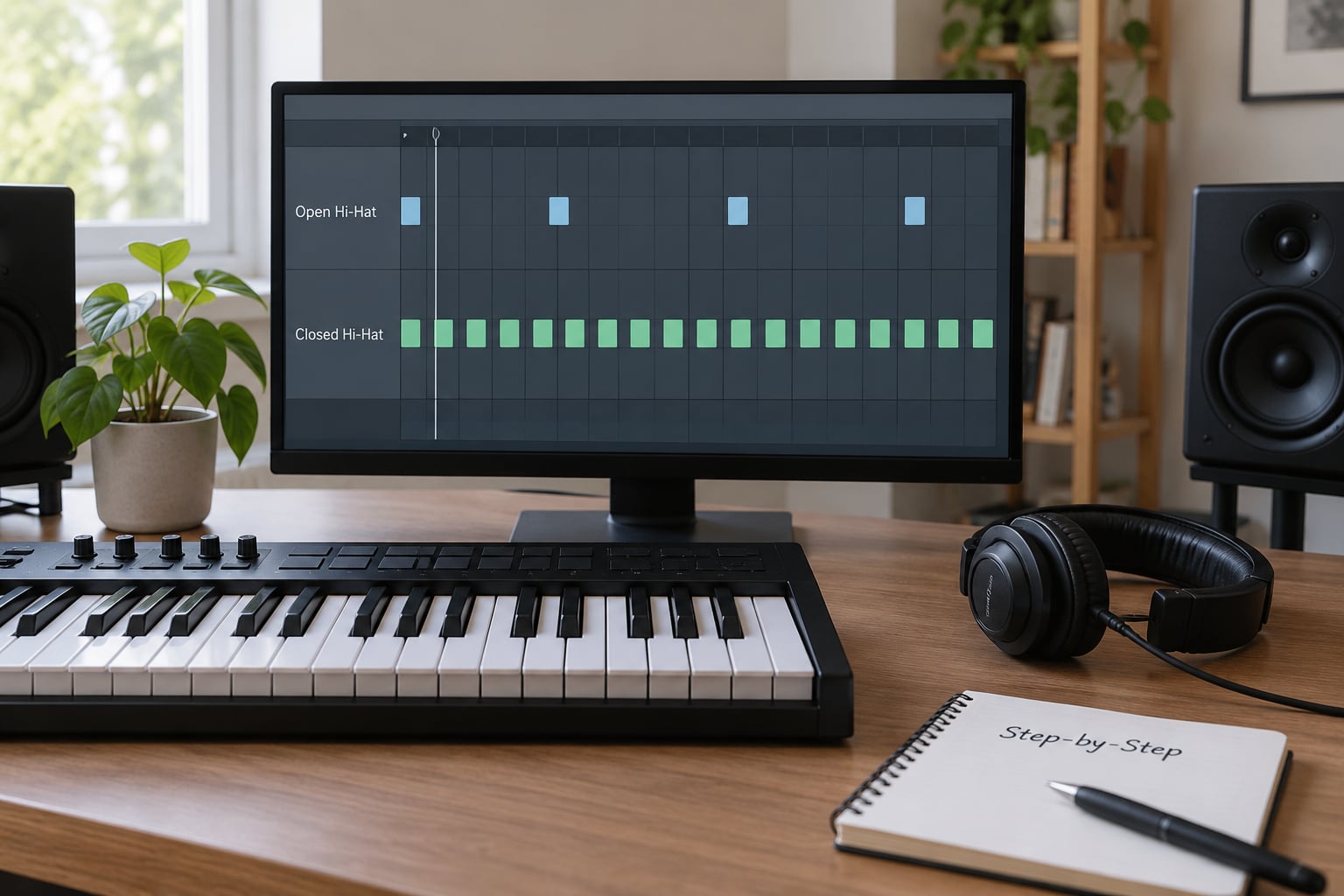
Work in this order and each stage gives you something to judge against. If a stage sounds worse than the one before it, back up — usually you have added too much rather than too little.
Choose a Hi-Hat With Clear Character
Pick a hat whose brightness, punch and decay you can identify in the first hit. Most 90s-style hip-hop grooves use a mid-bright, short closed hat, and that is the safest starting point. Bright, ringy hats are harder to groove because the transient smears the timing, and very dark hats can disappear behind a busy snare.
Decide the role before you decide the sample. A hat that carries the pulse wants a solid downbeat presence. A hat that sits behind the beat wants to be softer and darker. When in doubt, use the hat that is least interesting on its own, because you want the rhythm to be doing the work.
Keep an open hat from the same kit. Matching closed and open hats is the difference between a pattern that reads as one instrument and one that reads as a drum machine flipping between two presets.
Build a Simple Pocket With Eighth Notes
Start with quarter notes on the downbeats only, then eighth notes on the upbeats. That is the backbone, and it should be boring on purpose. A pattern that is too dense from the first bar leaves you nowhere to go, which is why 16th-note hats running for a whole track get grating by the second chorus.
Add the open hat last, on an upbeat just before a snare or at the end of a bar. One open hat per two bars is plenty to start. Check the result against the kick and snare: the hat should not be fighting either of them for the same frequency range or the same rhythmic moment.
How do you know the pocket works? Play the bar back and nod along. If your head wants to add a hat that is not there, the pattern is fine and you are hearing the missing subdivision. Add it at low velocity rather than filling everything in.
Add Swing Without Losing the Pulse
Swing delays every second subdivision, pushing it later to create a triplet-flavoured feel. The mistake is reaching for a huge amount. Above roughly 60% swing on hats, the backbeat drags behind the snare and the track feels sluggish rather than loose.
Instead of quantizing, play the pattern in. Producers consistently describe this as the better path: lay the hats in roughly where they land, then correct by ear. When you do quantize, keep quantize strength between 50% and 80%. At 100% every note snaps to the line and the groove dies; at 50% you close half the gap and the human timing survives. In Logic’s 960 PPQN grid, aim the second and fourth 16th near tick 60 rather than tick 120, then loosen slightly by hand.
Per-track swing beats one global setting. On GearSpace, one producer keeps the snare at 75% while the hats sit at 87% and it works, because the two elements serve different rhythmic jobs. Maschine also lets you set swing per sound; hold GRID and tap pad 16 to turn grid blocks off entirely, then place notes freely.
Two listening tests tell you whether the amount is right. Play the loop at full tempo and then at half speed — if the swing is obvious and slightly uncomfortable when halved, it is too much.
Vary Velocity to Create Human Motion
Velocity is the single biggest difference between robotic hats and played ones. Identical loudness on every hit is the clearest tell of a programmed part, and it is also the easiest thing to fix.
A pattern that works: accents at 100 to 120, body hits at 60 to 90, ghost notes below 70. A concrete pattern shared on r/WeAreTheMusicMakers is 100-60-90-60-120-60-90-60, which gives you a strong downbeat, a light upbeat, a medium offbeat, and one bigger accent to keep the bar from flattening out. Another approach from r/AdvancedProduction is to put hats on every subdivision at very low velocity and then gently raise three or four selected hits.
Draw the velocity lane rather than typing numbers into each note. In Ableton Live, enable the velocity lane below the piano roll, draw a shape with the pencil, and let the values land between them. Alt-drag copies the shape across a range so you can move a whole phrase at once.
Velocity doubles as a timbre control, which surprises people. The Ableton forum is blunt about it: play quieter and the pitch is slightly lower. So a ghost note is not only quieter, it is a slightly darker hat. That is a free variation you get without touching a single plugin.
Program Rolls, Triplets, and Open-Hat Breaths
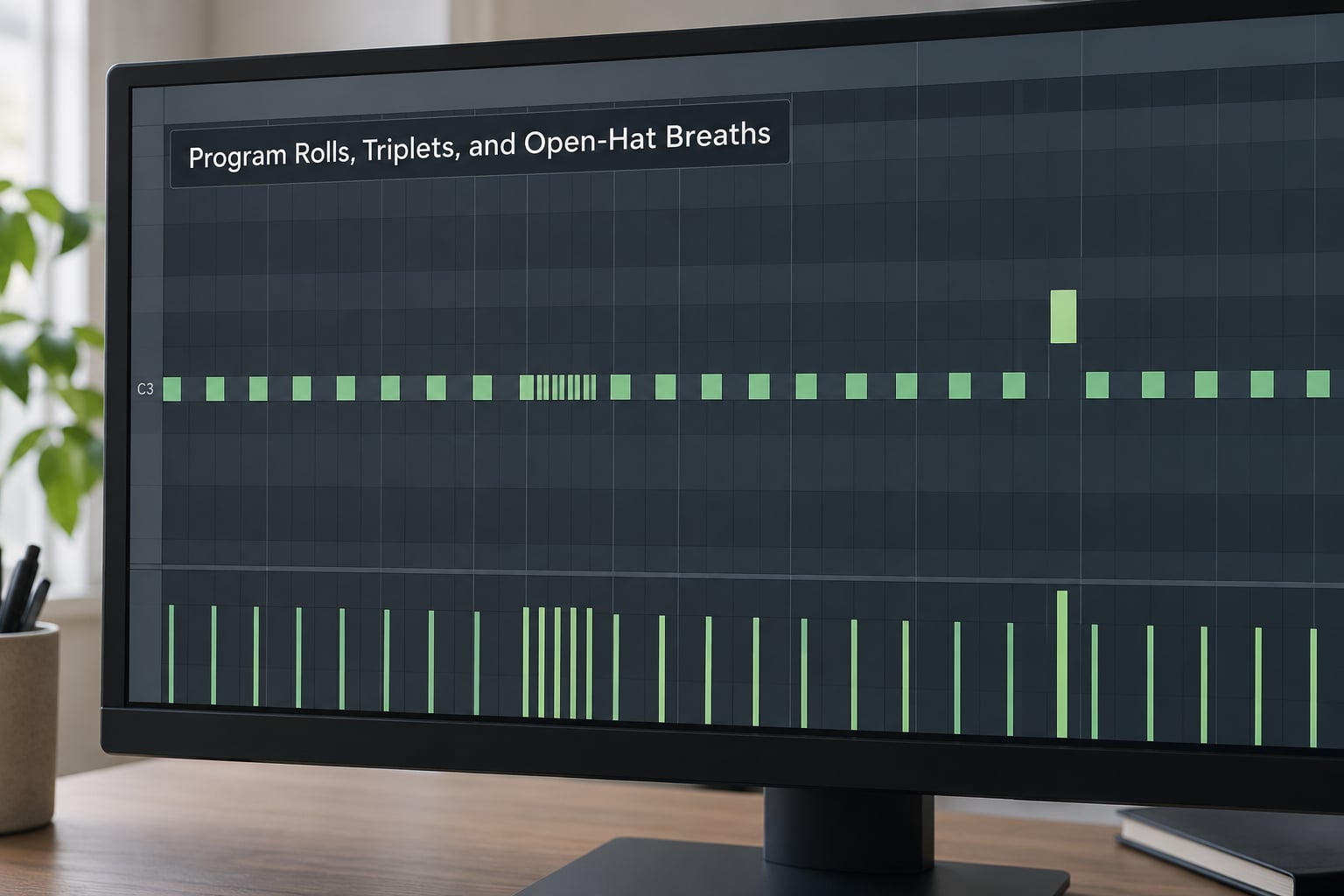
A roll is a burst of fast notes filling part of a beat. Use them as punctuation, not decoration — one at the end of a phrase or leading into a hook is plenty. In FL Studio, select the subdivision you want, set the step to 1/32 or 1/16, and draw four notes into the last beat of the bar. Alternating velocity across the roll, ending on the highest value, keeps it from sounding like a stuck repeat.
Triplets are useful when you want a hat pattern that sits against the snare instead of on it. A single triplet figure placed on the last 16th of beat four gives syncopation without adding density across the whole bar.
Open hats are where most people overdo it. Give an open hat room to ring by leaving a closed hat out of its path, then let the next closed hat choke it. If you want two open hats in a row, drop the velocity so it reads as a texture rather than a statement.
Check the result for space: if there is nowhere left for the vocal, the snare or the hook to breathe, you have added too many notes. Groove needs gaps.
Arrange the Hi-Hat Pattern Across the Track
Vary density and emphasis by section, because the same hat part over an intro, a verse and a hook flattens the song. Drop to downbeat-only hats in the intro, build eighths in the verse, add 16ths in the hook, and strip back to quarter notes for a breakdown. That contrast makes the loud sections feel larger than they actually are.
One-bar hat fills, 32nd-note builds into a pre-chorus, and sudden silence all work. A single bar with no hats at all before a hook does more for energy than adding another layer.
For reference, a three-minute track at 125 BPM contains roughly 1,500 hi-hat hits, making the hat the most-repeated sound in the entire mix. Any rigidity in it is the first thing a listener hears as programmed rather than played.
Common Mistakes
Overusing the open hat. Every upbeat open creates a busy, smeared feel. One per two bars, and only where it pushes the phrase forward.
Identical velocity on every hit. Draw accents at 100 to 120, keep body hits at 60 to 90, and drop ghosts below 70.
Too much swing. Past roughly 60% the hats sit behind the snare and the whole track drags. Back off, or use partial quantize instead of a large swing value.
Competing with the snare. If hats land on the same subdivisions as the snare at the same loudness, one of them should move. Cut the hats out of the snare’s window, usually beat 2 and beat 4.
No dynamic contrast. A 16th pattern at one velocity for four minutes has no shape. Change density and accent placement between sections.
Full 100% quantize on every element. This is the one that flattens everything else. Keep the kick and snare close to the grid, leave the hats at 50% to 80% strength or hand-placed.
One hat sample with no variation. Alternate two hats pitched slightly apart, or add a little random pitch variation — under 10% is plenty. In FL Studio, use the ALT+R Randomiser; in Ableton, put a tempo-synced LFO in Sample and Hold mode on the hat’s pitch.
Open hats bleeding into the next closed hat. That is a choke problem, not a pattern problem. In an Ableton Drum Rack, open the Show Chain List and Show Input/Output Section, then assign choke groups so the open hat is cut by every closed pad. In FL Studio’s FPC, set a Cut number on the open hat and add that number to Cut By on the closed one. Three things cause a choke that “doesn’t sound good”, the most common complaint on producer forums: leftover reverb baked into the sample, no velocity difference between open and closed, and choking on every single 16th.
Two extras worth a mention. Loops often arrive pre-reverbed, so run a transient shaper over them to pull the tail back before you add your own reverb, or the hats turn muddy. And hats should not share the same groove as the kick — tie them together and the whole kit moves as one block, which is the opposite of a pocket.
Genre Swing and Velocity Reference
Nobody publishes starting numbers for this, so here is a table to translate the technique into a first attempt. Adjust after you hear it.
| Genre | Swing / shuffle feel | Hat subdivision | Velocity accents | Open hat usage | Nudge direction |
|---|---|---|---|---|---|
| Boom bap | Heavy shuffle, around 58-62% or hand-placed | Eighths, 16ths on selected steps | Accents 110-120, ghosts near 60 | Rare, end of phrase | Hats about 20 ticks after the 8th |
| Trap | Straight with light roll feel | 16ths with rolls, occasional 32nds | Accents 100-115, rolls rising to 127 | Sparingly, on bar ends | Slightly ahead or dead on |
| House / EDM | Straight, 54-58% | Offbeat open hats with closed 16ths | Offbeat open at 100-110, closed 65-80 | The main event, every bar | Offbeats slightly ahead |
| Soul / R&B | Light, 54-56% | Eighths, sparse 16ths | Accents 95-110, soft bodies at 55-70 | Once per two or four bars | Laid back behind the snare |
| Afrobeats | Moderate, 56-60% | Syncopated 16ths across the bar | Alternating accents around 90 and 115 | On offbeats often | Even, with small pushes |
| Pop | Straight, 54-57% | Eighths into 16ths at the hook | Accents 100-110, bodies 60-85 | Every 4 or 8 bars | Straight with a light pull |
Frequently Asked Questions
How much swing should I use on hi-hats?
Start between 54% and 60% for most styles, and treat that as a ceiling rather than a goal. Above 60% the hats drag behind the snare and the track sounds slow. For boom bap, play the hats in by hand instead and quantize at 50% to 80% strength, which gives you looseness without committing to a swing value.
Should closed and open hi-hats use different velocities?
Yes, and the gap should be obvious. A common setup is closed hats at 60 to 90 with accents at 100 to 120, and the open hat at 100 to 110 so it reads as an accent rather than an accident. If the open hat sits at the same velocity as the closed ones, the choke sounds wrong and the pattern loses its punctuation.
What is the best way to make programmed hi-hats sound less repetitive?
Change four things across the track: velocity, density, sample and timing. Alternate two hat samples pitched slightly apart with variation under 10%, drop the pattern to downbeats in quieter sections, add 16ths only in the hook, and never quantize hats at 100%. Variation between sections matters more than variation inside a single bar.
How do I keep hi-hats from competing with my snare?
Move them out of the snare’s window. Leave the hats out of beats 2 and 4 or drop them to ghosts below 70 velocity there, and keep the snare at full level. Filtering the hats around 200 to 400 Hz where the snare body sits also helps, since that range is where both instruments fight for clarity.
Should I add a hi-hat roll on every chorus?
No. A roll works as punctuation because the listener expects plain eighths or 16ths most of the time. Use one roll at the end of a phrase or into a hook, alternate it with a chorus that has no roll at all, and let the velocity rise across the burst so the accent lands on the last note.
Do hi-hats need effects to sound good?
No, and processing before the groove exists just hides a bad pattern. Get the timing, velocity and choke behaviour right first. After that, a transient shaper to tighten the attack, a gentle high-pass and high-shelf, and a short ping-pong delay or throw of reverb add space without muddying the pocket.
Conclusion
Build the pattern down: downbeats only, then eighths, then 16ths at 60 to 90 velocity against accents at 100 or above. Set quantize strength to 50% to 80% so the hats keep some human timing, drag the whole hat lane about 20 ticks late if you are going for boom bap, and set up the choke so the open hat never smears. Once those four levers are right, add one small accent or roll per section and stop.