Here is the short version: hip hop chord progressions are usually one to four chords, almost always in a minor key, and they exist to set a mood under the vocal rather than to be the main event. You pick a key, choose a small loop, space the notes so the middle stays empty for the snare and the rapper, and let the 808 handle the low end.
That is genuinely the whole method. A beginner can build a usable beat in twenty minutes with a MIDI keyboard and a DAW, and the skill that separates a flat loop from one that feels expensive is not theory. It is register spacing, which is the one idea this guide gives the most attention to.
Producers on production forums keep hitting the same walls, so this is built around those. If your chords all sound identical no matter which numerals you type, you are probably choosing chords correctly and voicing them badly. If your melody feels weak while the drums and 808 sound fine, the chord choice is usually the reason. If you are stuck on theory, the eight progressions below are enough to make beats for years.
Everything here works in FL Studio, Ableton Live, Logic Pro, Studio One or anything else that accepts MIDI. No step below assumes a particular piece of software.
Table of Contents
- What You Need
- Step-by-Step: How to Use Chord Progressions in Hip Hop
- Common Mistakes
- Tips for Using Hip-Hop Chord Progressions Creatively
- Frequently Asked Questions
- What is the best chord progression for hip hop?
- How many chords should a hip hop beat have?
- Why do my trap chords sound thin even though the progression is right?
- What key is most hip hop music in, and should I use minor or major?
- What is the 1-5-6-4 chord progression called?
- How do I learn chord progressions without getting stuck on theory?
- Conclusion
What You Need
You need very little. Most of what gets sold as essential for hip hop production is optional, and a beginner with three things can cover every technique in this guide.
A keyboard or piano controller. A 25-key model covers the range of most loops. An electric piano, a MIDI controller with keys, or even a free on-screen piano works. Fingering matters less than you think because the progressions here are short, and repeated notes mean your hand barely moves.
A DAW. Any digital audio workstation records MIDI and audio, and every technique below works in all of them. If you have never opened one, the workflow is the same everywhere: load a drum loop or program drums, drop in a chord instrument, write or play MIDI, arrange, export.
Optional reference tools. A tuner helps you hear whether your chords are in tune. A reference track in the same key is worth more than any plugin. A scale or chord finder site can confirm what you built, but you do not need one to start.
One piece of background knowledge helps more than the rest: how time is counted. A bar, or measure, is a container for beats. A 4/4 bar has four beats, a half note lasts two beats, a quarter note one, an eighth note half of one, and a sixteenth a quarter of one. Hip hop harmony is almost always built in two-bar or four-bar loops, and when you hear a chord change every two beats you now know why.
That is genuinely enough. Everything else in this article is a technique, not a prerequisite.
Step-by-Step: How to Use Chord Progressions in Hip Hop
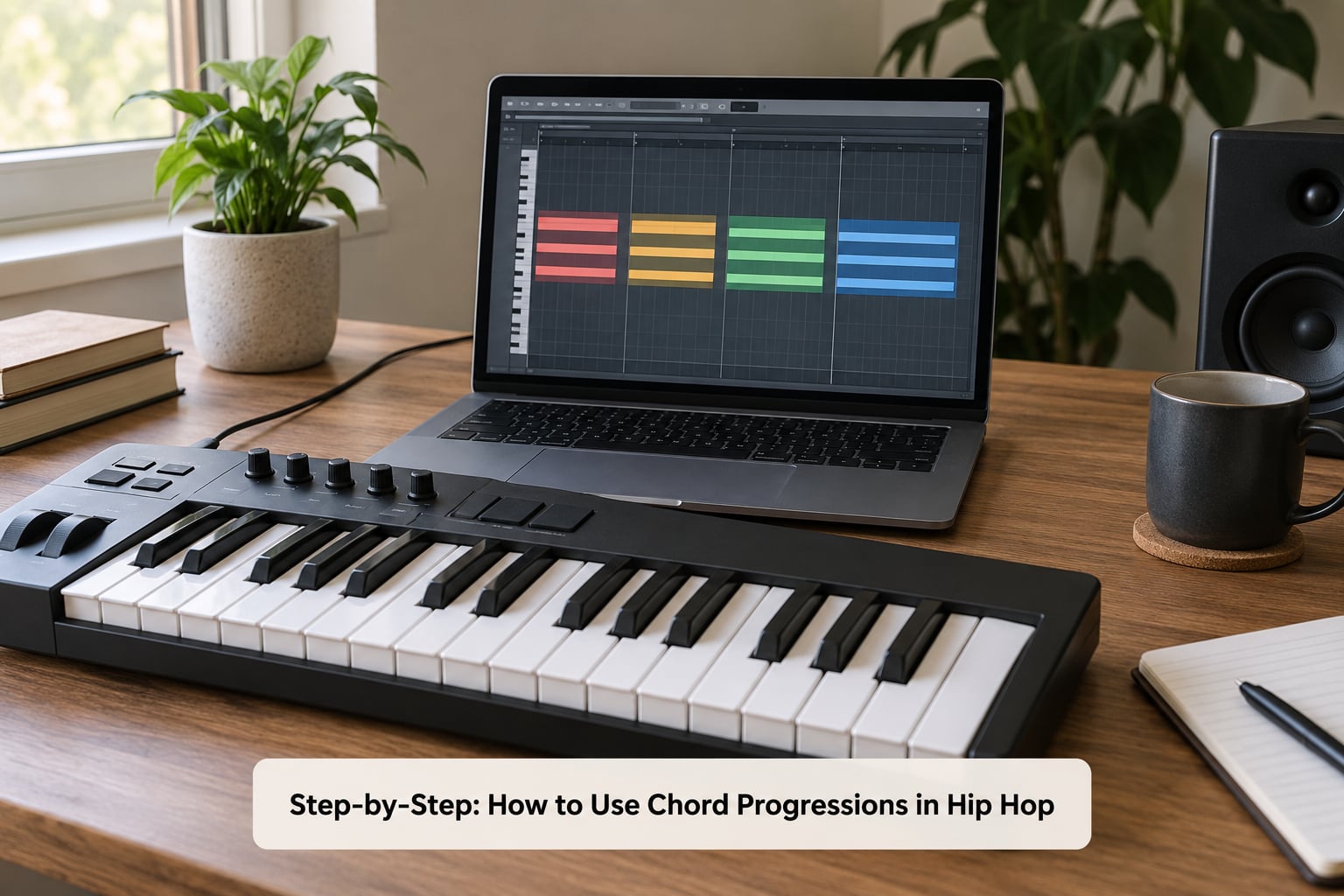
Choose a Key and Musical Mood
Start in A minor. It is the most common default in hip hop because the notes sit dark without being tense, and most of the progressions in this guide were built there so you can compare them directly.
Minor is the usual answer when a rap vocal is going to sit on top. Major keys work, but they read as brighter and more resolved, so they show up more in feel-good and commercial records than in night-time beats. Modal harmony sits between the two: a mode keeps the same seven notes as the major or minor scale but puts the emphasis somewhere different, which gives you a mood without the emotional weight of a full minor or major chord.
Matching a reference track is a practical shortcut. Pick a record you like, find its key, and build in that key so your beat sits in the same place when it is played next to the original. Chord finder tools and simple spectral plugins will read a key off a track in a few seconds, and you do not have to be right on the first guess. Move up or down a whole step or two until the loop sits comfortably behind the record.
A quick word on Roman numerals, since they show up in every table below. A numeral is just a chord measured against the key you are in. Lowercase means minor, uppercase means major, and a flat sign in front means the chord was borrowed from the parallel major or minor. In A minor, i is A minor, bVI is F major, bVII is G major, and IV is D minor. Once you can read those five symbols you can analyse most hip hop records on your own.
Eight Progressions to Start From
The practical answer to how to use chord progressions in hip hop is to pick one and loop it until you hear something you want to change. These eight cover the large majority of what you hear in trap, boom bap, drill, melodic trap and lo-fi. All of them are written in A minor so you can hear the shared notes. Substitute any other minor key and the character stays the same while the colours change.
| Progression | Numerals | Chords in A minor | Mood | Where it fits |
|---|---|---|---|---|
| The One-Chord Loop | i | Am | Focused, cold, patient | Drill, sparse trap, freestyles |
| The Two-Chord Turn | i – bVII | Am – G | Melancholic, settled | Melodic trap, boom bap |
| The Trap Standard | i – bVI – bVII | Am – F – G | Dark, confident | Trap, melodic rap |
| The Descending Plane | i – bVII – bVI | Am – G – F | Heavy, falling tension | Trap, dark melodic |
| The Dark Trap Cadence | i – bVI – V | Am – F – E | Unresolved, uneasy | Trap, horror-adjacent |
| The Drill Turn | bII – i | Bb – Am | Sliding, restless | Drill, UK bass textures |
| The Melodic Loop | i – iv – bVII – bIII | Am – Dm – G – C | Warm, nostalgic, bittersweet | Melodic trap, R&B, lo-fi |
| The 1-5-6-4 Lineage | I – V – vi – IV | C – G – Am – F | Bright, soulful, nostalgic | West Coast, G-funk, flip territory |
Two patterns show up over and over. The minor-key one, i – bVI – bVII, is the backbone of most modern trap because the root steps down a semitone at the end, which is the sound of minor chords. The major 1-5-6-4 lineage is the pop and soul loop that a lot of West Coast and flip-based beats grow out of, and it is worth learning next to the minor one so you can hear the difference.
Notice what is missing: the V chord. Avoiding a dominant chord means the loop never fully resolves, which is why these progressions can run for sixteen bars without sounding finished. You do not need to add a resolution. Leaving it out is the trick.
Build a Simple Four-Chord Progression
A four-chord loop is where the craft starts showing. Two methods get you there quickly, and both rely on moving the smallest possible distance between chords so the ear hears one shape transforming instead of four unrelated objects.
The first method is repetition. The Trap Standard, i – bVI – bVII, uses three chords, but A minor shares notes with F major and G major, so you can play a simple arpeggio figure and only the top note changes at each chord change. The second is stepwise movement, where each root moves by a step, as in the Melodic Loop.
Write it as a number line before you touch the keyboard. For i – iv – bVII – bIII in A minor, that is A, D, G, C, and as note numbers against the key, 1, 4, 7, 3. Put the four roots on beats one and three of a two-bar loop, hold each chord for a full bar or a half bar, and the arrangement is done before you add any ornament.
Beyond triads is the natural next move. A min7 adds a minor seventh to the chord, a maj7 adds a major seventh, and both make the sound rounder and less thin. A minor 9 or major 9 adds one more colour note on top and is the sound you hear in most melodic rap and R&B. Swap Am for Am9 and F for Fmaj7 and the same three-chord loop immediately sounds more expensive without getting busier.
Keep extensions, but count the tones. Every added note occupies space, and space is exactly what you need for the vocal.
Leave Space for the Rap Vocal
This is where most beginner loops fall apart, and the symptom is always the same complaint: the chords sound thin and the beat feels cluttered at the same time. Those two problems have one cause, which is that the notes are bunched in the middle of the keyboard.
The fix is register spacing. Put the root of each chord low, an octave or two below where the chord tones sit, and put the chord tones high. Leave the middle empty. That gap is where the snare, the hats and the vocal live, and once the vocal is recorded you will find the beat suddenly feels clearer without changing anything else.
Written out, the difference is obvious. A close-voiced A minor chord played with the left hand in a mid register sits from roughly A3 to E4, right in the snare and vocal range. Space it out and the root drops to A1 while the chord tones move up to A4 and above, and the A2 to A3 region that was making everything muddy is now silent.
Two more things help. Drop notes rather than only filtering them, so the chord has fewer tones competing for attention instead of the same number with a duller top end. And use inversions: putting the third or the fifth in the bass instead of the root gives you a different colour from the same chord, and lets the 808 glide into a new root more smoothly.
How do you know it worked? Hum the loop with the drums playing. If any note in the harmony fights your hum, that note is sitting too close to where the vocal will be, and it needs to move an octave or get cut.
Connect the Chords to a Hip-Hop Drum Pattern
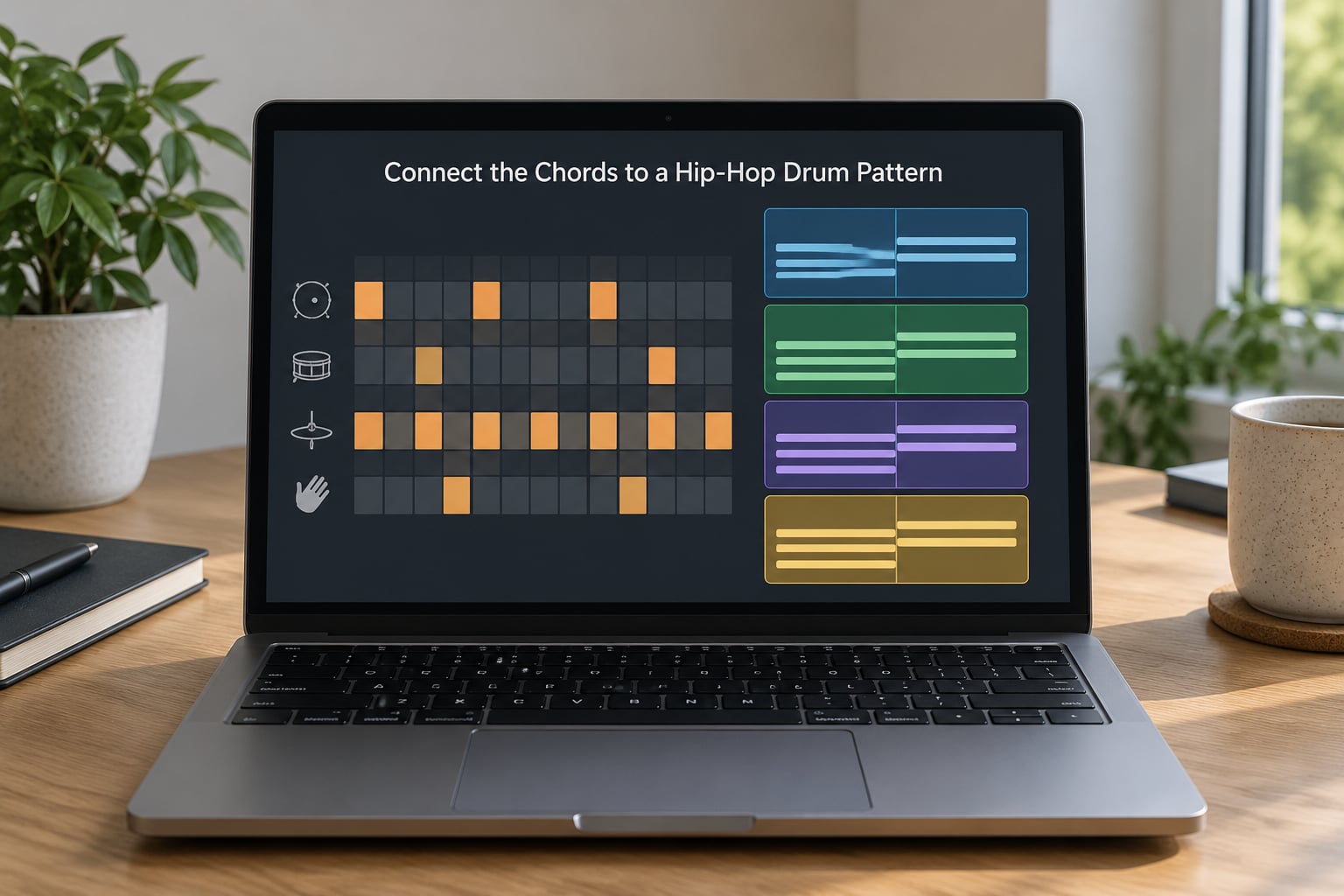
Chords in hip hop are a bed, so the drums set the clock they move on. A boom bap pattern in the high sixties to low nineties BPM and a trap pattern in the high one-hundreds move the same chords very differently, which is why the subgenre dictates the loop length more than the harmony does.
For boom bap, place one chord change every two bars and let each chord hold. The backbeat is sparse enough that a sustained chord reads as part of the groove, and a snare-led pattern needs room around it. For trap, chords often change on the half-time bar, meaning every second bar of a four-bar loop, and the changes usually land on a snare or a hat pattern you have already programmed.
Half-time is worth understanding because it explains why many producers think in a slower tempo than the project runs at. A beat at 140 BPM in half-time feels like 70, which is why a loop written for a boom bap mindset often works in modern trap. Set the project tempo to whatever feels right, then decide deliberately whether the chords move on the fast grid or the half-time grid.
Now the 808. Give the 808 the root and take the root out of the chord part, or accept a slight overlap only if it is intentional. Letting both instruments play the same low note doubles the energy and muddies the low end, and the standard trap answer is a long sustained sub under a short chord hit. Half-step slides into a new root, the little downward glide into the next note, work because they resolve into a note the chord part is already playing.
A useful default per subgenre:
| Subgenre | Tempo range | Chords | Extension level | Harmony role |
|---|---|---|---|---|
| Boom bap | 85-100 BPM | 4 to 6, or one sampled loop | Triad or min7 | Constant, groove-locked |
| Trap | 130-150 BPM | 1 to 3 | min7, m9 | Half-time bed |
| Drill | 138-145 BPM | 1 to 2 | Minor triad, occasional bII | Sparse, sliding |
| Melodic trap | 130-150 BPM | 3 to 4 | 7th and 9th chords | Lead-adjacent, emotional |
| Lo-fi | 70-90 BPM | 4 to 7 | 7th, 9th, 11th | Full arrangement, hazy |
| West Coast | 90-105 BPM | 1 chord plus stabs | Dominant 7th stabs | Rhythmic, swung stabs |
For West Coast specifically, the harmony is played as stabs rather than held chords: short, swung chord hits on the offbeat of a swung 16th grid, usually a dominant 7th sound, sitting over a bass line that does the melodic work. A swung feel means the last 16th of every group lands late, so nudge those chord stabs a few milliseconds behind the grid. The contrast between a straight drum pattern and a late stab is most of the style.
Everything above is DAW-agnostic. In FL Studio the steps are the 3×3 piano roll and the channel rack, in Ableton Live they are the MIDI clip and the device chain, in Logic they are the piano roll and the instrument track. Same decisions, different labels.
Common Mistakes
Almost every problem in a beginner hip hop loop comes down to spacing, chord count or timing. Each has a straightforward fix.
| Mistake | What it sounds like | The fix |
|---|---|---|
| Close voicing in the midrange | Thin chords that still crowd the vocal | Root down two octaves, chord tones up, empty middle |
| Too many chords | Busy, restless, nothing lands | Cut to one, two or three and hold each one longer |
| Chords fighting the vocal | Muddy vocal, no clarity | Delete chord tones in the vocal’s range rather than only lowering volume |
| 808 doubling the root | Muddy low end, weak kick | 808 plays the root alone, chord part starts an octave or two up |
| Abrupt chord changes | Jarring, no groove | Extend each chord to a full bar or half bar and land changes on the snare |
| Adding a V chord to resolve | The loop feels finished after two bars | Leave the V out. The unresolved loop is the reason it repeats |
| Static rhythm | The loop has no movement | Vary the arpeggio pattern or add a chord stab on the offbeat |
| Copying a generic progression site | Everything sounds the same | Reverse-engineer a record you like instead of browsing lists |
The melody problem is worth calling out separately, because it is the one producers describe most and the one least often linked to chord choice. If a melody you wrote sounds weak over a correct progression, the problem is usually register again. Your melody and your chord tones are competing in the same octave, so the melody has nowhere to sit. Move the chords apart, and the melody often sounds fine the moment you give it an empty space to occupy.
Second, a melody that wanders is usually a melody with no chord tones to lean on. Pull one chord tone, usually the third of the current chord, into the melodic line and the notes either side of it start making sense as an approach and a resolution rather than three unrelated pitches.
Tips for Using Hip-Hop Chord Progressions Creatively
Climb the extension ladder deliberately. A triad is plain and defined. A 7th is warmer and slightly unresolved, which is where most hip hop sits. A 9th adds wonder and is the classic melodic rap and R&B colour. An 11th opens the chord up further, and a 13th gives that wide, dreamy lo-fi sound. Move up one rung at a time and listen to what each adds, rather than stacking everything at once.
Use modal interchange. In one sentence: borrowing a chord from the parallel major or minor key. In A minor, the bVI and bVII in almost every progression on this list are borrowed from A major. Once you hear that, you can go further and pull in a bIII major chord for a brighter colour or a major 7th on the bVII for a floating, unresolved quality that sits well under a melodic hook.
Vary the rhythm, not just the notes. The same three chords sound like a completely different beat if you play them as a long held pad, as a fast arpeggio, or as short stabs on the offbeat. Producers often spend twenty minutes searching for new chords when rearranging the same loop rhythmically would have done more.
Write harmony in call and response. Give the chord part its own melodic fragment that answers the vocal instead of doubling it. Two bars where the vocal leads and the chord part answers, then two bars swapped, keeps the arrangement moving without adding a single new note.
Match the arc. Verses usually want fewer notes and more space. Hooks can carry more harmony or more rhythmic movement. An arrangement that keeps the same loop at the same level for two minutes gets boring even if the loop is good, so strip it back in the verse, add a stab or a counter-melody in the hook, and bring a new chord in only for the last eight bars.
Build your own progression from a record. This is where most producers’ best-sounding loops actually came from, theory knowledge or not. Find a soul, funk or jazz record you like and work through it in five steps:
- Find the loop. Pick a four-bar section with a chord you like, usually a Rhodes or electric piano part.
- Chop it. Slice the loop so each chord change is its own piece.
- Time-stretch it. Stretch the pieces to the BPM of your beat. The pitch stays where it is.
- Pitch-shift it. Shift the whole set up or down until it matches the key of your drums and 808.
- Re-chop it. Reorder, duplicate or drop pieces to build a progression of your own instead of the record’s order.
Clear the sample before you release anything, which is a separate process from the chopping. But as a learning exercise the workflow teaches more about voice leading than any theory chapter, because you are hearing the spacing a pianist chose decades before you sat down.
Frequently Asked Questions
What is the best chord progression for hip hop?
For most beginners, i – bVI – bVII in A minor, which is Am – F – G, is the single most useful starting point. It sounds dark, it loops endlessly because it never resolves, and it works under almost any rap vocal. If you want less, one chord on i is genuinely professional in drill and sparse trap. Start there, then move down to i – bVII when you want a bit more movement.
How many chords should a hip hop beat have?
Between one and four, with two or three being the sweet spot for most styles. Boom bap and flip-based beats can carry six or more because the drums are sparse, while trap and drill usually use one to three. The reason is that hip hop harmony is sparse by design, so every chord you add competes with the snare and the vocal for space. If a loop feels busy, it is almost always the chord count rather than the chord choice.
Why do my trap chords sound thin even though the progression is right?
Thin chords are almost always a voicing problem, not a progression problem. Put the root an octave or two lower, move the chord tones up, and leave the middle of the keyboard empty for the snare and the vocal. Adding a 7th or 9th also adds weight, since extensions are extra tones rather than louder ones. If it sounds thin and cluttered at the same time, you have too many chord tones in the vocal’s register.
What key is most hip hop music in, and should I use minor or major?
A minor is the most common default because it sits dark behind a rap vocal without sounding tense, which makes it an easy first key. Major keys work when the track is meant to feel bright, uplifting or commercial. If you are matching a reference track, match its key instead, so both sit in the same place when they play together. Modal harmony gives you a third option for a mood without the full emotional weight of minor or major.
What is the 1-5-6-4 chord progression called?
It is usually called the 1-5-6-4, or I-V-vi-IV, and in Roman numerals it is I – V – vi – IV. It is a pop and soul loop rather than a named classical progression, which is why you will not find a single traditional label for it. In hip hop it matters because it feeds the West Coast and G-funk sound, and it is the lineage behind a lot of chopped funk and soul loops. Try it as C – G – Am – F.
How do I learn chord progressions without getting stuck on theory?
Learn what a chord does rather than why it works, then reverse-engineer records you already like. Pick a beat you enjoy, find its key, and try to rebuild its loop with your own voicing. That gives you the reason a progression was chosen, which is far more useful than a rule about scale degrees. Practically, memorise three loops, use them until they are boring, then move on. Producers consistently report that functionality gets results faster than formal study.
Conclusion
Start with three chords in A minor, Am – F – G, held for one bar each over a boom bap pattern at about 90 BPM. Drop the root low, put the chord tones high, and leave the middle empty. Then play it with a vocal on top and listen for where the two fight, because that gap you leave is the whole difference between a loop that works and one that does not.
Revise by ear with the beat and the lyrics playing together, not in isolation. Change one thing at a time, keep a note on which progressions you have used, and revisit this guide as October 2026 brings new records worth reverse-engineering.