A mastering engineer is the last person to touch your record before it goes out. They take your finished stereo mix, correct what does not translate, set the loudness, and deliver files built for streaming, CD and vinyl. In short, what does a mastering engineer do? They make a good mix consistent, competitive and safe to release.
That is the whole job in one sentence. Below is what sits underneath it, from the first listen to the final export.
Table of Contents
- What Is a Mastering Engineer?
- What Does a Mastering Engineer Do? Step by Step
- How Do Mastering Engineers Prepare Tracks for Different Formats?
- What Tools and Measurements Do Mastering Engineers Use?
- How Does an Engineer Collaborate With the Artist and Mix Engineer?
- What Should You Send a Mastering Engineer?
- What Does a Mastering Engineer Deliver?
- Frequently Asked Questions
- Conclusion: Start with the Mix
What Is a Mastering Engineer?
Mastering is the final stage of audio production. The mix engineer decides how every track inside the song sits together and what the record sounds like. The mastering engineer receives that finished stereo mixdown and works on the whole thing as one object, without the individual stems.
Think of the mix as the photography and mastering as the printing. The exposure is already set; what is left is the paper, the chemistry and the careful pass that removes the dust.
Most mastering engineers work from a printed stereo file, though some accept stems or a multitrack session. Either way the deliverable is a set of masters, one per destination, plus whatever documentation the release needs.
What Does a Mastering Engineer Do? Step by Step
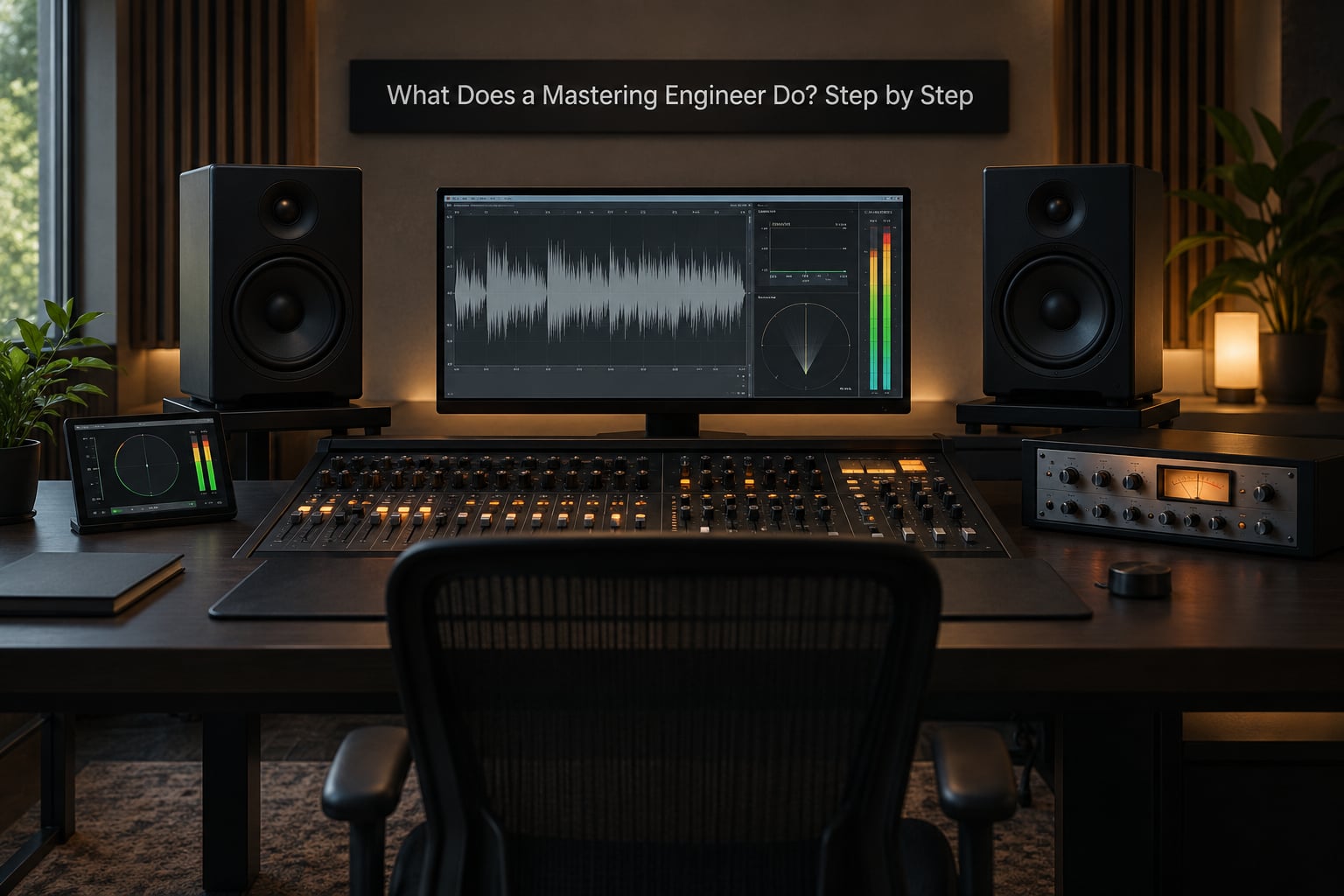
The order below is roughly how a session runs, though a good engineer loops back. The first three steps are listening, and they take longer than everything that follows.
How Do They Listen Before Changing the Mix?
Before touching a control, a mastering engineer plays the mix at a calibrated level, in a room treated to hold a flat response from roughly 20 Hz to 20 kHz. That neutral room is part of the qualification. In an untreated space the speakers fight the walls and every decision gets skewed.
The listen runs on several systems: the main monitors, a second pair, headphones, a phone speaker, a car system. A mix that collapses on an earbud or a phone speaker is not finished, no matter how good it sounds in the control room.
During that pass the engineer is checking tonal balance, whether low end turns to mud on small speakers, whether vocals fight the guitars, whether noise floor and clicks survive, and whether the stereo image collapses in mono. Reference tracks get used constantly, not to copy a song but to set a scale for punch, width and level.
What Does a Mastering Engineer Do to a Mix?
Once the problems are named, the work is corrective first and creative second. Equalization is usually the first tool: a cut around 200 Hz to clear muddiness, a gentle reduction of a harsh vocal peak between 2 and 4 kHz, taming of sibilance near 7 to 8 kHz, and a small mid-side lift around 12 kHz for air.
Compression follows, and usually gently, to even out level and add glue. A ratio near 1.2 to 1 is a typical starting point; anything higher flattens the track quickly. Then comes stereo imaging, where the mid and side signals are balanced to widen the mix without making it collapse in mono.
Saturation and harmonic generation add a little density when a mix feels thin. Restraint is the constant. Engineers tend to describe a good master as the last five percent, not a rebuild, and stacked EQs and limiters are the fastest route to a thin, lifeless record.
How Do Mastering Engineers Set Loudness?
Modern loudness is measured in LUFS, or loudness units relative to full scale, defined by the ITU-R BS.1770 standard. Two numbers matter: integrated loudness for the whole track, and true peak for the highest point in the waveform.
True peak matters more than it sounds. A sample peak reading of 0 dBFS can still hide inter-sample peaks above it, and lossy encoding like AAC or MP3 can push those peaks into audible distortion on the listener’s device. Staying a decibel or so below the ceiling, around -1 dBTP, keeps that from happening.
The following table is a set of working references, not rules. They vary by genre and by how a release is meant to be heard.
| Destination | Integrated loudness | True peak | Why |
|---|---|---|---|
| Streaming services | About -14 LUFS | -1 dBTP | Platforms normalize volume, so extra gain buys little |
| CD | About -9 LUFS | -0.1 dBTP | No normalization, so the master can sit higher |
| Typical commercial master | Roughly -10 LUFS | -1 dBTP | A common middle ground across releases |
| Club and DJ playback | Genre dependent | -0.1 dBTP | Systems are loud; headroom matters more than level |
| Broadcast, EBU R128 | -23 LUFS | -1 dBTP | Set by the standard rather than by taste |
Matching the level of a commercial track is not the same as matching its sound. A track can hit the same number with far more dynamic range and still sit correctly next to it.
How Do Mastering Engineers Prepare Tracks for Different Formats?
One master for every destination is a habit from an era when there was one destination. Today the deliverables diverge, and an engineer who ships a single file for streaming, vinyl and broadcast is cutting corners.
For streaming, the priority is a clean file at the right bit depth and sample rate, with true peak under the ceiling and enough headroom that the service’s own encoding does no damage. A 24-bit WAV at the session’s native sample rate, often 44.1 or 48 kHz, is the normal deliverable.
For CD, the master is delivered as a 16-bit file, usually through a DDP so the disc image is assembled before it reaches the plant. Dither is applied at that stage, because going from 24-bit to 16-bit without it throws away quiet detail in a way you can hear in fades and reverb tails.
For vinyl, the premaster is handled differently. The RIAA pre-emphasis curve boosts high frequencies and cuts lows so the record sounds right after playback, and the mastering engineer balances the track against that curve while leaving headroom for the way a cut disc compresses dynamics. Half-speed cuts demand even more space than normal-speed ones.
For club and broadcast, the priorities change again: long low end, controlled low-mid buildup, and in the broadcast case, delivery to a technical specification rather than a preference.
What Tools and Measurements Do Mastering Engineers Use?
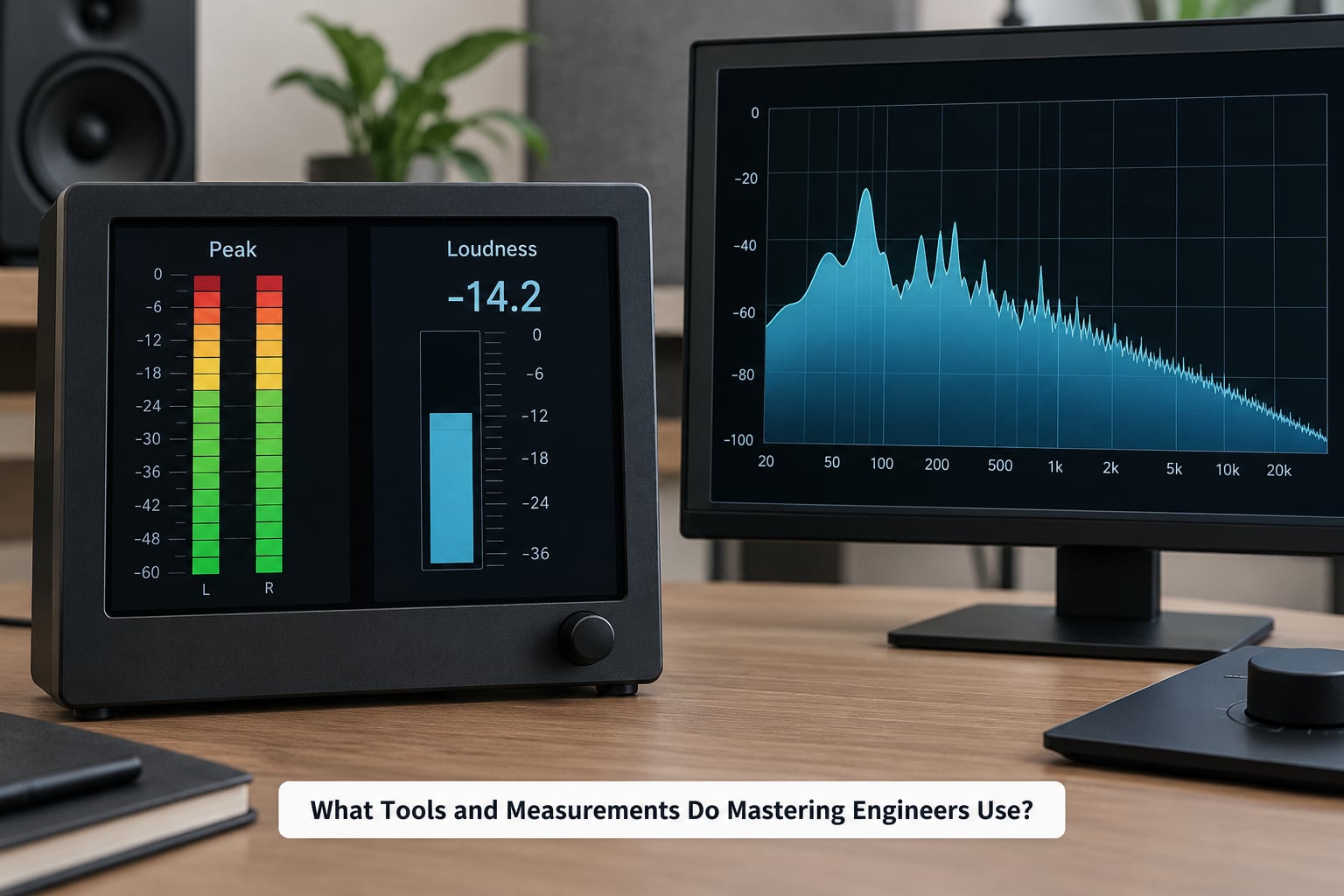
Monitoring comes first, and it is calibrated so the level is repeatable. An engineer who listens at an arbitrary volume makes different decisions each session, and loud playback also tires the ear faster, which is where over-processing usually starts.
Meters come next: loudness meters for integrated LUFS and loudness range, true peak meters, and a spectrum analyzer for spotting problems that are easier to see than hear, such as a narrow ringing resonance or a bass build-up in one band.
A stereo correlation or phase meter checks mono compatibility, which matters for club systems and phone playback. Processing itself may be software, such as Ozone, or outboard hardware. Some engineers hold a preference for outboard gear because it behaves the same way every session, but an expensive chain does not fix a bad mix bus. The room and the ear come first.
Genre shapes the target too. A trap record wants weight and a ceiling near 0 dBTP, an acoustic record wants dynamic range left alone, and an EDM track has to survive a system far louder than the one it was mixed in.
How Does an Engineer Collaborate With the Artist and Mix Engineer?
Mastering is a conversation, and it works best when the artist arrives with references and a sentence about what the record should feel like. Send two or three tracks that sit where you want this one, and say why. Without that, the engineer is guessing at a target you never stated.
Revision limits are normal, usually one or two rounds, and a good engineer will tell an artist when the request is going to damage the mix. Asking for louder is a common request and a legitimate one, since it is the job. Pushing a track past the point where transients survive is not.
On an album, the mastering engineer handles sequencing and level matching so track four does not jump out of the speakers after track three. Metadata also gets checked at this stage: artist name, song and album titles, track order, ISRC codes if they already exist, and split information for publishing.
There is a difference worth keeping straight. A mix is finished when the song works, when every part is balanced and nothing is obviously broken. It is mastered when the record works as a released object, holding together across ten tracks and every system a listener might use.
What Should You Send a Mastering Engineer?
Most engineers will ask for a specific set of things, and arriving with them saves a round of emails. The single most common mistake is a mix that is already too hot.
- The mix, at the highest quality you have. A 24-bit WAV at the native sample rate. Never an MP3, never a 16-bit bounce if a 24-bit export exists.
- About -6 dBFS of headroom. Peaks sitting well below full scale, with no clipping anywhere in the file.
- Labels and a tracklist. Artist name, song title, album title, in the order you want them.
- Notes. Which mix bus or version is the final one, and whether anything was printed on it.
- Reference tracks. Two or three, with a sentence on what you want from each.
- The intended format and release date. Streaming, CD, vinyl or all three, and when the files are needed.
- An instrumental or clean version if the release needs one, plus any legal or sequencing instructions.
A clipped file is treated as a hard no rather than a minor flaw. Clipping destroys information that no amount of processing brings back, and it is the reason for the headroom request in the first place.
Stems are worth considering too. When a mix engineer sends stems rather than one stereo file, the mastering engineer has more room to fix masking and vocal clarity. Most artists, though, are working with a stereo mixdown, and that is completely normal.
What Does a Mastering Engineer Deliver?
Deliverables vary by release, and a good engineer will confirm the list before starting. A typical package includes a high-resolution streaming master, a 16-bit CD version or DDP, a vinyl premaster with the RIAA curve applied, an instrumental version where needed, and a loudness report giving the integrated LUFS, true peak and loudness range of each track.
That report is the part most artists skip reading and the part most useful six months later. If a track sounds wrong on one service, the numbers tell you and the engineer whether it is worth another pass.
Frequently Asked Questions
Can mastering make a bad mix sound good?
No. Mastering corrects tone, level and translation, but it cannot fix a mix with buried vocals, a cluttered low end or a wrong arrangement. If the balance is wrong, the mastering engineer will send it back to the mix stage rather than mask the problem. This is the single most common thing engineers ask artists to fix first.
Is mastering the same as mixing?
No, they happen at different stages with different inputs. Mixing balances drums, bass, vocals and effects against each other, usually from stems or a session. Mastering takes the finished stereo mixdown and works on the whole record, setting tone, dynamics, stereo image and final loudness. You can mix without mastering, but mastering has nothing to work on until a mix exists.
Should I master my own track?
It depends on the goal and your setup. Self-mastering works well for demos, quick releases and as a learning exercise, particularly if you have calibrated monitoring and a treated room. For a record you care about, an outside ear is hard to argue with, since ear fatigue removes objectivity exactly when the record needs it most. Many engineers master other people’s mixes for this reason alone.
How much does professional mastering cost?
Rates vary widely and usually scale with the engineer’s experience, the length of the record and how many revisions are included. A new independent artist and an established facility sit at opposite ends of the range, and per-track pricing is common while full-album pricing is often better value. Always ask for a written quote covering format, revisions and what happens if you need changes later.
What format should I send to a mastering engineer?
Send a 24-bit WAV file at the native sample rate of your session, usually 44.1 or 48 kHz. Keep the peaks around -6 dBFS so there is headroom to work with, and make sure nothing is clipped. Include the tracklist, any notes, and two or three reference tracks. Never send an MP3, and never send a mix that has already been pushed to the ceiling.
Conclusion: Start with the Mix
Mastering refines a record. It does not rescue one, and the honest answer to what does a mastering engineer do is that they finish it, additively, from a set of fresh eyes and a neutral room.
So start where the work starts: export a 24-bit WAV at the native sample rate, leave about -6 dBFS of headroom, write down two or three references, and say in one sentence what you want the record to feel like. Everything after that is a conversation you have already made easier.