A mechanical royalty is the payment a songwriter or publisher receives when a musical composition is reproduced, either physically or digitally. It covers making a CD or vinyl record, selling a permanent download, playing a song on demand through a streaming service, and licensing it into a film, show, or ad. It is separate from performance royalties and from money paid for the master recording.
That distinction trips up more artists than anything else in music publishing. A single stream of your song can generate money under three different rights, paid to three different parties, through three different organizations. Get the categories straight and the paperwork becomes much less mysterious.
What follows is the plain-English version: what a mechanical royalty is, how the money is calculated, who actually receives it, and how to check whether yours is landing. Rates and collection rules vary by country and change over time, so treat the US figures here as a working snapshot rather than a permanent fact.
Table of Contents
- What Is a Mechanical Royalty?
- How Are Mechanical Royalties Calculated?
- How Do Physical Sales and Downloads Generate Royalties?
- How Does Streaming Generate Mechanical Royalties?
- Who Gets Paid a Mechanical Royalty?
- What Is the Difference Between Mechanical and Performance Royalties?
- How Is a Mechanical Royalty Split?
- How Can Artists and Songwriters Track Their Royalties?
- Frequently Asked Questions
- Conclusion
What Is a Mechanical Royalty?
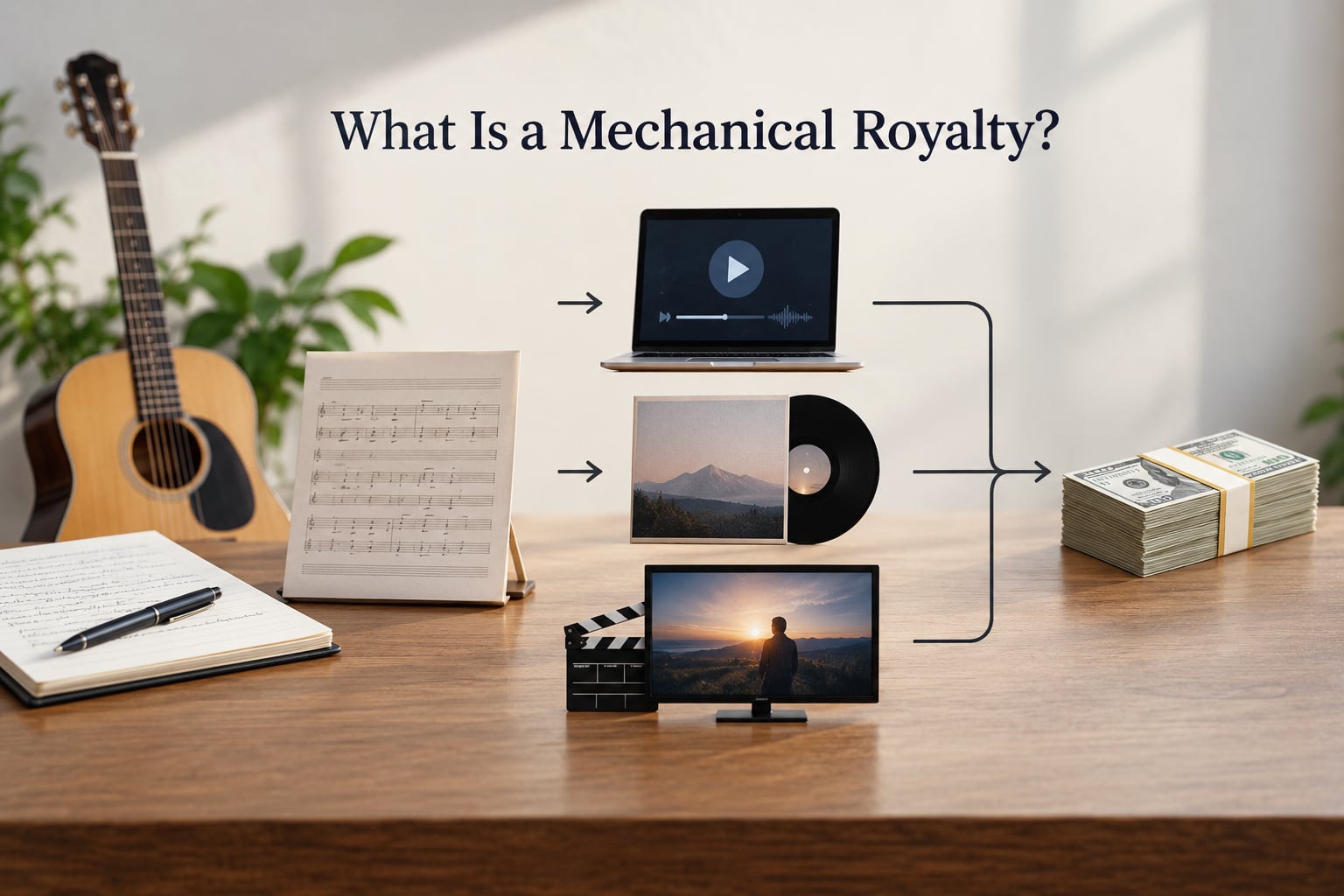
Short version: a mechanical royalty is compensation for the right to reproduce a copyrighted song. Every time a copy of the composition is manufactured, downloaded, or made available in an on-demand stream, that right is exercised and a payment is triggered.
The right comes from the copyright in the composition itself — the music and lyrics — not from the copyright in the particular recording of it. This is why the same song can generate mechanical royalties for a pressing in Japan, a download in Ohio, and a stream in Brazil, each handled by a different collector.
The US legal basis is the compulsory mechanical license under Section 115 of the Copyright Act. In plain terms, once a song is commercially available, anyone who wants to reproduce it has a legal route to do so and must pay the set rate rather than negotiate permission song by song.
That compulsory license is also why mechanical royalties cannot be negotiated away entirely. The rate schedule is set by the Copyright Royalty Board, and it is indexed so it rises over time.
How Are Mechanical Royalties Calculated?
The basic formula is simple: units used multiplied by the applicable rate. A thousand physical units at 13.1 cents each produces a mechanical pool of 131 cents per songwriter share. Downloads work the same way. Streaming does not.
For streaming, the calculation runs through a revenue pool rather than a per-unit rate. Digital service providers report usage, a share of subscriber and advertising revenue is set aside for mechanicals, and that pool is divided by ownership percentage. The current US statutory rate for physical units and permanent downloads sits at about 13.1 cents per unit, with the scheduled increases under Phonorecords IV carrying the per-minute rate higher in later years. For interactive streams, the statutory pool works out to roughly 15.3 percent of the revenue DSPs report.
What Counts as a Mechanical Royalty?
Grouping the common uses, a mechanical royalty is generally triggered by four things:
- Permanent physical copies — CDs, vinyl, cassettes, and other manufactured pressings sold to the public.
- Permanent downloads — a digital file the listener buys and keeps, including downloads bundled with an album.
- Interactive streaming — on-demand play on services where the listener chooses the song and can repeat it.
- Synchronization — a fixed, timed use of the song in film, television, advertising, or a game, normally negotiated as a sync license rather than at the statutory rate.
Non-interactive streams sit on the other side of the line. Background music in a bar or a personalized Pandora-style radio channel is treated as a public performance, so it is paid through a performing rights organization rather than as a mechanical.
A temporary reproduction that a listener cannot access on their own — a cached copy a streaming service stores to deliver the stream — is treated differently again. It is not counted as a permanent copy.
How Do Physical Sales and Downloads Generate Royalties?
Take a song written by two people with a 50/50 publishing split, sold on an album that includes ten tracks. Each album sold counts as one reproduction of that song, so 2,000 album sales generate 2,000 units for it.
At roughly 13.1 cents per unit, that pool comes to 262 cents. Each writer’s half is 131 cents. Under a negotiated deal rather than the statutory rate, or a digital download sold separately, the numbers move, but the units-times-rate structure stays the same.
Two layers of payment show up on the same sale. The mechanical royalty compensates the songwriters for the composition. A separate royalty compensates the master rights owner — often the label or the artist’s company — for the sound recording. A physical sale triggers both, through different paperwork.
Details that catch people out:
- Bundled albums — when a ten-track album sells as a download, each track counts as a separate reproduction. Only full-album sales are treated as one unit per song.
- Free downloads — free downloads generally produce no mechanical royalty, though they are not necessarily a license violation either. Promotion and reproduction are treated differently.
- Bundled pricing — when several download types are bundled, the law permits pricing by the lowest-paid component, which affects the pool.
- Promotional copies — giveaways to reviewers and radio stations sit in their own category rather than the commercial category.
Price and royalty are not the same thing. A higher retail price does not automatically mean a higher mechanical payment, because the statutory calculation works from a fixed rate applied to units.
How Does Streaming Generate Mechanical Royalties?
Interactive streaming replaced the sale unit with a reported period. A DSP such as Spotify or Apple Music tracks plays, reports usage to the mechanical licensing collective, and pays an amount based on its revenue and agreements rather than a set fee per stream.
Two things follow from that. First, there is no fixed songwriter payment attached to a single play — the figure people quote for a per-stream payout usually blends master and composition money. Second, the amount a songwriter receives depends on how accurately the usage was reported and matched to the right rights holders.
Suppose a service reports a total composition pool for a quarter and an administrator distributes it across registered works by ownership percentage. If you own half of a catalog representing a portion of those streams, your share is that portion of the pool multiplied by 50 percent, less the administrator’s commission. The catalog’s share of total streams shifts every quarter because listening changes.
Unmatched plays are the quiet failure point. A stream that arrives with a missing writer credit, a misspelled name, or an unregistered work cannot be matched to a rights holder, so it often sits unclaimed rather than being paid out. That unclaimed money is real and it accumulates.
Who Gets Paid a Mechanical Royalty?
Composition money travels a chain, and it pays whoever holds the composition copyright rather than whoever owns the record.
- Songwriters and composers — they own the copyright in the music they wrote, and they created the work the royalty compensates.
- Publishers and administrators — a publisher may take an ownership share in exchange for handling registration and collection. An administrator collects on the publisher’s behalf for a commission.
- Qualifying performers — a performing artist can earn mechanical royalties under rules tied to the sound recording, separate from the songwriter’s share.
Labels sit elsewhere in the picture. A label usually owns or licenses the master recording, so it collects master-side money. It does not automatically own the composition, and it does not collect songwriting mechanicals on your behalf.
What Is the Difference Between Mechanical and Performance Royalties?
Mechanical royalties pay for making copies; performance royalties pay for the song being heard in public. Different rights, different triggers, different organizations.
| Point of comparison | Mechanical royalty | Performance royalty |
|---|---|---|
| What it pays for | Reproduction of the composition | Public performance of the composition |
| Typical trigger | Sale of a CD, vinyl, or download; interactive stream; sync use | Radio or TV airplay, background music in a venue, non-interactive streaming |
| Who is paid | Songwriters, composers, their publishers | Songwriters, composers, their publishers |
| How it is set | Statutory rate set by the Copyright Royalty Board, or a negotiated license | Negotiated performance rates by blanket license |
| Who collects in the US | The Mechanical Licensing Collective for digital use; licensing agents for physical | ASCAP, BMI, or SESAC |
| Master-side money | Separate, paid to the master owner | Separate, often handled by SoundExchange |
One song makes that difference obvious. Play your track on a streaming service as a listener chooses and the songwriters can receive both a mechanical payment and, depending on the reporting, a performance payment. The same song aired on a radio station generates performance money for the writers, but no per-copy mechanical, because no copy was made.
Territories outside the US run the same logic through local societies, and the mechanical side is usually administered separately from the performance side in each country.
How Is a Mechanical Royalty Split?
A composition royalty is divided among the people entitled to it, and the shares come from the credits and ownership agreements rather than from a default rule.
Worked through the simplest case: two writers, equal publishing shares, no publisher share retained. A 2,000-unit sale at about 13.1 cents per unit creates a 262-cent pool, split 131 cents each. Add a publisher taking 15 percent, and each writer receives 111.15 cents instead.
The split has to be documented. Split sheets capture who wrote what and in what proportion, and the registrations filed with the collective and the PRO have to match them. Mismatches between split sheets and registrations are one of the most common reasons a payment stalls or arrives in the wrong amount.
Producer and beat maker situations add a wrinkle. A beat sold as a lease usually keeps publishing with the seller, while a work for hire or a buyout transfers it. Without a written agreement stating which publishing travels with the beat, disputes about mechanical royalties get expensive quickly.
How Can Artists and Songwriters Track Their Royalties?
Getting paid depends on records being right, not on chasing payments. A workable routine:
- Get an ISRC for every recording and a work registration for every composition. These identifiers are what let usage data find you.
- Finalize split sheets before release. Confirm names, percentages, and IPI or songwriter identifiers with everyone who receives a share.
- Register the work and the sound recording. Register compositions with the mechanical licensing collective and performing rights organizations, and the recording with the relevant digital performance and master-side organizations.
- Read the statements that arrive. Compare what each publisher, administrator, and PRO reports against what your own analytics show for the same period.
- Fix the metadata at the source. Credits carried in the file distributed to DSPs are the ones collectors match against, so correcting them there matters more than correcting a platform display later.
- Claim unclaimed money. Unmatched and unclaimed royalties are held rather than discarded, and a written claim with proof of ownership is usually what moves them.
- Escalate a mismatch to the right party. Publishing and registration problems go to your publisher or administrator; usage reporting problems go to the digital service; performance problems go to your PRO.
Timelines vary, so don’t read a slow first statement as a failure. Data flows through several intermediaries before a payment lands, and the first quarter of usage often settles after the next one closes.
Frequently Asked Questions
Is a mechanical royalty the same as a recording royalty?
No. A mechanical royalty compensates the copyright in the musical composition, the music and lyrics, whenever copies of it are made. A recording royalty compensates the master sound recording for its own use. A single CD sale can trigger both at once, paid to different rights holders through different channels.
Who receives mechanical royalties for a song?
Songwriters and composers receive mechanical royalties because they own the composition copyright. If a publisher or administrator holds a share, they collect and pass it on. Labels generally own the master recording instead, so they collect master-side income and do not receive songwriting mechanical royalties.
Are mechanical royalties paid for every Spotify stream?
Interactive streams do generate mechanical royalties, but there is no fixed payment per play. The collective divides a pool of reported streaming revenue among works according to ownership percentage. The amount reaching any writer depends on the DSP’s revenue, the share of catalog streamed, and how accurately the usage was matched.
Does a songwriter get mechanical royalties from radio play?
Not a per-copy one. Radio airplay creates no new physical or permanent copy, so it produces performance royalties for the songwriters rather than mechanical royalties. Broadcasters pay blanket performance licenses through collecting societies, and background and non-interactive streams are treated the same way.
How much is a mechanical royalty?
US physical and permanent download rates sit around 13.1 cents per unit under the current statutory schedule, with a slightly higher per-minute component and further increases set for later years. Interactive streaming uses a revenue-share pool instead of a per-unit rate. Negotiated deals often pay more, and rates differ by country and change over time.
Conclusion
A mechanical royalty pays for the reproduction of a song. Performance royalties pay for hearing it, and master-side royalties pay for the recording. Once those three are separated in your head, the paperwork that follows makes far more sense.
Start with the one step that fixes most problems: pull your split sheets and registrations together and check that every work has an identifier, correct credits, and matching ownership percentages everywhere. Money cannot reach a rights holder the system cannot identify. Rules and rates vary by country and shift over time, so for contract or tax questions specific to your situation, a qualified professional is the right call.