Copyright in the United States is automatic. The moment you fix a song in a tangible form — a recorded file, or lyrics written down — you own the copyright, and filing nothing does not change that.
What registration adds is enforcement. Filing with the U.S. Copyright Office puts a government record behind your claim, and that record is what a court will treat as proof of ownership when somebody disputes it. Understanding how to copyright a song means knowing the difference between those two things, so you can spend your time and money where it actually protects you.
Below is a practical, U.S.-focused walkthrough: what you need on hand, the six steps in order, the mistakes that cost people their claims, and what registration does not do for you. Fees, forms and portal screens change over time, so treat anything specific as a reason to check copyright.gov rather than a fixed fact. This is general information, not legal advice.
Table of Contents
- What You Need
- Step-by-Step: How to Copyright a Song
- Common Mistakes
- Frequently Asked Questions
- Do I need to register a song to own the copyright?
- What is the difference between a composition copyright and a sound recording copyright?
- Can someone steal my song if I do not register it?
- How long does copyright protection last for a song?
- Is a poor man’s copyright valid?
- What happens if someone else registers my song without permission?
- Conclusion
What You Need
Before you open an application, gather four things. Missing one of them is the most common reason a submission comes back for correction.
- The work itself. Either the composition — your melody, chords and lyrics — or a sound recording of that performance. You can register one, the other, or both.
- Contributor details. Every co-writer, producer, featured performer and arranger, with the legal names they use on paperwork. Nicknames cause rejections.
- Publication status. Whether the work has been released publicly, and if so, the date and the country. An unreleased work is called unpublished, and that is not a lesser claim.
- Your own identity. A full legal name and address, because the certificate is a public record and a misspelled name can complicate a dispute later.
A payment method also helps. The Office requires the fee with the submission, and unpaid applications sit in a queue without moving.
You do not need a lawyer or a publisher to file. You do need to know which right you are claiming before you start, because choosing the wrong application is the single most common wasted step.
Step-by-Step: How to Copyright a Song
Step 1: Identify What You Are Registering
A finished song usually involves two separate copyrights that belong to different people and cover different things. Getting this right before you file saves you from paying twice, or from protecting only half of what you made.
| What it covers | Musical composition | Sound recording |
|---|---|---|
| What it protects | The song itself: lyrics, melody, chord progression, arrangement of the underlying music | One particular master audio file of a performance |
| Who usually owns it | The songwriters and co-writers, split per their agreement | Whoever produced or commissioned the master — often a label, producer or the artist |
| Form used | Form PA, for a work of performing arts | Form SR, for a sound recording |
| What it does not cover | The audio file, drum programming, the mix | The melody or lyrics, which need their own registration |
So the answer to “do I own the master or just the song” is often: both, if you self-produced, and only the song if someone else paid for the session. If a beat seller made you an instrumental and you wrote the vocal melody on top, you may hold the sound recording while the beatmaker still holds a composition claim on his part.
AI-generated material raises a different problem. Current U.S. Copyright Office guidance centers on human authorship: a work generated entirely by a prompt generally will not be registered, while a human arrangement, selection or modification of AI output can be. If your track is largely AI-generated, talk to an attorney before spending money on an application that may be refused.
Step 2: Document Your Creation Before You Copyright a Song
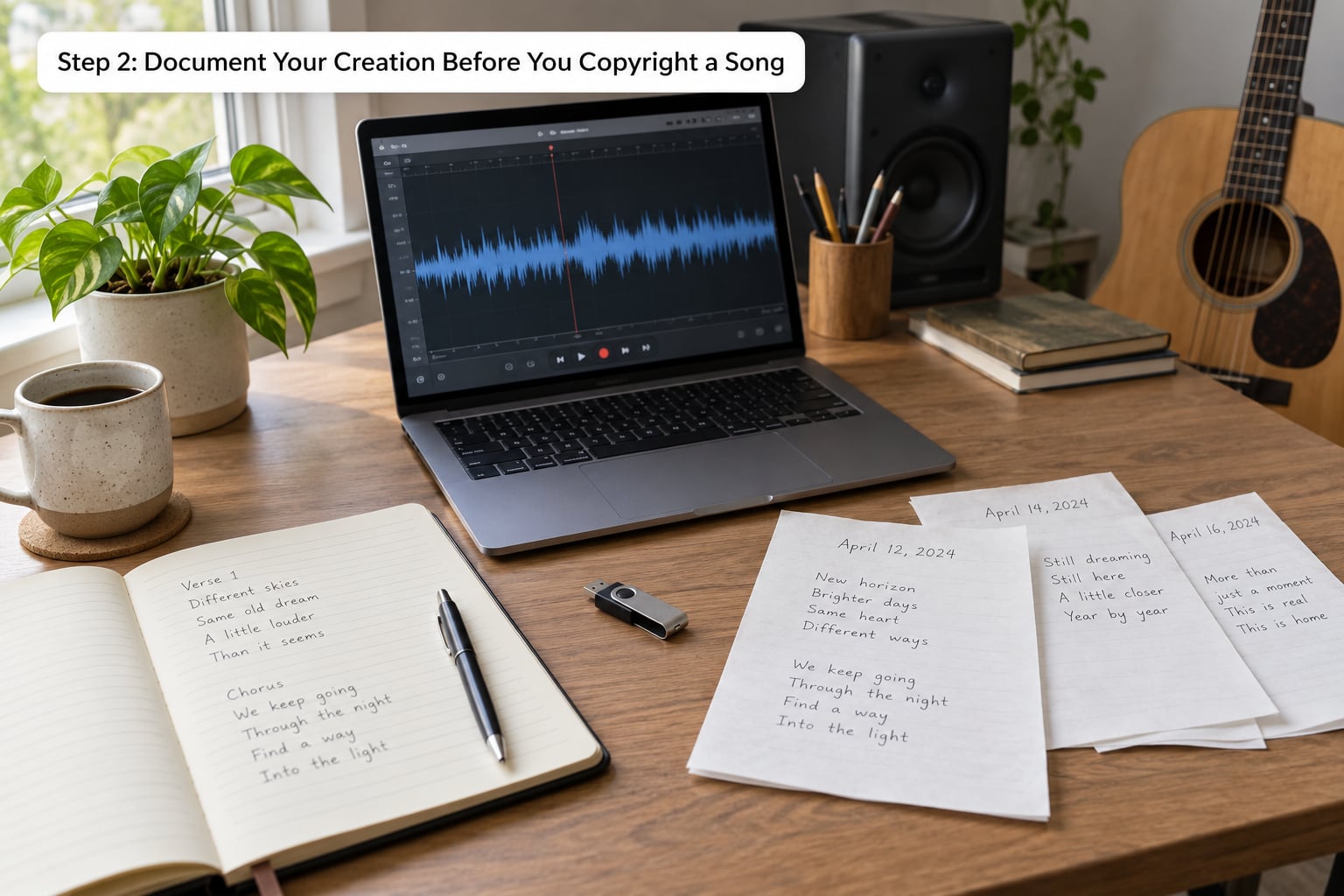
Automatic copyright means you can prove ownership with your own records. Registration makes that proof easier for a court to accept, so the evidence you build now is what you will be relying on later.
Veteran producers on recording forums consistently point to the same evidence as the strongest: your DAW session with the original source tracks exactly as they were captured, kept untouched. Add to that list:
- Dated exports of the mix at meaningful milestones, stored somewhere with a timestamp.
- Project file metadata, which often records when and on which machine a track was created.
- Dated correspondence with co-writers and the studio about who did what.
- Lyric drafts with revision dates in the file properties.
- Video or voice messages where you describe the song and its contributors, kept with their original dates.
Do not send full-resolution stems to someone before you have your own registration on file. Sending a watermarked, compressed copy — a mono file or a deliberately low-bitrate version — limits what a collaborator can take and register. Once the work is registered, sharing it becomes much simpler.
This is also where the poor man’s copyright myth lives. Mailing a sealed copy of your demo to yourself, or posting a video of yourself reading the lyrics, creates a timestamp but no legal standing. Nobody disputes the postmark; what is disputed is who owns the work. It costs almost nothing to do and it is not evidence in the way a registered certificate is.
Step 3: Check Contributors, Splits, and Contracts
Most ownership disputes in music are contract disputes, not copyright disputes. Copyright law starts with who created the work; a signed agreement is what makes that answer usable.
Identify everyone who contributed and categorize them honestly. Songwriters and composers own their share of the composition. A producer or engineer may own part of the sound recording, or may have created it as a work for hire, meaning the commissioning party owns it by contract. Performers, featured artists and sample sources each need their own treatment.
Then get it in writing, even when the project is three people who all trust each other. A split sheet that names each contributor, their percentage and their legal names prevents a much bigger problem later. If you sampled someone, clear it before you register, because registration cannot make an infringement into a permission.
One practical note on timing: the Copyright Office does not compare submissions against each other to spot duplicates. Nothing will flag a fraudulent registration for you in advance. Filing first is what gives you the earlier claim to point to.
Step 4: Prepare the U.S. Copyright Office Application
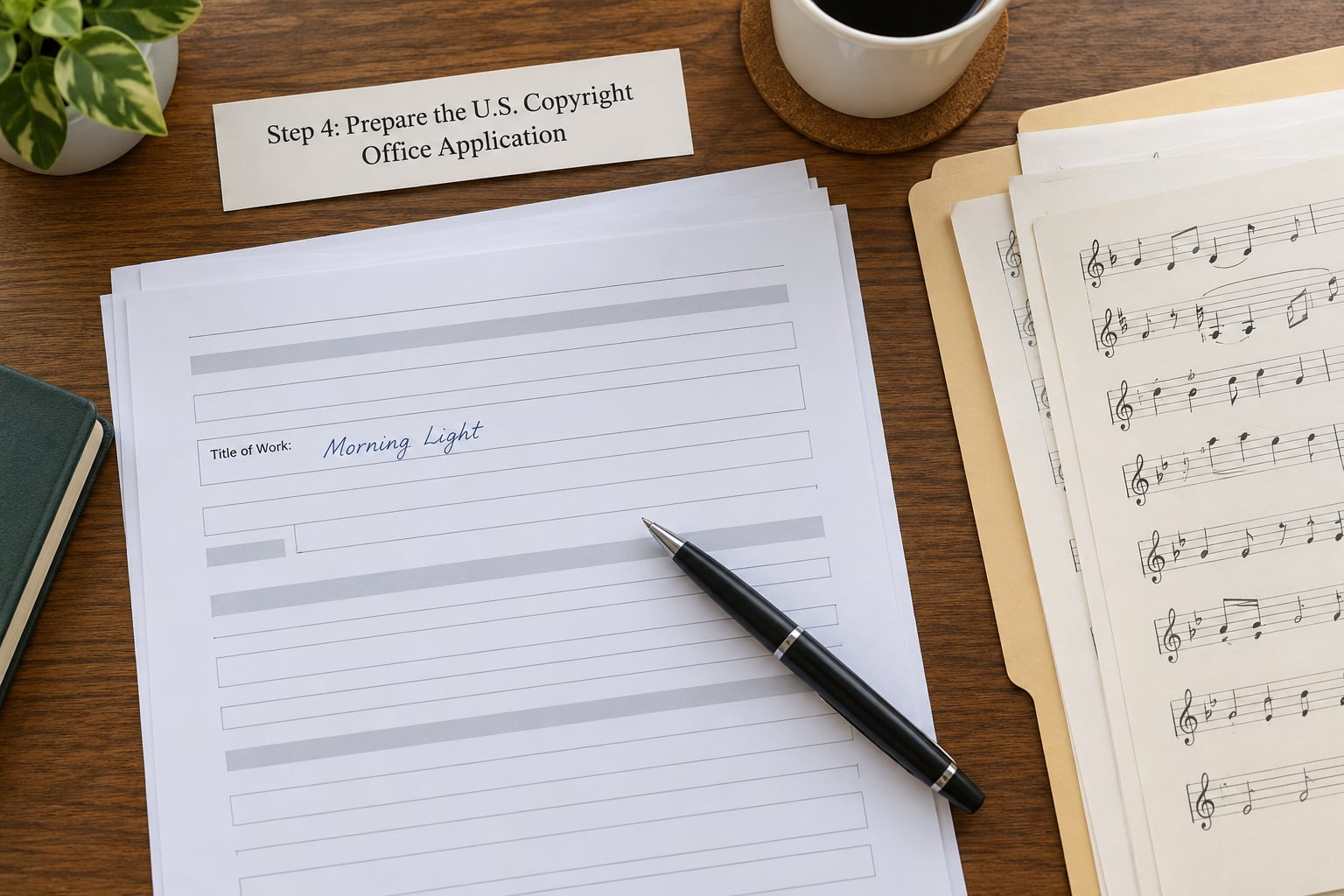
The Office publishes three forms relevant to musicians, plus a group option for people with a lot of unfinished material. Each covers a different situation.
| Form | Use it when | What you submit |
|---|---|---|
| Form PA | Registering an original musical composition, published or not | The work or a copy, plus a short description of authorship and ownership |
| Form SR | Registering a master sound recording | The recording or a copy, plus contributor and ownership information |
| Form GRUW | Registering up to ten unpublished works of the same type together | Each work listed individually, with its own identifying detail |
Expect to enter the title of the work, whether it is published and when, the names of all authors and claimants, any known limitations on your claim such as a prior contract, and your contact details. Be precise. Malformed submissions get returned, and practitioners note that the Office does not refund on a returned filing.
On the question of cost: single-work applications carry a modest government fee, and the group registration of unpublished works charges a single fee for up to ten works instead of one fee each. The exact amounts are set by the Office and change, so read the current fee schedule on copyright.gov before you send payment. An attorney charging several hundred dollars an hour is a separate line of cost entirely.
Step 5: Submit the Application and Pay the Fee
Use the official registration service operated by the U.S. Copyright Office, at copyright.gov. Third-party filing services can charge a mark-up on the same government fee, and none of them can file faster.
Create an account, complete the application, review every field against your own records, attach what the form asks for, pay, and submit. Then save the confirmation. It contains the case number you will need if the Office contacts you about a deficiency.
There is no penalty for waiting. Registering before you release gives you the earliest claim, which is helpful if the song travels to a producer, a sync agent or a playlist. Registering after release is still perfectly valid, and plenty of working musicians do it that way because revenue has not arrived yet. For most artists, the part of how to copyright a song that actually moves the needle is the moment you hit submit, not the day the certificate arrives.
Step 6: Save the Registration Record
Once the Office issues a certificate, download it and put it in the same archive as your session files and split sheets. The certificate becomes a public record, searchable by title and author name, and that visibility is exactly what discourages a later fraudulent claim.
If the Office writes to you asking for a correction, respond quickly and completely. A deficiency notice is not a rejection of your claim; it is a request for information, and the registration is not complete until it is resolved.
Two timing details people care about: the effective date of registration is the date the Office completed processing, not the day you mailed it, and a certificate can take a long time to arrive. If you are in an active dispute, do not wait for the paper.
Finally, know the difference between registration and the other layers of protection. A performing rights organization such as ASCAP, BMI or SESAC collects performance royalties, and a publishing administrator handles registration of your song with those organizations. Copyright registration does neither. It also does not clear a sample, and it does not stop a platform from filing a Content ID claim against you.
Common Mistakes
Registering only one of the two copyrights. A Form PA alone leaves your master unprotected against a separate claim. If you finished the mix, file the sound recording too, ideally as a separate application referencing the earlier composition registration.
Listing contributors from memory. A producer’s legal name may differ completely from their stage name, and a missing co-writer weakens the whole claim. Pull names from invoices, session paperwork and your own correspondence before typing.
Assuming registration creates ownership. The certificate documents the ownership you already had. If the underlying contract says the work was a work for hire, no registration changes that.
Relying on a self-mailed copy. A postmark proves a date, not authorship. Treat it as a habit worth keeping, not a substitute for filing.
Failing to clear a sample. Registering a track built on uncleared material documents your claim over a work that may infringe someone else. Clear first, register second.
Waiting on contracts to catch up with reality. A signed split sheet after the release can be cleaner than an unsigned one before it. Do not send files to collaborators until the split is written down, at minimum in an email you both keep.
Expecting the certificate to stop theft. Registration gives you standing to enforce. Taking someone down still means a platform claim, a DMCA notice or a legal action, and each has its own cost in time.
Frequently Asked Questions
Do I need to register a song to own the copyright?
No. Copyright in the United States arises automatically the moment you fix your work in a tangible form, such as recording it or writing the lyrics down. Registration is not required for ownership to exist. What registration provides is a government record that serves as prima facie evidence of ownership, the legal ability to file a federal infringement lawsuit, and access to statutory damages and attorney’s fees. Register before anyone else claims the work.
What is the difference between a composition copyright and a sound recording copyright?
The composition copyright covers the song itself: your lyrics, melody, chord progression and the arrangement of the music. The sound recording copyright covers one specific master audio file of a performance. They are separate rights, usually owned by different people, and each has its own registration form. A Form PA covers the composition. A Form SR covers the recording. Registering one does not register the other.
Can someone steal my song if I do not register it?
Yes. Nothing stops anyone from taking an unregistered song, and the Copyright Office does not compare submissions to detect duplicates. The practical risk is that you end up with two conflicting claims and no government record supporting yours. Your own dated files, session metadata and correspondence help, but a registered certificate is the strongest starting position. If a producer registers your mix in their own name, an earlier registration makes that far easier to challenge.
How long does copyright protection last for a song?
For most songs, copyright lasts the life of the author plus 70 years, and it runs from the date the work was fixed. Works made for hire and certain anonymous or pseudonymous works are treated differently and can be protected for 95 years from publication or 120 years from creation, whichever is shorter. For a collaboration, the term is generally measured from the death of the last surviving author. Registration does not extend the term; it only affects enforcement.
Is a poor man’s copyright valid?
A poor man’s copyright is mailing a copy of your work to yourself, or recording yourself describing it, to create a dated postmark. Courts have never treated that as proof of authorship. It may help establish a timeline, but a certified copyright registration is the record with legal weight. It costs a few dollars and takes a few minutes, so treat the mailing as a habit rather than a substitute for filing.
What happens if someone else registers my song without permission?
Document your own creation first: DAW sessions, source tracks, dated exports, metadata and correspondence with contributors. Then file your own application, because an earlier registration carries more weight. You can also submit a correction or contact the Copyright Office, and a platform claim can be challenged through the distributor or service that received it. For a significant amount of money at stake, consult an attorney rather than handling the dispute alone.
Conclusion
Start by deciding which right you actually own. Then gather contributor names, preserve your dated session files and exports, get splits in writing, and submit the correct application through the official Copyright Office service after checking the current forms and fees. If you have been searching for how to copyright a song and stopped at the form, that is the wrong end of the problem; ownership evidence is what a dispute turns on.
Registration is not what makes you an owner. It is what makes you an owner who can prove it.