A songwriting camp is a multi-day retreat where songwriters, producers and music-industry professionals write and record songs together, usually working to live briefs and finishing every session day with a group playback of the demos. Most camps run three to six days and are booked by application. Updated for 2026, here’s what goes on inside one.
The short version of how songwriting camps work: you apply, pay a fee or get sponsored, get placed in a small group with a producer, and spend your days drafting, rewriting and recording songs against a brief while people who want the material sit in the same building. It is a strange hybrid of writing clinic, networking event and recording session, and it works better for some writers than for others.
Table of Contents
- What Is a Songwriting Camp?
- How Songwriting Camps Work
- What Happens During a Typical Songwriting Camp?
- How Do Camp Participants Finish a Song?
- Who Teaches and Mentors at Songwriting Camps?
- What Should You Bring to a Songwriting Camp?
- How Do You Choose the Right Songwriting Camp?
- Are Songwriting Camps Worth It for Beginners?
- How Can You Make the Most of a Songwriting Camp?
- Frequently Asked Questions
What Is a Songwriting Camp?
Yes, songwriting camps are a real thing, and they have been for over thirty years. The format started in the early 1990s when Miles Copeland bought Chateau Marouatte, a French chateau, and invited roughly two dozen writers to spend the summer producing a song every day in exchange for a share of the publishing.
Since then the format has split into several flavours. A songwriting camp is not a songwriting class, though some camps run workshop-style mornings. It is not a producer camp, which teaches mixing, engineering and signal flow. It is not a music school, and it is not a spa.
What it actually is: a working environment where strangers collaborate under a deadline, with professional producers and, often, publishers or A&R people in the room. The output is finished, recorded demos with clear ownership, not worksheets and exercises.
How Songwriting Camps Work
The mechanics are consistent across camps even when the branding differs. Five things show up nearly every time: a live brief, a small assigned group, a producer in charge of recording, a nightly playback, and a closing showcase or listen-back.
The goals are practical, not therapeutic
Most camps exist because someone wants material. A publisher needs songs for a specific market, an A&R person needs a topline for an artist, a producer needs a lyricist. That person often pays part or all of the writers’ fees in exchange for first look at what comes out of the sessions.
That is the engine most of the industry runs on. A camp compresses several months of emailing and pitching into four or five days, because the person who wants the song is standing in the room with you.
Groups are small and assigned, not chosen
You rarely pick your collaborators. Organizers group writers deliberately, usually mixing a topline writer with a lyricist and a producer, sometimes pairing people from different genres on purpose. An r/Songwriting attendee described himself as a lone wolf songwriter who had never played in a band; the forced pairing was the point of the week.
Group sizes reported publicly run from about a dozen writers at a villa-style camp to roughly 60 at larger events, with one industry podcast describing a camp of 250-plus songwriters, producers and artists as the largest of its kind.
The writing happens under real time pressure
Two writing days, sometimes less. That constraint shapes everything about the songs. The same attendee noted the limit plainly: with time to write, rewrite and rehearse, the results have to stay simple. A concept that needs six weeks of development does not survive a camp.
Feedback happens in front of the room
The nightly playback is the most valuable and least comfortable part. You play a rough demo to the other attendees and the mentors, and people say what they hear. Critique at a camp is usually direct but not cruel, because everyone is in the same boat with an unfinished song.
The camp ends with a showcase
On the final night, songs get played for the industry people in attendance. Some camps run a main stage with live performance, and one camp format gives each attendee two main-stage slots, one per session block. Others do a listening session in a room with a playback system and a producer’s desk.
What Happens During a Typical Songwriting Camp?
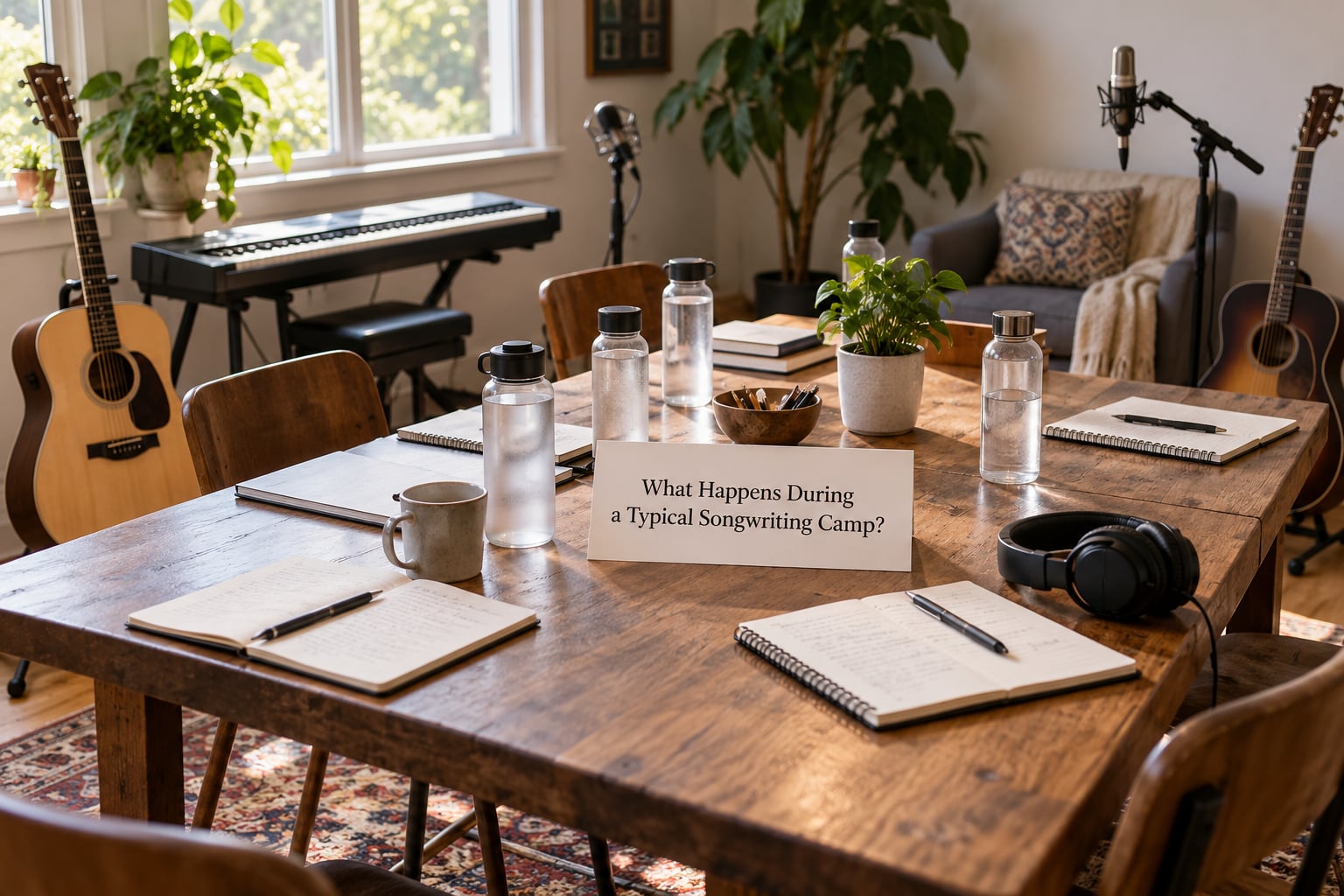
The daily rhythm is remarkably consistent across camps, because it is built around writing hours, not around conference sessions. Here is a representative day drawn from public recaps of multi-day camps.
| Time | Activity | What you produce |
|---|---|---|
| 8:30 a.m. | Breakfast | Nothing. Talk about yesterday’s songs. |
| 10:00 a.m. | Group announcements | Today’s brief, producer and studio assignment |
| 10:30 a.m. | Writing session one | Draft: concept, chorus, first verse |
| 1:00 p.m. | Lunch | Sometimes a lyric rewrite over food |
| 2:00 p.m. | Session two and record | First full demo take in the room studio |
| 5:00 p.m. | Rewrite and arrangement | Second and third takes, plus a playback for the group |
| 8:00 p.m. | Dinner | Informal feedback, usually the most honest hour |
| 9:00 p.m. | Evening playback | The day’s tracks played for the whole camp |
A writer from a Featured Artists Coalition recap of a Tileyard Education camp in Barcelona put the anchors at breakfast at 9 a.m., group announcements at 10, writing until roughly 8 p.m., then dinner and a playback of the day’s tracks. A different format, described in an r/Songwriting report, ran morning classes, song circles before dinner and main-stage performances afterwards.
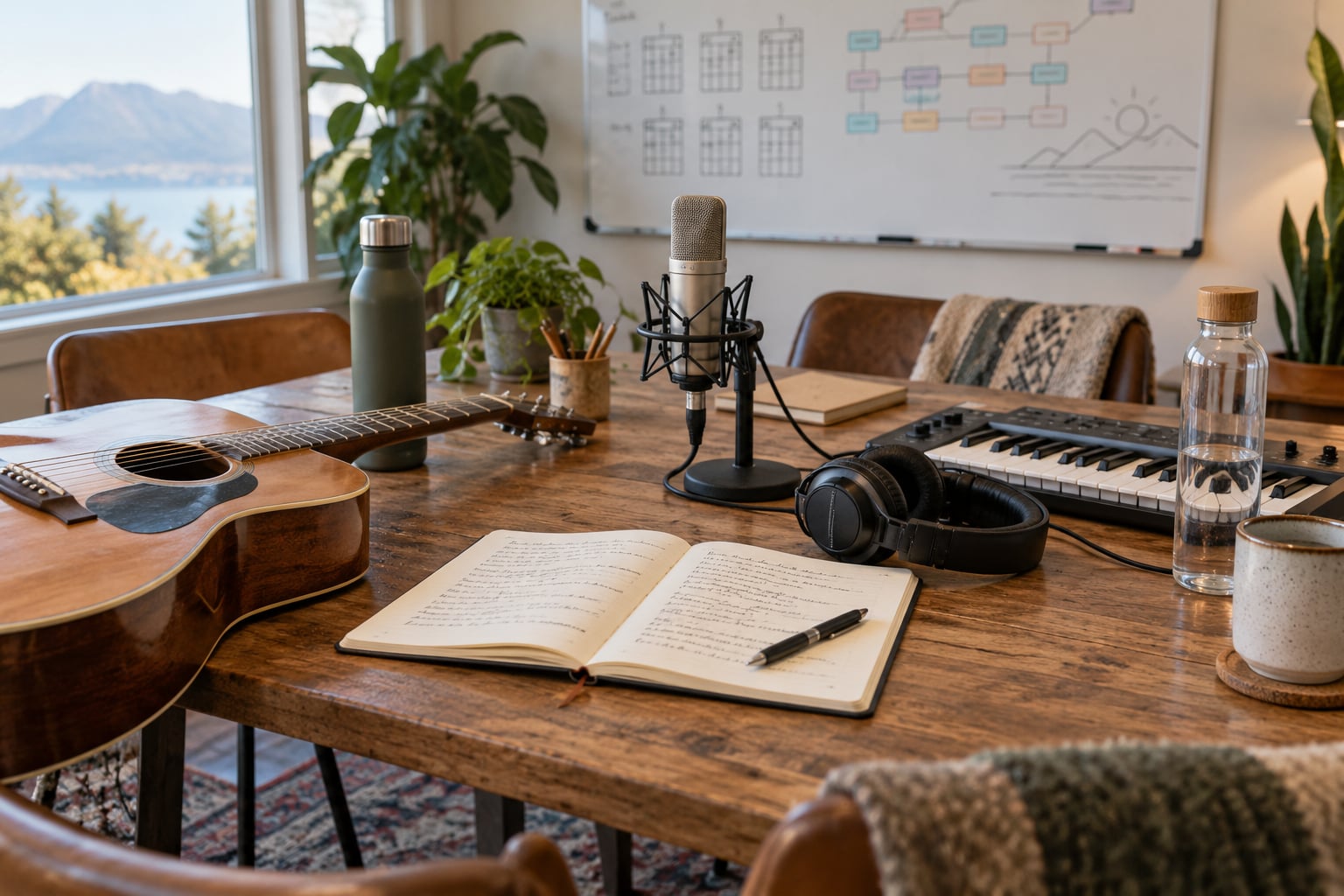
Two structural details separate real camps from writing retreats. The first is the brief. At the Tileyard camp, labels and artists were actively looking for material in pop, dance, R&B, country and K-Pop, so each group wrote to a live brief with a reference track and a target vocalist. The second is that the camp is temporarily converted into a recording facility: rooms become studios, producers set up mics and monitors, and you record your demo in the building rather than describing it.
One more thing happens that rarely fits in a brochure. Camps get emotionally heavy. The most affecting session in that Barcelona recap happened after the group dropped the brief entirely and wrote over an unfinished instrumental left in the room. The writer called it unexpected therapy. Expect that side of it.
How Do Camp Participants Finish a Song?
Most songs at camp follow the same five stages, and the deadline compresses each one.
Brainstorming against the brief
You start with the brief, not with a favourite idea. A brief might say male vocalist, mid-tempo, 90 seconds of chorus before the first verse, dance-pop with a synth hook. Every proposal gets tested against it in the first session, which kills about half your ideas before you record anything.
Draft and record early
The single biggest mistake is polishing lyrics for two days without pressing record. Camp producers push writers to get a take down by the end of day one, because a rough demo beats a perfect lyric sheet every time.
Revise in the room
Rewrites happen fastest when a producer is playing the track back. A chorus that reads well on paper often gets replaced within ten minutes of hearing it against a groove, and the version that survives the playback is usually not the one you came in with.
Sign the split sheet before you leave
This is the paperwork step that most guides skip and one r/musicbusiness poster was specifically asking about: with four writers on one camp song, who owns what and who gets paid what?
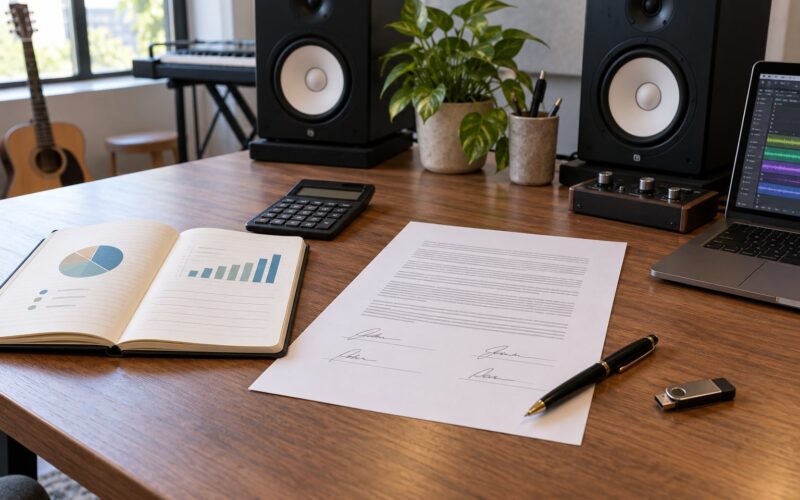
The short answer: a split sheet records who wrote which part of the song and in what percentage. The copyright in a song written by several people is shared among them by default, and a signed split sheet is the document that makes that share enforceable later. Get it signed while everyone still remembers who did what, before the post-camp amnesia sets in.
Publishing share and master ownership are two different things, and beginners routinely confuse them. The song is the composition: lyrics and melody, registered with a performing rights organization. The master is the specific recording. At camp you will normally share publishing with your co-writers, and the producer usually keeps ownership of the master they recorded unless the paperwork says otherwise.
Work-for-hire and assignment are the two terms to watch. Work-for-hire means your contribution is treated as the property of the paying party from the start. Assignment means you owned it and then transferred it. A publisher who funds your travel in exchange for a publishing share is doing the first kind of deal in a relatively normal way; a fee that quietly assigns your song outright is a different conversation entirely.
Who Teaches and Mentors at Songwriting Camps?
Nobody stands in front of a whiteboard for most of a camp. The teaching happens in the room, in short bursts, between writing and recording.
Producer-mentors
They set up the session, choose the tempo and key, engineer the take, and teach you how to get a usable demo out of a room in a couple of hours. Attendees pay attention to verifiable credits here. The Barcelona camp hosted five guest producers, and the recap specifically names their Paul McCartney, David Guetta and Billy Blonde credits.
Professional songwriters
They sit in your group, write their part, and demonstrate craft in real time. What you learn is process: how fast a chorus gets written when someone has written a thousand of them, and how much of that is revision rather than inspiration.
Publishers and A&R
They are not there to teach you to write. They are there to select. Some camps have a publisher sitting in on every playback; others only show up for the final showcase. Ask before you sign up which one you are paying for.
Instructors at non-profit camps
At some smaller camps, instructors are volunteers who receive free room and meals rather than a fee, which is worth knowing when you are weighing what your camp fee is buying. It does not mean the teaching is bad, but it does change the transaction, and honest camps say so.
What Should You Bring to a Songwriting Camp?
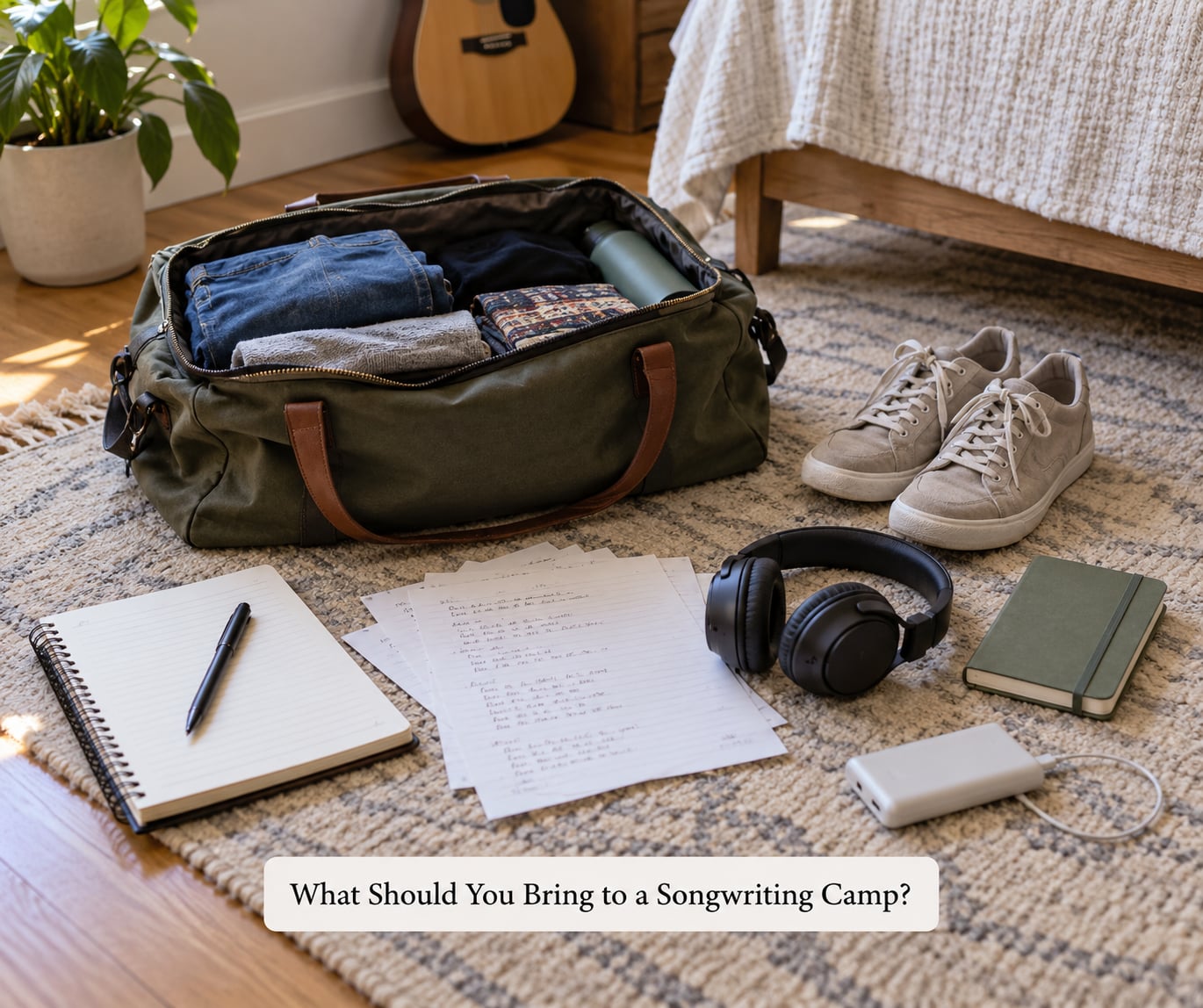
Bring less gear than you think and more paper than you think.
The creative kit
- A notebook that stays on the page, for ideas that arrive during someone else’s playback
- A lyric sheet template with verse, pre-chorus, chorus and bridge labels
- Your own cables and adaptors, plus headphones for checking mixes away from the session
- A portable charger. Long days with a phone at low battery is a bad way to end a session
- A small keyboard or MIDI controller if you are the type who needs to find the melody by hand
The personal admin
- Your government ID and any dietary or medical details the organizer asked for
- A copy of any demos you want feedback on, on a drive and in the cloud
- Contact details for your performing rights organization registration
- The agreement or terms the camp sent you, printed and read before you travel
The practical stuff
- Layers. Writing rooms get cold and venues get warm in the same afternoon
- Comfortable shoes. You will be on your feet in a main-stage showcase
- Water bottles, refilled. Hydration is not the reason you are tired at 6 p.m.
- A backup of every demo you record, stored somewhere other than the camp’s machine
How Do You Choose the Right Songwriting Camp?
Compare camps on five things: who is in the room, what the brief is, how long you get, what you leave with, and what the paperwork says. Everything else is decoration.
The main camp types, side by side
| Type | Who runs it | Typical length | Cost model | What you leave with |
|---|---|---|---|---|
| Publisher-run camp | A music publisher or label | 3 to 6 days | Often sponsored, fee waived or reduced in return for a publishing share | Finished demos with a real chance of being pitched |
| Producer-run camp | A producer or small team building a roster | 2 to 4 days | Fee, sometimes reduced for songwriters who fit the brief | Demos plus a relationship with that producer |
| Education camp | A music school or education company | 5 to 10 days | Tuition, highest of the categories | Skills, contacts and finished songs |
| Retreat | A coach or songwriting school | 2 to 5 days | Tuition plus travel | A finished song and renewed momentum |
| Artist camp | A label or artist | 1 to 3 days | Invite only | A showcase slot and possible recording |
The differences matter more than the marketing. A sponsored publisher camp costs you little and gives the host first look at your songs. A tuition retreat costs you real money and gives you no guaranteed path into the industry. A player in an r/synclicensing thread drove two hours to a three-day camp and called the experience surreal, which tells you about the atmosphere rather than the business model.
Five contract checks before you pay a fee
- Ask for the agreement in writing before you arrive, not on arrival day. One widely shared warning from a songwriter was to see an agreement and not leave without one.
- Read what happens to publishing you write there. A share in exchange for hosting is normal. Blanket assignment of the song is not.
- Establish who owns the master recording, and whether the producer’s fee includes a producer’s share.
- Check whether the camp takes a percentage of your future income or just co-publishes.
- Confirm the cancellation and refund terms, including what happens if the camp is postponed.
Camp versus writing at home versus an online co-writing session
| Songwriting camp | Writing at home | Online co-writing | |
|---|---|---|---|
| Cost | Fee, travel and lost working days | Your existing setup | Low, usually split with a co-writer |
| Time to a finished demo | 2 to 3 days | Weeks | One to three sessions |
| Feedback quality | Immediate, from several professionals | Whatever you send out | One other person’s opinion |
| Industry access | Built in | None unless you build it | Depends entirely on who you book |
| Comfort zone | Deliberately removed | Total | Partial |
| Best for | Breakthrough demos and a network | Depth and slow craft | Specific jobs with a known collaborator |
Are Songwriting Camps Worth It for Beginners?
Worth it for the right beginner, not for all of them. The honest test is whether you have finished anything at all yet.
A camp is a fast, expensive way to get better at the part of writing you cannot practise alone: taking feedback, killing your own favourite line, sharing the split, working to somebody else’s brief. If you have never completed a song, a weekend with three other writers and a producer will teach you more in three days than a month of solo noodling, because the deadline does the teaching.
What beginners can realistically finish in two days: one solid demo, one unfinished idea worth revisiting, and a working relationship with three people. Anyone promising you a finished, release-ready song from a weekend is overselling.
The honest limitations are worth stating. Camps are not cheap, and the fee is on top of travel, lodging and time away from paid work. The two-day writing constraint forces simple songs. Cowrites fizzle, as the r/Songwriting report showed: one of that attendee’s collaborations collapsed because the concept needed far more work than the clock allowed. And demographics can mismatch you badly. That same report described a camp of about 60 people with a median age near 60 and only around eight attendees under 30.
The writer’s own verdict is the fairest summary: whether it is worth it depends on your life stage, your budget, and whether you are already playing in a functioning local band. If you are, a camp mostly duplicates what you already have. If you write alone and have stalled, it is the cheapest interruption available.
Does attending a camp get you a record deal? Rarely directly. It gets you finished demos in front of the people who place songs, which is a slower and less glamorous route to the same place.
How Can You Make the Most of a Songwriting Camp?
A few habits separate the people who leave with songs from the people who leave with a nice story.
Before you go
Finish one song first, rough as it is, so you know what your process looks like end to end. Read the agreement. Learn the brief format if you are nervous, because you will be expected to hit its specs.
During
Record early. Ask for one specific piece of feedback per playback rather than a general verdict. When you do not get the song you wanted, take the second-best option rather than burning four hours chasing perfection.
Keep a running list of who worked well with you. The producer who fixed your chorus in twenty minutes is the person you want in the room in six months, and camp is the cheapest way to find out.
After
Send split sheets within a week, while memories are accurate. Register the songs with your performing rights organization. Then follow up on the one demo you did not finish, which is usually the one that matters most.
Frequently Asked Questions
Are songwriting camps a real thing?
Yes. The format dates back to the early 1990s, when Miles Copeland opened Chateau Marouatte in France and invited a couple of dozen writers to write one song a day in exchange for a publishing share. Today they run everywhere from three-day sponsor-funded camps to ten-day tuition retreats. Publicly described events range from roughly a dozen writers in a villa to gatherings of several hundred.
How much does a songwriting camp cost?
It depends on the model. Publisher-sponsored camps often waive or reduce the fee in exchange for a publishing share and first look at the songs. Tuition-based education camps and retreats charge a fee that does not include travel, lodging or days lost from paid work. Budget for all three together, because the travel is often the larger number. Ask whether the fee is refundable if the camp is postponed.
How are songs from a songwriting camp split?
Usually by contribution. Every co-writer on a camp song shares in the publishing by default, and a signed split sheet records who wrote which part and in what percentage. Get it signed at camp or within a week. The master recording is a separate ownership question, and the producer often keeps it unless the paperwork says otherwise.
Do producers get 50% of the royalties?
Not by default. A producer’s share comes from the split sheet and the deal, not from a fixed rule. On a joint song, publishing and master shares are set by agreement between the writers and the producer, which is why you should read the split sheet before you sign rather than assuming a standard percentage.
Do songwriting camps lead to record deals?
Not usually directly. What a camp offers is a set of finished demos played in front of publishers, producers and Au0026amp;R people while those people are still thinking about you. Deals come later, if at all. Attending improves your odds considerably compared to pitching cold, but it is not a shortcut, and camps that imply otherwise are selling something.
Can complete beginners attend a songwriting camp?
Yes, and many are explicitly beginner-friendly. You do not need a catalog or a following. What you need is the willingness to write fast, share a half-finished idea with strangers, and accept a critique in public. Arriving with one finished rough song, even a bad one, makes the week considerably easier.
Start by finding out which kind of camp you actually want: a sponsored publisher camp where your fee is low and your music is wanted, or a tuition retreat where you pay for instruction and finish with one good song. Then pick the brief that fits what you already write, read the agreement before you pay, and arrive with one finished rough song in your back pocket. That combination gets you more out of the week than anything else on this list.