The difference between mixing and mastering comes down to what you are working on. Mixing takes your separate recorded tracks — drums, bass, guitars, vocals — and balances them into one stereo performance. Mastering takes that finished stereo file and makes it translate well, hit the right loudness, and hold up everywhere it gets played.
Mixing always comes first, and a mix has to be genuinely finished before mastering starts. That is the short version; the rest of this guide unpacks what each stage actually does, why the tools overlap so much, and where the line sits in a modern home studio.
Table of Contents
- Difference Between Mixing and Mastering at a Glance
- What Is Audio Mixing?
- What Is Audio Mastering?
- How the Two Processes Work in a Track
- EQ, Compression, and Volume Control
- Stereo Image, Reverb, and Spatial Effects
- Loudness, Dynamics, and Final Playback
- The Difference Between Mixing and Mastering in Practice
- Common Mixing and Mastering Mistakes
- Which Should You Choose?
- Frequently Asked Questions
- Conclusion
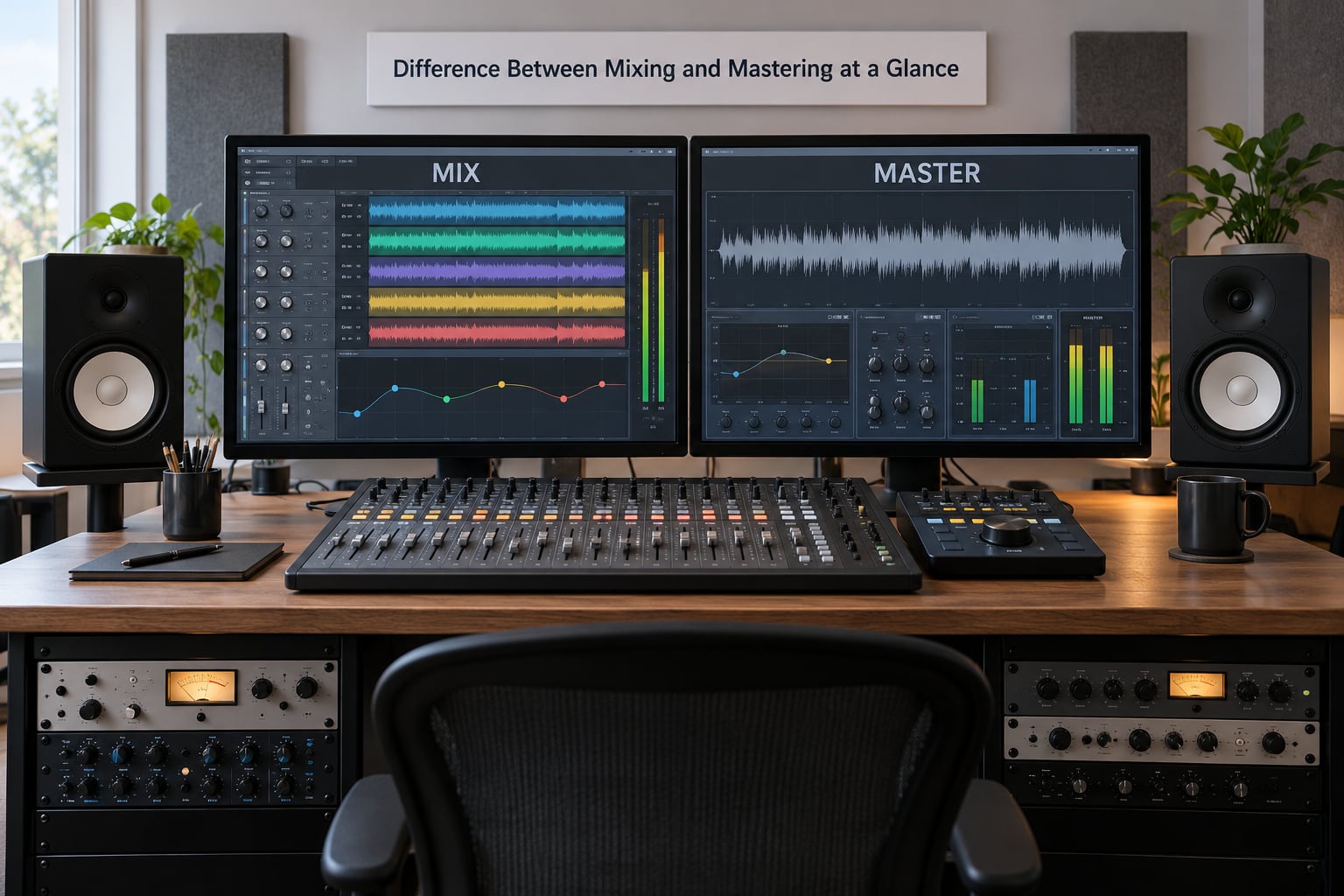
Difference Between Mixing and Mastering at a Glance
| Criterion | Mixing | Mastering |
|---|---|---|
| Purpose | Balance and shape the performance | Polish and prepare it for release |
| Input | Multiple individual tracks or stems | One finished stereo mix |
| Typical tools | EQ, compression, de-essing, panning, reverb, delay, saturation | Corrective EQ, mixbus or multiband compression, stereo imaging, limiting, dithering |
| Level balance | Between drums, bass, vocals and instruments | Final integrated loudness of the whole master |
| Creative latitude | Wide — arrangement and tone are decided here | Narrow — refinements, corrections and final loudness |
| Spatial effects | Reverb, delay, depth, width, panning | At most a light global stereo adjustment |
| Output | A stereo mixdown with headroom left intact | Distribution-ready files, plus vinyl or CD masters if needed |
| When it happens | After editing, once the arrangement is locked | Last, right before distribution |
Read that table once and most of the confusion about the difference between mixing and mastering dissolves. Notice that EQ and compression appear in both columns. Same plugins, completely different job description.
What Is Audio Mixing?
Mixing is the creative process of turning a pile of recorded tracks into one coherent performance. You decide what the listener hears first, how loud each element sits against the others, and where each element lives in the stereo field.
A typical example: your lead vocal is buried because the drums were mixed too loud and the guitars fill the same frequency range. During mixing you solve that relationship. You carve space with EQ, duck the guitars with sidechain compression where the vocal sits, and bring the vocal forward until the lyric is the clear focus.
The work happens in stages. You start with gain structure so every channel enters the mixbus at a sensible level and nothing clips. Then you cut with subtractive EQ, set static and panning positions, control dynamics track by track, and add reverb and delay to place elements in depth.
By the end, every sound supports the song and nothing masks anything else. When you hit play on a phone speaker in a kitchen, you can still hear the words. That is a finished mix, not just a balanced one.
What Is Audio Mastering?
Mastering is the final stage before release, and it works on the stereo mixdown rather than the individual tracks. The input is a single file. The output is a file that sounds right on earbuds, laptop speakers, a club rig, a car stereo and a phone at low volume.
Mastering engineers typically start with corrective EQ to fix any tonal imbalance left over from the mix, then work on overall dynamics with mixbus or multiband compression. A limiter raises perceived loudness while holding peaks under a ceiling. Stereo imaging gets checked for a mono-compatible low end and for width that does not fall apart on single-channel playback.
Headroom matters here. A mix that already sits at full scale with clipped peaks gives a mastering engineer nothing to work with, so the mix is usually delivered peaking somewhere around -6 dBFS with the loudness left well under a streaming target.
Mastering does not remake your mix. It cannot separate a vocal that is buried, rebuild a song missing a bass part, or undo a mix where the low end is smeared across eight instruments. It refines what you hand over.
How the Two Processes Work in a Track
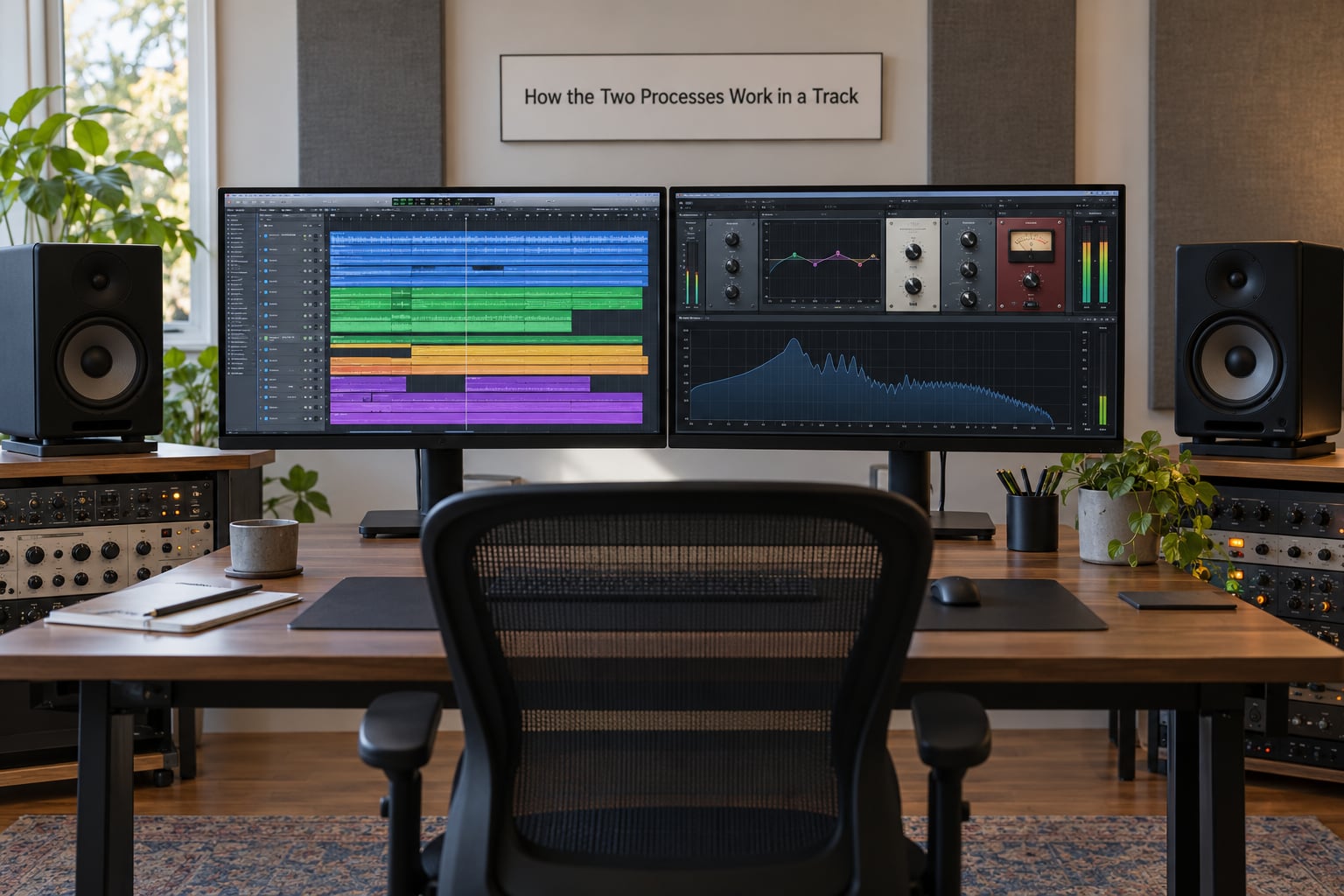
During mixing, every decision is relational. Nothing is judged on its own, because there is nothing to judge it against until the arrangement is playing. Automation, rides and transitions all belong to this stage, because they are part of how the song performs rather than how it sounds on a meter.
During mastering, the decisions are absolute. A mix either has a balanced low end or it does not, and the engineer’s job is to correct what can be corrected and set the overall level for the destination format.
The handoff between them matters more than most people expect. Mixing exports a mixdown at 24-bit with the sample rate matching the session, named clearly and versioned. Some engineers also send a rough reference so the mastering engineer can hear the artist’s intent, plus notes on any references the track should sit near.
There is a nuance worth naming. In a modern home studio, many producers mix and master the same project in one session, using tools that blur the boundary. That is not wrong. The stages are still different sets of decisions, even when the same person makes them within an hour of each other.
EQ, Compression, and Volume Control
Because both stages use EQ and compression, this is where most arguments get stuck. The difference is the level of the signal and the intent of the move.
In a mix, EQ is surgical on a single channel: high-pass a muddy guitar, tame a 3 kHz resonance on a snare, carve a notch out of a kick that a bass guitar needs. Compression is per-element, chosen so a vocal sits at a consistent level or so a pad stops swelling every bar. Faders set the balance, and if they are wide apart, your gain structure needs fixing first.
In mastering, EQ works on the summed stereo signal. You are notching a boxy 250 Hz resonance that smears the whole mix, or gently lifting 3 kHz because the master sounds dull everywhere except on the monitors in your room. Compression is broad and gentle, or multiband work to control a low end that only misbehaves on smaller speakers. The fader moves only at the very end.
Watch for duplicated correction. If a compressor already smoothed your vocal at -18 dB in the mix, running a heavy compressor across the full mix to make that vocal sit forward removes the very detail the first compressor preserved. One job per move.
Stereo Image, Reverb, and Spatial Effects
Depth, width and ambience are mix decisions. Reverb and delay decide how close an element feels and how large the room is, and panning decides whether a guitar sits beside the vocal or behind it. None of that can be reconstructed from a stereo file.
Mastering can make limited global refinements. An engineer might tighten the low end in mono to prevent a bass-heavy collapse on phone speakers, or gently correct a correlation problem that is squeezing the image. That is housekeeping, not spatial design.
Over-widening is the common failure. A wide mix can leave no solid centre for the vocal, and when a master gets squashed with a limiter, those outboard elements may collapse. Heavy reverb across everything leaves the master sounding like everything is at the same distance, and the loudness stage has to work harder to lift the whole thing, which flattens it further.
One habit catches this early: check the mono sum and check the mix on a phone. If the kick disappears or the vocal drifts hard left, the width was too wide before mastering ever touched it.
Loudness, Dynamics, and Final Playback
Mix-level balance and mastering loudness are different measurements. Balance is about the relative level of elements, which is one of the main reasons to leave your faders near zero. Loudness is the perceived level of the finished master, measured in LUFS, and it is what streaming platforms normalize.
That normalization is the source of a lot of confusion. Spotify, Apple Music and YouTube adjust playback volume to roughly -14 LUFS integrated, so a master delivered much louder than that simply gets turned down, sometimes with a fade at the start. A master sitting near -9 to -11 LUFS, typical for club-oriented and DJ-oriented material, will play at close to the intended level.
None of this means louder is better. Pushing a master to a target with heavy limiting shortens transients, raises the noise floor of quiet passages and makes the track tiring after a few minutes. A well-mastered track that is genuinely balanced holds up when a listener turns the volume up, which is a point that comes up constantly in producer forums.
Two practical numbers are worth remembering. Leave the mix peaking around -6 dBFS so there is headroom to work with, and keep the finished master under about -1 dBTP true peak so the lossy encoding step on streaming services does not create distortion. Targets vary by genre and destination, so treat them as context rather than a rule to hit at any cost.
The Difference Between Mixing and Mastering in Practice
Here is the whole thing in one short sequence, using a common home-studio scenario.
1. The rough mix. The vocalist tracked a strong take, then the producer mixed a few hours later with a limiter on the master bus cranking the vocal up until it sat still at the same level as the drums. The track is loud, and the vocal has no articulation left. Consonant endings and the difference between words are gone.
2. Back to the mix. The producer pulls the vocal bus down, rewrites the compression with a slower release and a lower ratio, and rebalances so the drums sit under it. A de-esser handles the sibilance, and the reverb on the vocal comes down slightly. This is mixing work, and it is where the track is actually fixed.
3. The mixdown. The session is exported as a 24-bit stereo mix with peaks around -6 dBFS, named with the version number and the intended release format. No limiter, no brickwall, no normalization on export.
4. Mastering. The mastering engineer checks tonal balance, finds a 200 Hz build-up across the kit and guitars, and applies a narrow cut. A gentle mixbus compressor sets the overall dynamic, a short stereo check confirms the low end sums cleanly, and a limiter brings the master to a target near -12 LUFS while holding true peak under -1 dBTP.
5. Final checks. Reference against a track the artist likes, listen on a phone and a small speaker, confirm there is no inter-sample clipping, export 24-bit WAV with dithering applied once, and only then deliver.
Common Mixing and Mastering Mistakes
Six mistakes account for most disappointing releases.
Mastering a rough mix. If the arrangement is not locked and the balance is not settled, no amount of mastering helps. Fix the mix first, always.
Running the same compressor twice without a purpose. The per-channel compressor shapes elements; the mixbus compressor glues them. If both are doing the same job at the same ratio, you are flattening dynamics for nothing.
Clipping the mix or the master. Once a signal hits 0 dBFS in the mix, the information is gone. Same for ignoring true peak on export, which shows up as distortion after lossy encoding.
Boosting the low end blindly. A muddy low end is usually a mixing problem with several instruments fighting in the same range. A mastering cut can reduce the mud but cannot put the bass back in the mix.
Chasing loudness to match a reference. Comparing your loudness to another producer’s master is a losing game, and it is advice you hear repeated constantly in mixing forums: you have no reason to be consistent with anyone else’s levels.
Changing the mix after mastering starts. Every revision restarts the mastering. Send the mix when it is truly done and expect the delivered master to be final.
Which Should You Choose?
Choose mixing when you are still building the song: choosing takes, arranging parts, setting the balance, choosing what space everything sits in. This is the stage that determines whether the track is good, and it takes the longest.
Choose mastering when you have an approved stereo mix and need it delivered for a release, a sync pitch, vinyl, or a broadcast spec. It is a shorter, more technical stage with a much smaller range of sensible moves.
Outsource mastering when playback consistency across playlists, formats and systems matters more than your budget allows, or when you want an objective set of ears on a mix you are too close to judge. It is also worth outsourcing when you are mastering a club track, where translation to a big rig is the entire point and home monitors tell you very little about it.
Outsource the mix, by contrast, if the song is complex, the genre is unfamiliar, or you want a second opinion before mastering. Mixing is where the creative decisions live, and a fresh perspective there is worth more than any master.
Frequently Asked Questions
Can one person mix and master the same song?
Yes, and most home producers do. Modern mastering tools are built into DAWs, so one person can make both sets of decisions in the same session. The stages are still different work: mixing settles balance, EQ, dynamics and space, while mastering handles final tonal correction, loudness and delivery. Do them in order, export the mix cleanly, and treat mastering as a separate pass even if it happens an hour later.
Does mastering make a bad mix sound better?
Only slightly, and never the way people hope. Mastering can correct tonal imbalances, add gloss and raise loudness, but it cannot separate a buried vocal, restore a missing instrument, or fix a mix that is too loud and clipping. A rough mix mastered hard usually sounds worse than a clean mix mastered gently. Producers who expect mastering to rescue an unfinished mix are usually disappointed twice.
Do I need stems for mastering, or is a stereo mix enough?
A stereo mix is enough, and it is the normal deliverable. Stems are useful only for unusual formats such as Dolby Atmos, stems for a DJ remix package, or a band that wants to print one master for several different mixes. Sending stems instead of a finished mix is a common mistake, because a mastering engineer can then no longer hear the balance you actually intended.
How many dB should mastering increase the loudness of a mix?
It depends entirely on the starting level and the destination. A mix delivered around -6 dBFS might gain 3 to 5 dB of loudness, while a quiet mix peaking at -12 dBFS might need 6 or more. For streaming, masters typically land near -14 LUFS integrated, and club-oriented material often sits between -9 and -11 LUFS. The goal is translation, not a bigger number.
Should a mix be finished before it is mastered?
Yes. Finished means the arrangement is locked, the balance is right, nothing clips, effects are in place, and you are not planning to swap takes. Mixing has to be done to a standard where you would happily release the file as is, because every change after mastering begins means paying for the mastering again.
Conclusion
The difference between mixing and mastering is scope, not equipment. Mixing decides how the parts relate to each other, and that is where a song is won or lost. Mastering then refines the finished stereo mix so it translates across playback systems and arrives at the right loudness for its release format.
Finish the balance, EQ, dynamics, panning and effects first, leave headroom on the mixdown, and then use mastering for what it is actually good at: consistency, translation and delivery.