A DJ set tells a story when it has a shape: an opening that sets a mood, a middle that builds pressure, and a climax and landing that leave the room satisfied. Most sets fall apart because tracks are picked one at a time instead of assigned a role first. Learning how to build a DJ set that tells a story takes about an hour of prep per hour of music, and the technique is mostly deciding what should happen before deciding what to play.
The core idea is simple. You write a rough plot, rate every track on a 1 to 10 energy scale, then fill the plot with music that fits each slot. The room notices the arc long before it notices your beatmatching.
Table of Contents
- What You Need
- Step-by-Step: How to Build a DJ Set That Tells a Story
- Step 1: Choose a Central Story or Emotional Arc
- Step 2: Build a Beginning, Middle, and Climax
- Step 3: Select Tracks for Musical Contrast and Development
- Step 4: Shape the Energy Instead of Chasing Every Peak
- Step 5: Connect Tracks with Purposeful Transitions
- Step 6: Rehearse the Set and Mark the Turning Points
- Step 7: End With a Deliberate Resolution
- Common Mistakes
- Frequently Asked Questions
- Conclusion: Start With One Clear Musical Idea
What You Need
Before you open your library, you need four things, and none of them are new gear.
- A one-sentence concept. What is this set about? Night-drive restlessness, a slow build into a warehouse peak, a warm-up that stays polite for ninety minutes. One sentence keeps a set from drifting.
- A prepared library. Tracks tagged with BPM, key, and energy. Rekordbox, Traktor, and Mixed In Key all handle key detection, and each one lets you sort by energy level once you set that field.
- A performance machine and a backup. A laptop or controller with the set loaded and analyzed, plus a second copy on an external drive or a backup stick.
- Cue points and headphones. Beat cues, phrase cues, and a loop cue on every track you plan to use. Setting these before the gig is the difference between a smooth transition and a scramble.
- A recorder. Recording every set you play, even practice ones, is the fastest way to hear your own arc. Most DJs never listen back, which is why most DJs can’t explain what their set was about.
Step-by-Step: How to Build a DJ Set That Tells a Story
Step 1: Choose a Central Story or Emotional Arc
Write one sentence describing the emotional journey before you touch a single track. “Pressure building to release” works. “Loose, warm, and unhurried” works. “Eleven tracks of dread then one hour of relief” also works, and it’s more interesting than either of the others.
That sentence gives you a shape to hang tracks on. Pick the shape that fits the slot:
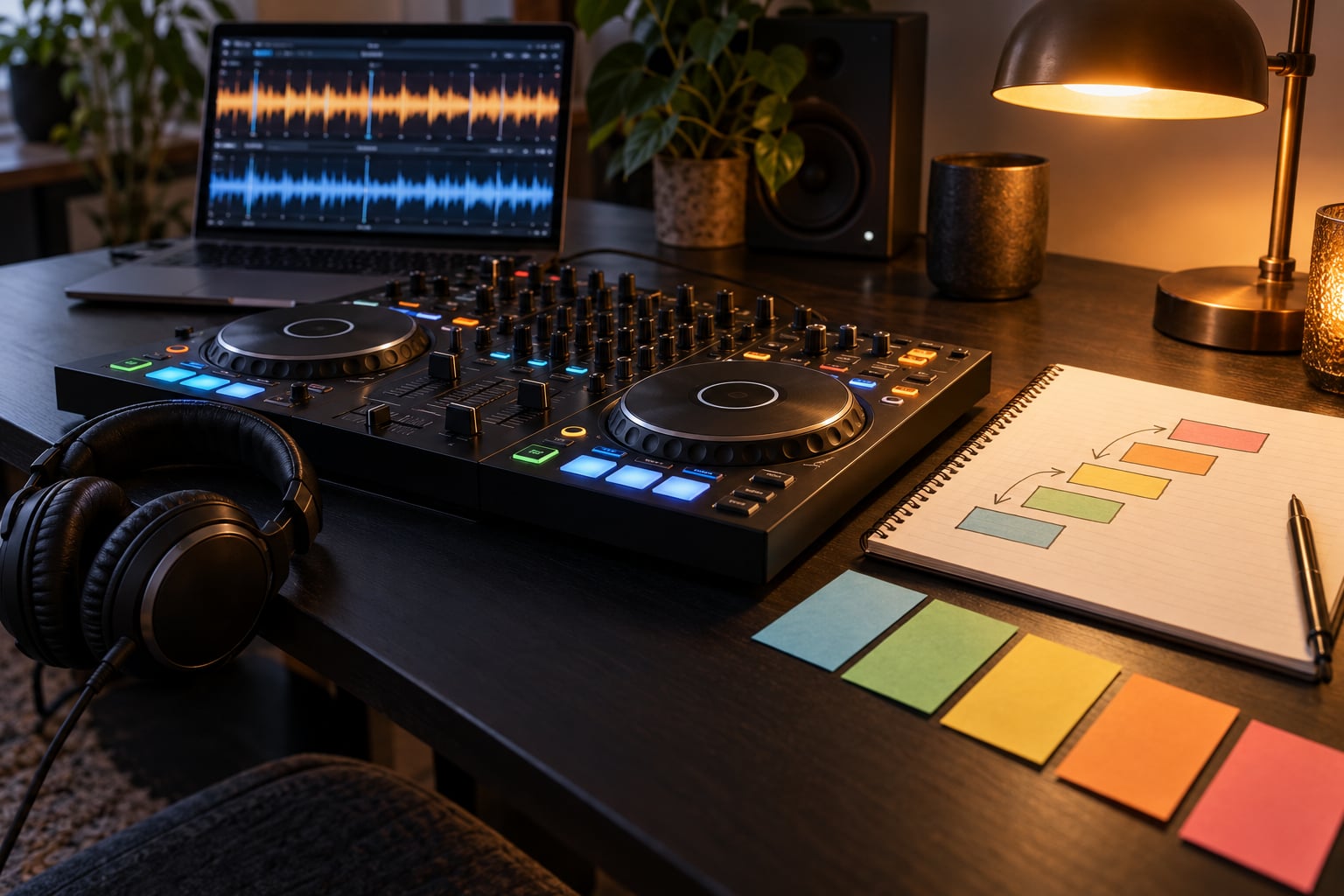
- Wave — energy rises, falls, and rises again, with two distinct peaks. Good for a two-hour room that needs several payoffs.
- Ramp — a steady climb, used almost every time. Safest choice for a club or festival slot.
- Story — a deliberate arc with a setup, a turn, and a resolution, closer to how a film is built. Harder to pull off and much more memorable.
Whichever you choose, give every candidate track an energy score out of 10. Some people use a smiley face scale in their tagging software, some just sort into folders. Either way, the number is the point, because it turns a mood into something you can plan against.
Step 2: Build a Beginning, Middle, and Climax
Map the set into acts and give each act a job, then assign a BPM band, an energy level, and a rough track count. Here’s a blueprint for a two-hour ramp with a story shape:
| Act | Job | Energy (1-10) | Typical BPM | Tracks |
|---|---|---|---|---|
| Act I: Open | Invite people in, introduce the palette | 4-5 | 118-124 | 8-10 |
| Act II: Build | Add texture, keep tempo steady, first curveball | 6-7 | 124-128 | 14-16 |
| Midpoint | The turn: a drop, a change of sound, one big surprise | 8 | 128-130 | 2-3 |
| Act III: Peak | Long stretch at full stretch, minimal breathing room | 9-10 | 128-132 | 12-14 |
| Close | One deliberate landing, no abrupt cut | 10 to 5 | Varies | 2-3 |
Do the arithmetic before you build. A full-energy track in a four-on-the-floor style runs about six minutes, so a two-hour set is roughly 18 to 20 tracks with normal mixing. A warm-up set of slower, longer material can be 12 to 14. Prepare more than you need. DJs on r/DJs and r/Beatmatch commonly say they carry 40 to 60 tracks per hour of playing so they can branch when the room disagrees with the plan.
Step 3: Select Tracks for Musical Contrast and Development
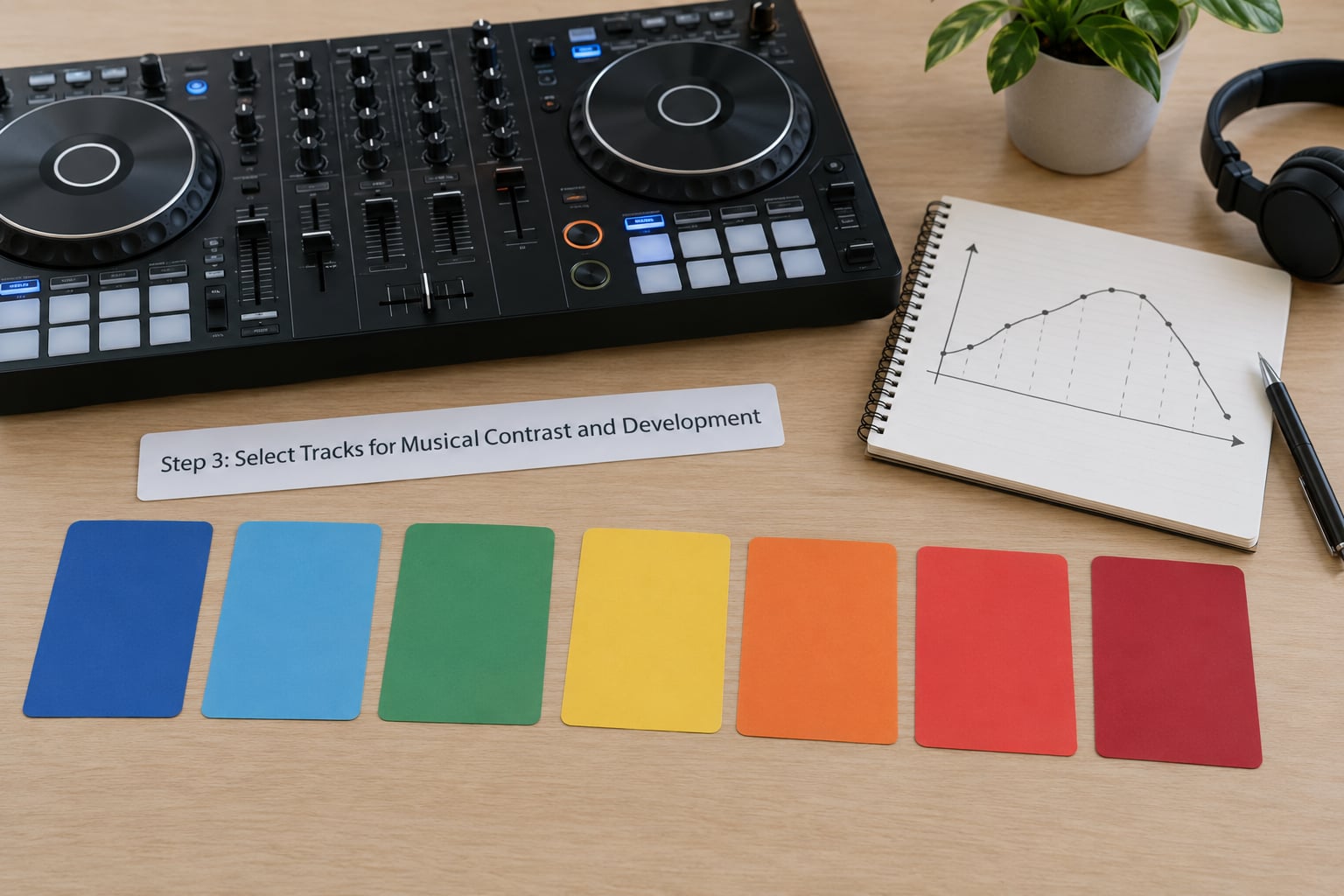
Contrast is what stops a set from turning into a playlist. A run of eight tracks that all sit at energy 7 with the same kick, the same vocal density, and the same tempo will feel like one long track no matter how well it’s mixed. Vary texture instead of stacking energy: a vocal sample, a stripped percussion track, a dub section, an instrumental with a long breakdown.
Anchor each stretch with two or three tracks you know land in that room or on that stream, then hide a curveball nearby. The curveball should share something with its neighbors — a tempo, a key, a mood, or a sonic detail — while breaking something else. A track that is faster, darker, or stranger than everything around it creates the moment people remember. Completely unrelated tracks do not; they just create a gap.
Multi-subgenre sets need the same treatment. When you move from one style into another, hold one element constant for the first two tracks of the new section. Keeping the tempo locked while the drums change, or keeping the same percussive feel while the tempo climbs, gives people a handrail during a shift that would otherwise feel like a jump cut.
Step 4: Shape the Energy Instead of Chasing Every Peak
A set that stays at maximum intensity for an hour is exhausting, and most people stop dancing somewhere in the middle without knowing why. Movement is what keeps a room, and movement means going down sometimes. Drops of three or four BPM between sections, a low-energy breather track, a long breakdown used as punctuation all read as movement even while the overall trend is upward.
The working rule is that energy changes should be gradual enough that nobody notices the moment they happen and obvious enough that everybody notices the hour. Use the 1 to 10 scale honestly rather than optimistically. A track you rated 8 when you were listening alone at home is often a 7 in a room full of people who have been dancing for an hour.
There is a number worth knowing: the rule of 32, borrowed from vinyl mixing, suggests a continuous mix should hit roughly 32 tracks an hour, which leaves room for longer tracks and for a couple of slow ones. Treat it as a sanity check rather than a law.
Step 5: Connect Tracks with Purposeful Transitions
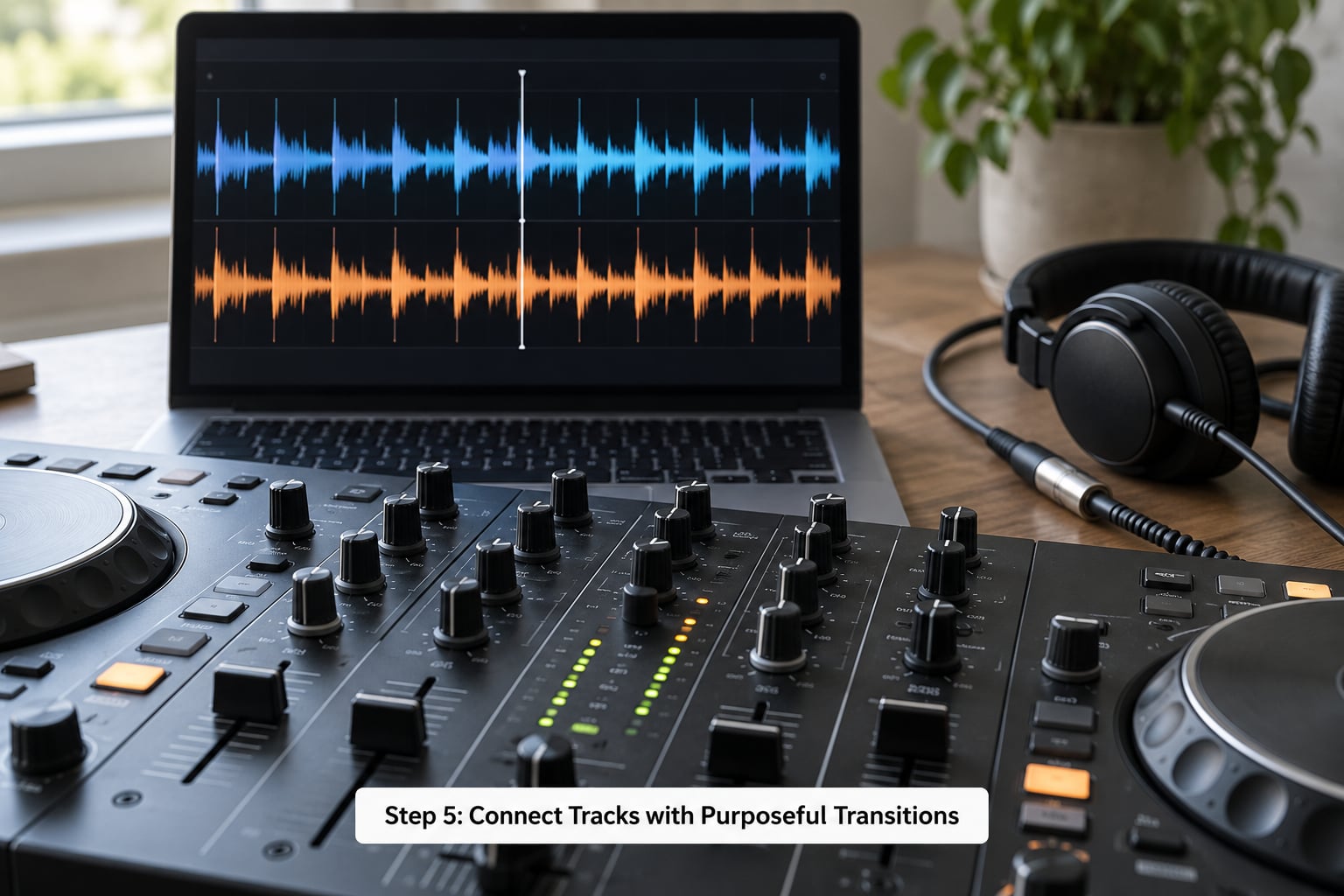
Transitions exist to serve the story. If two tracks sit at the same energy, a short blend or a quick beatmatched swap keeps the arc intact. If one track ends in a breakdown and the next starts full speed, that moment is a story beat and deserves a long blend or an echo-out. Match the phrase, bring the next track in on the downbeat, and ride the filter or the loop only when it adds tension.
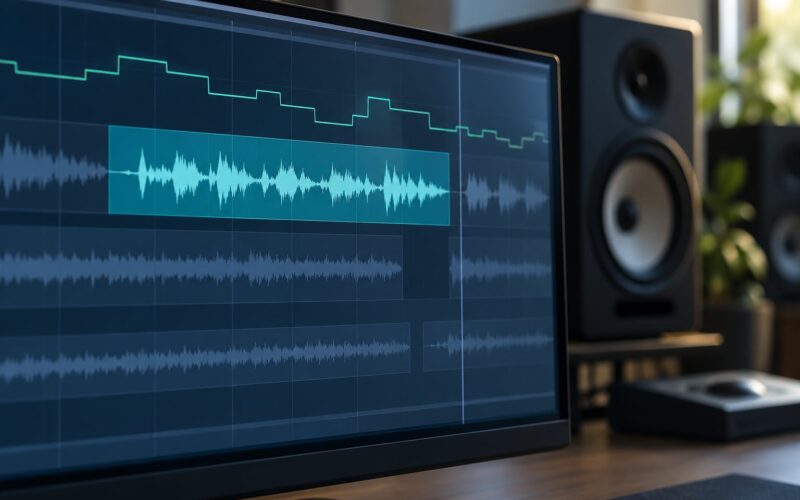
Cue into the right section and the transition problem mostly solves itself. Watch the waveform, and start tracks where the arrangement gives you something to work with rather than always at zero.
| Section | What it is | What to do with it in a mix |
|---|---|---|
| Intro | Drums and texture only | Best section to blend in from a similar track |
| Verse / Hook | First full statement | Good cue point for a longer blend |
| Build | Layers adding, energy rising | Cue here to create your own tension before a drop |
| Drop | Full arrangement | Land the energy change here, not at the track start |
| Breakdown | Stripped section | Use as the release, or as the setup for a peak |
| Outro | Elements drop away | Cue out of it, or use it to blend into a slower track |
Harmonic matching keeps transitions invisible, but invisible is not always what you want. Stay inside compatible keys for most of the set, then break the key on one deliberate track per act. The rule is simple: break it where the change in key becomes part of the story, not where you got tired of checking.
Step 6: Rehearse the Set and Mark the Turning Points
Play the whole set through once without performing it, just to hear it. Then mark four positions in your software: the first surprise, the energy drop, the biggest transition in the set, and the last track you plan to play. Those are your turning points, and they’re what you fall back on when you lose your place in the middle.
Listen back to the recording with a notebook, not just headphones for pleasure. Ask three questions: where did attention drop, which track felt like filler, and did the last five minutes feel different from the first five. Fix the flat spots by swapping tracks, not by pushing the tempo.
Then prepare for the version of the night that doesn’t go to plan. Build a skeleton of tracks that must appear in order, and a branch of alternates attached to each one. If the room wants more energy five tracks early, you have something ready. Planning too rigidly is the most common way a good set turns into a trainwreck.
Step 7: End With a Deliberate Resolution
Most sets end because the time ran out. A set that ends well gives the hour a shape people can remember. Pick the closer in advance and give it one job: to pay off the story you set up at the start. A callback that brings back a sound, melody, or vocal from your opener does this more reliably than any banger.
Decide how you’ll land it. Let a long outro play under a spoken thank you, blend out into a slower closing track for a bar or restaurant, or finish on a full-energy record and mix into it over a minute so the last thing the room hears is a gradual return to nothing. Whatever you choose, start it before your slot ends.
Common Mistakes
Starting from your favorite tracks instead of your story. Pick the shape first, then find the music. If you begin with the tracks you love, you’ll end up bending the arc to fit them.
One energy level for the whole hour. A flat set feels dead even when every track is technically perfect. Drop the tempo or drop the density between sections and the peak you planned will land twice as hard.
Cueing every track from zero. Mixing in at the very start of a track limits your options and makes transitions predictable. Cue into intros, builds, and breakdowns instead.
Over-planning and losing the room. A rigid setlist ignores what’s actually happening in front of you. Keep a required order and a branch of alternates, and let the room choose between them.
Spending the whole set on safe, known records. One or two curveballs an hour is enough to make the rest feel like a decision. Zero surprises reads as a playlist.
Not listening back to your own sets. Ten minutes of review after every gig will do more for your pacing than any amount of gear.
A few habits help when the story wobbles mid-gig. When you lose the thread, drop to a track you know cold and rebuild from there. When the floor is too far ahead of you, hold the tempo and introduce one texture change instead of jumping straight to maximum energy. And when you land the peak early, a breakdown is not a failure; it’s the second wave you planned for.
Frequently Asked Questions
How many songs are in a 2 hour DJ set?
For full-energy four-on-the-floor material running about six minutes each, expect 18 to 20 tracks in two hours with normal mixing. Slower, longer tracks or a warm-up style will bring that down to 12 to 14. Prepare more than you need, commonly 40 to 60 tracks per hour, so you have alternates when the room wants something different.
How to build a DJ set list?
Write a one-sentence concept for the set, then map it into acts with a BPM band, an energy score from 1 to 10, and a track count for each. Fill each act with tracks that match its energy and texture, keeping two or three anchors plus one curveball per section. Cue points, a rehearsal run, and a set of alternates finish the plan.
Should I plan my DJ set or improvise?
Plan the skeleton, improvise inside it. Decide the opening track, the midpoint, and the closer before you play, and prepare alternates for every track in between. That way you always have somewhere to go when the room reacts differently than expected, without losing the arc you designed.
What is the rule of 32 in DJing?
The rule of 32 comes from continuous vinyl mixing and suggests a mix should reach roughly 32 tracks per hour. It leaves room for longer tracks and the occasional breather. Most digital DJs end up with fewer tracks than that, so treat it as a rough upper bound rather than a target worth chasing.
How do I keep flow when mixing different genres in one set?
Hold one element constant for the first two tracks of any genre change: the tempo, the percussive feel, or a sonic detail. Change the other elements gradually over those two tracks. A sudden swap with nothing in common sounds like a jump cut, while a gradual handover reads as a deliberate part of the set.
What is a good opening track for a DJ set?
Pick something with a clear intro, an identifiable mood, and an energy that leaves room to climb. A track with a strong vocal moment tells the room immediately that someone is in charge. Avoid starting on your hardest, fastest track; you spend your best material early and have nothing left for the middle.
Conclusion: Start With One Clear Musical Idea
Knowing how to build a DJ set that tells a story comes down to three decisions made before you play anything: the emotional arc, the roles each section plays, and the tracks that fill them. Technical skill matters, but it’s what makes the transitions invisible, not what makes the hour land.
Start tonight with the smallest version of this. Pick one emotion, choose an opening track and a closer, then work backwards to fill the space between them. Whatever you’re playing in 2026, that order is the part that makes a set worth remembering, and it’s the part that gets you asked back.