Registering your songs for royalties in the US means putting the same song in front of several different organizations, each of which pays a different kind of royalty. A performing rights organization pays performance money, The MLC pays digital mechanical royalties, SoundExchange pays for digital use of the master, and a US Copyright Office registration is what lets you enforce the work in court. Most independent artists start that list four to six weeks before a release.
Membership with a PRO and registration with The MLC are free for songwriters, and your distributor usually handles SoundExchange for you. The Copyright Office charges a government fee that changes, so the official fee schedule is the only place to read the current numbers. The hard part is not the forms, it is keeping titles, writer shares and identifiers identical everywhere. Mismatched data is the reason most unpaid royalties never reach a songwriter.
Table of Contents
- What You Need Before You Start
- How to Register Your Songs for Royalties: Step-by-Step
- 1. Identify What Needs to Be Registered
- 2. Confirm the Writers, Owners, and Contributors
- 3. Prepare the Final Recording and Metadata
- 4. How to register your songs for royalties with the right organizations
- 5. Submit the Copyright and Rights Information
- 6. Register or Document Your Publishing Administration
- 7. Track the Registration and Follow Up
- Common Mistakes and How to Fix Them
- Frequently Asked Questions
What You Need Before You Start
Gather these in one folder per release. Everything below is something a rights organization will ask for, and hunting for it after submission is how registrations stall.
- The final audio. The exact file you are releasing, not the demo and not a rough bounce. A changed master later means a new ISRC and a correction request.
- Lyrics or a lyric sheet. Plain text is fine. Copyright Office deposits of lyrics must match the registered work.
- A signed split sheet. Percentages for every writer, every producer with a writing credit, and the publisher share, signed by all of them before you file.
- Exact contributor names. Legal names in the form each organization expects, including middle names and suffixes, matching your PRO profile.
- Publisher details. Whether that is you personally, an LLC, or a publishing administrator your distributor appoints.
- A catalog spreadsheet. One row per song with title, alternate titles, writers, splits, ISRC, ISWC, release date and registration dates. This becomes your audit trail.
- Access to the portals. A PRO member account, a MLC Portal account, your distributor dashboard, and an eCO account at the Copyright Office.
How to Register Your Songs for Royalties: Step-by-Step
The order matters more than the paperwork. Settle ownership before you register anything, because a registration filed with the wrong splits creates a correction queue that can take months to clear.
1. Identify What Needs to Be Registered
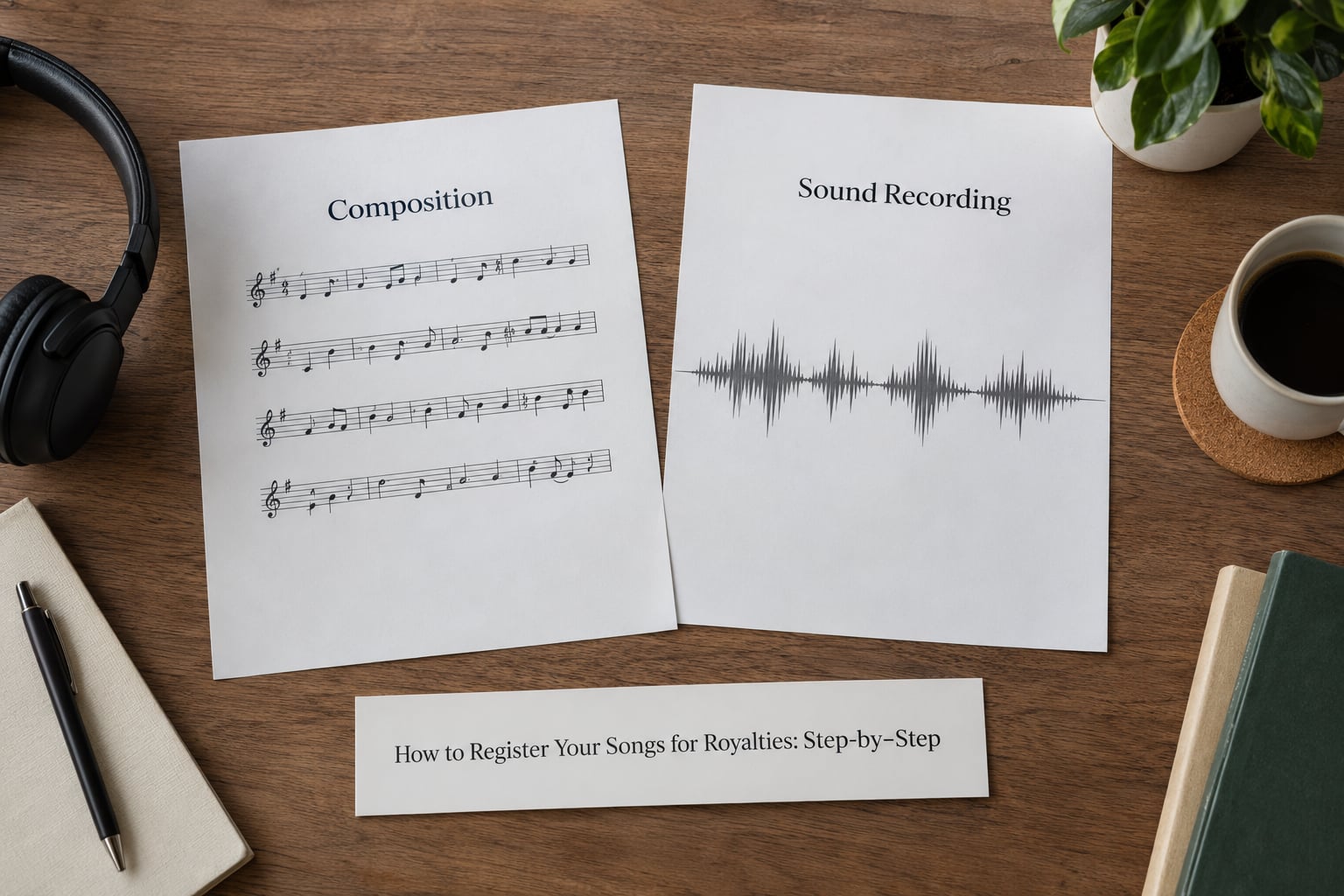
One song usually produces two or more separate rights. The musical composition is the melody, chords, lyrics and words. The sound recording is the particular captured performance of that composition, including the mix. Copyright in each one belongs to different people in many cases, and they get registered in different places.
Take a hip-hop track as the example. You wrote the hook and the verses, so you hold a writer share in the composition. The producer either sold you the beat outright or kept a percentage, and that determines whether they still own part of the composition or only the master. The master you own outright only if every sound in it came from you or was cleared.
| What it is | Who owns it | Where it gets registered |
|---|---|---|
| Musical composition | Writers and publisher | PRO, The MLC, Copyright Office as Work of the Performing Arts |
| Sound recording | Master owner, often the label or distributor client | SoundExchange, Copyright Office as Sound Recording |
| Lyrics as written | Lyricist, usually a co-writer | Copyright Office deposit, PRO writer credit |
| Third-party sample or interpolation | Whoever owns the sampled work | Cleared before release, documented in your split sheet |
Registering the master and forgetting the composition is the single most common error in this business. Copyright in your recording does not give you any right to the song inside it, and without a composition registration you collect no performance or mechanical royalties from your own release.
2. Confirm the Writers, Owners, and Contributors
Build a contributor list that names every person with a share, and get it agreed in writing. A split sheet is a short document listing each contributor, their percentage, and their signature. Keep it with the session files and give every co-writer a copy.
Two details catch people out. First, publishing splits and master splits are separate documents with separate numbers, and they rarely match; a producer who takes 20 percent of the master may have no writing share at all. Second, percentages must total one hundred across writers, and the writer share must equal the publisher share within the composition. Most PROs default to a 100 to 0 or 75 to 25 split between writer and publisher, so decide your ratio before you register rather than after.
Resolve disputes now. If a co-writer will not sign, file with the share you can document and correct it later through a split dispute or assignment process. Registering a song with a known wrong owner is harder to unwind than registering it late.
Collect each writer’s IPI number, the identifier PROs and The MLC use to recognise a songwriter across databases, once they have one. It is usually assigned automatically the first time a writer registers with a PRO.
3. Prepare the Final Recording and Metadata
Metadata is what gets your song matched to a payment months later. Get it right once, in the same form for every registration.
Your title needs to match the distributor, the streaming platforms and the copyright application exactly, including capitalization and spacing. If a title has changed, or if the release has alternate titles, list all of them. Featured artists, remix names, and version names all belong in the metadata so a sync placement or a platform listing can be traced back to your work.
The ISRC identifies the sound recording and normally comes from your distributor once the track is delivered. The ISWC identifies the musical composition and is usually created by your PRO or by The MLC once you register the work there. Distributors use DDEX style metadata standards, and matching those conventions makes your data land cleanly instead of as a new unmatched track.
Register before the track goes live wherever you can. Rights organizations match on release activity, and a song that starts collecting plays before it exists in a rights database often lands in an unmatched pool that you then have to claim by hand.
4. How to register your songs for royalties with the right organizations
There are four routes, and they are not alternatives to each other. Most working songwriters use all four.
| Route | What it collects | Who can use it |
|---|---|---|
| PRO such as ASCAP or BMI | Performance royalties from radio, live venues, streaming and background use | Open membership, writer and publisher sign-ups |
| The MLC | Digital mechanical royalties from streams and downloads | Open membership; writers use the Songwriter Hub, administrators use the Member Hub |
| SoundExchange | Digital performance royalties on the master from satellite, internet radio and jukebox use | Master owners, usually registered through the distributor |
| US Copyright Office | Legal enforcement, eligibility for statutory damages, prerequisite for a US infringement suit | Any author, claimant or owner |
SESAC and Global Music Rights are invite-only and are not accepting open submissions, so plan on ASCAP or BMI. Both are free for writers, and most artists join one. You can be a member of both, which is normal when your catalog has tracks registered with different organizations already, but pick one as your home for new work so your writer profile stays clean.
For publishing administration you have three options: appoint yourself as your own publisher, form a publishing company, or let a distributor or third-party administrator handle it for a percentage of the publishing income. Self-publishing keeps more of each dollar and costs more admin time. A deal with an administrator is easier but takes a cut and adds a middleman between you and The MLC.
5. Submit the Copyright and Rights Information
Copyright in a US work exists from the moment it is fixed in a tangible form, which is why mailing a copy of your song to yourself does nothing legally. Registration with the Copyright Office is what makes enforcement practical and what opens the door to statutory damages in a lawsuit.
Create an account in the Electronic Copyright Office, the Office’s online filing system. Choose the application type that fits: a Single Application covers one work, a Standard Application covers up to ten, and a Group of Unpublished Works application covers up to ten unpublished works by the same authors and costs the most per work but the least overall for a batch of new songs.
For the song itself, select the Work of the Performing Arts category for the composition, and file a separate Sound Recording application for the master if you want both. You may be able to claim authorship and ownership together if you wrote and recorded it yourself. Use the limitation on claims field carefully: it tells the Office that certain elements, such as unrecorded lyrics or a producer’s uncredited contribution, are deliberately not claimed.
Upload the deposit, which must be an acceptable copy of the work exactly as it exists, including the lyrics you are claiming. Check every name and percentage against your split sheet before you pay, because corrections after filing involve a follow-up application. Save the case number, the receipt and the submitted deposit copy in the same folder as the registration confirmations from your PRO and The MLC.
6. Register or Document Your Publishing Administration
This is the step where registration turns into income. A copyright registration protects the work. A copyright registration plus a PRO membership plus a MLC membership is what puts money in your account when the song gets played.
Writer share and publisher share are handled separately, and a common surprise is that your PRO will not pay out a publisher share to a writer-only member. If you self-publish, you need a publisher entity registered with the same organization, which on some PROs means a separate setup step and, on others, a separate fee.
At The MLC, writers with a publisher use the Member Hub, where the publishing administrator enters the work. Writers who self-publish can create a free account in the Songwriter Hub and register their own works. Once a work is live there, it can be matched against usage reports from DSPs. Registration changes can take days or sometimes weeks to appear as live, so check back rather than assuming something went wrong.
7. Track the Registration and Follow Up
Save three things for every song: the confirmation number from each organization, the date the work went live, and a copy of the metadata you submitted. When a royalty statement arrives six months later, these three items are the difference between a five-minute correction and a month of emails.
Royalty timing is slow. Performance money often arrives on a six to twelve month lag from the use, and digital mechanical royalties are distributed on their own schedule through The MLC. Your PRO’s unmatched or unidentified royalties pool, and The MLC’s unmatched and claiming tools, exist for exactly this situation: usage that reached the database without matching a writer. Both let you search by title and file a claim, and both are worth checking annually rather than only when you are broke.
When money does not arrive, work through these in order: is the work registered with everyone who should have it, do the percentages match across organizations, is your writer name and IPI number identical in each system, and did the usage actually match the work you registered. Conflicting data between a PRO and The MLC is common, because the two systems accept splits formatted differently, and mismatched shares are a frequent reason payments are held. Note the split defaults that cause it: a PRO treating your work as 75/25 writer to publisher while The MLC holds it as 50/50 will not reconcile automatically.
Common Mistakes and How to Fix Them
Registering the demo or the beat. Unreleased material is not worth registering, and a demo will never match the release. Wait for the final master.
Filing with guessed splits. Percentages that were never agreed produce a dispute on a share of every future payment. Get signatures first.
Leaving alternate titles out. A sync placement, a film credit or a platform listing will use a different title than you remember, and alternate titles are the search term that finds the work.
Treating copyright as royalties. Copyright Office registration gives you enforcement power, not income. The money comes from the PRO, The MLC and SoundExchange.
Registering after the song is already earning. Unmatched pools can be claimed, but the work is easier to trace when it existed in the databases before the use.
Skipping the publisher side. If you self-publish and never register a publisher share, part of every performance and mechanical payment simply has nowhere to go.
Waiting for an infringement before registering. Statutory damages in a US infringement suit are tied to registration status, so a late registration weakens a claim you would otherwise have had leverage for.
Frequently Asked Questions
Do I need to register my songs with ASCAP?
You do not need ASCAP specifically, but you do need a performing rights organization. ASCAP and BMI both accept open memberships and both are free for songwriters, while SESAC and Global Music Rights are invite-only. Pick one as the home for your new songs to keep your writer profile clean, then register every released work there with exact titles, writer names and shares. Membership without work registration collects nothing.
How much does it cost to register a song?
PRO membership and registration with The MLC are free for songwriters. SoundExchange registration comes free through most distributors. The US Copyright Office charges a government fee that varies by application type and changes periodically, so read the current fee schedule on the copyright.gov site rather than trusting an old blog post. Paid publishing administrators and split sheet services cost extra, and they take a cut of what they collect.
Can I copyright a song myself?
Yes. Copyright exists automatically once your song is fixed in a tangible form, so you can register it in your own name through the Copyright Office without a lawyer or a publisher. Mailing a copy of the song to yourself, called a poor man’s copyright, carries no legal weight in the US. Registration still matters because it is required before filing an infringement suit and it is what makes statutory damages available.
Can you join BMI and ASCAP at the same time?
You can, and it is common for catalogs that already carry works registered with different organizations. Nothing stops you holding memberships with both. The practical advice is to designate one as your home for new registrations so your writer profile, IPI number and contact details stay consistent, because conflicting metadata across two systems is a common cause of held or unmatched payments.
Do I need a publisher to collect royalties?
No, you can self-publish. You register as your own publisher with the same organizations you use for your writer share, or you appoint a publishing administrator. The catch is that writer share and publisher share are separate registrations, so a writer-only membership typically will not pay out the publisher half of a performance or mechanical royalty. Self-publishing keeps more money in your hands but takes more admin time.
What happens if I do not register my songs?
Copyright still protects the song, but nothing gets paid to you automatically. Unregistered works fall into unmatched pools at PROs and The MLC, and you have to search and claim them by hand, sometimes years later and sometimes never. For streaming mechanical royalties, a work that was never registered with The MLC has no owner record to match against, so that income is simply redistributed to others.
Start with the split sheet, not the portal. Agree percentages in writing with every co-writer, pick one PRO, and create your MLC Portal account on the same afternoon, because those two registrations take the longest to become live. Once the splits are signed, register the works in your PRO and The MLC before the track goes out, deliver clean metadata to your distributor, and file the Copyright Office application for the composition and the master. Add every confirmation number to your spreadsheet on the day you receive it, and the follow-up work becomes a ten-minute task instead of a search through email.