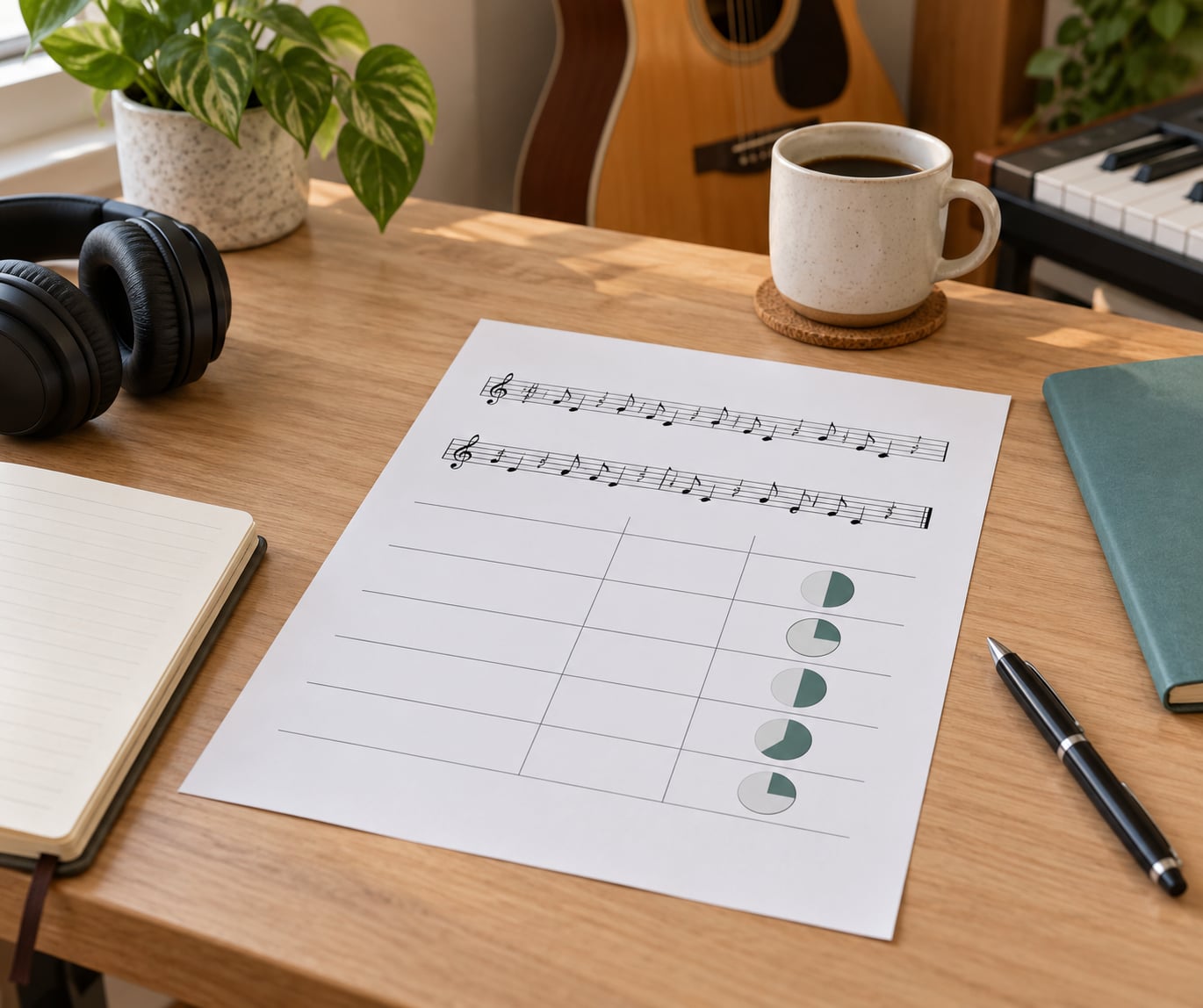
A split sheet is a written record that documents who helped write a song and exactly what percentage of it each person owns. It usually covers both the composition and the master recording, and it gives performers a performing rights organization (PRO) something concrete to pay from when the song earns money.
The reason to sign one early is simple: nobody can pay you correctly without it. If a song does well and the paperwork is vague, everybody’s money gets held up until the disagreement is settled, which can take months or years.
Table of Contents
- What Is a Split Sheet?
- Why Do You Need a Split Sheet?
- What Does a Music Split Sheet Include?
- Master Rights vs. Publishing Rights
- How to Fill Out a Split Sheet
- Split Sheet Examples for Common Music Situations
- Common Split Sheet Mistakes to Avoid
- When Should You Create a Split Sheet?
- Frequently Asked Questions
- Conclusion: Document the Split Before You Release
What Is a Split Sheet?
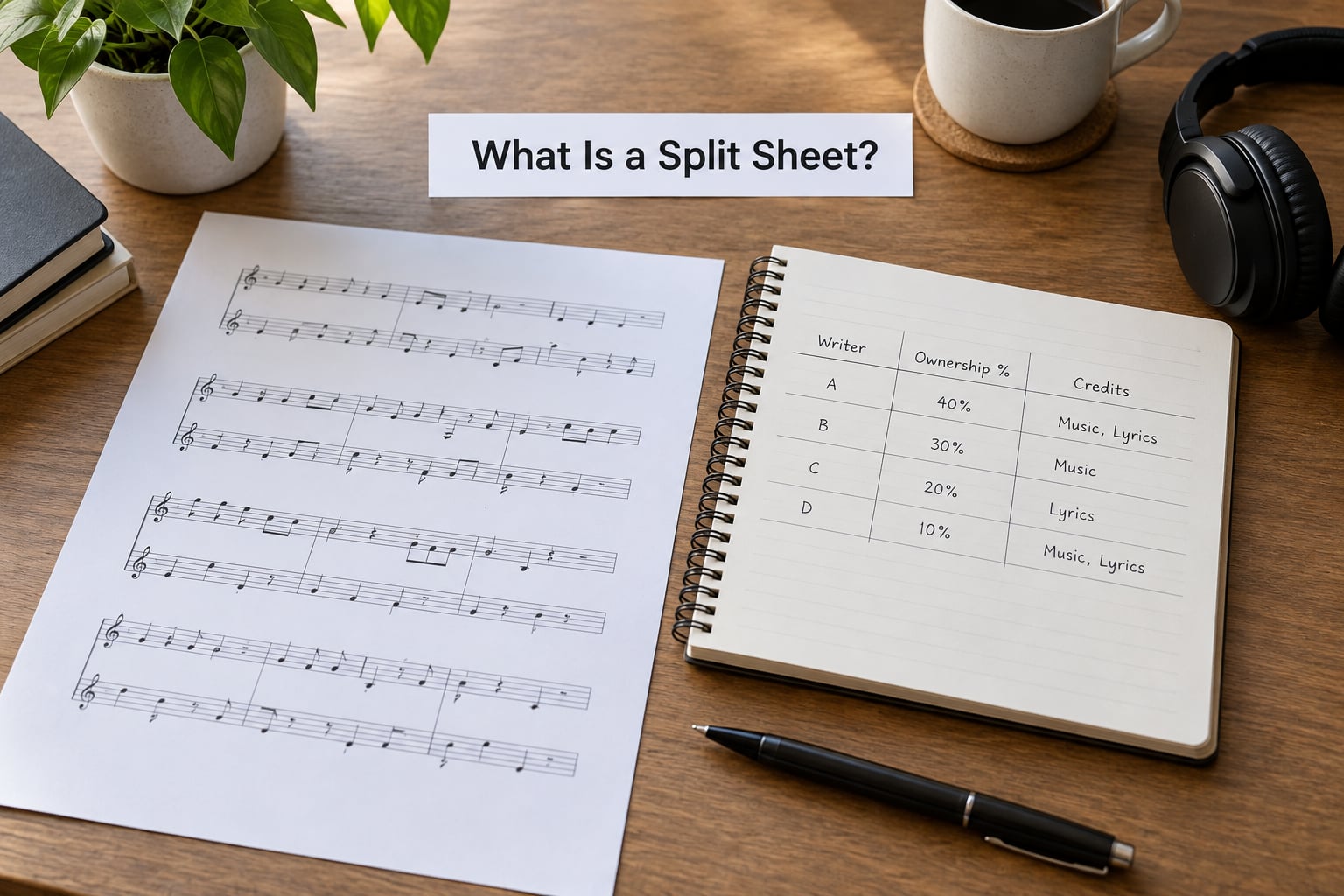
A split sheet is a document that lists every contributor to a song and records the percentage of the song each one owns. It names the song, the writers and producers, their roles, their ownership shares, and their signatures. It is used to set publishing splits and master ownership percentages before release.
It is a shared record of an agreement rather than a transfer of rights. Copyright in a new composition belongs to whoever wrote it by default, so the split sheet mostly confirms what already exists and stops anyone from guessing later. It is also not a substitute for a real contract when money changes hands, a beat is bought outright, or someone is hired to write to order.
What a split sheet is not
A split sheet does not register a copyright, transfer a master to a label, or substitute for a work-for-hire agreement. Registering the song with the US Copyright Office is a separate step, and so is signing a producer agreement that states what a beat buyer is buying.
It also does not clear a sample. Sample clearance is a permission you obtain from someone else, and a split sheet between you and your co-writers has no bearing on it.
Why Do You Need a Split Sheet?
Understanding what is a split sheet and why you need one comes down to a single fact: royalties only move when ownership is identifiable. Your PRO (ASCAP, BMI, SESAC in the US, or PRS, GEMA, TEOSTO, SACEM elsewhere) matches your registered share against usage and pays it out. Without a written record, the PRO often assumes equal splits, which quietly hands someone a bigger or smaller cut than they agreed to.
Disputes are where it matters most. Forum discussions on music production boards keep circling the same stories: money arrives, a co-writer remembers the session differently, and the PRO freezes the whole balance until both people agree. Nobody is paid during that freeze, including the person who is right.
Sync licensing makes it worse. A music supervisor or an ad agency needs every co-writer’s approval and accurate share information to clear a track for picture. One unreachable co-writer can sit on a placement for months, and the fee goes to whoever responded.
There is a long tail, too. Songwriting royalties keep arriving for decades, which means a wrong split recorded once tends to stay wrong through every statement that follows.
What Does a Music Split Sheet Include?
Every sheet is a bit different, but these fields are the ones that cause problems when they are missing:
- Song title and version name. If you have an alternate version, write it down separately so registrations do not collide.
- Date of the song. A date of creation settles which version is the original when titles get reused.
- Legal names. Full legal names, spelled correctly. Stage names go in a separate field, not instead of the legal name.
- Artist name or pseudonym, where it applies. Needed for PRO registration matching, but it does not replace the legal name.
- Roles. Songwriter, composer, lyricist, producer, beat maker, arranger, engineer, featuring artist.
- Publishing split percentages. Who owns what share of the composition, totalling 100 percent.
- Master ownership percentages. Who owns the recording itself, also totalling 100 percent.
- Publisher and administrator details. If a deal memo exists, name the publisher and the publishing administrator handling the share.
- PRO affiliation. Which performing rights organization each person belongs to.
- IPI number. Each songwriter has one, and a missing IPI is a common reason a payment stalls.
- Contact details. Email and phone for each contributor, so the person collecting metadata can reach them in two years.
- Signatures and dates. Every contributor signs the same copy, and everyone gets a copy of the signed version.
Master Rights vs. Publishing Rights
Two separate copyrights are attached to every finished record, and confusing them is the most expensive misunderstanding in independent music.
Publishing covers the composition: the melody, the lyrics, and the underlying work. The money arrives from performance royalties collected by a PRO, from mechanical royalties collected by The MLC in the US, and from licensing when the song is used in film, television, or advertising.
Master covers the specific sound recording. That money comes from streaming, downloads, physical sales, and from licensing the recording itself for sync.
The same three people can own completely different percentages of each. A producer who sells a finished, commissioned beat is often a co-writer on the composition and owns nothing of the master, because the master belongs to the person who paid for and released the recording. Another producer who plays every instrument and mixes the track may own 100 percent of the master and still take no publishing share, because playing instruments is not writing.
That second case comes up constantly on production forums. Performing, arranging, and engineering do not create a publishing share by themselves. A producer who also helped write the hook has a claim, and that claim belongs on the sheet.
How to Fill Out a Split Sheet
- Write down the legal names first. Get full names and contact details from everyone before percentages come up, while the mood is still fine.
- List the contributions. Melody, lyrics, top line, sample, beat, arrangement, engineering. Contribution is what justifies a share, so be specific rather than generous by default.
- Decide equal or contribution-based. An equal split means everyone takes the same percentage. Contribution-based splits weight shares by what each person actually brought to the song.
- Calculate and check the total. Both the publishing column and the master column must add to 100 percent. If they do not, stop and fix the numbers before anyone signs.
- Fill in PRO, publisher, and IPI details. Leave a blank rather than a guess. A guessed IPI sends money to the wrong songwriter.
- Have every contributor sign the same copy. Signatures are what make the document useful when the argument arrives two years in.
- Send a copy to everyone immediately. A signed sheet in one inbox and nowhere else is not documentation.
How splits usually work by situation
In hip-hop, a producer selling a beat and an artist writing to it is the most common arrangement, and 50/50 on publishing is the usual starting point. Some producers ask for a larger composition share when they wrote the hook or the melody, and some take points on the master instead.
In bands, members often split publishing evenly as a group, with master ownership following the band agreement. Problems start when somebody leaves, so decide in advance how catalog from before the departure is handled.
In electronic music, one person writing and producing everything means 100 percent of both sides. When a vocalist is brought in on a finished production, the credit is a judgement call, and it belongs in writing because session vocalists are often paid a flat fee with no publishing attached.
Split Sheet Examples for Common Music Situations
Artist writes and produces alone. One person, 100 percent of the composition and 100 percent of the master. No collaborators to list, though publishing the song with your PRO still matters.
Artist and producer, no beat fee. Artist writes the lyrics, producer makes the beat. Publishing 50/50. Master ownership depends on the deal: if the producer was paid a fee, the recording often belongs to the artist; if the producer is taking a royalty instead, they may hold a master share too.
Beat purchase. The producer delivers a beat for a flat fee and keeps a publishing share, often 50 percent, or a smaller agreed share. The buyer owns the master recording. Some buyers ask for the publishing share to go to them as well, in which case the sheet records 100 percent on one side and states clearly what changed.
Three writers on one song. Two co-writers split the composition evenly and bring in a topline writer for the hook, so 40/40/20 on publishing. Naming the topline writer is the point; an unnamed contributor cannot be paid.
Clear sample used in a new song. The original songwriters receive whatever the sample licence provides, and that amount is deducted before the new composition is split. Record both agreements so the arithmetic is visible.
Common Split Sheet Mistakes to Avoid
- Percentages that do not total 100. Some PROs reject a registration outright, and the error can sit unnoticed for years. Recalculate both columns.
- Stage names only. A PRO needs the legal name to match the IPI record. Missing legal names are the single most common reason a payment fails to route.
- No publisher share listed. If a co-writer has a publisher or administrator, that detail is what lets the share get collected and paid out.
- An unsigned copy. An unsigned sheet is a draft. It shows intent, but it settles very little when two people remember the conversation differently.
- An outdated song title. Renaming a track after registration splits your metadata across two titles and makes the data harder to match to income.
- Assuming the beat licence covers a sample. A beat deal and a sample clearance are separate permissions, often with separate owners and separate fees.
- Using a split sheet as a contract. When real money is involved, a lawyer-reviewed agreement does the work better than any one-page form.
If co-writers cannot agree at all, the practical move is to put down each person’s version of the split in writing, then have a manager, publisher, or music attorney look at contributions rather than trying to settle it by memory. Unresolved splits stall the money for everybody, so getting a third party in early is cheaper than waiting.
When Should You Create a Split Sheet?
Before the song is released, and preferably at the end of the session that created it. The best time is when the track is fresh, the contributors are still in the room, and nobody is emotionally invested in a big cheque that does not exist yet.
Bring it up early rather than when something exciting is happening. Waiting until an offer lands makes the conversation about money instead of about the song, and that is when agreements get pushed through without reading.
One sheet per song is the norm. A single document covering an entire catalogue is harder to use and gets outdated as soon as the songs change.
If you are late, write it now and have everyone sign the current state of the agreement, with the date filled in. A document signed this month that reflects the real agreement is far better than no document, and far better than one signed three years ago under a title that no longer exists.
The long horizon is worth keeping in mind. Copyright in a song can run for well over a century, and a well-documented share keeps earning its share for that entire period. Getting it right once is cheaper than fixing it repeatedly.
Frequently Asked Questions
What are publishing splits in music?
Publishing splits are the percentages of the song’s composition that belong to each writer or publisher. The split covers the melody, lyrics and underlying work, and it decides who receives performance royalties from your PRO, mechanical royalties from The MLC, and a share of any sync licensing fee. The shares must add up to 100 percent, and a split sheet records the agreed percentages with signatures.
What does a 50/50 publishing split mean?
A 50/50 publishing split means two people each own half of the composition. Each one receives half of the performance royalties, half of the mechanical royalties and half of any sync fee for that song. It does not automatically apply to the master recording, which is documented separately on the same split sheet.
Is a split sheet legally binding?
A signed split sheet is strong written evidence of what everyone agreed, and courts and PROs treat it seriously. It is still a short form rather than a drafted contract, so the wording matters. When real money or ownership is changing hands, a lawyer-reviewed agreement written for that specific deal is the safer document.
Do producers get a songwriting split on every beat?
Not automatically. Playing instruments, arranging and engineering do not create a publishing share on their own. A producer earns a composition share when they contribute to the writing, such as the melody, chords, lyrics or a top line. Producers who are not paid a fee often negotiate a publishing share or points on the master, and both belong in writing.
What happens if a co-writer will not sign a split sheet?
The split stays undocumented, and the PRO may register equal shares or hold the balance until ownership is resolved. The song can still be released, but payment gets delayed for everyone. Document the contributions in your own notes, keep messages where they discuss the split, and ask a manager, publisher or music attorney to step in if the disagreement hardens.
Conclusion: Document the Split Before You Release
Put every contributor on one page with their legal names, their roles, their publishing percentages and their master percentages, and have everyone sign it before the track goes out. Confirm both columns total 100 percent, collect PRO affiliations and IPI numbers while the conversation is still fresh, and give each person a copy of the signed version.