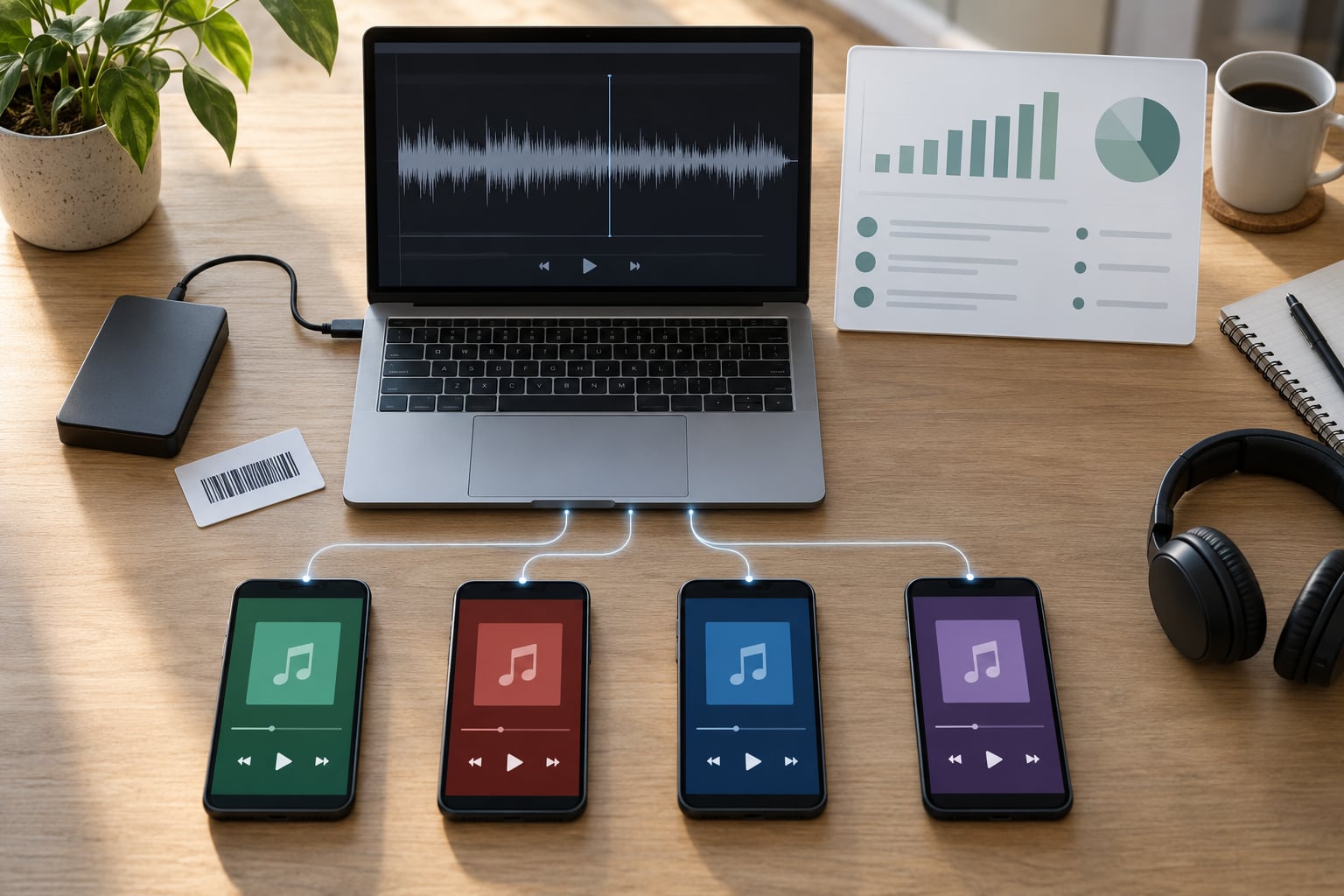
A music distributor is the middle layer between you and a streaming service. You upload finished audio and artwork to the distributor, they check the files, assign identifiers, and deliver the release to Spotify, Apple Music, Amazon Music and the rest. When listeners stream or buy the track, the platforms report back to the distributor, which takes its fee and pays you the balance on a set schedule.
Nothing about that chain is optional for anyone releasing outside a major label deal. Streaming platforms do not accept uploads from individual artists, so a distributor is the only route in. What varies is which distributor you use, what they charge, and how they behave when you want your music back.
What Is a Music Distributor?
A distributor is a company that handles delivery, metadata and royalty collection on your behalf. Think of it as freight forwarding for audio files, with an accounting department attached. It converts one finished master into hundreds of correctly formatted, correctly labelled copies across every store and territory you choose.
What a distributor is not matters as much as what it is. It is not a record label: it does not sign you, fund you, or decide what you should record. It is not a playlist editor: getting on a Spotify editorial playlist depends on the platform’s own team reviewing your release, and a distributor can only submit a pitch on your behalf. And it is not the owner of your copyright.
That last point deserves plain language, because it is the thing artists search for most and vendor pages rarely state. A standard distribution agreement leaves ownership of the master recording with you. What the distributor holds while you use their service is a licence to deliver and collect on your behalf. You should still read your own agreement, because terms vary, but “they will take my music” is not how the standard model works.
Distributor vs publisher vs label vs PRO
Four different businesses get confused with each other constantly. They sit on different layers of copyright and get paid from different sources.
| Role | What they handle | Paid from | Typical cost |
|---|---|---|---|
| Music distributor | The master sound recording: delivery, metadata, platform reporting, collection | Streaming, download and platform sales revenue | Annual fee, per-release fee or commission |
| Publisher | The musical composition: licensing, administration, collecting songwriter and performance royalties | Performance, mechanical and sync income | Commission on collected income, sometimes an admin fee |
| Record label | The whole business: funding, A&R, marketing, manufacturing, deals | Label revenue share from everything above | Percentage points off the top, plus recoupment terms |
| PRO | Collecting performance royalties for songwriters and publishers | Performance royalties from broadcasters and platforms | Membership dues plus a share of collected royalties |
A distributor can also offer publishing administration as a paid add-on, which is convenient and occasionally confusing. Registering your songs with a performance rights organisation such as ASCAP, BMI or SESAC is a separate job, and doing one does not replace the other.
Why you cannot upload to Spotify or Apple Music yourself
Artists ask this constantly, and the answer comes down to scale rather than gatekeeping for its own sake. Four reasons explain it better than any conspiracy theory:
- Volume. Major platforms ingest millions of tracks a week. Onboarding every artist one at a time is not operationally possible.
- Standardised metadata. Every store requires identical identifiers, credit strings, rights data and file specifications. An aggregator normalises all of it once, at scale.
- Collections and billing. Stores need one counterparty to invoice, one contract per territory, one settlement system. That counterparty is the distributor.
- Accountability. Fraud, duplicate uploads and rights disputes need an entity that can be suspended, audited and held responsible. That layer exists so the stores do not have to police ten million uploaders.
The blunt framing from the CD Baby DIY Musician page puts it well: your fans are the platform’s customer, not you.
How Do Music Distributors Work?
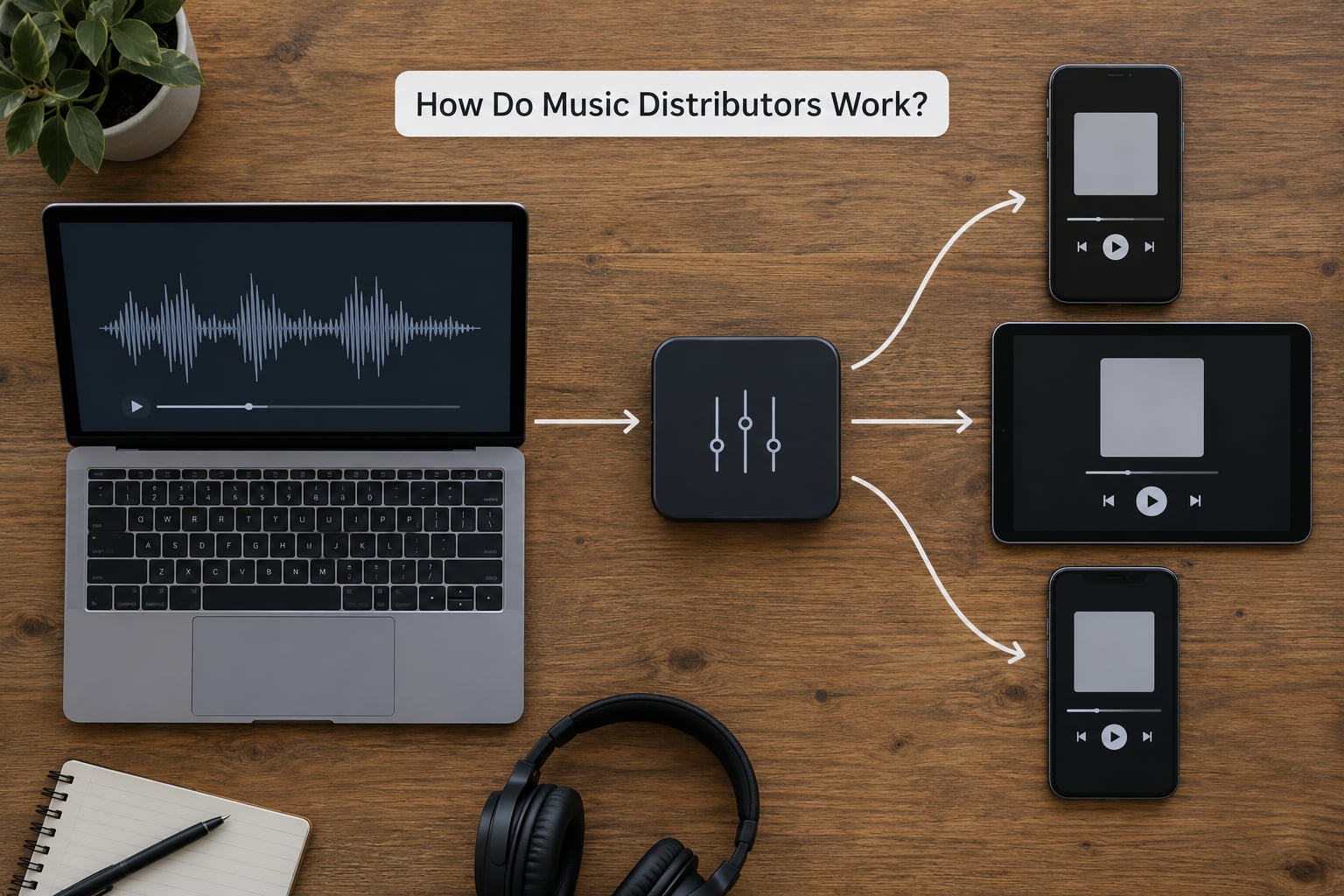
Distribution runs as a repeatable five-step chain. The same structure shows up in the answers Google’s AI Overview gives for this question, and it is the shortest accurate description of the whole system.
- Upload assets: you send the distributor finished audio files, cover art and your release details through its dashboard.
- Check metadata: the distributor validates the files, matches your credits, and assigns an ISRC to each recording and a UPC to the release.
- Deliver to stores: everything is pushed to every digital service provider you selected, plus physical partners if you chose them.
- Collect money: listeners stream, buy or license the track, and the platforms report usage and revenue back to the distributor.
- Pay the artist: the distributor deducts its fee or commission and sends you the remainder when you hit the payout threshold.
Here is the same chain with the responsibility and the clock attached.
| Step | Who does it | What it produces | Typical timing |
|---|---|---|---|
| 1. Upload | You | Audio masters, artwork, credits, release date | A few minutes, once the files are ready |
| 2. Metadata check | Distributor | Clean metadata, ISRC per track, UPC per release | Same day to about a week |
| 3. Delivery | Distributor and its digital distributor | Records ingested by each store | A few days to a few weeks |
| 4. Store review | The platform | Go-live approval or a rejection with reasons | Several days to a few weeks |
| 5. Royalty reporting | Platform, then distributor | Usage and revenue reports | Typically a couple of months behind the listening |
| 6. Payout | Distributor | Money in your account | On the service’s payout cycle, above its threshold |
There is a layer most explanations skip
Your distributor is usually not the company that talks to Spotify and Apple directly. Most send delivery through an intermediate digital distributor, historically names like PlayNetwork and MediaNet, with FUGA now widely used in the same role. That middle layer holds the commercial licences and technical connections into each store, which is why a small distributor can offer worldwide delivery without negotiating worldwide contracts.
So the real path is: artist, then your distributor, then the digital distributor, then the streaming platforms, then the listener, then reports flowing back along the same road in reverse. The top result on Reddit for this question explained it in one line, which is about as clear as it gets. Skipping that layer is the reason so many plain-English guides feel like a fairy tale.
What Does a Music Distributor Do With Your Release?
Once you upload, the distributor handles a specific list of things. This is the part where most first releases go wrong, because the artist treats the metadata form as paperwork instead of the instructions the whole industry reads.
- Audio preparation. Files are checked against delivery specifications, generally uncompressed WAV at a standard resolution, and transcoded into whatever formats each store requires.
- Artwork. Images are checked for size, format and content rules. Stores reject a release for a square low-resolution file as readily as they do for a bad song.
- Identifiers. Each recording gets an ISRC, which tracks a specific sound recording, and each release gets a UPC, which is the barcode for the collection of tracks. Once assigned, these codes should never be reused, and keeping them means streaming counts follow your music if you move.
- Credits and splits. Songwriters, producers, featured artists and label credits are entered here. Typos here are why songwriter royalties go unpaid years later.
- Territory and release date. You choose which markets get the release and when it goes live. Available worldwide means delivered worldwide; it does not mean you own rights in every territory.
- Store selection. Some stores need a specific distributor application, and others are excluded by default. Regional services may be included only on certain plans.
How do music distributors work with metadata and identifiers?
Metadata is the instruction set that travels with your music, and it is the single highest-leverage thing an artist controls. Descriptive metadata is the listing itself: title, artist name, release date, genre, language. Ownership metadata tells the royalty chain who owns the master and who wrote the song. Recommendation metadata is the editorial pitch a distributor can pass to platforms on your behalf.
Get the artist name character-for-character identical everywhere, or your catalog fragments across near-duplicate artist pages and your streams split between them. That is the most common self-inflicted streaming problem, and no distributor can repair it for you afterwards.
Physical distribution runs alongside all of this. Vinyl and CD need a manufacturing partner, and the distributor either handles fulfilment or connects you with one. Revenue models differ sharply from digital, with manufacturing costs up front and no per-stream economics.
How Do Royalties Work Through a Distributor?
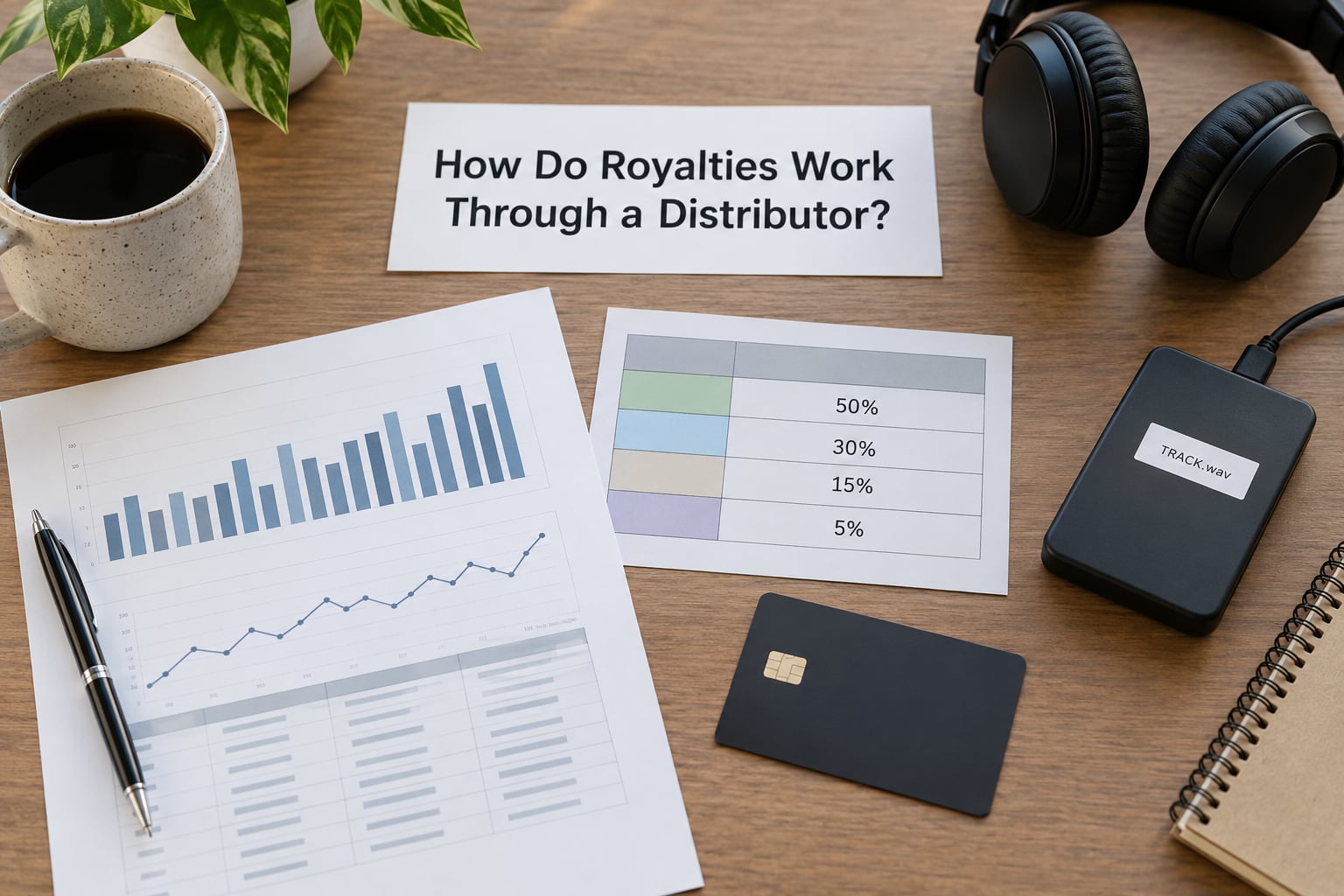
Royalties move backwards along the chain. A listener in a city you have never visited streams your track. The platform records that play against your ISRC, applies its own subscription and territory weighting, and adds the revenue to your balance. Periodically, it sends a usage and revenue report to your distributor, which deducts its fee and credits the rest to you.
Because the reporting runs on the platforms’ schedules rather than yours, money arrives well behind the listening that earned it. The pattern is consistent across services: listening in a month, usage reported a couple of months later, distributor statement after that, payout on the next scheduled cycle once you pass the minimum threshold. Anyone promising same-month payouts on streaming revenue is describing something other than how streaming actually pays.
Two separate income streams sit next to each other here, and conflating them causes years of unpaid royalties. The master recording produces streaming, download and sync revenue, which is what the distributor collects and pays you. The musical composition produces performance, mechanical and sync revenue, which is collected by publishers and performance rights organisations. A distributor’s publishing administration add-on can handle the second, but joining a PRO is still a separate registration many songwriters never complete.
Sync licensing, where your track lands in a film, show, ad or game, usually pays more per use than streaming and is handled differently. Some distributors register your tracks with a licensing administrator who pitches them for sync; others leave that entirely to you.
Where royalties get lost
Unclaimed money is usually a metadata problem wearing a costume. Wrong writer credits, missing split percentages, a duplicated ISRC, or an unregistered bank detail all send income into a suspense account where it waits for someone to file a claim. The fix is always the same: check your credits, confirm your identifiers, then ask the distributor’s royalty department to trace a specific ISRC and period.
How Much Does a Music Distributor Charge?
There is no standard rate, and any article quoting a single number is out of date. Pricing models change frequently, so check a distributor’s own page before you commit. As of October 2026, the market runs on four basic models, often combined.
| Model | How it bills | Who it suits | Trade-off |
|---|---|---|---|
| Annual subscription | Fixed yearly fee, unlimited releases on most plans | Artists releasing regularly with steady output | The bill arrives every year whether the catalog sold or not |
| Per-release fee | One-time charge each time you release, with no renewal | Occasional releasers and anyone nervous about recurring bills | Costs add up fast for a heavy release schedule |
| Commission | A percentage cut of revenue, sometimes on top of a fee | Artists with unpredictable income who want no upfront risk | Your share shrinks permanently on every sale |
| Hybrid | Lower annual fee paired with a commission on streaming | Artists optimising for low fixed cost | Harder to predict monthly income |
Watch for the charges that sit outside the headline number: per-album or per-artist fees, charges for additional ISRCs, physical manufacturing and fulfilment, sync registration, and year-by-year catalogue renewal. Renewal deserves attention because some services offer a one-time fee to keep a catalogue online after you cancel. That fee is widely resented because it is poorly explained, and artists regularly discover it the first time they consider leaving.
Choosing a Music Distributor: What to Compare
There is no best distributor, only the one that matches your release volume, genre and revenue. Artists on forums argue endlessly about this, and the honest answer is that tooling quality has converged while policies have not. Compare these points before you sign.
- Delivery reach and speed. Check that your genre’s stores are included. Electronic artists in particular should confirm delivery to Beatport, and anyone monetising uploads should confirm YouTube Content ID is included.
- What happens if you stop paying. This is the question vendors answer least clearly and artists care about most. Some services remove releases from stores when a subscription lapses. Others leave the catalogue live. Ask in writing before you upload.
- Royalty reporting depth. Per-track, per-territory and per-platform reporting matters when you are chasing a specific playlist or market.
- Payout threshold and schedule. A high minimum threshold can strand small balances indefinitely, which matters early in a career.
- Ownership and terms. Confirm the agreement grants you a licence rather than transferring rights, and read what happens to your catalogue and identifiers on cancellation.
- Migration rights. You can move a catalogue between distributors, but you should keep your ISRCs, artwork, splits sheet and lyric and credit files. Transfer usually takes a few weeks and involves a short period where releases are briefly offline, so plan around a quiet release window.
- Support quality. Test it with a real question before you upload your album. Slow, dead support on a release week is worse than no support.
- Policy on artificial streaming and AI content. Platforms detect artificial traffic and now scrutinise fully machine-generated releases. Distributors enforce these rules, often by removing releases and holding funds, so check the policy before you upload.
One more note on pitching. Distribution gets your music onto the store. It does not get it heard. Editorial pitching, social campaigns and playlist placement are separate work, and services that market themselves as promotion usually charge for a submission form rather than a guarantee.
Frequently Asked Questions
What does a music distributor actually do?
A music distributor delivers your finished recordings, artwork and metadata to streaming platforms on your behalf, assigns an ISRC to each track and a UPC to each release, then collects and reports the revenue those streams generate. Platforms do not accept direct uploads from independent artists, so this middle layer is required rather than optional. Most distributors hold a delivery licence, not ownership of your master.
Do music distributors own your music?
Usually not. Under a standard distribution agreement you keep ownership of the master recording, and the distributor holds a licence to deliver and collect on your behalf. Some deals differ, particularly with artist-services companies that fund recordings in exchange for a share, so read the term sheet rather than assuming. Your ISRCs stay with your recordings too, which is what lets a catalogue move without losing its history.
What happens to my music if I stop paying a distributor?
It depends entirely on the service. Some remove your releases from stores once a subscription or renewal lapses, and others leave the catalogue live indefinitely. A few charge a one-time fee to keep a catalogue online after you cancel. Because the answer decides how much risk a distributor is for you, ask in writing before you upload anything, and pay attention to the renewal terms.
How long does it take to get music on Spotify with a distributor?
Most services deliver within a few days to a few weeks, and platform review adds more time on top. Plan a release date at least three to four weeks ahead for a modest independent release, and longer if you are pitching to editorial teams, which usually need several weeks of lead time. Royalty reporting lags behind listening by a couple of months regardless, so the first meaningful payment arrives well after the first streams.
Is a publisher the same as a distributor?
No. A distributor works on the master sound recording, delivering it to platforms and collecting streaming, download and platform sales revenue. A publisher works on the musical composition, licensing it and collecting performance, mechanical and sync income. Some distributors offer publishing administration as a paid add-on, which handles both, but joining a performance rights organisation is still a separate registration.
What are the most popular music distribution platforms?
It helps to sort them by category first. Major labels use in-house distribution arms such as The Orchard. Artist-services companies like AWAL and DistroKid sign or accept artists directly. Open aggregators such as CD Baby and TuneCore take any release for a fee. White-label providers distribute for other labels, collectives and managers under someone else’s name. Each category suits a different release volume and business model.
Conclusion
Start by confirming you own the master and the composition, then line up your credits and splits properly, because nothing downstream can fix messy metadata. After that, compare distributors on the policies rather than the headline number: what happens if you stop paying, whether your genre’s stores are covered, and what happens to your identifiers if you ever leave. Pick the one that matches how often you actually release, and keep your ISRCs, artwork and split sheets somewhere that is not the distributor’s dashboard.