How to handle difficult clients in a studio comes down to one thing: expectations you never wrote down. Most engineers who get stuck in a bad session did not fail at the craft, they let scope, revision count and session time stay vague. Set those in writing first, stay calm when the emotion rises, keep the session structured, and you can de-escalate almost anything. Updated for October 2026.
This guide is for engineers, producers, mix and mastering engineers, and studio owners who book artists, bands, podcasters and voice clients directly. You can read the five steps in order, or jump to Common Mistakes if you are in the middle of a session right now and need the short version.
One framing worth holding on to before you read further: a difficult client in a recording studio is usually not a bad person. It is a client whose expectations were never written down, so every take turns into a negotiation. The same artist who is impossible on Tuesday can be completely easy to work with on Thursday, once someone writes down what a revision round actually is.
Table of Contents
- What You Need
- Step-by-Step: How to Handle Difficult Clients in a Studio
- How to Handle Difficult Clients in a Studio: Prepare Before the Session
- How to Handle Difficult Clients in a Studio: Stay Calm and Set Boundaries
- How to Handle Difficult Clients in a Studio: Control the Session
- How to Handle Difficult Clients in a Studio: Redirect the Conflict
- How to Handle Difficult Clients in a Studio: Document Decisions and Close Professionally
- Common Mistakes
- Frequently Asked Questions
- How will you handle a difficult client?
- How many mix revisions should I include in my rate?
- How do I handle a client who wants to change my EQ and compression?
- How do I charge a client for going over the session time?
- Should I fire a difficult client?
- What red flags should I screen for when booking a new client?
- Start With One Document This Week
What You Need
Everything below is a document or a rule, and you can assemble the whole stack in an afternoon. The point is not paperwork for its own sake. It is that a written rule lets you say no without spending personal credibility.
A session brief. One page covering song, tempo, key, reference tracks, which parts matter most, what the artist is afraid of, and what success sounds like when it is finished. Send it 48 hours ahead and ask the client to correct anything wrong in it.
An agreement or session contract. Even one page, signed. Cover scope of work, session hours, rate, deposit, revision rounds included, overtime rate, cancellation terms, file delivery, credit, and who owns the final recording. Point of confusion for many engineers is ownership and points, so put those in plain language.
A written revision policy. Define what a round is. My definition: one consolidated list of changes, delivered by one person, within an agreed window. A round is not one email per track, and it is not a new round every time you send a new mix file.
An overtime rule, stated before the session. One studio owner on GearSpace put it plainly: she tells clients before the session that she charges from the scheduled start time, no exceptions. That sentence removes almost every awkward billing conversation you would otherwise have at 6pm.
One communication channel. Pick email or a messaging app, write it into the agreement, and route feedback there. Feedback arriving by text, call and DM simultaneously guarantees you are tracking three versions of the same request.
A named decision-maker. One person gives the final word on creative choices. If a manager, an A&R rep and the artist are all in the room, you need to know who signs off, because you will otherwise get three contradictory instructions and no way to satisfy any of them.
A revision log. A shared sheet with round number, date, timestamp, request, who approved it. It is dull and it is the single most useful document when a client claims a change was never made.
A session checklist and a room plan. Who is in the room, where they sit, break times, temperature, water, and how long you intend to run before the first pass. Sound engineers control sessions partly through environment. A hot room and a four-hour block with no break will produce conflict that has nothing to do with the music.
Step-by-Step: How to Handle Difficult Clients in a Studio
How to Handle Difficult Clients in a Studio: Prepare Before the Session
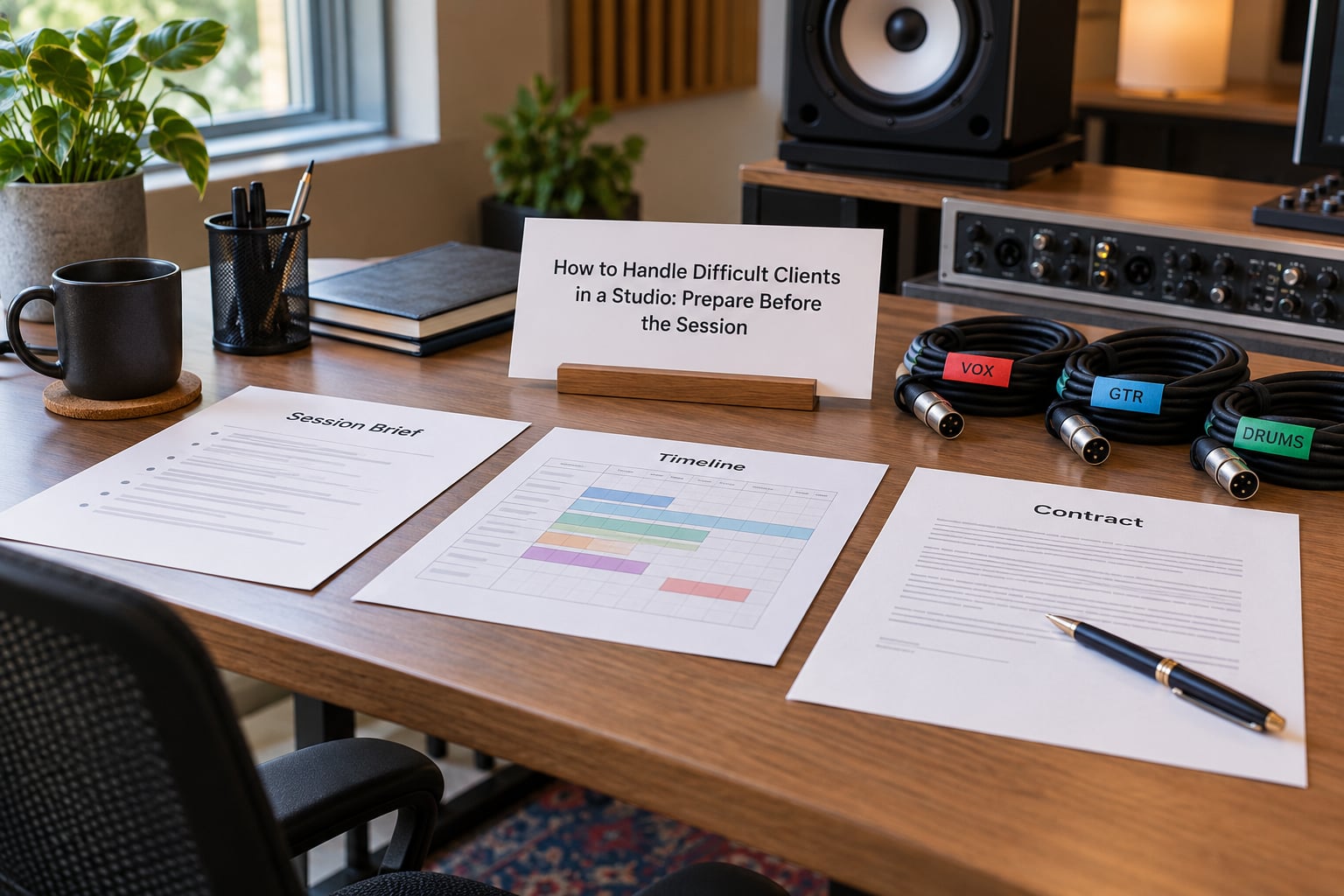
Preparation is where most of the handling happens, because a boundary you set in writing does not have to be defended in the room. Send the brief, get the agreement signed, take the deposit, confirm who the decision-maker is, and put the revision count and overtime rule in the same document.
Then screen. A ten-minute call before booking catches most problems, and asking a few direct questions is not rude. Useful ones: who is making the final creative call, what is the song supposed to feel like, what do you like and dislike about the reference track, and is there anything in our agreement you cannot live with. That last question catches scope disputes before money changes hands, not after.
You will hear the warning signs. A client who cannot name what they want, who assumes everything is included, who laughs at the idea of a revision limit, or who cannot say who signs off. One r/audioengineering thread is full of exactly this: new studio owners asking how to filter at booking time, because filtering is cheaper than untangling.
How you know it worked: the client repeats your terms back to you in their own words, and nobody is surprised on session day.
How to Handle Difficult Clients in a Studio: Stay Calm and Set Boundaries
When emotion rises in the control room, the move is acknowledgement followed by a question. Not agreement, not argument. Acknowledge the feeling, then ask for the specific thing behind it.
Try: “I can see this matters to you and I want to get it right. Tell me what you are hearing that is not working.” Vague complaints like “it feels wrong” cannot be acted on. Specific ones can, and asking for the specific version is a reasonable professional request rather than a challenge.
Separate the feedback from the behavior. “The vocal is too buried” is creative feedback you can work with. “You clearly have no idea what you’re doing” is not, and you can name that without escalating: “I’m happy to talk about the mix. I am not able to work while I’m being insulted, so let’s take ten minutes.”
State the limit once, calmly, and repeat it the same way every time. Varying the wording each round signals that you are negotiating even when you are not. Say the limit, then return to the work: “Two rounds are included in the agreement. This is round one. Here are the other options I can build on top of it.”
How you know it worked: the client repeats your boundary back to you and the session continues within a few minutes.
How to Handle Difficult Clients in a Studio: Control the Session
Structure is a de-escalation tool. A session with an agenda stays calmer than an open-ended afternoon in the same room, for exactly the reason you would expect: people argue less when they can see the shape of the afternoon.
Open with the plan out loud. “We’re tracking the vocals and the bridge today. Rough pass by two, mix playback at four, then we’re done.” Short takes beat long ones when tension is high, because there is less distance to fall through. Put breaks on the clock, not up to negotiation, and use them to reset the room rather than to keep working.
Only one person gives notes while a take is running. If a client wants to jump in after every pass, offer the alternative engineers use: keep talking and let me write it down as you go. That single request removes half of the classic control-room interruptions, and it turns the client into a collaborator instead of a critic with a stopwatch.
Watch for passive-aggressive behavior, because it corrodes a session quietly. Repeated late arrivals, jokes aimed at your ears, complaints about the room temperature that contradict your actual meter, nitpicking unrelated details, and silence after every suggestion. None of it is worth confronting in the moment. Write down the pattern, adjust the structure, and address it in the follow-up summary.
How you know it worked: notes arrive in batches instead of mid-take, and you reach the planned playback without an argument about the clock.
How to Handle Difficult Clients in a Studio: Redirect the Conflict
Most conflicts in the room are requests with no shape. Give them a shape and they get much smaller. “Add distortion and delay to the backup vocal in the second chorus” is workable. “It’s boring and I hate it” is not.
Use reference tracks. When a client cannot describe what they want, ask which song, which moment in that song, and what is happening there. That converts taste into an action you can test in ten minutes rather than argue about for an hour.
Use two options with trade-offs. Engineers report on r/audioengineering that offering an alternate approach defuses conflict without surrendering the session: “Here is the way I would do it. Here is the way you described. The first is punchier, the second is more open. Which one are we printing from?” Decision-making moves to the client, and your ear stays respected.
Timebox the decision. “Let’s hear both at half speed, you pick, and then we commit.” When communication actually breaks down, pause the session rather than pushing through. Ten minutes outside, or a scheduled break, cools the exchange faster than any sentence you could construct in the heat of it.
How you know it worked: the client chooses instead of circling, and you are both playing the same version of the next take.
How to Handle Difficult Clients in a Studio: Document Decisions and Close Professionally
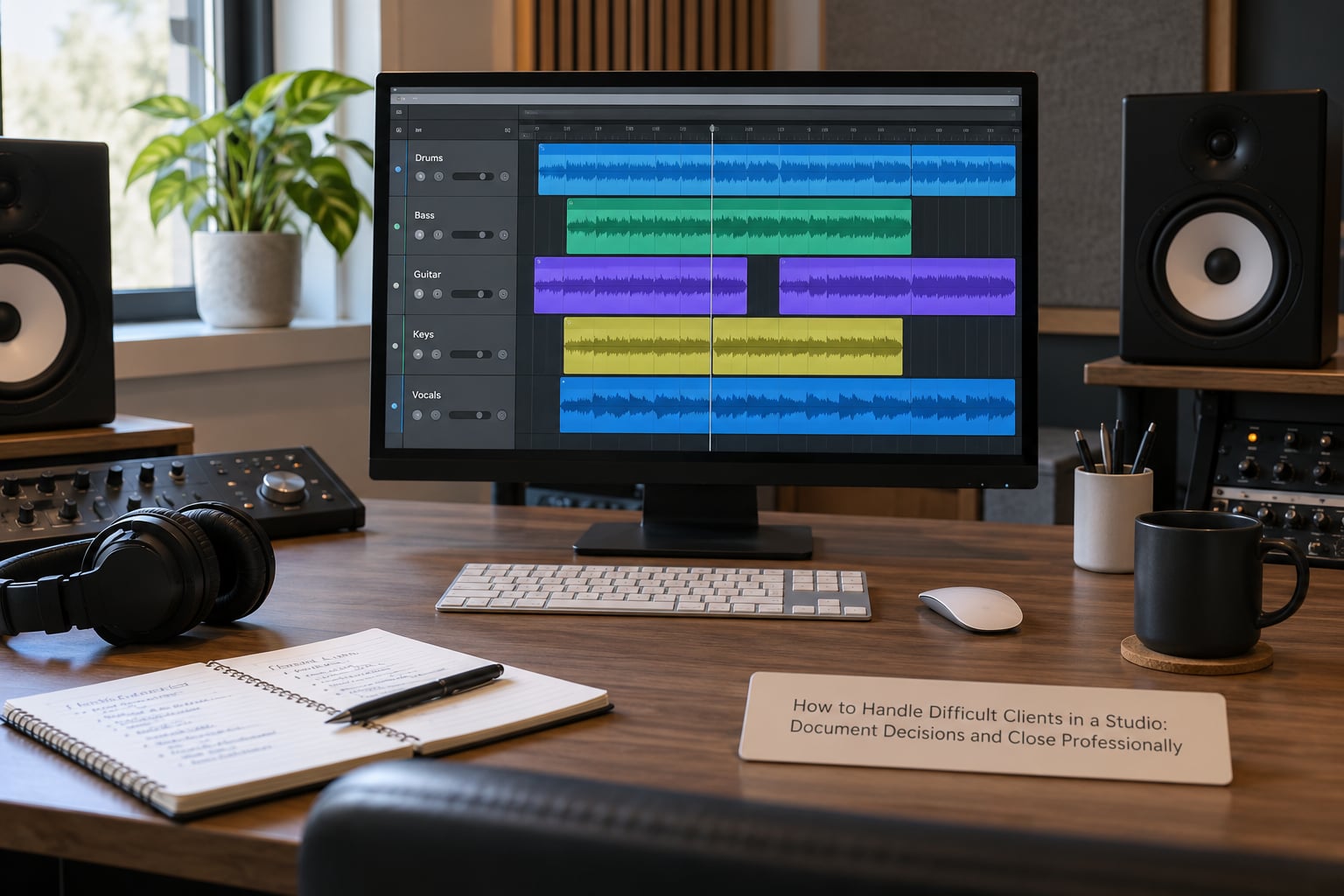
The end of a session decides whether the next one is easier. Write the summary the same day, while you still remember what was agreed.
Include the round number, the changes you made, the changes you declined and why, the open questions, the next session time, and what you are waiting on from them. Confirm revisions and deliverables explicitly: “Round one is attached. The three items I did not change are listed with the reason. Let me know by Friday which of the two options you want for round two.”
Collect payment as the agreement says, and name file delivery clearly. One engineer described receiving a folder of 30 tracks named things like voiceaudio_16 that did not line up with the reference mix, and then doing unpaid cleanup work. Your side of that fix is boring and effective: send a labeled track list, name stems to match, and confirm the format before invoicing.
Keep the boundary intact at the close. Reiterating the agreement while things are calm is far more effective than enforcing it while they are not.
How you know it worked: the client replies with a single clear answer and no new requests appear that were never on the table.
Common Mistakes
Arguing in the session. A debate you win still costs you the room. Correction: end the exchange with a decision point and a time. Tip: if you must, have the argument by email where you can think before you type.
Promising unlimited revisions. The all-inclusive set price produces mutual disappointment; engineers on r/audioengineering describe one side or the other walking away dissatisfied, every time. Correction: two included rounds, priced extras after that. Tip: price the extra round so the client can see what it costs to change their mind.
Never writing expectations down. A verbal agreement you remember differently from your client is not an agreement. Correction: brief, contract, revision policy, overtime rule, all in one document. Tip: send it early, since corrections to a brief are much cheaper than corrections to a finished mix.
Giving unclear feedback back. “It needs more energy” guarantees a fourth round. Correction: ask for a timestamp and a reference. Tip: if you cannot act on a note within a minute, ask a clarifying question the same day.
Letting the session run past the booked time. Billing it afterward turns a time problem into a money problem. Correction: state at the start that the clock runs from the scheduled time, warn at the halfway mark, and offer a choice of stopping or extending. Tip: the warning at halfway is the part that prevents the whole conversation.
Running an unproductive session instead of ending it. Tired, hungry, argumentative people do not make better records. Correction: end the session, send the summary, reschedule. Tip: book the next slot before they leave so momentum survives the reset.
Two more that come up constantly. Letting a manager or label rep overrule the artist in real time creates a two-front problem; handle the decision-maker question in the agreement, not in the room. And believing that a firing ruins your reputation. Top-voted advice in a well-known r/audioengineering thread is the opposite: never be afraid to hand a session off, especially when you have your money, because sometimes things just are not a match. Clean exits protect the people who are still booking you.
Frequently Asked Questions
How will you handle a difficult client?
You handle it in three stages. First, prevent it: confirm the brief, the revision count, the overtime rate and the decision-maker in writing before the session, and take a deposit. Second, de-escalate in the room: acknowledge the emotion, ask for a specific request with a timestamp, offer two options with trade-offs, and timebox the decision. Third, exit cleanly if the boundaries are ignored again: stop the work, refund or credit the balance, release the files they have paid for, and recommend another engineer.
How many mix revisions should I include in my rate?
Two rounds is the most common workable number, and it works because it is simple to explain. One round feels stingy on an expensive project. Three or more quietly invites a moving target. Define a round as one consolidated list of changes, sent by one person, inside an agreed window, and price further rounds rather than arguing about them. Put the definition in the agreement so nobody has to negotiate it on delivery day.
How do I handle a client who wants to change my EQ and compression?
Do not debate the settings in the abstract, because you will lose even when you are right. Offer two versions instead, each with a trade-off, and let the client choose from finished examples rather than settings. Then write down the decision in the revision log so it cannot reopen next week. Engineers routinely find that most clients want a feeling, not a filter, and the second option usually gives it to them.
How do I charge a client for going over the session time?
Tell them before the session that you charge from the scheduled start time, with no exceptions, and put it in the agreement. At the halfway mark, warn them and give a choice: stop and reschedule, or extend and pay overtime. Say it as a time fact rather than an accusation, because engineers consistently report that raising billing tone makes the whole thing personal. A client who was warned an hour ago rarely argues at six.
Should I fire a difficult client?
Fire them when the pattern is repeated rather than occasional. One engineer talked three times about a boundary, saw the same behaviour continue, and ended a sixteen-year working relationship. Clean exit mechanics matter more than the decision: stop the work, refund or credit the last payment, release the files already paid for, deliver a labeled track list, and recommend another studio. It feels worse than doing nothing, and it is usually worth more.
What red flags should I screen for when booking a new client?
Watch for someone who cannot name a decision-maker, laughs at the idea of a revision limit, assumes everything is included, cannot describe what they want beyond reference tracks, or sends nothing in writing. A client who pushes back once on your contract in a reasonable way is fine. A client who resists the deposit, the overtime rule and the scope at the same time will cost you more than the session is worth.
Start With One Document This Week
If you take one thing from this guide, write the revision policy and the overtime rule into your booking template. Everything else on this list is downstream of those two lines, and they are what turn how to handle difficult clients in a studio from a personality problem into a process you already have.
Send it with your next booking and see what happens. Most of the arguments you are currently having in the control room were never about the music.