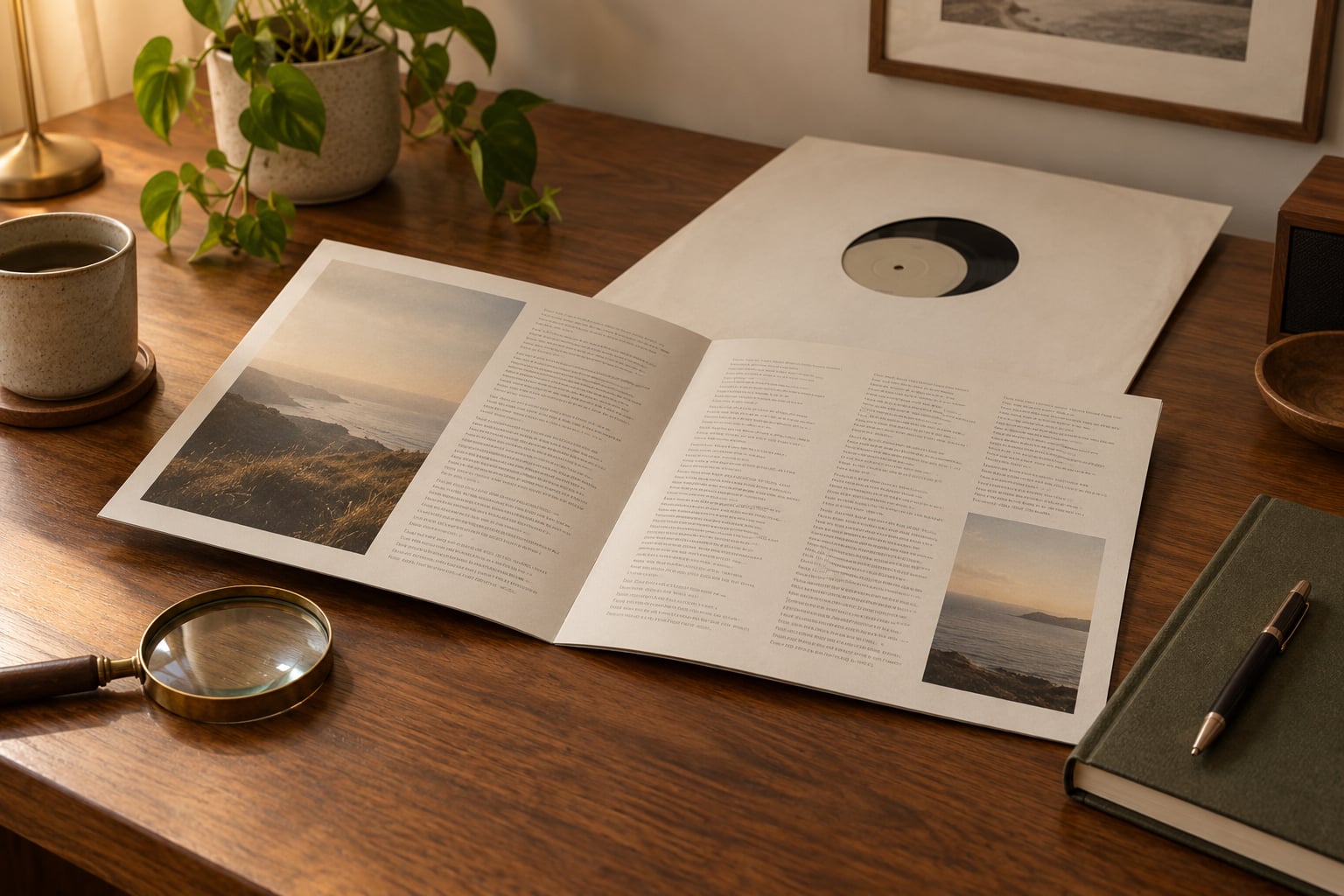
Liner notes — also called sleeve notes or album notes — are the printed text, credits, images and essays packaged with a music release. They sit on the inner sleeve of an LP, inside a CD booklet, or in a digital booklet, and they tell you who wrote, played, produced, engineered and mastered the music, plus where and when it was recorded.
If you have ever wanted to know how to read liner notes properly instead of squinting at a wall of abbreviations, the trick is order. Liner notes have layers, and each layer answers a different question about the record.
Key takeaways
- Liner notes follow a fairly fixed order: release identity, track list, personnel, production, packaging, copyright.
- Most credit language is trade shorthand, and one glossary covers nearly all of it.
- A credit printed once near the top usually applies to the whole album, while a name attached to one song applies only to that track.
- The catalog number identifies an edition, while the matrix number identifies the physical pressing.
- When two sources disagree, keep both and mark the uncertainty rather than picking a winner.
Streaming stripped most of this away, which is why a lot of listeners never learned the vocabulary. It is all still there, and the habits below still work in 2026 whether you are holding a record or clicking through a downloads folder.
Table of Contents
- What You Need
- Step-by-Step: How to Read Liner Notes on Any Release
- Common Mistakes
- Frequently Asked Questions
- What should I look for first when learning how to read liner notes?
- Why are there so many abbreviations in album credits?
- How can I tell if an album booklet is from the first pressing?
- Does the copyright year tell me when an album was recorded or mastered?
- Who gets a songwriting credit when a song contains a sample?
- What should I do when different liner-note sources list conflicting credits?
- Conclusion: Your How to Read Liner Notes Checklist
What You Need
You need very little, and everything is optional except the release itself.
- The booklet or sleeve. A CD booklet, an LP inner sleeve, a cassette j-card, or the digital booklet attached to a Qobuz, Tidal or Bandcamp download. Digital booklets are frequently skipped and are often the only place an essay survived.
- The record itself, if you have it, for the parts printed on the disc rather than the packaging.
- A magnifier or your phone camera. CD booklets squeeze credits into roughly 25 square inches, and type sizes get tiny. Runout markings are etched or stamped in shallow metal, which is almost unreadable under flat room light.
- A strong light you can move. Raking light across the runout area at the end of a record makes shallow etchings visible.
- Something to write on. A notes file works better than memory once you start comparing pressings.
- Optional reference tools: a discography database such as Discogs for release identification, a session-player discography, and the label’s own archive page for the intended credit list.
A physical LP takes about fifteen minutes to work through in the order below. A digital booklet takes two minutes, and the same order still works.
Step-by-Step: How to Read Liner Notes on Any Release
Read front to back, in seven passes, without stopping to follow tangents on the first one. The order matters because each step depends on the one before it, and mixing details from different editions is the single most common way people end up confidently wrong.
Start With the Album Identity
Find five things before you read anything else: the artist, the album title, the release year, the label, and the catalog number plus format. The catalog number is the label’s own identifier for this specific edition, printed on the label, the back sleeve or the disc itself.
That combination tells you which release you are holding. An album reissued five years later may carry a new mastering engineer, a corrected songwriter line and a different set of bonus tracks, so a credit you read on one pressing may be wrong for another. Streaming complicates this further, because the year shown next to an album is sometimes the reissue year rather than the original release.
Note the side designation while you are there. LPs are marked side A and side B, and the two sides can carry different matrix numbers, different studio credits and sometimes different production notes.
Use a How to Read Liner Notes Checklist
Almost every release lays its information out in the same sequence, whether it is a 1971 gatefold or a streaming booklet. Run this checklist in order and you will not miss a layer.
- Front and back cover, including any sticker, hype sticker or obi strip with regional release details.
- Track list with running times, and which track each song was written for.
- Personnel credits: who performs, who writes, who arranges, who produces.
- Production and technical notes: studios, recording dates, engineers, mixing, mastering.
- Lyrics, or a libretto for a classical or stage work.
- Thanks and acknowledgements, which often name the studios, engineers and players who mattered.
- Copyright and label information: the ℗ line, the © line, publisher strings, the catalog number, and the barcode.
If you only have time for two items, do the personnel block and the production block. That is where the information nobody puts in a streaming app actually lives.
Decode Names, Roles, and Abbreviations
Credit language is a trade vocabulary designed to save space. A producer does not record every instrument, an engineer is not automatically the mixer, and being listed somewhere on the sleeve does not mean a person performed on all eleven tracks.
| Credit or symbol | What it stands for | What it tells you |
|---|---|---|
| A&R | Artist and repertoire | The label person who signs, develops and oversees releases. Usually not a musical decision-maker in the room. |
| w/ | With | A featured collaborator appearing alongside the main artist. |
| arr. | Arranger | Who wrote the instrumental parts for a song, sometimes decades after the fact. |
| prod. | Producer | Overall creative and financial responsibility for the record. Not the same as making every recording decision. |
| eng. | Engineer | Who set up and ran the recording sessions, often track by track and studio by studio. |
| mx or mix | Mix | Who assembled the recorded parts into the finished stereo balance, sometimes a year after recording. |
| mastered by | Mastering engineer | Who prepared the final master for release. Different name on a reissue means a different master. |
| lacquer cut by | Lacquer cutting engineer | Who cut the physical groove for a vinyl pressing. Plant-specific, and not a sound-quality award. |
| p/s, pub. | Publisher | The company that administers the song and collects the songwriter royalties. |
| adm. | Administrator | The publishing administrator working on behalf of a songwriter or estate. |
| ℗ | Sound recording copyright | Who owns the recording itself, usually the label, usually dated to the release. |
| © | Copyright on art and packaging | Who owns the artwork, photography, design and typography. |
Two more terms confuse beginners. A performing rights organisation, usually printed as ASCAP, BMI, SESAC, GEMA, PRS, APRA or SOCAN, collects performance royalties on behalf of songwriters; it has nothing to do with the master recording. And names repeated with forward slashes in the publishing block are the same writer listed once per publisher, which is how a share gets attributed.
Be careful with the top block. Many albums print one paragraph of musicians that applies to the entire record, then add track-specific names underneath individual songs. Players such as Leland Sklar, Russ Kunkel, Rick Marotta, Waddy Wachtel, Danny Kortchmar and Larry Knechtel have the kind of careers that turn up in exactly this paragraph, and following one of those names is a reliable way to fall down a very good rabbit hole.
Separate Track-Specific and Album-Wide Credits
Ask of every credit: does this apply to the whole album or to one song? A single personnel paragraph near the track list is album-wide. A name printed under a title, or a parenthetical note attached to one track, is not.
Common track-specific cases: a featured vocalist who appears on one song, a horn section that only plays on one track, an engineer credited for a single session at a different studio, a producer credited for one song rather than the record, and a co-writer who only touched one title. Some records mark this explicitly with wording like “except where noted” or “on tracks 3 and 7”.
When a credit is ambiguous, check a second source. Session discographies and rights-holder databases usually break credits out by track, and a well-kept discography entry will list a song-level personnel section that a one-paragraph sleeve credit cannot express.
Read Production and Technical Details
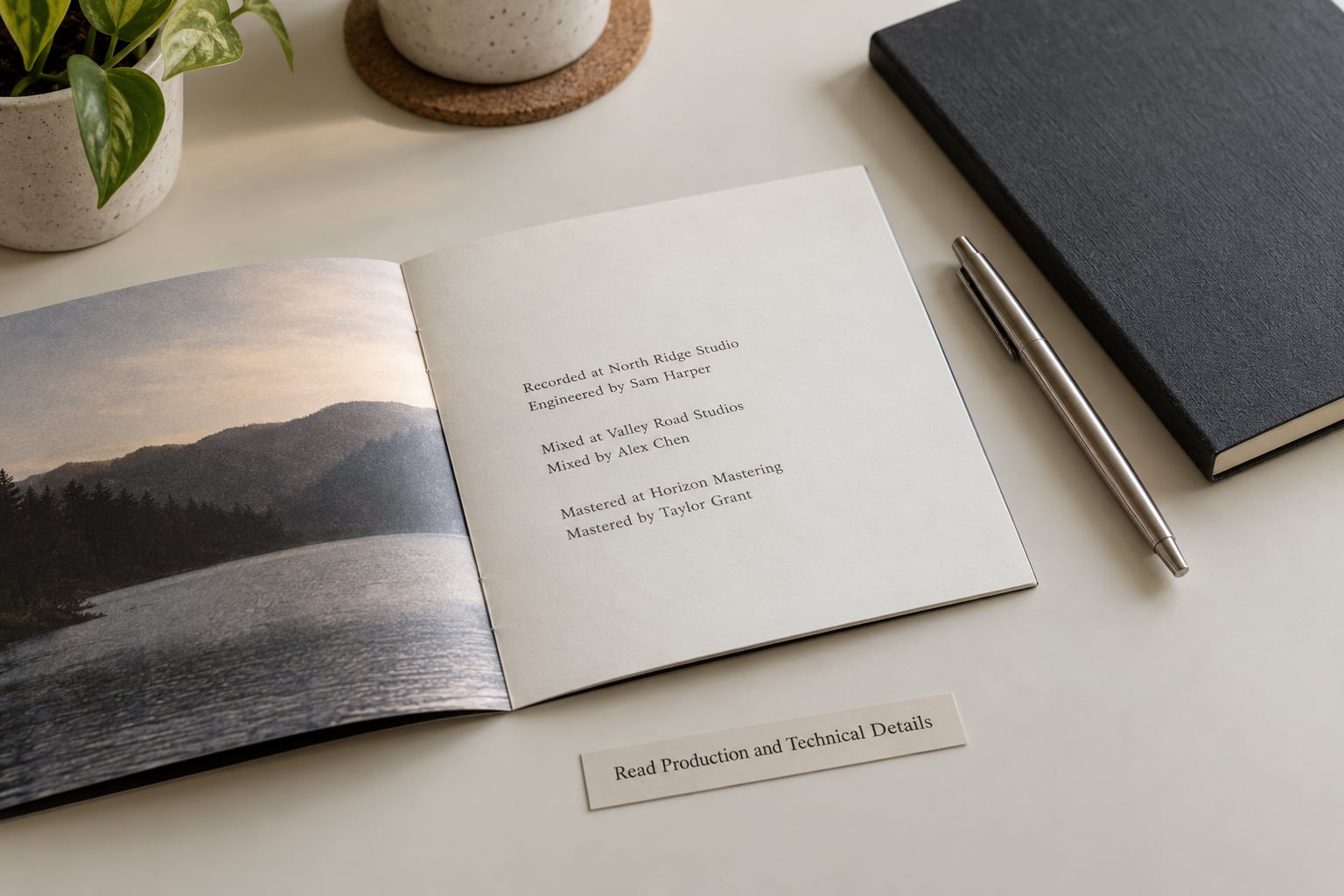
Production lines are the part listeners skip and producers read twice. Look for the recording location, the recording dates, the studio name, the mixing credit, the mastering credit, and any format description such as analog multitrack, tape or digital.
These details explain a lot of what you hear. A song recorded live in a room rather than tracked in a booth sounds different before anyone reaches the mixing desk, and knowing which engineer was in that room changes how you evaluate the record. Mastering credits matter even more for reissues, because a new master can change an album’s character without a single note changing.
Watch for sample credits as well. Phrases like “contains a sample from” or “used by permission” tell you the record used existing sound, and the accompanying publisher and rights-holder names tell you whose work it was. They are a provenance note, not a claim of authorship. Where the release is sold digitally, an ISRC code identifies the specific recording so that different masters of the same composition can be told apart.
Identify Edition and Authenticity Clues
The physical identifiers are what separate one release from another, and they live in different places with different jobs.
| Identifier | Where to find it | What it tells you | What it cannot tell you |
|---|---|---|---|
| Catalog number | Label, back sleeve or spine | Which release the label assigned this configuration. Often a label prefix plus digits; European releases frequently add a two-letter country code. | Nothing about the pressing quality, and nothing about whether it is the earliest issue. |
| Matrix number | Runout area, between the final groove and the label or outer edge | The master and lacquer used for that pressing, usually stamped or etched and ending in a side suffix. | Rarity. The matrix number itself is rarely evidence of a scarce pressing. |
| Runout or dead wax | The same area, at the end of side A and side B | Hand-etched or stamped plant and mastering marks, sometimes with additional symbols. | Audio quality. Codes are plant-specific and era-specific, and an unfamiliar symbol proves nothing. |
| Stamper code | Near the matrix number | Which plant pressed the discs, and sometimes a rough window of when. | Exact pressing sequence, unless the database entry for that plant is well documented. |
| Barcode | Back cover or sleeve | The commercial distribution code for that edition, which is useful for pricing and market comparisons. | Which country the disc was pressed in. Barcodes and matrix data regularly disagree. |
Other edition clues are softer but worth noting: an obi strip on Japanese releases carries catalogue and pricing information, bonus tracks signal a reissue, and a copyright line with a later year than the release year usually means refreshed packaging or new artwork.
The one rule collectors insist on is humility. Transcribe exactly what the metal says, mark any character you cannot resolve as uncertain, and compare it against a documented pressing before drawing conclusions. Over-reading a runout symbol is the fastest way to lose a knowledgeable audience.
Cross-Checks and Preserve Your Findings

Booklets are a primary source, but they are a snapshot of what a label wanted to claim on release day. Rights-holder systems get corrected later, and a single fix in a publishing database can change a credit years after the record came out.
Check suspicious details against a discography database, a session-player discography, the label’s archive, published interviews, and library catalogue records. Where a name is disputed across sources, write the disagreement down instead of resolving it in your own head. A note that reads “songwriter listed as A on sleeve, B in publisher database” is useful; a confident guess is not.
Understand why streaming is often wrong. Credits reach platforms through structured feeds supplied by rights holders rather than scraped from the booklet, and industry trackers put the share of recordings that send complete official credits data at well under half. Missing credits are therefore normal, and a wrong credit is often a database error rather than a printing error. Where a corrected credit matters to you, submitting it to a community database is genuinely useful and takes a few minutes.
Common Mistakes
- Treating a featured artist as the main performer. A name after “w/” appears on one track. The primary performer is whoever the album is credited to.
- Assuming the producer made every decision. Producers set direction and pay for the record. Engineers capture the sound, mixers balance it, and an executive producer mostly oversees.
- Confusing copyright with recording or mastering date. The ℗ year usually tracks the release, and the © year tracks the artwork. Mastering can happen years after release.
- Reading credits for the wrong edition. Reissues revise credits and mastering. Confirm the catalog number before you rely on a name.
- Taking a sample clearance as proof of authorship. A clearance line acknowledges and licenses a source. It says nothing about who created the sampled sound.
- Reading runout symbols as a rarity or quality claim. Codes vary by plant and era. Transcribe them, then check a documented pressing.
- Trusting a streaming credits panel over the booklet. Convenient, frequently incomplete, and only as good as the feed behind it.
One more habit worth adding: read the acknowledgements. Names in the thank-you list are often the same engineers, studios and players who shaped the record, listed without a job title, which makes them easy to miss on a first pass.
Frequently Asked Questions
What should I look for first when learning how to read liner notes?
Start with the release identity: artist, album title, release year, label, and catalog number. Those five items tell you which edition you are holding, and every credit after that has to be read against that specific version. Credits get revised for reissues, with a new mastering engineer or a corrected songwriter line, so mixing details from two pressings produces confident nonsense.
Why are there so many abbreviations in album credits?
Space, mostly. A CD booklet offers roughly 25 square inches, and sleeve designers assume a reader recognises trade shorthand instantly, so they use w/ for with, eng. for engineer, arr. for arranger and mx for mix. The vocabulary passes from one packaging generation to the next and stays consistent enough that one glossary will get you through almost any record.
How can I tell if an album booklet is from the first pressing?
Find the catalog number on the label or back sleeve, then compare every character of the matrix numbers around the runout area against a documented pressing entry. A first pressing usually matches the earliest known runout for that catalog number, but bonus tracks, country-of-origin issues and label copy variations all muddy the picture. Treat a match as evidence, not proof.
Does the copyright year tell me when an album was recorded or mastered?
Not reliably. The ℗ symbol with a year normally marks the sound recording copyright and usually corresponds to the release rather than the recording dates. The © line covers artwork, design and packaging and often carries a different year. Mastering may have happened years later, particularly on a reissue, so read the copyright year as a publication date, not a production date.
Who gets a songwriting credit when a song contains a sample?
Usually the writer of the sampled song is credited alongside the writers of the new one, with the publishers named in parentheses. Some credits instead read contains a sample from or used by permission, which acknowledges the source without allocating a share. Interpolating a melody or re-recording it in a new key is a different situation again, and the credit wording reflects the difference.
What should I do when different liner-note sources list conflicting credits?
Keep all of them and note where each came from. The booklet shows what the label put forward at release; discography databases and rights-holder systems hold later corrections and are often more accurate. Streaming credits are the least dependable, since they depend on what the rights holder supplied and what the platform chose to display. Recording the conflict preserves the useful part.
Conclusion: Your How to Read Liner Notes Checklist
Start with the release identity, because everything else depends on knowing which edition is in front of you. Then work through the personnel block by role rather than by name order, so you know who played, who wrote, who produced and who engineered.
Next, separate album-wide credits from track-level ones, and read the production lines for studios, dates, mixing and mastering. If you own the disc, finish with the catalog number, matrix numbers and runout marks, transcribed exactly and marked uncertain wherever you are guessing.
Before you draw a conclusion from any credit, check it against one other source and write down what you could not confirm. That last habit is the one that separates reading liner notes from repeating whatever the packaging claimed.