Knowing how to listen to an album critically means hearing it as one sequenced piece of work and tracking what the artists chose, instead of reacting one track at a time. It takes about an hour and forty minutes per album: one uninterrupted playthrough, then two or three shorter, focused passes with notes. No music theory degree required.
The reason to bother is simple. A single pass tells you how a record felt. Two or three deliberate passes tell you how it was built, and that is what turns an opinion into something you can defend out loud.
I’ve watched people rate an album after one commute listen and regret the number six months later. The fix isn’t more time. It’s a routine.
Table of Contents
- What You Need
- How to Listen to an Album Critically, Step by Step
- Common Mistakes
- Frequently Asked Questions
- Do I need to know music theory to listen to an album critically?
- How many times should I listen to an album before reviewing it?
- Should I analyze the lyrics or focus only on the music?
- How can I tell whether an album’s repeated sounds are intentional?
- When should I read reviews after listening to an album?
- Conclusion
What You Need
Four things, and three of them are free.
- Uninterrupted playback. An album in order, ideally 35 to 55 minutes with nothing asking for your attention.
- A quiet room at a fixed, moderate volume. Loud playback tires your ears, and a loud listen is not the same judgment as a quiet one.
- A notes template. A phone note or a paper page with one line per track. Detail belongs on pass two, not pass one.
- Optional reference material. The album’s own liner notes and credits, the lyrics if there’s singing, and one record you already know cold for comparison.
What you do not need is the list people assume you need. You don’t need to read chords, name a key, or know what a compressor does. You don’t need a studio, a stereo, or a pair of expensive headphones — a decent pair of earbuds in a normal room will reveal far more than most people bother to look for.
What you do need is a system, and a place where you always do it. Consistency matters more than fidelity here: the same setup in the same chair at the same volume makes your second listen comparable to your first.
How to Listen to an Album Critically, Step by Step
Six passes. Each one has a job, and doing them out of order is the most common reason critical listening fails — you end up analyzing details you haven’t earned yet.
Prepare without deciding what to hear
Before you press play, check only what you need to run the album: who made it, roughly how long it is, and whether it has a single you already know. That’s it.
What you deliberately skip is everything that would hand you an opinion. Review videos, ratings, hype threads, the producer’s name if it’s already building a story around them. Every one of those gives you a conclusion to defend before you’ve heard anything, and the first listen is the only clean data you’ll ever collect on a record.
Set your volume once, at a level where a normal conversation in the room would be hard to hold. Then don’t touch it for the whole album. Set the phone in another room if you can.
You’ll know preparation worked when the record starts and your first reaction is about the music rather than about the reputation of the music.
Listen once without stopping the music
Play it start to finish, in order. No skipping, no replaying a track, no reading lyrics, no detailed notes. If you miss a song, miss it — that’s information too.
This pass is for feeling, not for analysis. Notice three things without writing anything down:
- Where your attention drifted, and whether the music earned it or lost it.
- How the energy moved between songs — where it climbed, where it dropped, where it refused to change.
- Which two or three moments stayed with you after the last track ended.
That last item is the honest measure of the album’s reach. Forum listeners report the same thing constantly: after one full pass most people can only name two or three songs. If an album leaves you with nothing, that’s a finding. Write it down in a single sentence before you start listening again — not a review, just the reaction, dated.
How to listen to an album critically on a second pass
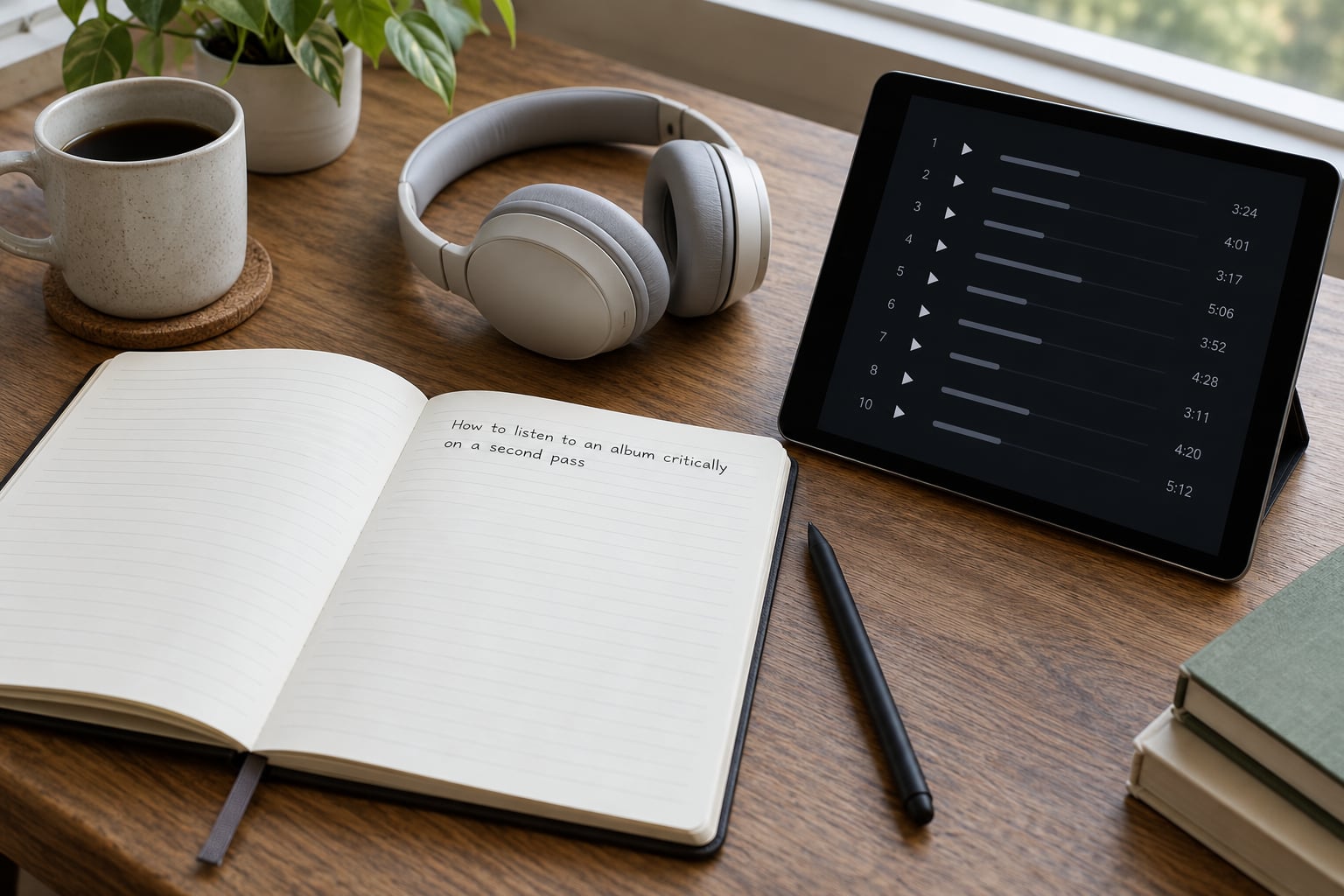
Now you work. Same album, same order, same volume — notes allowed this time.
Cap yourself at three observations per track. Three is enough to notice a pattern across nine tracks; ten is homework, and homework is where people quit. Write fragments, not sentences. “Same guitar figure as track 3” is a usable note. “The guitar figure in track 7 is also in track 3, which makes those two feel like a pair” is a usable note. “This song is really quite good” is not.
Listen for these on pass two, in this order:
- Memorable passages. The specific 20 seconds you’ll still remember, and what makes them stick.
- Mood shifts. Where the record turns, and whether the turn feels earned or abrupt.
- Repeated devices. A melodic fragment, a rhythm, a chord loop, an instrument that keeps coming back.
- Production choices. How close the voice sits, how much room is around it, how wide or narrow the sound feels.
- Vocal performance. Breath, phrasing, whether the delivery matches the words.
- Connections. Does track 6 answer track 2? Does the closer pay off something set up in the opener?
Here’s the useful distinction: on pass one you collect reactions, on pass two you collect observations. Mixing the two is how a first impression quietly hardens into a conclusion you can’t revisit.
Trace the album’s structure and recurring ideas
Take your pass-two notes and look at them from above. What comes back three or more times is probably a pattern. What shows up once might be an accident, a leftover, or a single deliberate contrast — all three are legitimate, and you can’t tell which from a single instance.
Look at sequencing next. Album arc means the track order argues for something: the record opens one way, escalates or distorts, and closes somewhere you didn’t expect. Some albums deliberately put their best-known song second, or save the real statement for track nine. Judging a song in isolation misses that entirely.
Give side B and the deep cuts real attention. The singles are the songs the record was marketed around; the fourth track nobody quoted is often where the actual identity sits. If the album exists on vinyl, the flip is a genuine boundary in listening, not a marketing detail.
Add context after forming an initial reading
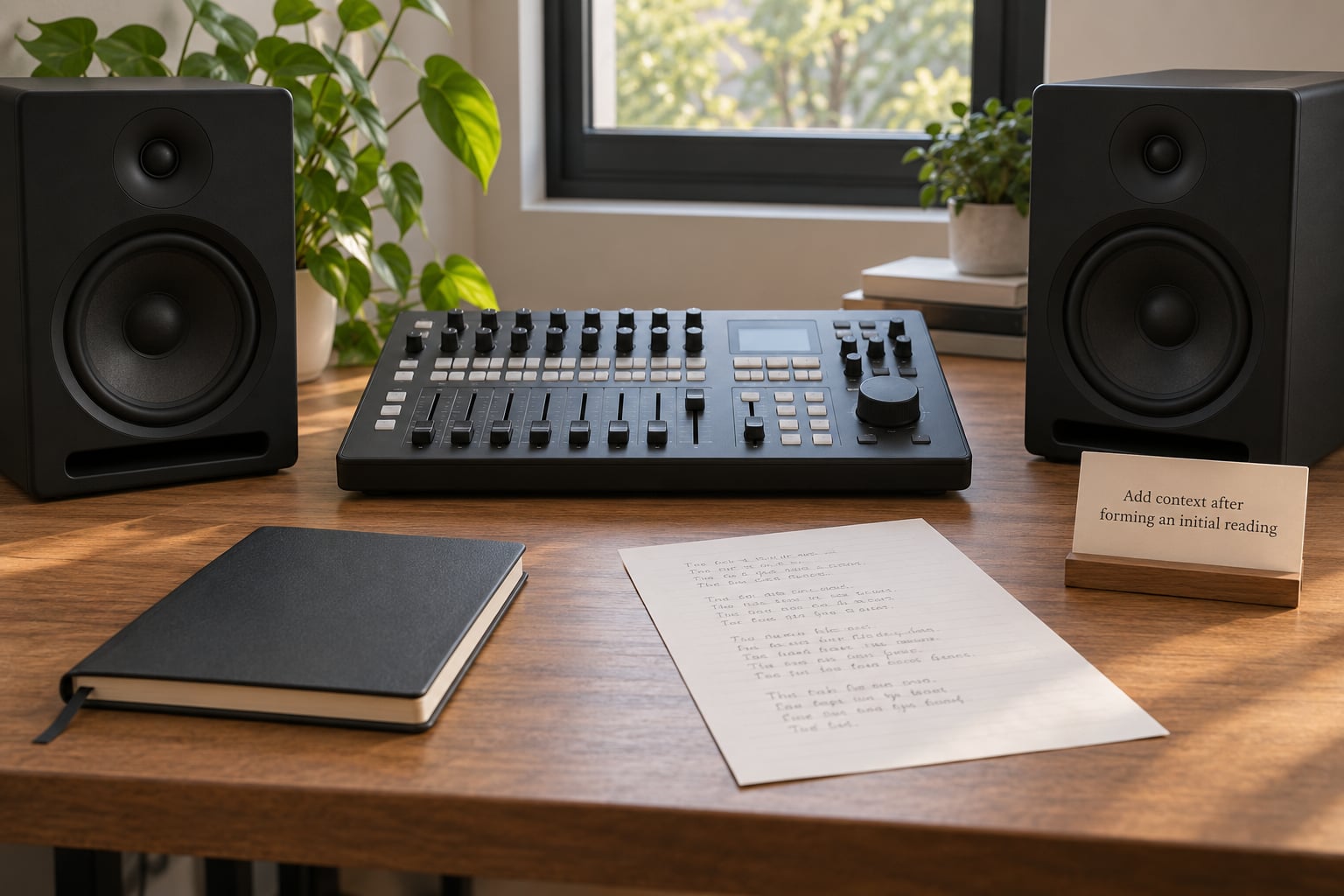
Only now read the liner notes, the credits, the lyrics, and any interview with the artist. Context is a second pass, never the first — because context that arrives before the music tells you what to hear.
The payoff is specific. A songwriter explaining that a record was written after a death reframes the closer entirely. A producer describing how a drum sound was recorded in one take tells you whether the rawness you noticed was an accident or a decision. A credit list showing one person playing every instrument tells you why the album feels like one mind arguing with itself.
Keep a hard line here: context should sharpen your reading, not replace it. If your honest reaction to a track was confusion, an essay telling you what the songwriter intended doesn’t make your confusion wrong. It makes it interesting.
Build and test an evidence-based opinion
By now you have notes. Turn them into a judgment in three parts — a claim, specific evidence, and the effect that evidence has.
Weak: “The production is great.”
Strong: “The mix keeps the bass under everything else, which is why a nine-song record feels effortless; by track 8 the drums finally push forward and it finally feels like the record is going somewhere.”
The weak version can’t be argued with because it says nothing specific. The strong version can be disagreed with, which is exactly what makes it worth saying.
Then test it. If someone asked “why,” could you point to three things you heard? If not, you have a preference, not a critique. And be honest about the edges: “I couldn’t tell whether the shift at track 5 was intentional” is a more accurate sentence than a confident wrong one.
Common Mistakes
Analyzing every detail. Not every hi-hat placement is a decision. Listen for the four or five things that shape the record’s identity and let the rest be pleasant.
Fix: cap yourself at three observations per track. The cap is the method.
Judging from one standout track. A brilliant opener tells you about track one.
Fix: your verdict cannot be written until the closer has played. Judge the arc, not the single.
Letting reviews set the standard. This is the one forum listeners argue about most. Watching a review first does not make you better informed; it makes your first impression borrowed, and you’ll never know which reactions were yours.
Fix: listen first, read second, and notice whether your opinion moved. If it moved, you know what to distrust.
Applying genre stereotypes. Calling a quiet album boring or a loud album crude before listening is a habit, not a judgment.
Fix: learn one thing about the genre’s conventions — the head, solo, head format in jazz, a tone poem’s lack of a verse structure, a producer-forward beat tape. Ten minutes of background removes most of the blind spots.
Confusing familiarity with quality. Knowing every word does not mean hearing the record.
Fix: if you know the songs by heart, that’s the moment to switch to a record you don’t know.
Assuming every choice was intentional. Some of what you’re hearing is a take that happened to sound good, and hunting for meaning in it produces reading, not listening.
Fix: keep two columns — what you heard, and what you think it meant. Never merge them while listening.
Listening past ear fatigue. After about an hour, your ears adapt and your judgment drifts. The album that suddenly sounds “flat” at the 50-minute mark often just sounds familiar.
Fix: 60 minutes of listening, then a 10 to 15 minute break. Never form a verdict in the last five minutes of a session.
Tips for Keeping the Process Enjoyable
Let the first pass be completely relaxed. Full attention doesn’t mean tension. Walking is fine — plenty of listeners do their best first passes outside — as long as you’re not reading, editing, or driving.
Compare two versions of the same album when the format allows it. Streaming versus vinyl versus CD is a genuinely useful exercise, not a purity test: the differences teach you what mastering does, and they’ll teach you faster than a textbook.
Talk about the record with someone after pass one, before pass two. Their favorite track versus yours is usually more informative than either opinion alone.
Wait a day before writing a final verdict. Fresh reaction is valuable and unreliable in equal measure; overnight, the reaction settles and the evidence gets a vote.
Frequently Asked Questions
Do I need to know music theory to listen to an album critically?
No. Critical listening is mostly attention and structure: hearing the record in order, noticing what repeats, and writing down what you observed before you interpret it. Naming a key or reading chords can sharpen a description later, but plenty of good published reviews contain no theory at all. If anything slows you down, skip it. Describe what the music did instead of what it was built from.
How many times should I listen to an album before reviewing it?
Two full listens is the practical minimum for a defensible opinion, and three is where most reviewers land. The first pass is for feeling, the second for observation and notes, the third for structure and detail. Spacing those out helps more than repeating them back to back, since fatigue flattens your judgment. Forum consensus across music communities clusters around two to four full listens before a rating or a review.
Should I analyze the lyrics or focus only on the music?
Follow whichever comes first in your own listening. For most records that’s the music, and forcing words into the analysis early produces readings that feel borrowed. Read the lyrics during the first playthrough if the words interest you, then again later to see whether the writing changes how the music lands. Some records are carried entirely by arrangement, and saying so is a legitimate finding.
How can I tell whether an album’s repeated sounds are intentional?
Look at frequency and placement. A device that appears three or more times, often at structural turning points, is almost certainly a choice. Something you noticed once may be a coincidence, a leftover take, or a deliberate contrast, and you usually cannot distinguish those by ear alone. Credits and interviews help here: a producer describing a recording approach can confirm a decision you only half heard.
When should I read reviews after listening to an album?
After your second full listen, ideally a day later, so your reaction is written down before anyone else’s is. Reading reviews first imports someone else’s conclusions into your only clean first impression, and you lose track of which reactions were yours. Reading second also lets you test your opinion: if a review changes your rating, you know exactly which observation was worth less than you thought.
Conclusion
Pick an album tonight and do the minimum version of this. Play it once, straight through, phone in another room. Write down two or three moments that stayed with you. Then play it again with a notebook, capture three observations per track, and read only what you wrote when it’s done.
That first interpretation is yours. It came from evidence you gathered yourself, which is the only kind worth arguing about.