Recording an album in the US costs anywhere from $500 for a home project to well over $100,000 for a fully professional release, and most independent records land between $5,000 and $20,000. Two things move that number more than anything else: the tier of studio you book and how many days the arrangement actually needs.
Everything below reflects typical US market rates for 2026. Rates vary by city, by room and by engineer, and they move over time, so treat these as ranges you negotiate against rather than numbers anyone will quote you twice.
Table of Contents
- How Much Does It Cost to Record an Album by Project Type?
- What Album Recording Costs Should You Budget For?
- What Affects the Price
- Ways to Save
- Frequently Asked Questions
- How much does it cost to record an album at a professional studio?
- Is it cheaper to record an album at home or in a studio?
- How much does it cost to record 10 songs for an album?
- Should an independent artist pay for mixing and mastering separately?
- How much should I budget for musicians and other performers?
- What is the most affordable way to produce a professional-sounding album?
- Plan Your Recording Budget First
How Much Does It Cost to Record an Album by Project Type?
Four scenarios cover almost every album someone actually makes. The difference between them is not vanity, it is who shows up and does the work.
| Project type | Typical total | Recording days | Who does the work |
|---|---|---|---|
| Home production | $500-$2,500 | Spread over months at home | You, on your own gear or a borrowed studio |
| Independent studio | $5,000-$18,000 | 10-20 tracking days | Engineer plus a hired producer or band |
| Professional full-service | $22,000-$70,000 | 25-45 tracking days plus pre-production | Producer-led team, session players, staff engineer |
| Premium artist-led | $75,000+ | 45+ days across multiple rooms | Established producer, staff, arranger, string and horn players |
Home production gets you a finished record for very little money, but you supply the ears. An artist in a small market recording solo vocals and programmed instruments might finish for under $1,000 including distribution and artwork.
The independent tier is where most first albums actually land. A band pays for a control room, brings its own gear where needed, hires an engineer, and mixes and masters the record afterward. That is the $5,000 to $18,000 band.
Professional full-service means a producer runs the project from arrangement through delivery. Pre-production, session musicians, mix and master all sit inside one fee, which is why the number jumps so far.
Premium projects with named producers and full session orchestras are a different market entirely. Those budgets are not what an independent artist is comparing against, but they are useful context for what the top of the scale looks like.
What Album Recording Costs Should You Budget For?
The tracking bill is rarely the biggest line. Here is a ten-track album budgeted across three realistic tiers.
| Line item | Home DIY | Independent | Professional |
|---|---|---|---|
| Studio time and engineering | $0-$600 | $3,000-$7,000 | $12,000-$30,000 |
| Producer fee | $0 | $1,000-$3,000 | $8,000-$25,000 |
| Session musicians | $0 | $0-$2,500 | $5,000-$20,000 |
| Editing and comping | $0 | $400-$1,200 | $1,500-$4,000 |
| Mixing | $0 | $1,500-$5,000 | $6,000-$18,000 |
| Mastering | $100-$400 | $500-$1,200 | $1,500-$4,000 |
| Gear rental and backline | $0-$300 | $300-$1,000 | $1,500-$5,000 |
| Cover art and photography | $0-$250 | $400-$1,500 | $2,000-$8,000 |
| Distribution | $0-$25/yr | $0-$25/yr | $200-$500 |
| PRO and publishing registration | $0-$150 | $0-$150 | $300-$1,000 |
| Promotion | $0 | $500-$2,500 | $5,000-$25,000 |
Distribution through services like DistroKid, TuneCore or CD Baby is a subscription or a one-off fee and rarely the line that breaks a budget. Cover art and promotion are the two most common surprises.
Register your own songs with ASCAP, BMI or SoundExchange before release. It costs almost nothing and you cannot do it retroactively for streams that already paid out to nobody.
How Much Does Recording Time Cost?
Recording studio rates in 2026 run from about $35 an hour in a small local room to $400 and up an hour at a top-tier facility. A working band needs $50-$90 an hour in most markets, with major metros running 40 to 60 percent above smaller cities.
Three pricing models exist. An hourly rate bills you for the door-to-door time. A day rate usually covers eight to ten hours and saves 15 to 30 percent against hourly billing. A lockout is a full day where the room is yours alone, which is what you want when a band is tracking live.
Worked example: a two-hour session at $75 an hour with an engineer included costs $150. The same two hours on a $600 day rate with the engineer billed separately at $250 costs $850. Check which one you are being offered, because a lot of advertised rates are space-only.
Overage usually bills at 1.5 times the hourly rate. Rush fees for turnaround under 48 hours commonly add 25 to 50 percent of the session cost, and vocal booths or live tracking rooms often carry their own premium over a project room.
Here is the part that surprises people: a finished song costs more studio hours than the song count suggests. Ten songs at a clean three hours each is optimistic. Real sessions eat time on mic placement, headphone mixes, comping, punch lines and re-takes, and a song that is not finished on the day you planned becomes a second booking.
Recording time is also where rewriting hurts most. Artists describe unfinished songs rearranged on paid studio time as the most expensive songwriting session they will ever book, because you pay tracking rates to discover you do not have a chorus.
How Much Do Mixing and Mastering Cost?
Mixing usually costs more than tracking once you count the room and engineer separately. Community-reported rates run from about $250 to $2,500 per song depending on engineer tier, with a well-known name well above that range.
Mixers quote three ways. Flat fees per song, hourly rates that usually run $50 to $150, or a flat project fee for the whole record. Album-scale pricing is standard: most engineers discount per-track cost when you book all ten songs at once.
For ten tracks, expect roughly $1,500 at the entry tier, $3,000 to $6,000 for a working independent mixer, and $10,000 plus for a name.
Mastering is cheaper and shorter. Album masters run about $500 to $1,200 for an independent release and $1,500 to $4,000 at a professional tier. Premium mastering with an analog signal chain, tube stages and hands-on monitoring costs more than automated or high-resolution digital mastering.
Ask whether the fee includes pre-mastering preparation, which is clipping repair, sequencing across the record, level-matching and gap timing. It should. If it is quoted as an extra, you are paying twice for the same pass.
Count revisions into the quote. Two rounds of notes is standard, and anything beyond that usually bills extra per round. Getting a professional mastering pass is the highest-value spend on a cheap record, which is why it is the last thing to cut.
How Much Does It Cost to Make an Album Cover?
Artwork runs from free to $10,000 and has almost nothing to do with sound quality. Independent projects pay $300 to $1,500 for cover art and photography. Professional projects with a photographer, a designer and a shoot run $2,000 to $8,000 or more.
Getting 500 vinyl records made is a separate and much larger question. Short-run pressings start around $6 to $12 per unit at small quantities and drop sharply as quantity rises, plus mastering, lacquer cutting, jacket, inserts and shipping. Large runs bring the unit cost down but need the orders to exist.
What Affects the Price
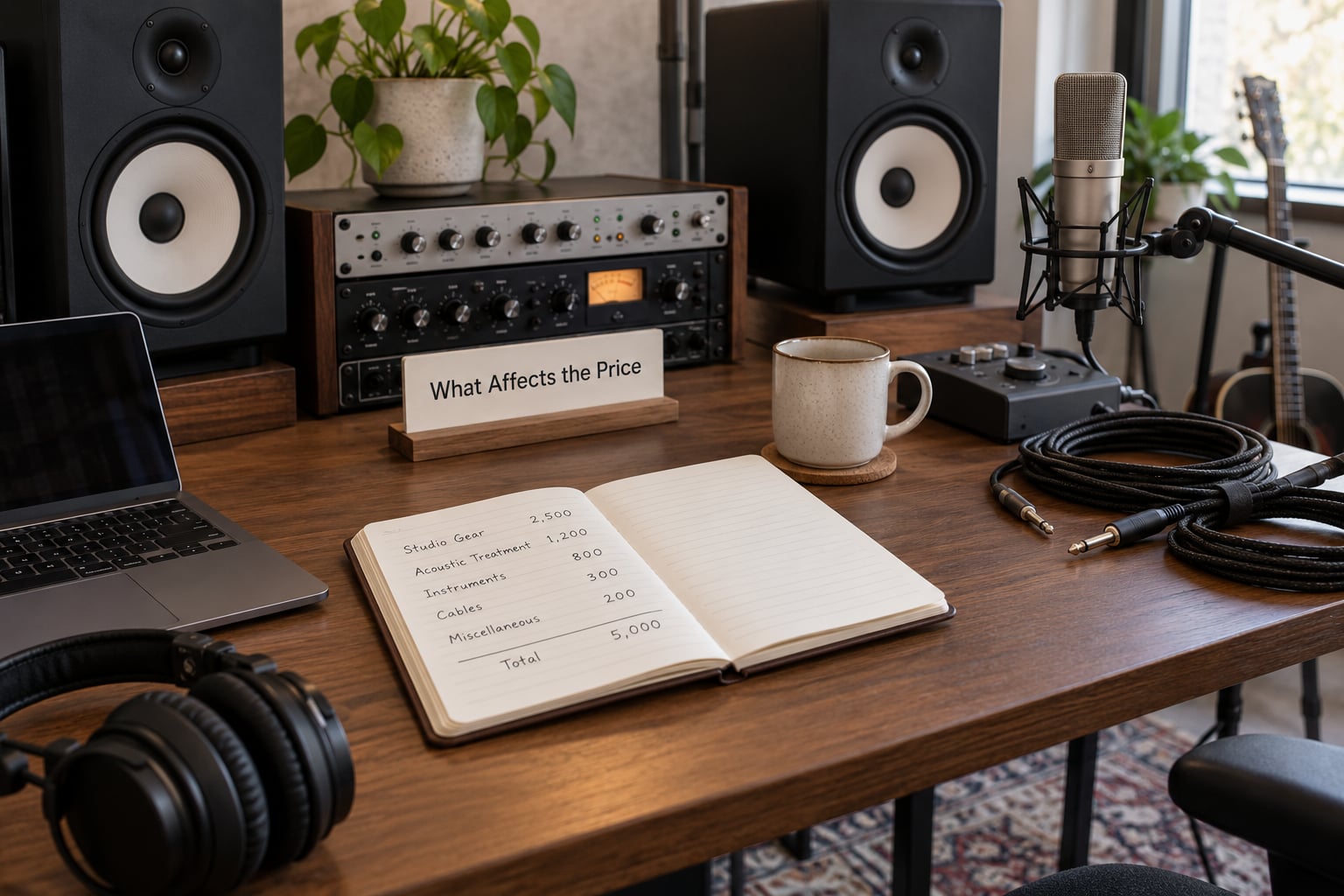
Two albums with the same track count can differ by a factor of ten. These are the variables that explain it.
Arrangement density is the biggest one. A solo voice over programmed drums is a fast session. A five-piece band tracking live is slow. Strings, horns and stacked backing vocals multiply the hours far faster than they multiply the song count.
Typical days for a ten-track record:
- Solo electronic or solo vocal: 5 to 8 studio days
- Two or three-piece band: 10 to 15 days
- Full band tracking live: 20 to 30 days
- Band plus string players or horn section: 30 to 45 days
Producer involvement is the second. An engineer records what you play and charges by the hour. A producer arranges, rewrites, coaches performances and directs the sessions, and charges a fee for that time whether the room is booked or not. That fee can exceed the studio bill.
Location sets the floor. The same engineer charges differently in Nashville, Los Angeles and New York than in a smaller market, and rooms with genuine acoustic treatment and a good outboard gear locker cost more than a treated bedroom with a good interface.
Track count matters less than you think. Twenty short tracks are not twice the work of ten medium ones if the arrangements are simple. Length, arrangement complexity and how many separate tracking days they need drive the bill.
Rights and usage add up quietly. Synchronisation, library music, cleared samples and loops all carry fees. Buyout terms for a loop you use ten times on a record cost more than a standard license.
Turnaround and rush add a percentage, not a fixed fee. If a mixer has a queue of records ahead of yours, paying for a rush is usually cheaper than waiting three weeks for the same work.
Once the mixes are done, sequencing across the album becomes its own deliverable. Mastering engineers arrange running order, trim tracks and check transitions. Singles never get that treatment, which is part of why an album sounds like a record instead of a playlist.
Ways to Save
Reduce the bill without reducing the quality of the finished record.
- Rehearse and pre-produce before you book. Know the parts, know the tempo, know the arrangement. Pre-production days are cheaper than tracking days, and most studios will quote you a lower rate if you arrive with the work finished.
- Book day rates, not scattered hours. A band paying hourly across six two-hour bookings pays for six setups and six ramp-ups. One six-hour lockout costs materially less for the same hours of work.
- Track vocals separately from the band. Full-band tracking is the slowest, most expensive way to get down a song. Laying down drums, bass and guitars first and adding vocals later is standard practice for a reason.
- Use fewer players and double parts. One player covering two parts often sounds tighter than two mediocre players, and it halves the tracking time.
- Set a hard session cap in writing. Agree the number of days and the number of finished songs up front, and put a revision limit on the mix quote.
- Finish arrangements before the clock starts. Rewriting on studio time is the most expensive habit in independent production.
- Book one engineer for the whole record. A consistent engineer across all ten tracks produces a more even album and costs less per song. Splitting an album across studios costs more and usually sounds worse.
- Spend where it shows. If the budget is tight, cut a photographer before cutting professional mastering.
A first-album thread on r/WeAreTheMusicMakers broke down roughly $1,000 to $1,200 for about ten days of pre-production and $700 to $1,000 for recording, with tracking around $850. That is a real budget for a real record, and it is a useful check on whether a quote you have been given is out of line.
One band on Gearspace reported recording to tape and mixing at home end to end for about $2,000, excluding artwork, physical manufacturing and promotion. Add those and a modest independent budget lands somewhere between $5,000 and $8,000.
A suspiciously low quote is worth interrogating rather than celebrating. Community consensus treats a very cheap full mix as a signal that the work is being pushed through an upmixer plugin rather than done in a room. Ask for the number of included revisions, ask whether the engineer is inside the room rate, and ask what the deliverables actually are.
Frequently Asked Questions
How much does it cost to record an album at a professional studio?
A professional studio album typically runs $22,000 to $70,000, covering pre-production, tracking, session musicians, mixing and mastering. An independent studio release with an engineer and your own band lands lower, usually $5,000 to $18,000. A home production can finish for $500 to $2,500. Rates vary by city and change over time, so quote three rooms.
Is it cheaper to record an album at home or in a studio?
Home is cheaper on paper, usually by thousands, but you supply the ears and the time. Studio time gets you an experienced engineer, a treated room and a producer who can fix a weak arrangement. If your material is finished and you know mixing, home works. If songs still need arranging or performing, studio time pays for itself.
How much does it cost to record 10 songs for an album?
Ten songs typically need 10 to 20 studio days for a solo or small band project, which at independent studio rates is $3,000 to $7,000 including engineering. Mixing adds $1,500 to $5,000, mastering $500 to $1,200, and artwork, distribution and promotion push a complete independent album to $5,000 to $18,000. Complex arrangements need far more days.
Should an independent artist pay for mixing and mastering separately?
Usually yes. Mixing and mastering are different jobs done by different people with different tools, and bundling them often means the mastering is a plugin preset rather than a real pass. If a producer mixes your record, pay for mastering separately regardless. It is the cheapest quality lift available on a finished album.
How much should I budget for musicians and other performers?
Session musicians typically charge $250 to $600 per player per day, and horn or string players run higher. Budget $0 to $2,500 for an independent record and $5,000 to $20,000 for a professional one with arranged parts. Musicians who are band members cost nothing in fees but still add tracking days, which is where the real money goes.
What is the most affordable way to produce a professional-sounding album?
Finish your arrangements and rehearse fully, track in one efficient block on a day rate, and spend your remaining money on a professional mix and master rather than a long tracking session. Use one engineer for the whole record so the album stays consistent. A well-mixed, well-mastered home or small-studio recording consistently outshines an expensive one left unmixed.
Plan Your Recording Budget First
Pick your tier before you look at a single rate card, write down everything the quote must include, and hold back 10 to 15 percent for the revision round everyone needs and the overrun nobody predicts.
In 2026, a typical independent album budget starts around $5,000 and a professional one around $22,000. Know which of those you are building, then book accordingly.