If you want a straight answer for how to price your beats as a producer: most direct sales land between 30 and 500 USD, with a premium non-exclusive lease around 150 USD being a reasonable planning benchmark, and an exclusive license running from roughly 500 USD into the thousands. Where you land inside those ranges depends almost entirely on the rights you hand over and the hours behind the beat.
Those numbers are observed ranges from beat stores, producer forums and client conversations, not official market rates. Treat them as a starting band and then do the arithmetic yourself.
Most producers lose money in the same two directions. Some sell a three-hour session for the price of a one-hour loop and wonder why the work never pays for itself. Others quote a flat rate for a beat that took four collaborators, a cleared sample and fifty stems, then get blamed for being expensive when the artist is comparing them to a 20 USD pack.
The fix is a framework, not a number. Decide what the buyer receives, work backward from what you need to earn, then check the result against comparable offers. That takes about an hour per beat once you have it down.
How to Price Your Beats: Typical US Costs
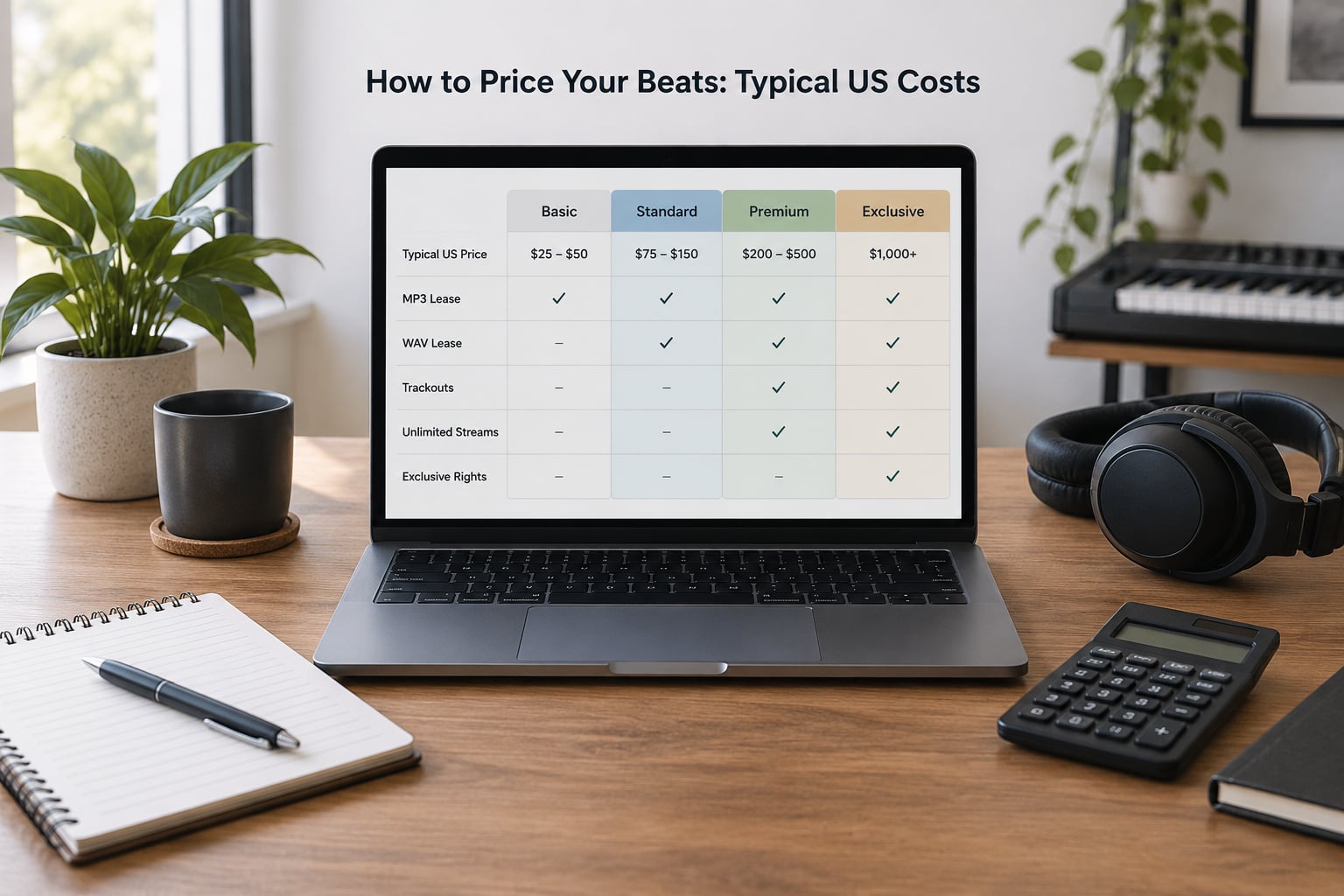
Every beat gets sold two ways: as a non-exclusive license where you keep selling the same beat to other artists, or as an exclusive license where you hand over the beat and take it off your store. The price gap between those two is not a judgement of quality. It is the difference between renting out one room and selling the house.
| License type | Typical US range | Ownership after sale | Streams | Distribution | Paid shows and radio | Music video | Revisions | Trackout stems |
|---|---|---|---|---|---|---|---|---|
| Basic non-exclusive lease | 30 to 75 USD | Producer keeps ownership and can keep selling | 2,000 to 5,000 | Up to 2,500 copies | No | No | Usually none | Tagged MP3 only |
| Premium non-exclusive lease | 75 to 200 USD | Producer keeps ownership and can keep selling | 10,000 to 50,000 | Up to 10,000 copies | Usually no | Paid promotion only | 1 to 2 rounds | WAV and MP3, sometimes trackouts |
| Unlimited non-exclusive lease | 200 to 500 USD | Producer keeps ownership and can keep selling | Uncapped | Uncapped | Yes | Yes | 2 to 3 rounds | WAV, MP3 and trackouts |
| Exclusive license | 500 to 5,000 USD and up | Artist owns the master; beat is retired from your store | Uncapped | Uncapped | Yes | Yes | As negotiated | Full trackouts required |
| Custom commissioned beat | 500 to 3,000 USD and up | Depends on the contract you write | Set by the contract | Set by the contract | Set by the contract | Set by the contract | Set by the contract | Set by the contract |
These are typical US ranges. They shift by region, by genre and by the year you look, and a producer with documented placements can sit well above every number on this table. Read the table as a map of what is being sold, not as a rate card.
One detail in that table causes more arguments than any other. A buyer who blows past 2,500 streams on a basic lease has broken the contract, not earned a bigger license. Say the cap in the agreement, in the checkout page and in the email confirmation. The caps are the reason the tiers are worth different amounts.
How to Price Your Beats by License Type
Build the number in this order: hours, then complexity, then rights. Start with what you would charge a stranger to sit with you for one hour of your time. Call that your base hourly rate. Plenty of working producers use 25 to 60 USD as the floor and honest freelancers use more.
Multiply the hours by the rate. A three-minute beat that takes 12 hours from sketch to final bounce is 300 to 720 USD of labour before you consider anything else. Now apply a complexity factor, somewhere between 1.0 for a straightforward loop and 1.8 for a beat with live players, a cleared sample, three collaborators and a custom sound design pass. A 500 USD beat at 1.5 complexity is 750 USD of underlying value.
Then adjust for rights, and only for rights:
- Uncapped streams and uncapped distribution roughly double a non-exclusive tier, because you are removing the ceiling on what the artist can earn with it.
- Music video use and paid performance rights add real money for artists who actually perform and shoot.
- Trackout stems add work for you and remove the producer’s ability to re-use parts of the beat, so they cost extra on any tier.
- Revision rounds cost you the same as making a beat, so cap them and price each additional round as a fixed extra.
- Exclusivity retires the beat. You are not just licensing one song, you are giving up every future lease, so the price belongs in a different band entirely.
Worked example. Three-minute beat, 14 hours of work, your base rate at 40 USD gives 560 USD. Complexity factor of 1.5 for two collaborators, a cleared sample and a custom 808 layer brings it to 840 USD. The buyer wants premium stems, two revision rounds, a music video licence, and a non-exclusive term with a 500,000 stream cap. Add 30 percent for the trackouts and revision rounds and 25 percent for the wide reach, and you land near 1300 USD as your ceiling. Quote the premium tier at 400 USD, the unlimited tier at 500 USD, and hold the exclusive at 1,800 USD. Every number in that quote can be explained in one sentence.
That is the whole method. If you cannot explain a price line by line, it is a guess.
What Affects the Price
Two beats that sound identical to a client can be worth very different amounts. The difference is in the work, the rights and the proof. Here is what actually moves a number, roughly in order of impact.
| Factor | Effect on price | What it looks like in practice |
|---|---|---|
| Hours in the session | Direct, linear | 12 hours versus 3 hours is the difference between a part-time and a full-time rate |
| Arrangement complexity | Up to double | Live players, custom sound design, an orchestral pass versus a two-layer loop |
| Collaborator splits | Reduces your net | A featured artist session or a co-producer’s cut means your usable income is lower |
| Sample clearance | Raises or removes the sale | Cleared loops you can license; uncleared ones usually cannot be sold at all |
| License term and stream cap | Up to double | Two years at 10,000 streams versus unlimited for life |
| Trackouts and file delivery | Add 15 to 30 percent | WAV and MP3 versus tagged MP3 only, plus full trackouts |
| Revision limits | Add per round | Two included rounds, then a fixed fee per extra round |
| Genre and intended artist | Wide swing | Sync-ready instrumental work commands more than a bedroom demo |
| Placements and reputation | Justifies a premium | A credit on a charting record changes the conversation entirely |
| Platform fees | Reduces your net | Marketplace commission and payment processing come out before you see anything |
| Exclusivity | Different band entirely | 500 to 5,000 USD and up, depending on everything above |
Time and complexity behind the beat
Hours are the easiest thing to justify and the easiest thing to forget. Producers routinely count only the final bounce session and ignore the two hours of sketch revisions at midnight that made the bounce possible. Log your time for a month and the number will surprise you, usually upward.
Complexity is the part clients cannot see, so it is where producers most often talk themselves out of money. If a track took four people and a week, it is not the same product as something you built in an afternoon, and the licensing terms should say so. When an artist says a price feels high, ask how many arrangements you think are inside it. The conversation usually moves on its own.
Rights, delivery and what the buyer can do with it
Rights are where the real money hides. A non-exclusive license with a 2,000 stream cap and one that is uncapped both give the artist a song, but only one of them gives them a career. Price the reach, not just the audio.
Trackout stems deserve their own line. The standard producer advice is to sell non-exclusive leases to budget buyers, charge more for exclusives, and include stems at the higher tiers, and the reason is practical: once someone has your stems, you can never un-sell the idea. Bundle stems with the top tier and they stop being a negotiation.
Delivery format matters less to the artist and more to your workload. Sending a WAV plus a tagged MP3 plus a full trackout folder takes you ten minutes nobody priced in.
Reputation, genre and the artist in front of you
Placements are the cleanest premium you will ever get. One credit on a record that people can check turns an argument about your rate into an argument about your terms, and the terms are where you have the leverage.
Audience size cuts the other way, and producers keep ignoring it. A producer with a few hundred social followers quoting 300 to 500 USD exclusives reads as arrogant rather than premium, and the damage to your own brand usually outweighs the one sale. Credibility has a floor. Know where yours is before you name a number.
Genre sets the ceiling for practical reasons. Instrumentals pitched at sync, licensing and ad work are judged on clearance, edit points and stems, not on vibes, and those buyers pay a different market. Beats sold to artists still building a first audience are judged almost entirely on whether the number feels safe.
One more factor sits underneath all of it: platform fees. When a marketplace takes a commission and a payment processor takes its cut, the price on your store page is not the money in your account. Producers regularly forget this and then blame the artist for lowballing when the checkout total was already thin.
How to Set a Break-Even Price From Your Own Numbers
Range-checking against other producers tells you whether your number looks normal. It does not tell you whether it pays you. For that you need a worksheet, and it takes five numbers you already have.
Add up what the business costs you in a month: the beat store subscription, plugins, sample packs you paid for, a share of your gear, and the hours you spend on admin and outreach. Then add the income you need from beat sales alone to hit a normal month. Add the platform and payment fees you expect to lose on every transaction. Divide that total by the number of licenses you realistically expect to complete in a month, not the number you hope to sell.
| Line | What goes in it | Monthly example |
|---|---|---|
| Fixed costs | Store subscription, plugins, gear share, admin and outreach hours | 400 USD |
| Target producer pay | The minimum you need to take home from beat sales | 1,200 USD |
| Transaction losses | Marketplace commission and payment processing, as a percent of gross | 15 percent of gross |
| Expected completed licenses | Realistic closed deals in the month, not page visits | 5 |
| Break-even gross price | (fixed costs plus target pay) divided by licenses, then grossed up for fees | 376 USD per license |
That last line is the number most producers never bother to calculate, and it is usually uncomfortable. If your break-even comes out at 376 USD and your store is selling unlimited leases at 120 USD, you are not running a cheap business, you are running a hobby and calling it revenue. The fix is never to cut the target pay. It is to sell more, raise the tier prices, or stop giving away the unlimited tier for less than it costs you.
Run the same worksheet with a pessimistic column. If the pessimistic case is three licenses, price so three sales cover the month. That is the actual safety net, because the month you plan for is rarely the month that happens.
One more reason to write the worksheet down: it turns a vague sense of what feels fair into a number you can say out loud without flinching. A producer who can explain the line items stops negotiating against themselves, which is where most of the lost money actually goes.
The cost-per-hour reality check
Do the division on a single sale and the picture gets uncomfortable fast. A beat that took eight hours to make and sold as a 40 USD basic lease pays five USD an hour before platform fees, and after fees it pays closer to three. That calculation has been running through producer forums for years, and it is the clearest argument for not chasing the cheapest tier.
Run the same check on a 150 USD premium lease with 12 hours of work and you get twelve USD an hour, which is a freelance rate rather than a passion project. A 1,800 USD exclusive with twenty hours and a cleared sample lands above eighty USD an hour, which is the number that justifies turning down a lease entirely.
This is the most useful single argument to have when an artist compares your price to a cheaper store. It is factual, it is short, and it does not require you to argue about quality, where the other producer always has an opinion.
Ways to Save
Ways producers can hold costs down
The cheapest beat to make is the one you already know how to finish. Keeping a small set of session templates, a personal sound library and a fixed editing chain cuts hours per beat without touching quality, and hours per beat is your margin.
Build the catalog once and sell it many times. A beat that sits on a store earning nothing still costs you nothing per month, so leave slow beats up rather than deleting them, unless the platform’s distribution rules make them a liability.
Price the extras instead of hiding them in the base. Unlimited revisions, rush delivery and custom arrangement changes are all separate line items. Producers who bundle them into one number end up absorbing costs that were never in the quote.
Grandfather old clients when you raise rates. A producer who sells a beat for 40 USD to someone in year one and then raises the store to 120 USD keeps the relationship and raises the business. Tell the existing customer their old rate is locked for that beat and nobody feels it as a betrayal.
Ways buyers can spend less
Start with a non-exclusive lease instead of an exclusive. It is the same song, it is a fraction of the cost, and if the song does well you can always come back and buy the exclusive later, usually for more, which works in your favour either way.
Buy the term and the caps you will actually use. A tighter stream cap or a shorter term is a real discount if the song is going somewhere specific, and it is a bad deal if the artist plans to push it hard. Be honest about which one this is.
Buy in packs only when the numbers work. A five-pack at a 20 percent discount beats three singles when you genuinely need three beats, and it wastes money when the extra two were never going to be used. The bundle discount should reward a decision, not create one.
Skip the trackouts on the lower tier. WAV plus MP3 is enough for release. Stems are for mixing sessions and for artists who want to rework the beat themselves, and they are worth real money to you.
Pay for revisions you will use. Two included rounds covers most songs. A producer who will not agree to a revision cap is telling you something about how the rest of the project will go.
What to say when the artist says it is too expensive
Lowball offers are rarely insults. They are usually an artist with no reference point and no idea what a license costs, which means the problem is information, not attitude. A short script beats an instant discount every time.
When someone says another producer charges less, the answer is a question about what that other producer gave away: “Happy to match that. Does their license include trackouts, unlimited streams and two revision rounds?” Most of the time the answer is no, and the price stops looking like a markup.
When someone offers 50/50 instead of a fee, that is a real option rather than an insult, and it is how a lot of producers get started. Take it only if the publishing split is written down, the beat keeps earning, and you understand that 50 percent of nothing is nothing. If the artist has a real audience, that deal can beat a small fee.
When someone asks for a discount, cut scope instead of price. Same track, lower tier, tighter cap, one revision round. The artist still gets a song, you still get paid, and nobody is arguing about what a beat is worth.
When someone goes quiet after the quote, do not chase with a lower number. Send the terms once, in writing, and let the silence be information. Producers who negotiate themselves down in the first message teach every artist that the first number was invented.
When an artist is clearly serious and asking you to move, put the change in writing with a reason. A deadline on the beat or a first-listening date is honest; a fake countdown timer is how a licensing business stops being one.
How to talk about the number before you send it
Artists say the price is too expensive when they have no idea what is inside it. The fix is a quote, not a discount, and the format matters more than the arithmetic.
A written quote needs seven lines: the beat name, the license type, the exact stream and distribution caps, the term, the files delivered, the number of included revisions, and the price with platform fees noted separately. Add one sentence explaining what the highest tier is worth. That single line is often enough to move someone to the tier you actually wanted.
When someone pushes back, do not immediately drop the number. Ask which part of the license is out of reach, the tier or the cap, and offer the cheaper version of the same rights. Producers on these boards keep repeating the same lesson: a buyer who has no written terms will ask for unlimited revisions at the end of the project anyway.
Two habits protect the number. Keep your prices identical across every store and your own site, because inconsistent pricing is the fastest way to lose trust, and raise prices on a schedule rather than emotionally, testing one change at a time so you know what caused what.
Frequently Asked Questions
What is the average cost to buy a beat from a producer?
Most non-exclusive leases sell between 30 and 500 USD, with basic tiers near 30 to 75, premium tiers around 75 to 200, and unlimited tiers from 200 to 500. Exclusive licenses start around 500 USD and run into the thousands for established producers. Artists who buy regularly tend to spend 25 to 50 USD per beat on the basic end, and 50 to 300 USD once they want wider caps, trackouts and revision rounds.
Should producers charge per bar or per song?
Per song, every time. Bar pricing sounds fair in theory, but it punishes you for writing an efficient beat and rewards padding. A 16-bar loop and a two-minute arrangement can cost the same 14 hours to finish, and the buyer only cares about the finished track. Use per-song pricing and let the license type, the caps and the stems carry the differences instead.
How much should extra revisions cost on a beat?
Charge a fixed fee per additional round, roughly a quarter of the tier price or a flat 50 to 150 USD, and put a hard limit on the number of rounds. A revision is not an unlimited conversation. Artists accept this easily when the original quote listed two included rounds, because the expectation was set before anyone was excited about the track.
How much more should an exclusive beat license cost?
An exclusive should cost several times your top non-exclusive tier, because you retire the beat and give up every future lease of it. A common rule of thumb is eight to ten times the unlimited lease price, with a floor around 500 USD. Producers with real placements can and should charge several times that, and should never let a first sale talk them below the floor.
How do I price my first beat sale?
Quote from your hours and the license you are selling, not from what feels safe. A first sale at 30 USD is fine if it is a basic lease with tight caps, and it is a mistake if it is an unlimited lease with trackouts. Sell the lowest tier first, deliver it well, get a credit, and let the second and third sales carry a higher number.
Conclusion
Price a beat in three steps: count the hours and weight them by complexity, set the price for the rights you are actually selling, and check the result against comparable offers before you publish it. Everything else in this guide is detail on one of those three steps.
Start today by picking three beats already in your catalog, writing out the real hours behind each, and quoting a basic, premium and unlimited tier plus an exclusive for all three. Put the numbers on your store, keep them identical everywhere, and revisit the whole catalog in six months. That single exercise fixes more pricing problems than any rate list you can copy from another producer.