An artist bio is a short, third-person summary of who you are, what you make and what you have actually done — usually 80 to 140 words. Writing a good one comes down to three things: a specific one-sentence identity, concrete details instead of adjectives, and three lengths ready for wherever the text lands. Budget about an hour for the first draft and half an hour for the edits.
Most weak bios I read fail in the same two spots. They open with a compliment instead of information, or they bury the one detail that makes the artist memorable under a list of every show ever played.
Here is how to write an artist bio that holds up in a booking inbox or a press query, plus the fixes for the mistakes that trip up most first-time writers.
Table of Contents
- What You Need
- Step-by-Step: How to Write an Artist Bio
- Common Mistakes and How to Fix Them
- Frequently Asked Questions
- How long should an artist bio be?
- Should an artist bio be written in the first person or third person?
- How do I write an artist bio with no experience?
- What is the difference between an artist bio and an artist statement?
- What is the 70/30 rule in art?
- Should I use an AI bio generator to write my artist bio?
- Conclusion
What You Need
Gather this before you type a word. It turns an hour of staring at a blank page into twenty minutes of assembly.
- Your artist name as it appears everywhere else. If it changes between your streaming profile and your flyers, settle that first.
- Genre, sub-genres and three named influences. Specific names give a writer something to anchor to.
- Your origin point. City, country, and the year you started making work seriously.
- Releases and performances. Record titles, venues, dates and any support slots you are proud of.
- Proof. Press quotes, playlist adds, radio plays, residencies, grants, collaborations or sales worth mentioning.
- Current goals. Where you are pushing next, and who you want to reach to get there.
- A tool to write in. A notes app for raw material, a word processor for the versions you save and reuse.
Write the raw facts in a bulleted list first. Prose is much easier to build from a list than the other way round.
Step-by-Step: How to Write an Artist Bio
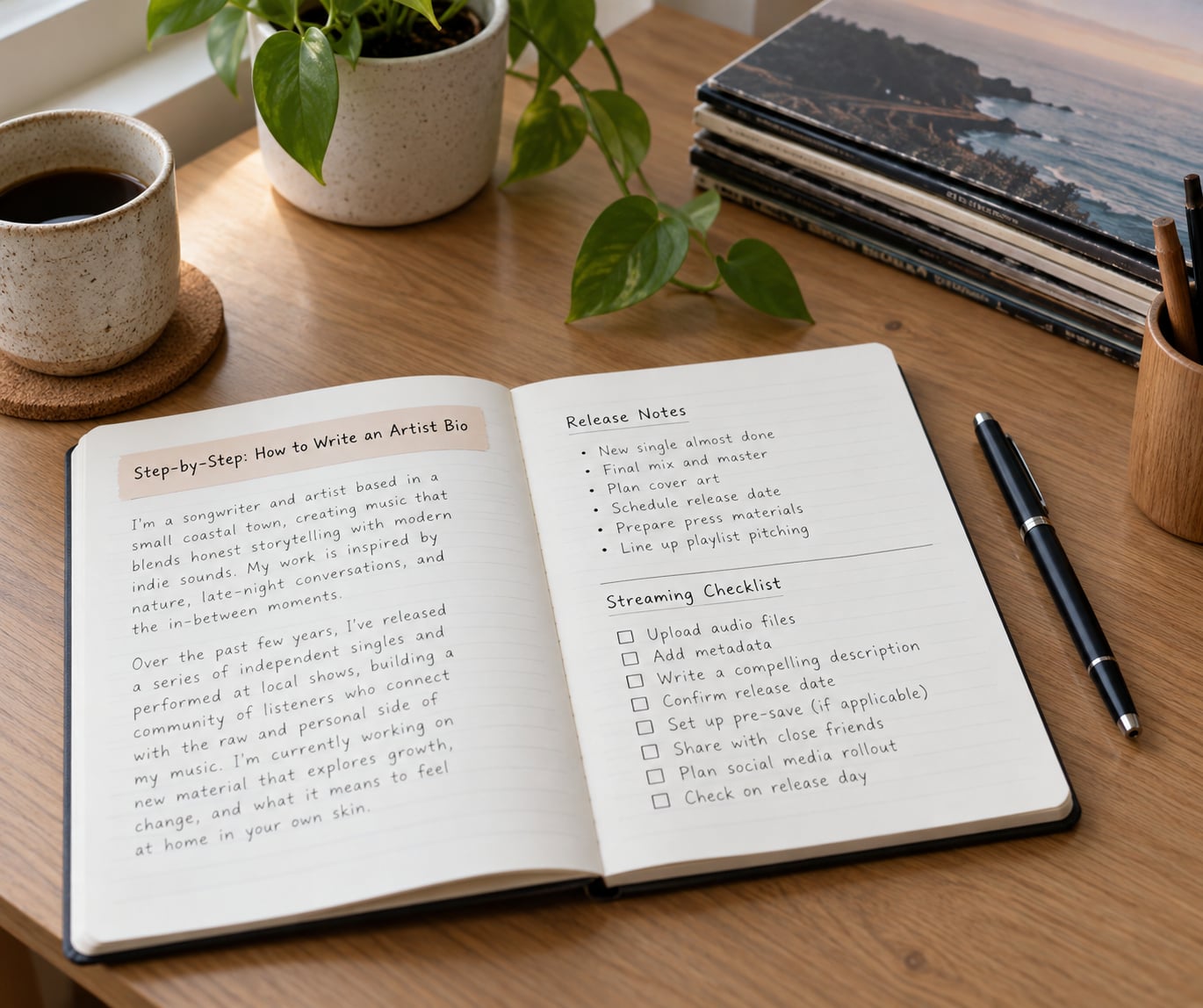
Each of the five steps below adds one layer. Stop after each one and read the paragraph aloud before moving on, because problems are much easier to hear than to see.
Start With a Clear One-Sentence Identity
The first sentence tells the reader who you are without any filler. Build it from four parts: what you do, what it sounds or looks like, the perspective you bring, and the single most distinguishing detail you have.
Here is a weak opening: Nova Grey is an up-and-coming singer-songwriter from Manchester whose music has been described as refreshing.
It says almost nothing. “Up-and-coming” and “refreshing” are the kind of words a reader skims past. Try instead: Nova Grey is a Manchester singer-songwriter who writes sparse, tape-saturated songs about night-shift work, and has released four singles since 2026, two of them on local label Field Recordings.
That sentence names the sound, the subject, the location, the output and the label. It is 38 words and it earns the second sentence.
Add Your Music, Influences, and Creative Point of View
Once the identity is set, describe what you make using language a listener or curator can actually picture. Musicians get the most mileage here, and it is the hardest paragraph for new artists to write.
Aim for two or three influences and one line about what you took from each. “Influenced by Radiohead and Bon Iver” is a list. “Takes Bon Iver’s habit of leaving a vocal doubled and thin, then sets it over drum machines that run slightly behind the beat” is a description.
Add the point of view in a clause rather than a manifesto. Say what the work is about and let the music prove it. Long paragraphs of intention read as filler, because nobody can verify them.
Include Proof of Experience and Activity
Now add only the facts that support the sentence you just wrote. If the first line claims momentum, the next lines have to show it with dates, names and titles.
Specific beats impressive: “supported Rival Lines across 14 dates in 2026” lands harder than “toured extensively.” “Quoted in 2026 by” plus the publication’s name beats “featured in various outlets.”
If you are just starting out, the proof section shrinks, and that is fine. Release dates, a residency application you got accepted into, an open mic win, a self-released single with real plays, or consistent monthly output all count. Skill is the one thing you cannot borrow, and readers forgive thin résumés faster than they forgive vagueness.
Keep the whole proof section under about 60 words. If it runs longer, you have written a resume.
State What You Do and Who You Want to Reach
Close by naming where you are going and who can help you get there. A DJ reading this wants to know the room you fit; a playlist curator wants to know the lane you sit in; a label wants to know the size of the audience you bring.
Keep it to one or two sentences and keep it factual. “Nova Grey is writing the follow-up record and booking spring support dates” is useful. “Nova Grey is the future of British indie” is a sales pitch, and curators delete those.
This is also where a 20/80 habit pays off. A rule of thumb artists mention often is that a small share of your bookings or streams comes from most repeat contacts — referrers, promoters and playlist people who already believe in you. Your bio is a tool for converting strangers into that second circle.
Edit for Voice, Length, and Use
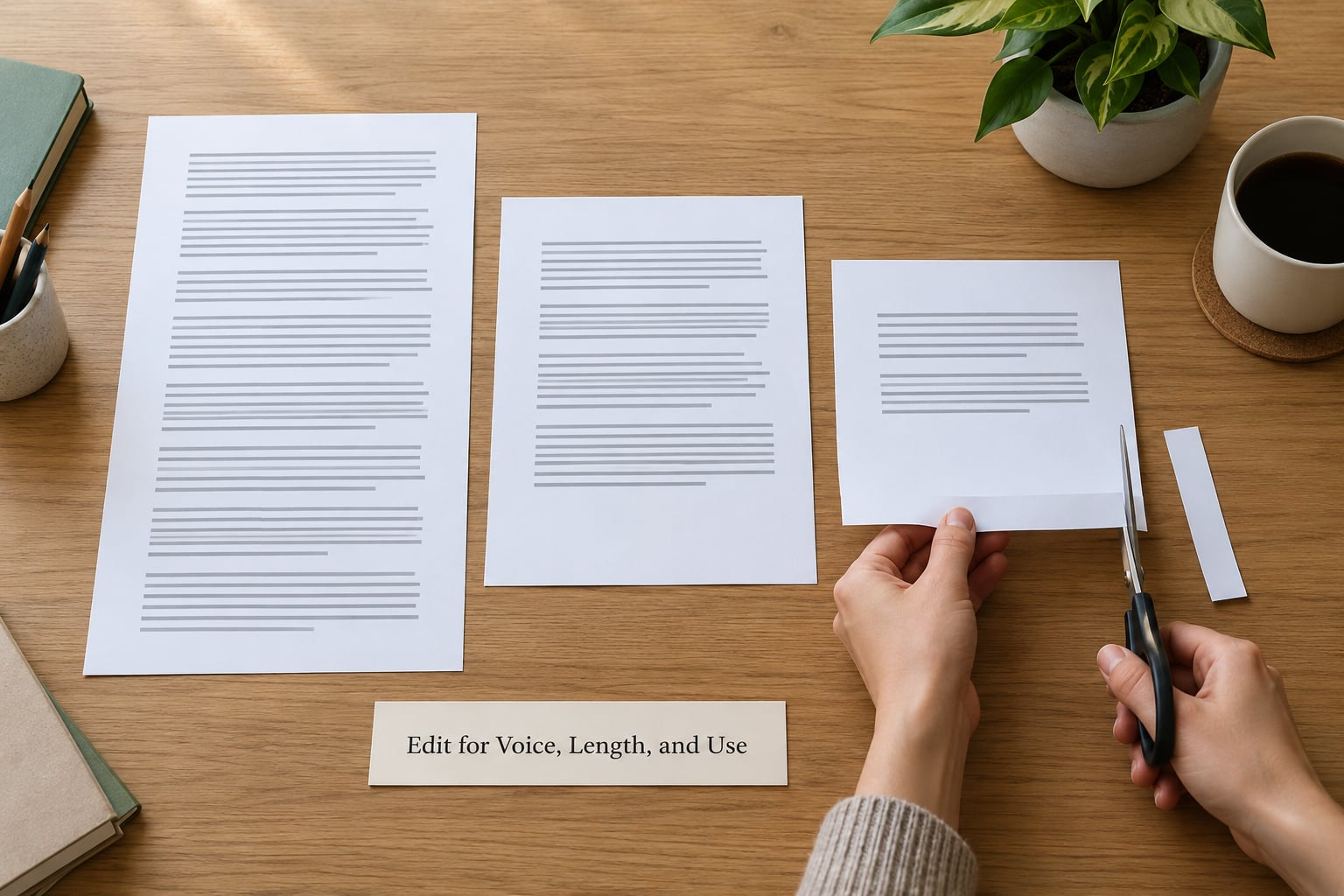
Read the draft out loud twice. Anything you stumble over, a reader will too.
Then cut. Strike every adjective you cannot defend with a fact: unique, authentic, groundbreaking, passionate, boundary-pushing. Replace “an experienced performer” with the number of shows. Delete any sentence that would fit unchanged in another artist’s bio, because it is doing no work.
Finally, build three versions and store them in one place:
- Short, about 50 to 100 words. Social profiles, festival applications, playlist submissions and quick email intros.
- Medium, about 150 to 250 words. Press kits, EPKs, booking queries, guest posts and local listings.
- Long, about 300 to 500 words. Your website about page, liner notes, grant applications and interview intros.
Write the long version first and trim down from it. Building upward usually produces padding.
Common Mistakes and How to Fix Them
These are the revisions that change a bio the most, in the order I make them.
Writing for everyone. A bio aimed at “music lovers” persuades nobody. Name one reader — a booking agent, a curator, a playlist editor — and write the details that reader needs.
Opening with praise. “Widely admired,” “critically acclaimed” and “a force to be reckoned with” are claims you cannot prove in a bio. Open with the identity sentence instead.
Listing everything. Every show, every band member, every festival application dilutes the one or two facts that matter. Choose the highlights and drop the rest.
Borrowed press language. Copying a stranger’s bio wholesale is the fastest way to sound generic, and it is obvious to anyone who reads many submissions. Use your own phrasing even when you are describing the same career.
Third-person stiffness. “She is a singer who has been singing for many years” reads like a form. Write it as plain sentences about the work, and let the third person carry itself.
Unsupported superlatives. “Biggest break of the year” needs a source or it needs to go. Credibility in this business is short-lived, and one inflated line can cost you the rest of the pitch.
Never updating it. Set a reminder to revise after every release, tour or new press mention. A bio listing a two-year-old single as your latest is a small mistake that reads as inactivity.
Frequently Asked Questions
How long should an artist bio be?
Match the length to the use. Keep 50 to 100 words for social profiles and playlist submissions, 150 to 250 words for press kits, booking emails and festival applications, and 300 to 500 words for your website about page, grant forms and liner notes. Write the longest version first, then trim it down. Reviewers rarely read past 150 words, so anything important needs to appear in the first two sentences.
Should an artist bio be written in the first person or third person?
Third person is the standard for press-facing bios, and it is worth knowing why. Journalists, DJs and curators lift sentences directly into listings and event copy, and third-person text pastes cleanly into a paragraph about someone else. First person works on your own website or in a first-person essay. The exception: some artists keep a first-person line as the opener, then shift to third person for the body.
How do I write an artist bio with no experience?
Lead with what you make and why, then use evidence you can actually document: releases, dates, venues, consistent output, workshops, open applications and self-initiated projects. Experience in this field is not measured in credentials alone, and self-taught artists regularly compete alongside graduates. Describe your practice honestly, name the influences you have studied, and say what you are working toward next.
What is the difference between an artist bio and an artist statement?
A bio is factual and outward-facing: who you are, what you have done, where you have shown it. A statement is interpretive and inward-facing: your ideas, process, research and meaning behind the work, usually in first person. Galleries and juries usually ask for both. If a submission asks for a biography, give dates, venues and achievements. If it asks for a statement, explain your thinking and your influences.
What is the 70/30 rule in art?
The 70/30 rule is a rule of thumb artists and galleries repeat to explain uneven outcomes: roughly 70 percent of sales or attention tend to come from about 30 percent of the artists working in a field. Nobody has measured it cleanly, so treat it as a description of the market rather than a law. The useful takeaway for bio writing is that visibility compounds for a small group, which is why specific details and named venues matter more than adjectives.
Should I use an AI bio generator to write my artist bio?
Useful as a drafting scaffold, weak as a final draft. Generators are good at assembling standard structure and at listing the elements a submission form expects. They cannot know your specific argument, and the output tends toward the same generic voice as everyone else using them. Generate a draft, then replace every sentence with something only you could write. If a line could appear in another artist’s bio, it is finished.
Conclusion
Start with one sentence that says what you make, what it sounds or looks like, and the detail that separates you from everyone else applying to the same inbox. Add concrete proof, name where you are heading, then cut everything you cannot defend.
Write the long version today and trim it into short, medium and long cuts this week, while the sentences are still fresh.