Most independent releases get ignored because the announcement buries the news under a paragraph of praise. Learning how to write a press release for a song means writing one page that answers who, what, when, where and why before an editor stops reading. The whole job takes an hour once you have your facts assembled.
The format has not moved in decades, and neither has the reason it works: editors want a source they can quote without calling anyone to check a date. What changed is the pitch around it. A private streaming link, a short personalised email and one polite follow-up decide whether your carefully formatted page ever gets opened at all.
Last updated October 2026.
Table of Contents
- What You Need
- Step-by-Step
- Start With a Clear Song News Angle
- Write a Strong Headline and Subheadline
- Build the Release Around an Editor-Friendly Lead
- Add the Song Details, Story, and Credentials
- Format and Proofread the Final Release
- Pitch Relevant Music Writers and Press
- How to Write a Press Release for a Song: Example
- Common Mistakes
- Frequently Asked Questions
- How long should a press release for a song be?
- When should I send a song press release?
- What should the subject line of a music press email say?
- Should I include a music video or streaming link in the press release?
- How do I get a song reviewed by music press?
- Can I send the same press release to multiple publications?
- Conclusion
What You Need
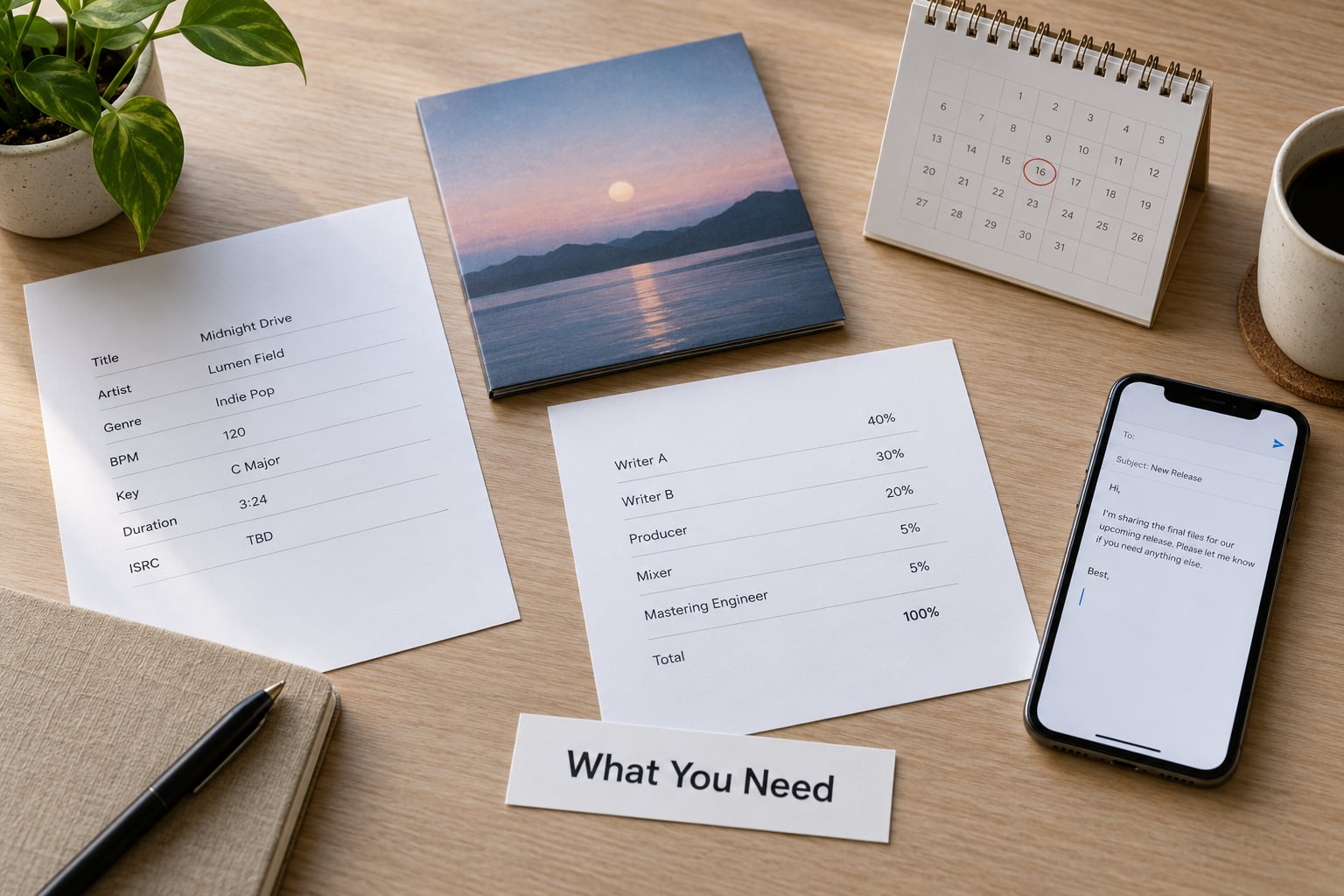
Drafting starts long before you write a word. Gather these first and the release itself takes about an hour.
- Song and release facts: exact title in quotation marks, artist name as it appears on the distributor, release date, single versus EP versus album, track runtime, and the genre you would actually call it.
- Distribution details: distributor name, label or imprint spelled exactly as registered, ISRC for the track if you have it, and whether the release is flagged explicit.
- Credits: producer, co-writers, featured artist, engineer, mixer and masterer. Check every spelling of a collaborator’s name twice.
- Approved artwork: the final cover in high resolution, at least one press photo, and credit lines for both the photographer and any illustrator.
- Your news angle: one sentence explaining why this song matters right now. First release, a milestone, a feature with someone an editor already follows, an album anniversary, a tour announcement, an award nomination.
- Private streaming link: a Bandcamp or SoundCloud page that does not expire, plus your public links for Spotify for Artists and Apple Music for Artists. Press never wants a file they have to download.
- Contact block: one name, one phone number, one email address you check during working hours. Not three managers, not a booking agency form.
- Your electronic press kit: a single page holding the bio, photos, artwork, credits and links, so a journalist who wants more does not have to email you for it.
Step-by-Step
Here is the order that works. Each step sits in the same place on the page, top to bottom, so an editor who lands halfway down still finds the parts they need.
Start With a Clear Song News Angle
Every release announcement needs one reason to exist beyond “here is a new song”. That reason is the angle, and it decides what the headline says and which editors you pitch. A debut single from an artist who has never released music is news for a local paper. A record-breaking streaming milestone is news for a trade blog. A guest vocal from someone with a recognisable audience is news for anyone covering that artist.
Write the angle as one plain sentence before anything else. If you cannot finish it in one sentence, you have two angles, and the release will read like mud. Artists who announce everything at once usually get nothing, because a journalist covering new hip-hop has no reason to run a post about an unrelated soul record.
Write a Strong Headline and Subheadline
The headline names the artist, the title and the angle, and it stays under about 120 characters. A subheadline underneath adds the detail the headline had to drop: release date, where it is out, and any context an editor needs to judge relevance.
Compare these two. “New Single Out Now” tells an editor nothing except that someone released music, which is roughly 40,000 releases a day. “Chicago artist Drea Nolley releases debut single Half-Light on 8th, recorded in a single take in a converted garage” gives them the artist, the city, the record, the type of record and a specific detail worth writing about. Weak headlines get skimmed. Specific ones get opened.
Skip every word that could sit on any other release: groundbreaking, incredible, essential, must-hear. If the music deserves those words, a sentence of fact will prove it better anyway.
Build the Release Around an Editor-Friendly Lead
Open with “FOR IMMEDIATE RELEASE” in the top left, or an embargo line such as “EMBARGOED UNTIL 9:00 AM ET, OCTOBER 17”. Directly beneath it, put the contact block: name, phone, email. Editors check who to call before they read anything else.
Then the dateline: city, state, and date in full, like “CHICAGO, Ill., Oct. 1, 2026“. A dateline tells an editor where the news is happening, which is how they decide whether you are local news or a national item. If the release is out everywhere, use the artist’s city anyway rather than a blank.
The first paragraph carries the five W’s and nothing else. Who the artist is, what the record is, when it arrives, where it is available and why it exists right now. Keep it to two or three sentences. Forum discussion among working musicians lands on the same point repeatedly: journalists read the top third of the page and the first two lines of the email, so anything you bury there might as well be gone.
Add the Song Details, Story, and Credentials
The second paragraph is where the story lives, not the sales pitch. What happened, what shaped the record, what you set out to do. Artists with no press mentions and small streaming numbers often over-hype here because they feel they have nothing credible to offer. The fix is specificity: a producer credit, a real number from a real room, a scene, an influence, a first-listen story. Details beat adjectives every time.
Add one third-party quote when you have it, and only when you have it. A producer, an engineer, the person on the featured vocal or a venue booker can all speak on record, and a named outsider carries weight that self-praise never will. Attribute it to the person and their role, not to “a producer”. If there is genuinely no quote available, leave it out rather than inventing one.
Finish with a short artist biography: three or four honest sentences on where you come from, what you have done and what this release means. This boilerplate gets pasted into the story, so write it to be lifted cleanly. If your only credential is that nobody has ever heard of you yet, say that too and name the scene, the hometown and the rooms you have played.
Close the details block with the essentials an editor copies verbatim: release date, distributor, credits, and streaming links. Then add the call to action, which should be a specific request rather than a vague “please support”. Premiere, review, interview, roundup inclusion or playlist consideration are all reasonable asks, and asking for one of them gets a reply far more often than hoping for anything.
Format and Proofread the Final Release
One page is the hard rule, roughly 350 to 500 words. Anything longer gets skimmed and anything shorter usually means something is missing.
Keep the page boring in the right ways. Your name and contact details at the top, headline, subheadline, the body, a boilerplate paragraph marked “###” or ending with “# # #”, and the media contact repeated at the bottom with any required credits for photos. Use consistent capitalisation for track titles, one date format throughout, and spell the label and distributor the same way in every document.
Send two versions: a clean plain-text file and a PDF on your letterhead or with your logo at the top. A PDF with your mark and contact details looks professional; a text version survives being pasted into an email. Before either goes out, open every link on a phone rather than a laptop, and confirm each one loads on first click. A broken smart link costs more coverage than a mediocre paragraph ever will.
Read the draft aloud. Anything you would not say out loud to another person is probably filler. Also read it as someone who has received four hundred releases this week and ask whether yours earns the second paragraph.
Pitch Relevant Music Writers and Press
The document does not sell itself. Research outlets that already cover your genre, your city or the artist you collaborated with, read their recent pieces, and find the journalist who writes them. Then send a short email: one line on why this song is for them specifically, two or three on the record, the private link, and one clear request. Around 150 to 250 words is the working range most artists land on.
Never mass-send. Artists in music marketing communities describe the flood of untargeted release announcements as the single biggest reason their inbox fills with deletions, and they are right. Ten well-matched writers will beat two hundred blind sends, and the ones you build a relationship with before release day are the ones who answer later.
Send Tuesday through Thursday in the morning, and allow around three weeks before release day so an editor can plan space. If nobody responds, follow up once after a week with something new attached, then stop. Three contacts is the polite limit.
Track it in a simple spreadsheet: outlet, journalist, date sent, angle pitched, request type, response date, result. This takes two minutes per send and saves you from following up twice on the same person.
How to Write a Press Release for a Song: Example
Below is a complete release for a fictional independent hip-hop artist. Every line is there so you can see where a piece sits and why it is worded the way it is.
Press release format example — fictional artist and label:
FOR IMMEDIATE RELEASE
Contact: Drea Nolley, management | (312) 555-0148 | [email protected]Chicago producer Drea Nolley releases debut single “Half-Light on 8th,” recorded live in one take in a converted South Side garage
New single arrives 2026 on all streaming platforms through Firestone Records
CHICAGO, Ill., Oct. 1, 2026 — Chicago-based producer and rapper Drea Nolley today announced “Half-Light on 8th,” her debut single under Firestone Records, set for release on 2026. The track was recorded live, start to finish, in a single take inside a converted two-car garage on the South Side, with no edits and no additional overdubs.
Nolley built the track around a live drum loop from her grandfather’s house, layered with a detuned upright bass and a four-bar piano figure she wrote at 4 a.m. The recording process, not the subject matter, is the point of the song: it is about how a place sounds when nobody is performing in it.
“I wanted the whole song to feel like one long breath,” Nolley said. “The first time we played it back, we all just sat there. We kept that take because everything after it felt worse.”
“You can hear the room in it,” said engineer Rafael Ibarra, who mixed the track. “That is the hardest thing to fake and the first thing people notice.”
“Half-Light on 8th” was written by Drea Nolley and produced by Drea Nolley, mixed by Rafael Ibarra, and mastered by Sunita Bhatt. The release includes an instrumental version and an alternate edit.
###
About Drea Nolley
Drea Nolley is a Chicago producer and rapper working between beatmaking and live band arrangements. She has performed at three city showcases in recent years and produces for a small roster of local rappers. “Half-Light on 8th” is her first official release under Firestone Records.Press contact: Drea Nolley, management | (312) 555-0148 | [email protected]
Private streaming link: [Bandcamp link]
Electronic press kit and press photos: [EPK link]
Notice what is missing. No claim that the song is the best thing out this month, no invented first-week numbers, no quote from a writer who never reviewed it. The credibility comes from details an editor could verify, which is exactly what makes the release usable.
To adapt it, keep the skeleton and swap the facts: your headline structure, your dateline city, your real quote, your real credits, your real contact. If you have no press quotes at all, use the same release and simply leave the quote paragraph out. A well-written single-source release gets read; a padded one does not.
Common Mistakes
Leading with vague praise. “Highly anticipated,” “genre-defying” and “raw talent” mean nothing to an editor. Fix: start with a fact, then let the music argue for itself.
Burying the news. If the release date is in paragraph four, the headline should not have been vague. Fix: the five W’s belong in the first two sentences, and the headline already told them the rest.
Too many adjectives. Three descriptions of the same song is one too many. Fix: describe the sound with specifics instead, such as live recording, key change, tempo, instrumentation or a guest credit.
Turning it into a biography. The boilerplate belongs at the bottom in three or four sentences. Fix: cut the life story from the body and keep the story to what the song is and why now.
Mass-sending one release to everyone. A pitch with no reference to the outlet reads as noise, and writers say so plainly. Fix: research ten outlets, mention something specific from each one, and send ten versions.
Making claims you cannot prove. Fake first-week numbers, invented chart positions and quotes nobody said will surface, usually in a bad way. Fix: only publish what you can show, and leave the rest out.
Attaching files instead of links. Journalists open links; they rarely download attachments from strangers. Fix: send a private Bandcamp or SoundCloud link that never expires, plus your EPK page.
Sending too late, or following up three times. An editor working on a features well needs three weeks. Fix: start roughly three weeks out, send Tuesday to Thursday mornings, follow up once.
Frequently Asked Questions
How long should a press release for a song be?
One page, which works out to roughly 350 to 500 words. That is enough for a headline, a lead paragraph with the five W’s, one story paragraph, an optional quote, a short bio, release details and a contact block. If it runs onto a second page, tighten the biography and the adjectives before you cut any release facts.
When should I send a song press release?
Start outreach around three weeks before release day so an editor can plan space, and send on a Tuesday, Wednesday or Thursday morning. Avoid Monday, when inboxes are full after the weekend, and Friday, when most desks are already winding down. If the story needs an exclusive, hold it for one outlet first and offer the rest an embargoed version.
What should the subject line of a music press email say?
Use the artist name, the release title and one specific detail, then the request: “Drea Nolley, debut single recorded in one take — review or premiere request.” Keep it under about 60 characters where you can. Avoid “CONCERT INVITE” and generic announcements, since untargeted subject lines are the fastest way to be marked as spam.
Should I include a music video or streaming link in the press release?
Yes, and link it in the details section rather than describing it in the headline. Use a private streaming link on Bandcamp or SoundCloud that does not expire, plus your EPK page for photos and artwork. Send a live link instead of an attachment, and test every link on a phone before you send so nothing fails on first click.
How do I get a song reviewed by music press?
Pitch ten or fifteen writers who already cover your genre, scene or city, and mention something specific from a piece they wrote. Ask for one clear thing: a review, a premiere, an interview or roundup inclusion. Follow up once after a week with a new detail attached, then stop. Artists with no press mentions and no numbers do best with the story behind the record, not with bigger claims.
Can I send the same press release to multiple publications?
The document itself, yes. Send the same PDF and plain-text version to every outlet on your list, since it is written for editors in general. The email must change every time: one line on why this song suits that outlet, and the request you want. Identical emails across a hundred outlets get filtered and mark your address as a spam source.
Conclusion
Learning how to write a press release for a song comes down to three decisions: pick one verifiable news angle, gather the approved details before you open a document, and lead with a first paragraph that gives an editor the whole story in two sentences. Everything after that is formatting, and formatting is the easy part.
Write the angle on one line first. If you can do that, the rest of the release writes itself, and your odds with an editor improve more from a specific headline and a working link than from any amount of hype.