Hybrid rap vocals are a delivery style that puts spoken-rhyme rapping in the verses and genuinely sung, pitch-led melody in the hooks and pre-choruses, with both halves sitting tight in the pocket of the beat. Learning how to sing rap hybrid vocals comes down to one clean lead take, then layering doubles, harmonies and light pitch correction on top.
This guide is for rappers who want to carry a song through a sung chorus, singers who want a harder verse, and home producers who keep hitting the same wall: the verse sounds great and the hook sounds thin and lifeless. A full session usually takes two to three hours the first time, mostly because of comping and layering rather than tracking.
You do not need to be a trained singer to do this. You do need to know which section of your song gets which delivery, and you need to stop treating the whole record as one performance. That is the switch most guides skip, and it is the part that decides whether the track sounds intentional.
Table of Contents
- What You Need
- How to Sing Rap Hybrid Vocals: Step-by-Step
- Common Mistakes
- Frequently Asked Questions
- Do I need to be a good singer to record rap hybrid vocals?
- What equipment is enough to record rap hybrid vocals at home?
- Should I record the rap and singing parts together or separately?
- How do I make rap vocals sound more melodic without losing their edge?
- What is the best way to add harmonies to a rap song?
- How much reverb and tuning should I use on hybrid vocals?
What You Need
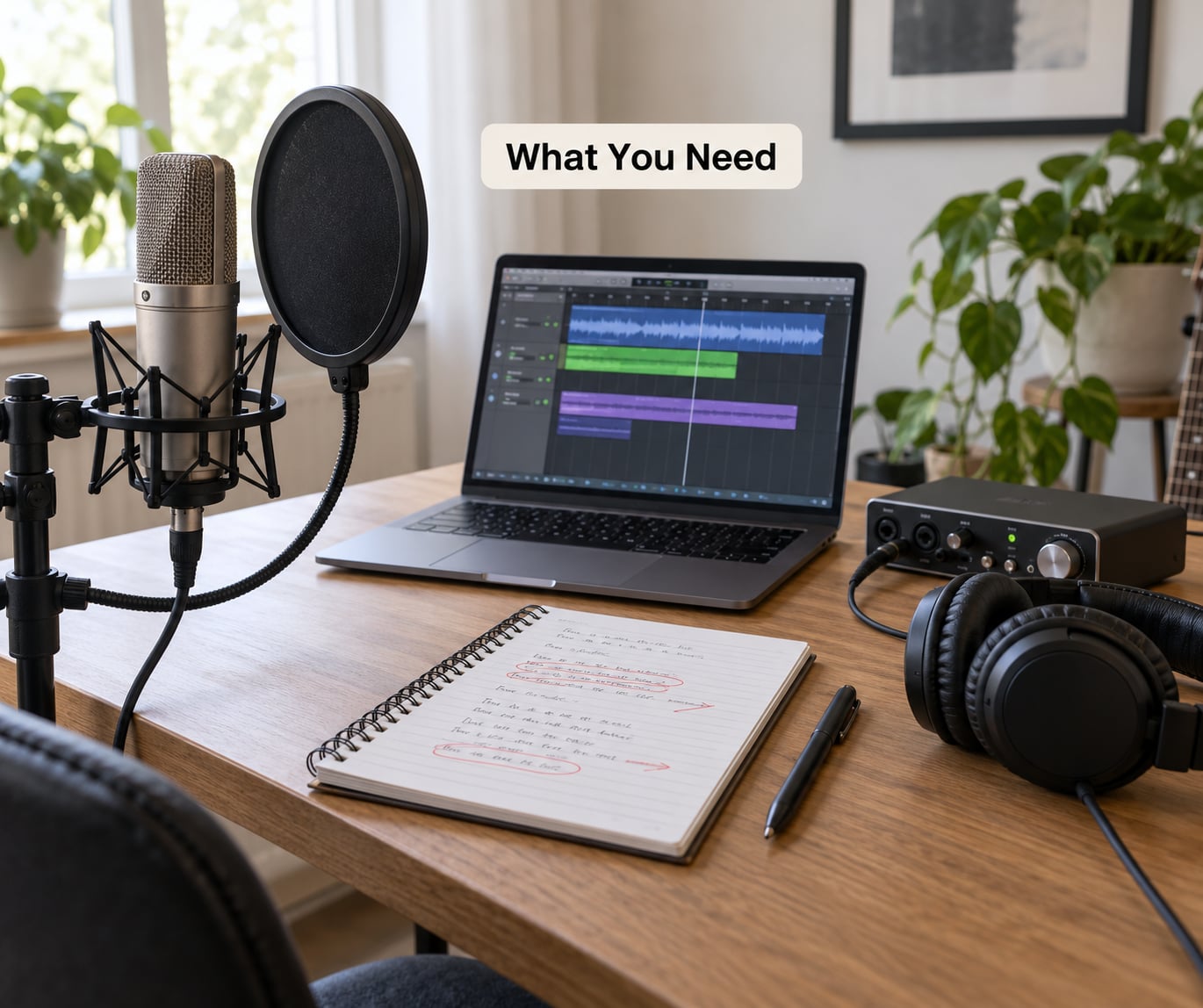
Here is the honest version: the performance decides the result, and the gear only protects it. Plenty of records with huge budgets still have flat hooks because nobody did the prep work below.
- A lyric sheet marked up with delivery notes. Write S for sung, R for rapped and H for half-sung next to each line before you record anything. This single page prevents most of the confusion people hit in the booth.
- A reference track. One song that already has the rap-to-sing blend you are chasing. Play it four or five times before you record so you know the target by ear, not by memory.
- A microphone you can grow with. A large-diaphragm condenser captures the sustain and air that make a sung hook sit forward. A decent dynamic works if your room is untreated, which most rooms are.
- Closed-back headphones. You need them to hear the beat bleed without an open pair leaking the vocal into the mic.
- An audio interface with real gain. Clean headroom matters more than anything else at this stage. A noisy preamp gets tuned later and sounds worse forever.
- A DAW with clip gain and comping. Any of the major ones handle this fine. You are editing audio, not doing advanced routing.
- A pop filter for the sung lines. Plurals, sibilance and hard consonants are far louder when you are sustaining vowels, so a filter saves you from taking the take again.
- A room that is not a mirror. A closet full of clothes beats a bare bedroom with hard walls. Hang anything soft if a duvet is all you have.
- Optional: a pitch-correction plugin such as Melodyne or Auto-Tune for the hook, plus a doubling or harmony track you can record yourself.
How to Sing Rap Hybrid Vocals: Step-by-Step
Work through these in order. Skipping to the mixing step before the lead take is clean is the reason most home hybrid vocals sound thin.
1. Map the Rap and Singing Sections
Decide the delivery mode for every section before you sing a note. Most hybrid records follow a simple pattern: rapped verse, half-sung pre-chorus, fully sung chorus, and a bridge that flips back to rap for contrast.
| Section | Typical delivery | Why |
|---|---|---|
| Intro | Rapped or half-sung | Sets the pocket before the melody arrives |
| Verse | Rapped, chest placement | Holds lyric density and contrast |
| Pre-chorus | Half-sung, rising contour | Builds tension without spending the hook |
| Chorus | Fully sung, sustained vowels | The memorable part, layered with doubles |
| Bridge | Rapped or conversational | Resets the ear so the final chorus lands |
Look for the emotional lift. The beat switch, the drum fill, the key change, the moment the snare drops out. That is where the mode usually flips, and if you pick the flip on a musical cue rather than on a whim the transition stops sounding random.
One rule I use: never sing two full sections in a row unless the artist you are imitating does it. Two sung sections back to back gives the listener no contrast to rest against.
2. Record a Clean Lead Vocal
This is the take everything else gets built on, and it should be boringly accurate rather than impressive. Set your mouth about a fist’s width from the pop filter and stay there for the whole song.
Three things to get right:
- Distance. Roughly four to six inches, close enough to get low-mid weight without stepping into the sibilance. Moving around mid-take is the single most common cause of a vocal that won’t sit still in the mix.
- Gain. Set it so your loudest moment leaves 6 to 10 dB of headroom. Rappers usually push too hard because the mic is treated like a stage mic, and clipping kills every mix decision after it.
- Breath. Take the breath before the bar, not inside it. Rushing to fit words into a bar that already has too many syllables is the number one beginner complaint on recording forums, and the fix is cutting syllables, not speeding up.
Record at least three complete takes. Your first is a warm-up even when it felt good. Listen back with headphones on and mark the lines where the diction slipped, the volume jumped, or the tone got thinner.
A usable lead vocal has clear diction, consistent level, a stable tone and no obvious clipping. If you cannot hear those four things, the problem is performance, not plugins. Fix it before touching anything else.
3. Add Melodic Doubles When Singing Rap Hybrid Vocals
Doubles are the fastest way to make a hook sound like a record instead of a demo. Record the same melodic phrase again with a stronger singing tone, a slightly different attack, or a register a step above.
Three places doubles work best:
- On the hook’s long vowels. Double only the sustained lines. Doubling the whole chorus muddies the consonants and the hook stops being clear.
- As a soft octave. Sing the melody an octave down underneath at lower volume. It adds weight without competing for the center.
- On the last line of a verse. One sung repeat where the verse ended rapped gives the section a lift and signals the chorus is coming.
Leave space on purpose. If the verse is forceful, the chorus does not need four vocal layers on top of it. Sparse arrangements let the rap stay aggressive, and that contrast is what makes the sung section hit.
Pan doubles just a touch wider than the lead, roughly nine o’clock and three o’clock, and pull their level a few dB under. If you can tell the double is there, it is too loud.
4. Build Harmonies Around the Hook
Start with thirds, sixths and octaves, and only where the melody already has room. Stack a third above the lead for brightness, a sixth below for a darker color, or an octave for width.
Match your vowels, not just your notes. If the lead sings an “ah” and the harmony slides to “eh,” the pitch correction will chase the difference and the layer will wobble through the whole bar.
Keep the main melody in the center and treat the harmony as a wash. On a rap verse, harmony is usually the wrong choice entirely. Use a call-and-response layer instead, singing the hook’s last four words after the rap line ends. It fills the pocket and reads as intentional.
5. Tighten Timing and Tune the Performance
Comp first, tune second. Slice the take into four-to-eight bar blocks, keep the best version of each, and line up the transients against the beat before any pitch work starts.
Micro-timing is the quiet craft here. A hook can sit a few milliseconds behind the beat and sound heavier, and a rapped line pushed slightly ahead of the snare can feel like it is pushing the song forward. Move each layer by ear, in small increments.
Then tune. What Auto-Tune settings should you use for hybrid vocals? Rap lines want slow correction, around 25 to 40 ms retune speed, so the pitch slides naturally between notes and the consonants keep their snap. Sung hooks can go faster, 60 to 80 ms, so sustained notes lock into the key.
| Setting | Rapped verse | Sung hook |
|---|---|---|
| Retune speed | 25-40 ms | 60-80 ms |
| Humanize | High | Medium |
| Formant shift | 0 | Optional, 0 to +2 |
| Drift and detail | Low | Medium |
Add gentle compression after the performance is right, not before. Pull the level even, then leave the consonants in front. Correcting a rushed verse will not fix the rushing, and it makes the vocal sound mechanical on top.
6. Mix the Rap and Singing for One Sound
The best mix of rap and sung vocals is a balance problem, not a volume problem. Sit the rapped verse around 1 to 2 dB under the sung hook so the melody stays the focal point without the verse feeling buried.
A short plate reverb or a tight delay on the hook layers will glue the doubled and harmony tracks together. Keep the return low and the pre-delay on, around 30 to 60 ms, so consonants still cut through.
Avoid reverb on the rap verses. It smears the transients and takes the weight out of the low end that makes rap sound solid. High-pass any layered vocal around 100 Hz, tame sibilance with a de-esser, and sidechain the hook layers gently to the kick when the beat needs the space.
Reference the track against your session at a normal volume. If the rap and the singing sound like two different artists, the level, tuning or placement is off somewhere, and the fix is in the lead performance rather than the plugins.
Common Mistakes
Forcing every line to sing. If your voice is not built for sustained high melody, sing lower and lean into a darker register. Push up into strain and the take is unusable no matter what you do to it later.
Recording with an unstable mic position. Drifting a few inches between lines changes level and tone enough to force heavy correction. Mark your position on the pop filter with tape and come back to it every take.
Over-tuning. Fast correction across the whole verse is why many rap vocals sound robotic. Slow the retune on the rapped parts and let the pitch move the way a voice actually moves.
Too much reverb. Reverb on a rapped verse blunts the consonants that make the lyric audible. Send only the sung and doubled layers to a short plate or slap delay.
Letting layers compete. Every added harmony, double and ad-lib takes up space the hook needs. Cut a layer, listen, and add it back only if the hook got stronger.
Poor breath support. If you run out of air four bars from the end, the verses are too dense or the breath is too loud on mic. Rehearse the exhale quietly and take it in the gap before the bar.
Editing too aggressively. Chopping every syllable produces a vocal with no groove. Comp in blocks, leave small breaths in, and cut syllables in the writing stage instead of the edit stage.
One last habit worth keeping: record the hook first, even out of order. Once you know exactly how the chorus sounds, you know what the verse is arguing against, and the rap delivery usually improves on its own.
Frequently Asked Questions
Do I need to be a good singer to record rap hybrid vocals?
No. Most hybrid hooks sit in a comfortable chest or mixed-voice range, and the tuning step smooths small inaccuracies. What you do need is a melody you can sustain for a full phrase without strain. Pick a key you can hold for eight counts, record it flat and dry, and decide if it feels like your voice before you add any effect.
What equipment is enough to record rap hybrid vocals at home?
A large-diaphragm condenser or a decent dynamic microphone, closed-back headphones, an interface with clean gain, a pop filter and any DAW will cover it. A treated corner and a soft surface behind the mic matter more than an expensive mic. Pitch correction and doubling tracks are helpful second-stage upgrades, not requirements for the first record.
Should I record the rap and singing parts together or separately?
Separately. Rap and sung sections place the voice in different positions, and switching modes mid-take tends to change your level and tone halfway through the song. Track all the rap in one session, then all the sung parts in another. Bring a clean mental memory of the hook with you into the verse session so your delivery still argues against it.
How do I make rap vocals sound more melodic without losing their edge?
Keep the rhythm and the consonants and add pitch contour only where the beat gives you room. A common move is rapping the verse normally, then half-singing the final two lines and the hook with sustained vowels. That keeps the diction sharp and the flow intact while giving the listener somewhere to rest. Doubles on the sung lines add polish without softening the verse.
What is the best way to add harmonies to a rap song?
Harmonies belong on the sung material, not the rapped verse. Use thirds or sixths above and below the lead hook, match the vowels exactly, and keep the main melody in the center of the stereo image. On a verse, a call-and-response layer or a single octave double underneath usually serves the pocket better than stacked intervals.
How much reverb and tuning should I use on hybrid vocals?
Keep the send low on both. A short plate or slap delay with a 30 to 60 ms pre-delay is enough to glue the hook layers, and almost none of it belongs on the rapped verses. For tuning, use roughly 25 to 40 ms retune speed on rap lines and 60 to 80 ms on the sung hook, then compress gently to even out the level.
Start with the map, not the microphone. Mark every section R, S or H, record the hook first in a key you can hold, then go back and lay the rap over it knowing where the contrast lands. Everything else on this list is a detail on top of that decision.