Knowing how to get your first DJ gig comes down to proof and relationships. Promoters hire people they have watched work or heard sound credible, so you build a small live track record first, then pitch with a short demo and one specific reason they should want you. Most beginners land something within four to twelve weeks of steady effort, and plenty of working DJs started in their late twenties or beyond.
This guide walks the whole route, from gear and rehearsal to the pitch email, the set you build, and the follow-up that turns one date into a recurring slot. It also covers the question nobody asks out loud, which is what a first booking actually pays.
Table of Contents
- What You Need Before You Pitch Anyone
- Step-by-Step: How to Get Your First DJ Gig Booked
- Step 1: Build a Repertoire That Works for One Venue
- Step 2: Practice a Complete 30-Minute Set
- Step 3: Record a Demo Mix Promoters Will Finish
- Step 4: Get Live Proof Before You Pitch for Money
- Step 5: Research Venues and Promoters by Difficulty
- Step 6: Make a Simple Booking Package
- Step 7: Reach Out and Follow Up to Book Your First DJ Gig
- Common Mistakes That Stall Beginners
- Frequently Asked Questions
- Conclusion: Start This Week
What You Need Before You Pitch Anyone
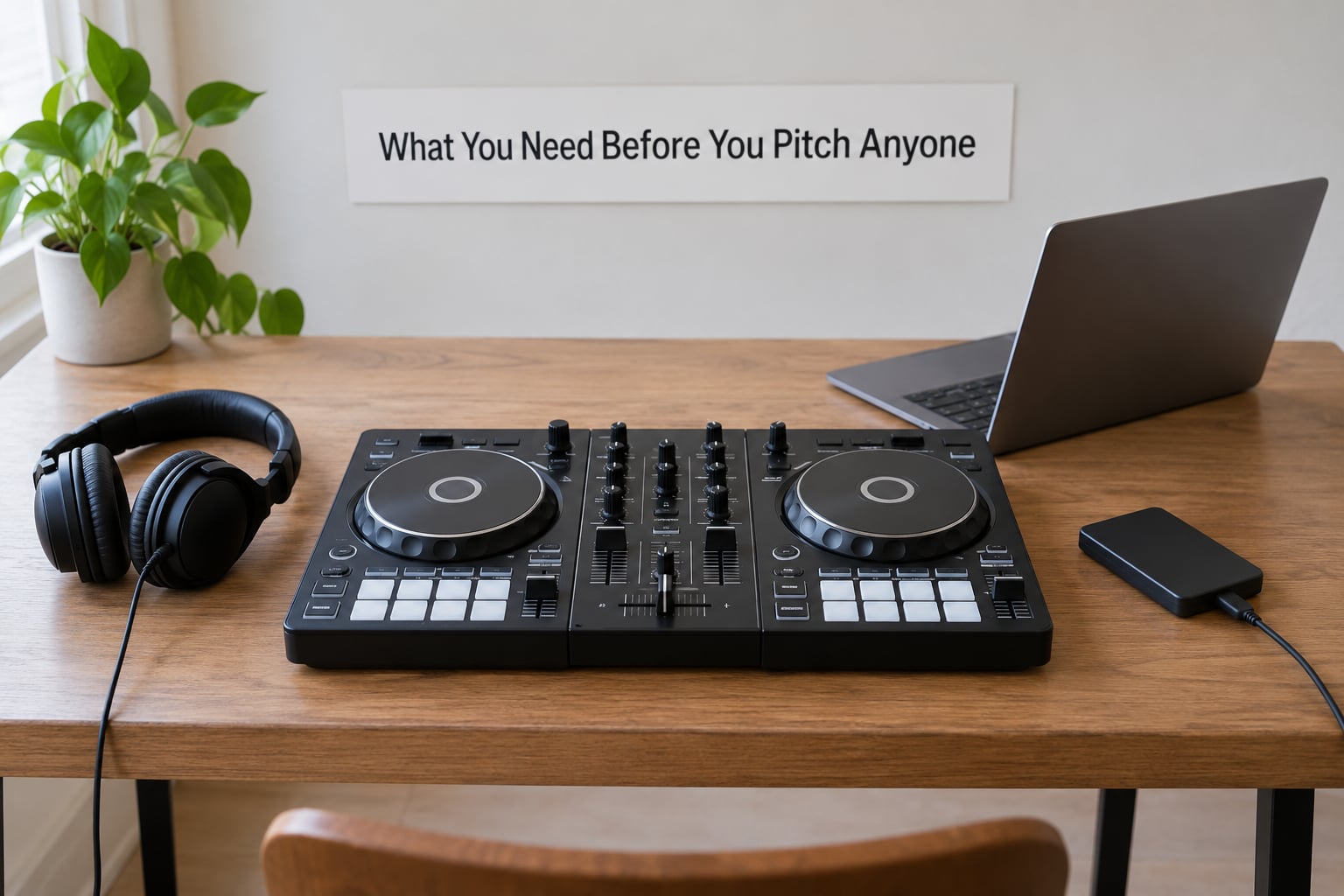
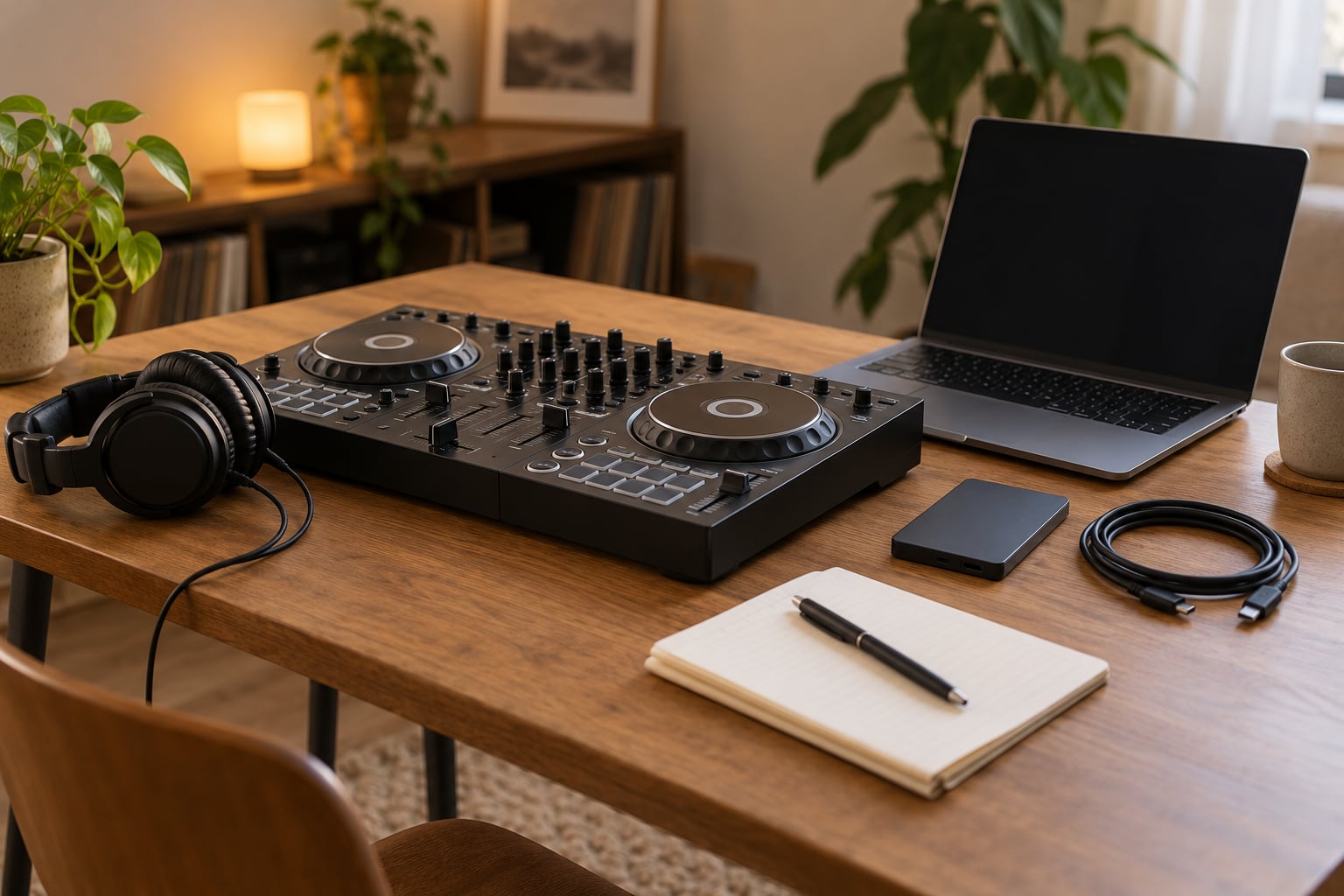
Start with the smallest kit you can control well. A two-channel controller, a decent pair of closed-back headphones, and a laptop running whatever software you already know will get you through a bar gig this month.
- One setup you know blind. Buttons, not a new controller on the night. Cue and play with your eyes closed.
- Headphones you trust. Closed-back and comfortable for two hours. These are how you cue, blend and check your mix.
- Music that fits one venue. A focused collection beats a huge library you never finish sorting.
- A second way to play. A spare stick, a backup laptop, or both. If the venue player dies mid-set you still have music.
- A finished demo mix. Twenty to thirty minutes, recorded properly, no long introductions.
- Contact details that look professional. One email address you check every day, plus a profile page with your mixes.
- A written set plan. Slot length, arrival time, sound check, and how the energy should move.
Ask venues what they provide before you buy anything else. A lot of bars and small clubs hand you a CDJ pair or a Denon player with a two-channel mixer, plus the cables, so you can arrive with nothing but headphones and your music.
One more piece of prep matters more than any gadget: know your slot. A warm-up set is two hours of building, mostly low and mid energy, where people are still arriving. Peak time is the loudest, most crowded hour of the night. Your first gig will almost certainly be the warm-up, and knowing that in advance removes half the nerves.
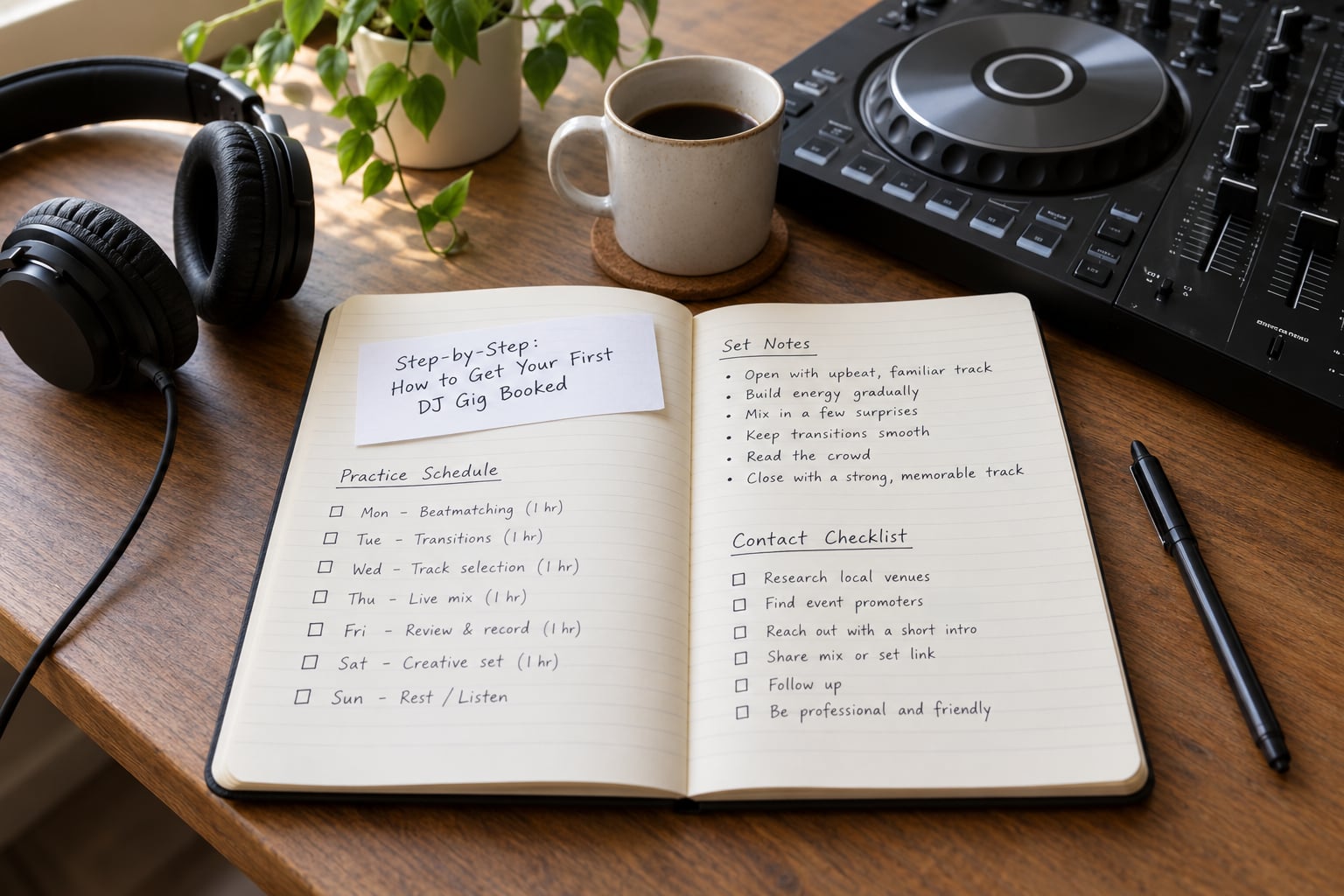
Step-by-Step: How to Get Your First DJ Gig Booked
| Phase | Goal | What you do |
|---|---|---|
| Weeks 1 to 4 | A rehearsable set | Narrow your music, build one 30-minute set, record it |
| Weeks 3 to 8 | Live proof | Open deck nights, house parties, bar volunteering, mix competitions |
| Weeks 6 to 12 | A booking | Target off-peak nights, pitch owners and promoters, follow up twice |
Work the steps in order. Skipping to the pitch is what gets a demo ignored, because there is nothing behind it yet.
Step 1: Build a Repertoire That Works for One Venue
Pick one type of night and learn its music properly. If you want house, learn the last three years of house records people actually dance to, not every genre you have ever downloaded.
Work out who is in the room, when they arrive and when they leave, and how loud the room can get. A Tuesday bar slot at 10pm and a Saturday club at midnight are different sets, even with the same tracks.
You know this step worked when you can name the venue type you are aiming at and your music fits it without you arguing with yourself during practice.
Step 2: Practice a Complete 30-Minute Set
Most beginners practise mixing tracks. You need to practise a set: an opening that matches the room, a middle that shifts energy, and an ending that leaves the DJ position cleanly rather than fading out mid-track.
Set cue points and hot cues on every track you plan to use, tag them, and note the key. Export a backup copy of the crate to a second drive the night before.
You know it worked when you can run the whole 30 minutes without stopping, and when the backup file exists even if you think it is unnecessary.
Step 3: Record a Demo Mix Promoters Will Finish
Record 20 to 30 minutes. Long enough to show range, short enough that a promoter finishes it. Drop long intros, dead air, and any stretch where nothing happens.
Let the music introduce itself, get to the mixing early, and show personality in track choice rather than effects. Clean transitions and a set that moves matter far more than a trick you can only do once.
Post it in a place with a real player, tag the genres, and write two lines about yourself. Check the link on your phone before you send it to anyone.
Step 4: Get Live Proof Before You Pitch for Money
This is where most beginners stall. A polished demo says you can mix; it does not say you can read a room or recover when a track fails. So get in front of people while the stakes are low.
Look for open deck nights, where a venue hands the booth to whoever signs up, bar and restaurant shifts where the owner hears you play, house parties, and local mix competitions. Forums like r/Beatmatch and DJ TechTools are full of people who landed their first paid slot through exactly this route.
One beginner I read about worked as a bartender at a sports bar, learned on the house player, played 30-minute sets, and was offered the Tuesday slot. That is the fastest route most people find, because the owner is already watching you.
You know it worked when at least one person who is not a friend has heard you play a full set.
Step 5: Research Venues and Promoters by Difficulty
Not all bookings are equal. Start where a beginner can succeed, then climb.
| Venue type | Typical first-gig fee | How it is usually paid | What they provide |
|---|---|---|---|
| Open deck night | Nothing | Free slot | Booth and player |
| Weekday bar or sports bar | About 80 to 150 USD for four hours | Cash on the night | CDJ or Denon players, mixer, booth |
| Student or club open-mic night | Nothing to 50 USD | Cash or voucher | Full booth and sound |
| Private party or wedding | About 150 to 400 USD for four hours | Half up front, half on the night | Usually you bring your own setup |
| Club warm-up slot | About 100 to 250 USD | Bank transfer or cash | Full booth and sound engineer |
| Peak-time club headline | 300 USD and up | Contract or transfer | Full booth and engineer |
Treat these as typical US ranges rather than a rate card. Region, city and the size of the room move them, and rates change, so confirm the figure in writing before you agree to a date.
Search for venues that already book DJs, check who is on their calendar, and read what their regulars post about the night. Look at the room size, the sound system, and whether they have a working mixer. A promoter who answers those three questions in one message is a promoter who respects the work.
Step 6: Make a Simple Booking Package
Keep it to one page in the email body. Five things: two short lines about who you are, a link to your demo mix, the genres and formats you play, the gear you can cover, and your availability plus expected rate.
Write it to one specific venue. Mention the night they run, the slot you want, and why that night suits what you play. A promoter who runs a warm-up-friendly Monday night and gets a message about exactly that reads as someone prepared, not someone blasting a template.
There is one thing experienced promoters say again and again: do not send an unsolicited mix link. They get dozens. If you want them to hear you, ask how they prefer to review applicants, and enter the mix competition they run instead.
A short version, if you are messaging rather than emailing:
Hi, I’m Sam, a house DJ based in the area and I build sets for relaxed early-hours rooms. I saw you run the Monday session and I think that slot suits what I play. Here’s a 25-minute demo and a short intro. Would you be open to a trial set on a date in the next month? Happy to bring my own controller and cables.
You know it worked when a promoter replies with a question about your availability or your music, rather than nothing at all.
Step 7: Reach Out and Follow Up to Book Your First DJ Gig
Send ten targeted messages a week to venues that fit your style. Ten is enough to be a nuisance-free regular presence and small enough to stay personal. Reply to gig listings, ask the specific questions above, and follow up once after a week and once after three.
No response usually means no, not not yet. Move on, and keep showing up at the venue as a customer.
On the night, arrive early, do the sound check, watch the room for the first ten minutes and start lighter than you think. Finish on time even if the room is peaking, because the promoter is standing right there watching how you handle the end of a set.
Within a day, thank the promoter and the venue, ask what they would change about the set, and send one thing you will do differently next time. Then ask for a specific date. A resident DJ is someone a venue books regularly, and the only way to become one is to keep showing up and asking.
Common Mistakes That Stall Beginners
- Waiting until you feel expert. Nobody feels expert. Set the bar at a clean 30-minute set and start playing; fix the rest in front of a crowd.
- Cold-messaging promoters with no live proof. Fix: get one open deck or house party under your belt, then pitch with something to point at.
- Sending an unasked-for demo link. Fix: ask how they review applicants, or enter their mix competition.
- Playing to the room you wish was there. Fix: watch the floor for the first half of your set and adjust before the mood sours.
- Turning up with one way to play music. Fix: bring a backup drive, spare cables, and know the venue’s system well enough to recover.
- Accepting three unpaid dates in a row. Fix: say yes to one free or barter gig to get footage and a reference, then quote a real rate. Playing for exposure every time keeps you stuck.
- Never following up. Fix: thank the promoter, ask one useful question, and request a specific next date before you leave.
- Booking the same venue every week. Fix: spread across two or three rooms so your name stays fresh and you hear more styles.
- Not asking what the slot is. Fix: confirm the time, the length, and whether you are opening or closing before you accept.
Frequently Asked Questions
How much should a beginner DJ get paid for a first gig?
Expect 80 to 150 USD for a four-hour weekday bar shift, and closer to nothing for your first one. Many first bookings are unpaid or barter, usually open deck nights, volunteer slots or student events. Treat one free gig as a trade for footage and a reference, then quote a real rate for the next one.
How much should a DJ charge for 4 hours?
There is no fixed rate, and it moves with city, room size and how much gear you supply. A four-hour set in a small bar often falls between 80 and 150 USD, a club warm-up slot between 100 and 250 USD, and private parties run higher at roughly 150 to 400 USD. Always confirm the figure in writing before the date.
What does it mean when a DJ gets a residency?
A residency is a recurring booking with the same venue, usually one fixed night a week or month. It means guaranteed slots, a stable relationship and often a better rate, but it also locks you into that room’s schedule and sound system. Most residents got there by playing several one-off dates for the same promoter first.
Is 27 too late to start DJing?
No. Plenty of working DJs began in their thirties and forties, often after years of going out and loving the music. What matters is whether you show up, practise a full set, and play live in front of strangers early. Age affects how fast you learn, not whether it is worth starting.
What is the rule of 32 in DJing?
It is a practice convention rather than industry law. You restrict yourself to a small set of roughly 32 tracks and mix them over and over until the transitions are automatic. The idea is that mastering a short playlist builds muscle memory much faster than shuffling a huge library you never learn properly.
Should my first DJ gig be free?
Once, yes. A free or barter date at an open deck, a student night or a friend’s bar gets you live footage, a reference and a contact list. Say yes again and you are doing free work with no leverage. Set a limit of one unpaid booking per venue, then quote a real fee for everything after it.
Conclusion: Start This Week
Pick one venue type you want to play in, choose twenty tracks that suit it, and record a 25-minute demo. Then send ten specific messages to rooms that already book DJs, after one open deck night where a stranger heard you play.
That is the whole of how to get your first DJ gig: prove you can play a set, then ask the right room for a date. Expect a few weeks of silence before the first yes. That is the normal part, not a sign you are doing it wrong.