Playlist placement is the act of getting a released track added to an existing playlist so that listeners who follow that playlist hear your song without searching for it. It happens through three separate routes: a human curator adding it, an algorithm testing it, or a paid campaign buying reach. Understanding how playlist placement actually works means separating those three, and separating what streaming platforms confirm from what the industry repeats as rumor.
- Editorial playlists are chosen by staff editors. You enter by pitching unreleased music through the platform’s artist tools.
- Algorithmic playlists such as Discover Weekly and Release Radar are assembled from listener behavior. You cannot apply, and there is no public stream threshold that guarantees entry.
- User-curated playlists are run by independent curators and labels. You enter by research and outreach, and you can build a relationship over time.
That distinction matters because the advice you get online usually mixes all three together and then promises results. The mechanics underneath are simpler than the folklore, and once you can see them you can make better decisions about your next release.
Table of Contents
- What Is Playlist Placement?
- Who Decides What Gets Added to a Playlist?
- How Does a Curator Decide to Add Your Music?
- How Playlist Placement Actually Works Across Major Platforms
- What Happens After a Song Reaches a Playlist?
- How Do Algorithms Choose Tracks for Playlists?
- Can Artists Pay to Get Playlists?
- Which Playlist Placement Metrics Actually Matter?
- How Can an Independent Artist Improve Placement Chances?
- Frequently Asked Questions
- Can a playlist curator guarantee a spot for a fee?
- How long does editorial playlist consideration usually take?
- Does getting on small playlists help an independent artist?
- Is paying for playlist promotion safe?
- How many streams should a song have before pitching it to playlists?
- What is the best way to measure playlist placement?
- Start With the Audit, Not the Pitch
What Is Playlist Placement?
Playlist placement is any instance of your released track appearing inside a playlist that already has an audience. The playlist owner may be a streaming platform, a record label, an editorial brand, a radio host, or a fan with a taste in a specific subgenre.
It is worth separating four outcomes that people all call a placement, because they carry very different value:
- Inclusion means the track is simply in the list. This is the baseline and the cheapest outcome to earn.
- Track position means where in the running order your song sits. The first track gets played by nearly everyone who opens the playlist; track twenty gets played by a fraction of them.
- Featured placement means the playlist is built around your track, or it is marked as the pick of the week. On Spotify, tagging your own playlist with the Artist Pick feature does something similar for your profile.
- Repeated exposure means the track stays in rotation and gets resurfaced. A single add that brings a few hundred real listeners can be worth more than a huge add that produces one spike and nothing after.
Most of the promotional language you see online sells you the first one while implying you have bought the fourth.
Who Decides What Gets Added to a Playlist?
Every playlist has a decision maker, and the type of playlist tells you who that is. The three-tier taxonomy below is the cleanest way to sort any list you find.
| Playlist type | Who controls it | How you get in | What it signals |
|---|---|---|---|
| Editorial | In-house platform editors and brand teams | Pitch an unreleased track through the platform’s artist tools, ideally three to four weeks ahead of release | Human judgment that a song fits a specific release moment |
| Algorithmic | Recommendation systems | Listener behavior on your track: saves, replays, completion, low skip rate | Strong early response from a small, relevant audience |
| User-curated | An individual curator, blog, radio show, or fan | Research the list, follow the curator, pitch privately, or get added organically | Real overlap between their audience and yours |
Underneath those three sit a few more routes. Labels place their own artists on their own playlists and on partner lists as part of a release campaign. Distributors often have direct relationships with editorial teams. Radio and blog curators maintain their own follow-based public lists that anyone can submit to, usually through a form.
Software sits across the whole ecosystem. Playlist discovery tools, submission networks, and playlist analytics dashboards exist for every tier, and they mostly help you research and submit rather than decide anything on your behalf. What Spotify confirms publicly is narrow: it confirms that editors review pitches submitted through Spotify for Artists, that you can recommend one unreleased track at a time, and that submissions need to be in at least seven days before release. Everything past that point is inference or folklore.
How Does a Curator Decide to Add Your Music?
Curators decide based on fit first and polish second. The most common signals they weigh are the sound itself, whether their existing audience already listens to you, how the track is described and filed, and whether the release looks planned rather than accidental.
Sound and audience fit. A curator for a hyper-specific scene can tell within fifteen seconds whether you belong in the list. Nothing you write in a pitch overrides a bad match.
Listener overlap. This is the number independent curators care about most and the one promoters rarely mention. If your monthly listeners substantially overlap with the people already following the playlist, you are useful to that curator because you bring their audience something new.
Metadata quality. Genre, subgenre, mood, instrumentation, and the plain-language description field on Spotify for Artists are how an editor or algorithm understands what your track is. Vague or inaccurate metadata makes a track harder to place.
Presentation. A complete artist profile with a photo, a banner, a bio, and a filled-out EPK reads as professional. Missing fields read as an unfinished release.
Release behavior. Curators notice artists who keep a release schedule, pitch early, and follow through on their promises. They also notice the opposite.
Here is the honest version of the rest: no single factor guarantees placement. A great song with no metadata and a rushed campaign still gets passed over. What these factors do is stack, so that when the fit is right you are not also fighting a weak presentation.
How Playlist Placement Actually Works Across Major Platforms
How playlist placement actually works is broadly similar across platforms in shape and different in entry mechanics. Spotify runs the deepest editorial structure and the best-known algorithmic surfaces. Apple Music and Amazon Music run curated editorial programs you can submit to. YouTube Music inherits YouTube’s editorial and algorithmic machinery. Pandora relies more heavily on personalized radio built from listening history than on playlist browsing.
Spotify
Unreleased music can be pitched once through Spotify for Artists, and editorial teams review on a schedule rather than on request. There is no second official submission path. Below the editorial layer, algorithmic surfaces such as Discover Weekly, Release Radar, Daily Mix, and Radio assemble themselves from how real listeners behave. Community playlists are added by people, usually after a pitch.
Apple Music and Amazon Music
Both run curated editorial teams with their own submission tools on their artist dashboards. Both also lean hard on personalization, so a track that earns strong saves and completion in a small audience can travel. Independent playlists on these services often behave like blog networks: you submit, they listen, they reply.
YouTube Music
Because it sits on YouTube, discovery leans on watch behavior and search as much as on listening. A track that is doing well as a video can surface in music contexts that it would never reach on an audio-only service.
Pandora
Pandora is the outlier in the group. Its core product is personalized radio built from thumbs up, thumb down, skips, and station seeding, so the equivalent of a placement is a heavy rotation inside a station rather than a spot in a shared list.
What Happens After a Song Reaches a Playlist?
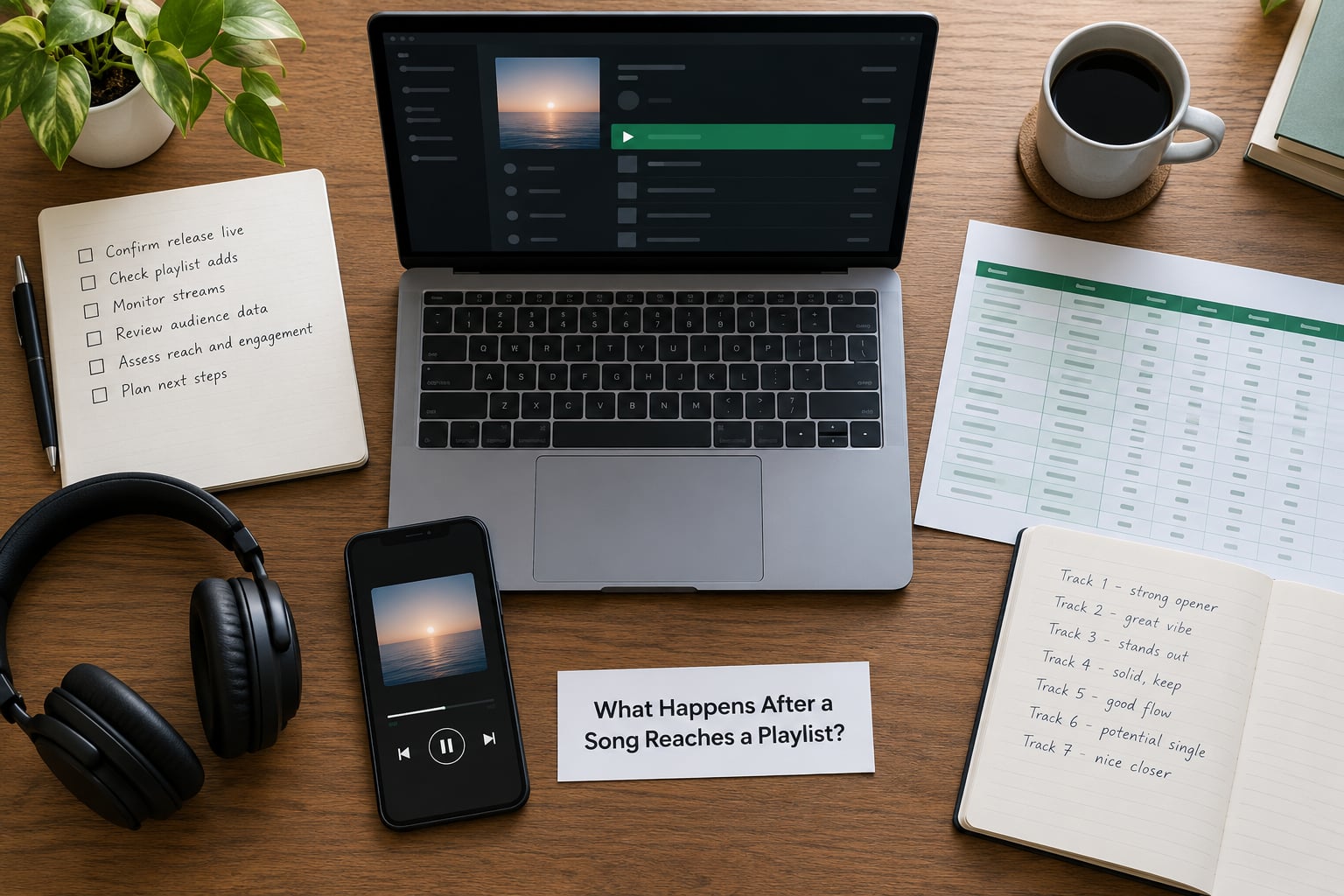
The sequence below is the part most promotional content skips, and it is where the actual value is created or destroyed. A placement is the starting line, not the finish.
1. Submission and review
The track goes to a human or a system. Editorial pitches go through the platform’s review cycle. Curator pitches arrive by email, DM, or submission form and often get a reply within a week, sometimes never.
2. Placement decision
The track is added, usually to a running playlist with updates rather than a one-time feature. Editors frequently place an artist in a release-week or new-releases slot, which rotates.
3. Impressions and reach
Followers of that playlist see your track in their feed. How many actually press play depends on position and on how much the audience trusts the curator’s taste.
4. Listener response
Some listeners skip in the first few seconds. Some save it, add it to their library, replay it, or share it. This is the only moment that matters for what happens next.
5. Exit or rotation
A track that gets skipped quickly is usually dropped from a curator’s running list. A track that gets saves usually stays, because the curator wants the list to keep working.
6. Possible algorithmic pickup
Strong early response in a small, relevant audience is the kind of signal recommendation systems are built to act on. Nothing is confirmed about the exact mechanism, and no public threshold exists.
7. Audience conversion
The real prize is followers who now know who you are. That is why artists in music marketing forums keep saying small, genuinely listened-to community playlists produce better downstream results than one large placement with passive listeners.
| Stage | What is happening | What you control |
|---|---|---|
| Pitch | Track enters an editorial or curator queue | Lead time, metadata, one-song focus |
| Add | Curator or editor decides to include it | Fit, audience overlap, presentation |
| Impressions | Playlist followers see the track | Position within the running order |
| Response | Saves, replays, completion, skips | The first ten seconds of the track |
| Rotation | Track stays, rotates out, or is featured | Consistent new releases, follow-through |
| Follow-on | Algorithmic testing surfaces the track | Nothing directly. Early response only |
How Do Algorithms Choose Tracks for Playlists?
Algorithmic playlists are assembled by recommendation systems, and they work from behavior rather than from a form you fill in. The broad inputs are well understood even where the exact formulas are not published.
- Listener behavior. Saves, library adds, replays, full completions, and low skip rates carry the most weight because they cost a listener effort.
- Song attributes. Tempo, energy, loudness, valence, and instrumentation shape who a track gets matched to. This is also why clean metadata matters.
- Context. Time of day, recent activity, and what a listener has been playing all narrow the field.
- Freshness. New releases get tested in limited windows before wider exposure, which is the entire logic behind release-week listening.
- Past performance of the artist. A listener who replayed your last track is more likely to be tested on this one.
What Spotify Does Not Publicly Confirm
The so-called 1000 rule, the idea that a track needs roughly a thousand streams to enter Discover Weekly, is not published guidance. No streaming platform has confirmed a stream threshold, a follower threshold, or a save threshold for any algorithmic playlist. Every specific number you see sold as the trigger is folklore that changes with the year.
That does not make the rules unknowable. It makes them conditional on a comparison against other tracks in the same test group, which no artist can inspect from the outside. Artists who fixate on hitting a round number end up delaying a release while playing marketing mathematics.
Can Artists Pay to Get Playlists?
Yes, in some forms, and the differences between those forms matter more than the fact of paying.
Platform advertising is legitimate. Buying Spotify Ads or Apple Music Ads places your track in front of listeners matched to your audience. It does not buy a playlist add, and the listeners are real because they chose to listen.
Independent curator campaigns are normal. Paying a small independent playlist for a feature or a sponsored slot is how a lot of niche outlets operate. The concern is when the payment buys a specific add to a list pretending to be organic.
Guaranteed-placement services are a warning sign. Any service promising a specific playlist, a fixed stream count, or a specific Discover Weekly result is selling something the platform’s systems do not sell. Artists on r/musicindustry and r/musicmarketing describe the pattern bluntly: a guarantee is the tell.
Bots and artificial streaming are the real danger. Platforms detect coordinated artificial listening and respond with removed tracks, withheld royalties, and distorted analytics. Songs flagged repeatedly can have their audience data corrupted, which damages your future recommendation chances too, not just the current release.
Payola is the word to keep in mind. Paying for a specific placement without disclosure is the practice that gets an artist talked about badly in industry forums and watched closely by platforms. The cost of being known for it outlasts any playlist add.
Which Playlist Placement Metrics Actually Matter?
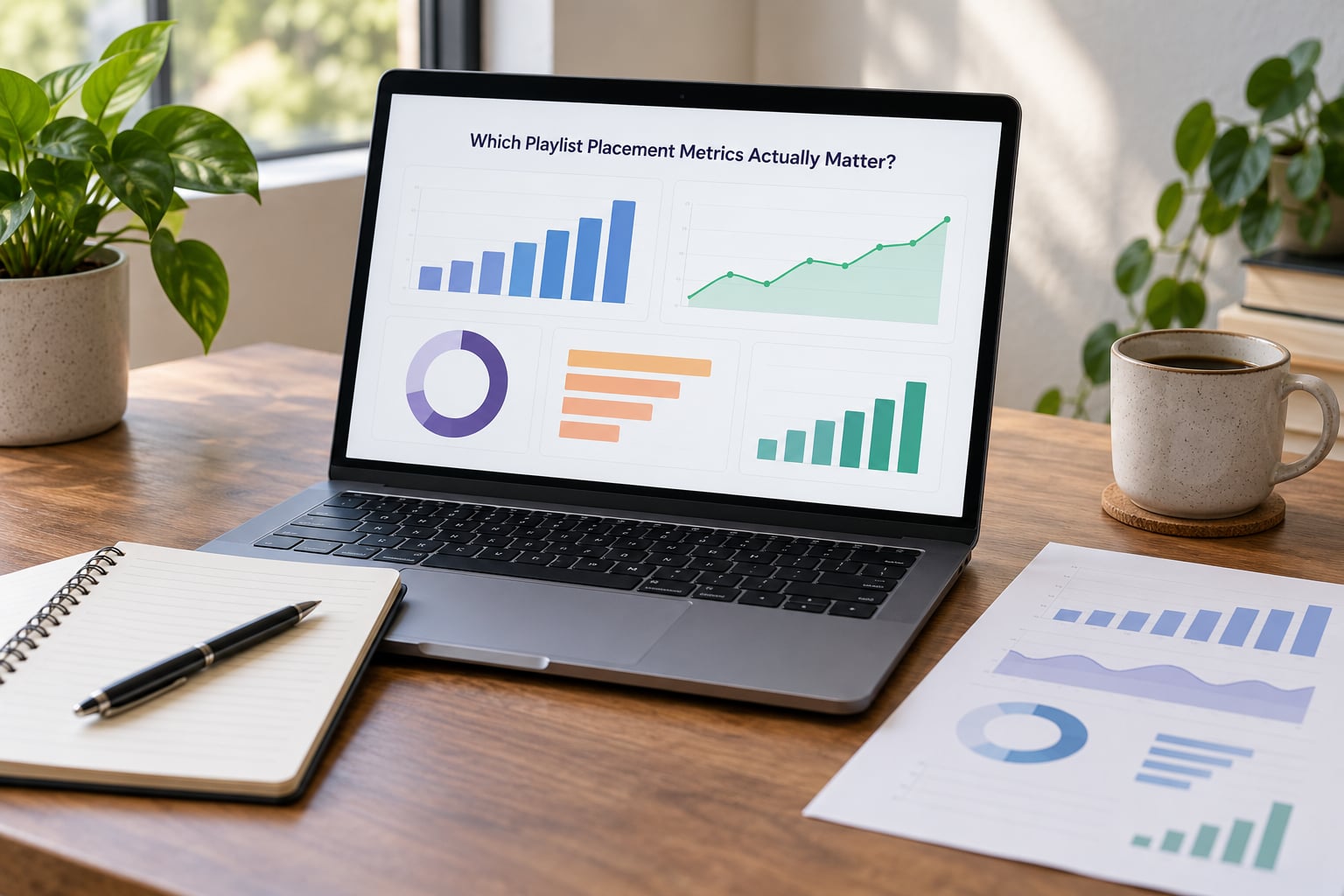
Streams are the headline number and the least useful one on its own. A thousand streams from listeners who skipped past your chorus tell you almost nothing except that a thousand people were offered the track.
| Signal | What it tells you | Why it matters more than streams |
|---|---|---|
| Save rate | Share of listeners who kept the track | A save is a deliberate act; a stream is often accidental |
| Completion rate | How many heard it through | Closest public proxy for whether the song works |
| Skip rate | How many left in the first seconds | Shows up first when a placement lands on the wrong audience |
| Streams per listener | Repeat plays per person | Distinguishes a real fan from a passing impression |
| Playlist adds from listeners | Listeners who added you to their own list | Shows the placement created a relationship, not a spike |
| Follower growth in the window | New people who chose to follow | The most durable output of a placement |
| Listener overlap with the playlist | Audience fit | Tells you whether to pursue that curator again |
Industry benchmarks get quoted constantly and shift with genre and audience size, so treat any single figure as a reference point rather than a target. The useful comparison is your own release against your previous release, in the same tier of playlist.
When you evaluate a playlist you are pitching, ask a few blunt questions. Followers versus monthly listeners is the fastest sanity check: a list with tens of thousands of followers and a few hundred monthly listeners is not a functioning audience. Artists regularly catch this by opening a handful of profiles on the playlist’s top tracks and seeing where the listening actually comes from.
How Can an Independent Artist Improve Placement Chances?
None of this is a trick. It is a sequence that rewards artists who do the unglamorous parts early.
Make the release ready before you pitch. Complete profile, filled metadata, a real EPK, artwork that fits the format. Editors and curators are reviewing hundreds of items and discarding anything that looks unfinished.
Pitch one song, early, with context. Lead time of three to four weeks is the range most independent teams report working; seven days is the platform minimum, not a target. Say where the track fits, who it sounds like, and why now.
Research curators properly. Open their playlist, look at the last ten adds, check whether their listeners overlap with yours, and read their submission rules. The Discovered On panel on artist pages surfaces the playlists listeners already follow after an artist, which is a fast way to find lists with genuine overlap.
Write pitches that respect the inbox. Four parts: one line on fit, one on why the timing is right, a private streaming link, and one clear ask. No paragraphs about how much the music means to you.
Build momentum you control. Pre-saves, a small but active core, and a release pattern that makes your next drop predictable. Artists on r/musicindustry and r/Music consistently describe modest but real audiences as the thing that turns a pitch into a yes.
Send the traffic back. Tag the curator, share the placement, and post the playlist. That behavior is one reason curators keep adding artists who add well.
Review results honestly. After each release, log who added you, what the listener response looked like, and where your followers came from. Most artists discover their best curator relationships after two or three campaigns, not twenty pitches in a week.
Frequently Asked Questions
Can a playlist curator guarantee a spot for a fee?
No reputable curator or platform offers that, and any service that does is selling something that does not exist. Legitimate routes are platform advertising, which buys audience targeting rather than a playlist add, and independent curator campaigns, where a payment buys a clearly labeled feature. A guarantee is the clearest signal that streams will be artificial, which risks royalty withholding and removal.
How long does editorial playlist consideration usually take?
Pitch an unreleased track at least seven days before release, though three to four weeks gives a review team more room to plan a slot. You will not get a status update, accepted or not, so treat a pitch as a request rather than a transaction. Pitching one song is standard, and a follow-up pitch after a release usually lands better than a first one.
Does getting on small playlists help an independent artist?
Usually yes, because small lists with genuine listener overlap produce stronger downstream results. A few hundred listeners who save the track and follow you are worth more than a large placement full of passive skips. The value is in audience fit, so a 900-follower list in your exact subgenre beats a general list many times its size.
Is paying for playlist promotion safe?
Platform advertising is safe because listeners choose to listen. Paying an independent curator for a disclosed feature is ordinary practice. Paying for a specific organic-looking placement, or buying a package with a guaranteed stream count, is not. The risk is artificial streaming detection, which can mean removed tracks, withheld royalties, and analytics that no longer reflect a real audience.
How many streams should a song have before pitching it to playlists?
There is no confirmed number for algorithmic playlists, and no streaming platform publishes a stream threshold for Discover Weekly or Release Radar. Editorial pitching happens before release, on an unreleased track. What you can build beforehand is a small active core that replays and saves, because that early response is the behavior recommendation systems actually use.
What is the best way to measure playlist placement?
Track save rate, completion rate, skip rate, playlist adds from listeners, and follower growth in the days after the add, rather than raw stream totals. Compare each release against your own previous one, since benchmark figures shift with genre and audience size. Check listener overlap too, because that tells you whether the curator is worth pitching again.
Start With the Audit, Not the Pitch
If you take one thing from this, make it the boring part. Audit the release you are about to put out: is the profile complete, is the metadata accurate, does the EPK exist, and does the first ten seconds earn a skip or not. Then audit the curators on your list: do their listeners overlap with yours, and does the playlist actually function or is it just a follower count.
That is how playlist placement actually works in practice, once the noise is stripped away. Someone makes a decision, a listener responds, and that response is the only signal that moves anything. Get the release and the targets right, then treat every pitch as a conversation with a person who has taste and a limited inbox.