To get added to editorial playlists, deliver your unreleased track with a future release date, claim your artist profile in the platform’s for-artists dashboard, then submit that one track through the built-in pitching tool at least seven days before release, ideally three to four weeks. Fill in every metadata field and write a short pitch describing what the song sounds like, where it fits, and how you will promote it.
That is the entire process, and it is genuinely open to artists with no label, no manager, and no audience. It is also competitive. Spotify receives tens of thousands of pitches a week, and most of them are declined. The difference between a pitch that lands and one that disappears in a queue is rarely the music alone. It is timing, accurate metadata, and a pitch that reads like a human wrote it for a specific editor.
What follows is the process in the order it actually happens, starting with what you need on hand before you contact anyone. If you only remember three things: pitch early, pitch one song, and describe the music instead of selling it.
Table of Contents
- What You Need
- How to Get Added to Editorial Playlists: Step-by-Step
- 1. Define Your Release and Audience
- 2. Research the Right Editorial Playlists
- 3. Prepare a Complete, Shareable Release Package
- 4. Build a Credible Music Profile
- 5. Write a Short, Specific Editorial Pitch
- 6. Send the Pitch to the Right Person
- 7. Follow Up Once, Then Keep Building Momentum
- 8. Track Results and Improve the Next Pitch
- Common Mistakes
- Frequently Asked Questions
- Do independent artists need a publicist to get on editorial playlists?
- How long does it take to hear back from a playlist editor?
- Will a playlist placement guarantee more streams and fans?
- How can an artist find the right editorial playlist contacts?
- Should I pitch a song before or after its official release?
- What should I do if an editor does not respond?
- Conclusion
What You Need
Editorial teams move fast. When a pitch arrives without the basics attached, it cannot be evaluated, so it never gets evaluated. Have these ready before you write a single line:
- Finished, delivered audio — a clean master plus the mixes you would actually release. Pitch a track that is delivered to the platform with a future release date, not a private SoundCloud link.
- Squared artwork — high resolution, no URLs, no social handles, no pricing text burned into the image.
- Complete credits — songwriters, producers, co-writers, featured artists, label and distributor, split sheet if you have one.
- Lyrics — clean text, no formatting notes. Instrumentals are fine, but say so explicitly.
- Release plan — the date, the format (single, EP, album), the follow-up singles, and the channels you will push it through.
- Press materials — one-paragraph bio, longer bio, press photos, press kit, and a smartlink or pre-save page.
- Playlist research — a shortlist of the editorial playlists that already carry your genre and sound, not a generic list of the biggest names in music.
- Contact routes — verified submission portals, label or manager representatives, public business emails, and official channels for the specific playlists you want.
- A tracking sheet — one row per contact, with the date sent, the channel, the response, and the outcome. You will want this for release three.
If you are on a distributor such as DistroKid, TuneCore or UnitedMasters, ask your representative whether they route pitches to platform editors on your behalf. Plenty of independent label services do, and a routed pitch carries more weight than a cold email.
How to Get Added to Editorial Playlists: Step-by-Step
1. Define Your Release and Audience
You cannot pitch a song you have not described to yourself. Before you write anything, be able to answer four questions in one sentence each: what genre and subgenre it is, what the mood and tempo are, who the listener is, and what territory they are in.
The genre answer matters more than most artists expect, because curators are often assigned specific genres and micro-genres. If your song is emo-adjacent post-hardcore with trap drums, do not lead with post-hardcore alone. Name the specific lane and the adjacent audience you are courting, because that is how a curator maps a track onto a playlist journey.
Then list your genuine competitive edges. Bedroom production that sounds expensive, a story only you can tell, a co-sign from an artist with a real audience, a live set that gets filmed well. Three concrete strengths beat a paragraph of vague promise every time.
2. Research the Right Editorial Playlists
Editors are not looking for artists to discover. They are looking for artists who fit a specific playlist they are updating. So the research is specific: pick three to five playlists where your track would sound at home, then look at what has been added to each one recently.
Ask concrete questions. Is the playlist mostly new releases or a back catalogue? Are the artists on it independent, or is it a major-label lane? Does it lean toward one sub-scene or a broad mood? Does it appear in a playlist journey that starts smaller and ends somewhere larger? An editor building a Friday afternoon hip-hop playlist is not the same target as one curating a Sunday morning jazz playlist.
Tools help here. Chartmetric shows who is on a playlist and which playlists tend to feed larger journeys, which tells you where a realistic ladder starts. Musicstax gives a popularity score, and a rough goal of 25 percent or higher tells you whether you are in range for editorial consideration at all. If you are at six percent, keep pitching but fix your listener base first.
Write each playlist name into your tracking sheet. This list becomes the spine of the pitch, because the strongest pitches name the playlist they fit.
3. Prepare a Complete, Shareable Release Package
Curators need to be able to do three things quickly: listen, understand, and share. Most failures here are packaging failures, not music failures.
Bundle everything behind one link that opens on a phone and loads fast. It should hold the audio, the artwork, the credits, the lyrics, a short bio, the release date, and a pre-save button. If the link needs a login to hear the song, it will not get heard.
Check the metadata twice. Genre, subgenre, mood, instrumentation, and language of lyrics are not decorative. They are the fields curators filter and search against. If you tag a fully instrumental track as having English vocals, or leave the mood blank, you have narrowed the pool of editors who can find you for no reason.
For niche scenes, use the words people in the scene actually use. The scene’s own vocabulary is more useful than a broad category, because broad categories are crowded and editors already know who fills them.
One practical note on delivery: the track has to exist in the platform’s catalogue before you can pitch it. Pitching a file that lives only in your distributor dashboard unlocks nothing, which is a common and confusing early mistake.
4. Build a Credible Music Profile
Editors check who you are before they press play. If your profile is bare, you are asking them to take a risk on a stranger, and they will not.
Fill in everything the dashboard asks for. Claim your profile and verify it, write a bio that says where you are from and what the music sounds like, add photographs, list your credits, set your artist pick and your top songs, and post at least a few pieces of original content rather than leaving the feed empty. On Apple Music, the same work applies through Apple Music for Artists, where the profile, social links, and in-app content function as the closest thing to a pitch form that Apple offers.
Add your artist playlists. A few well-built playlists that show taste tell an editor more about your audience than a thousand followers do. Give yourself a reason to follow you.
Then make the outside links match up. If your website, socials and streaming pages tell three different stories, you have handed an editor a reason to close the tab.
5. Write a Short, Specific Editorial Pitch
On Spotify, the pitch field holds 500 characters. That limit is the single best editing tool you will get, so use it. Five things belong in those 500 characters: what the song sounds like in mood and topic, the playlist it fits, relevant cosigns, your promotion plan, and the story behind the record.
Compare these two openings.
Weak: “Our new single is a banger that is going to blow up the scene. We have huge energy and this is the one. Please check it out and consider adding it.”
Strong: “Anaïs is a one-take, 82 BPM track built on a single detuned Juno loop and a whisper vocal recorded in a converted stairwell. It sits between bedroom pop and slowcore, closer to the sadder side of the ‘fresh finds’ mood than the festival side.”
The second one tells an editor the tempo, the instrumentation, the vocal delivery, the production story, and where it sits in the catalogue. That is enough for them to place it, or to know it is not for them.
Swap in your own cosigns. A co-writer who has placed before, a producer with a name editors follow, a live set that circulated. A featured artist who already has a real audience is the strongest cosign you can name, so lead with it when you have one.
Then state the promotion plan in plain numbers: a pre-save campaign, a handful of dates, a short-form video push, a guest playlist or two. Curators are tracking whether an artist can move a song after it lands. A vague plan signals that you have not thought about it.
6. Send the Pitch to the Right Person
There is no public form for most editorial decisions, so the route you use depends on the platform and the playlist.
Spotify gives you exactly one pitchable unreleased song at a time, submitted through the for-artists dashboard, and it should be sent at least seven days before release. If you have a manager, manager or label representative, that person is the right route for anything beyond your own pitch.
Apple Music works differently, and this trips people up. There is no equivalent public pitch form. Your route is curator and platform relationships built through Apple Music for Artists, your press and publicist, radio servicing, and consistent proof that people are listening. Artists report landing curated Apple placements with no Spotify placement at all, which is exactly the pattern that makes sense when one platform runs relationship-driven curation and the other runs a self-serve pitch queue. Expect to work Apple Music differently and over a longer horizon.
For third-party playlists, use the submission route the curator publishes. Check whether the playlist takes submissions, whether there is a stated lead time, and whether previous submitters were actually added. If the last ten additions all come from one label, that is your answer.
Only use a public business email when no submission route exists. Keep it short, keep it specific, and send from an address that looks like a real person rather than a pitch blast.
7. Follow Up Once, Then Keep Building Momentum
Silence after a pitch is normal and tells you very little. Most teams do not reply to declined submissions, so a lack of response is not a rejection you can argue with.
If the playlist published a submission route, follow their stated timeline. If you emailed a curator directly and heard nothing, one polite follow-up after roughly two weeks is fine. Reference the song, add anything new that happened, and keep it to three sentences.
After that, stop. A second follow-up signals that you treat placements as owed, and curators notice that pattern across hundreds of emails a week.
Then redirect the energy. Pitch one new song, send the next single to press and radio, and work the user-generated playlists that actually respond to outreach today. Momentum comes from the next action, not the pending reply.
8. Track Results and Improve the Next Pitch
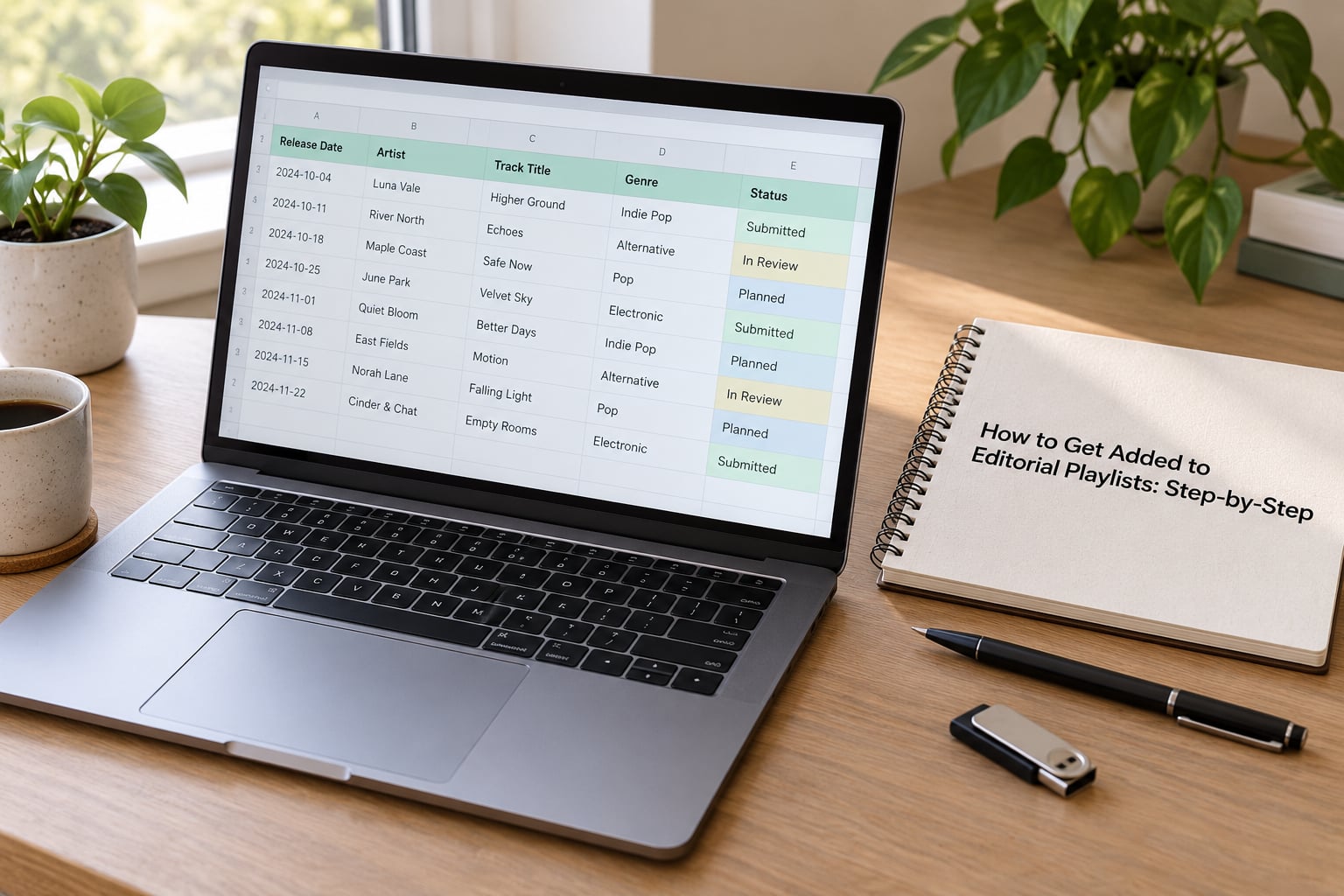
Keep one spreadsheet for the whole process. Columns: playlist name, platform, contact route, date pitched, response, placement date, and where the listeners came from.
After release week, look at which placements produced saves rather than just plays. A playlist that sends listeners who save the track is worth far more than a much larger one that produces passive streams, and that ratio is visible in your for-artists analytics.
Then read the pattern across releases. Artists with three singles before an EP have gone from no placements to several by changing timing and pitch specificity alone, with no new audience. That is the shape of an improvement you control: same music quality, better packaging, earlier submission, sharper pitch.
Common Mistakes
1. Mass-emailing strangers who have nothing to do with playlists. A blast of two hundred editors is not outreach, and it burns the artist name you were trying to build. Fix: twenty researched, specific messages beat two thousand generic ones.
2. Writing hype instead of description. Curators receive thousands of pitches a week and can tell within two lines whether you have listened to the song carefully. Fix: tempo, instruments, mood, and the scene you belong to.
3. Incomplete metadata. Empty mood fields and wrong instrumental tags quietly remove you from the searches editors run. Fix: complete every field the platform offers, on every release, before you pitch.
4. Pitching too late, or pitching an undelivered track. Seven days is the stated minimum; three to four weeks is where reliable advice lands. Pitching before the track is live in the catalogue means the pitch button does not exist. Fix: build the calendar backwards from release day, delivery included.
5. Believing you need an audience first. Artists in the low hundreds of monthly listeners get placed regularly, and one artist reported an EP landing editorial after pitching six weeks ahead with no prior traction at all. Fix: pitch the next single anyway, and use the audience you do have honestly in the promotion section.
6. Paying for guaranteed placement. Any service promising editorial placement is either lying or violating platform rules, and the fallout can include takedowns on your catalogue. Fix: services that pitch to independent curators are a different category and worth using. Guaranteed editorial slots are not for sale. One rule covers both: if the service cannot explain exactly who is receiving the pitch, walk away.
One last tip. Keep the pitch you used for every release, along with the outcome, in a single document. By your fourth single it will be a better pitch template than anything you can download.
Frequently Asked Questions
Do independent artists need a publicist to get on editorial playlists?
No. Every major platform gives independent artists direct access to pitching, and plenty of unsigned artists with no publicist land placements. A publicist helps with press, radio and curator relationships over time, but the pitch itself is open to anyone who has claimed their artist profile and delivered the track. What matters most is a finished release, accurate metadata and an early submission.
How long does it take to hear back from a playlist editor?
Often you never hear back at all, and that is the normal case rather than the exception. Large editorial teams do not reply to declined pitches, so silence carries almost no information. For third-party playlists that publish a submission window, expect roughly one to four weeks. For major platform editorial, decisions are made across a release cycle and there is no feedback loop at all.
Will a playlist placement guarantee more streams and fans?
No placement guarantees anything. What an editorial slot does is put you in front of listeners who did not already know you, which is why it matters. Judge the placement by the save rate and follow-through from listeners rather than the raw play count. A smaller playlist with a high save rate is worth far more to your next release than a large one full of passive streams.
How can an artist find the right editorial playlist contacts?
Start with each playlist’s own page and official channels, then check whether the curator publishes a submission route. Look at recent additions to see who the playlist actually serves, and use distributor, manager and label representatives where you have them. Chartmetric shows which playlists feed larger journeys, which is useful for spotting realistic starting points for an artist with no audience.
Should I pitch a song before or after its official release?
Pitch before. The song must be unreleased and delivered with a future release date, and Spotify requires at least seven days of lead time, with three to four weeks being the more reliable window. You can only pitch one unreleased song at a time, so plan which single gets the shot and let the rest of the release focus on user-generated playlists and independent curators.
What should I do if an editor does not respond?
Treat it as a no and move on. One polite follow-up after about two weeks is reasonable if you emailed a curator directly; anything more reads as pressure. Then use the time productively: pitch the next single, send the record to press and radio, and grow listener numbers so the following pitch is stronger. Silence is not feedback, and chasing it costs you the energy the next release needs.
Conclusion
Start with three actions this week. Write down your release in one sentence: genre, subgenre, mood, audience. Then research three editorial playlists that already carry that sound and read their recent additions. Finally, assemble your release package, complete every metadata field, and send one short, specific pitch at least seven days ahead of release.
How to get added to editorial playlists comes down to preparation and timing more than talent or luck, and that is genuinely good news, because both are yours to fix. If the pitch does not land, you still have a live audience to build and one more single to pitch.