
What is a UPC and ISRC code? A UPC (Universal Product Code) is the 12-digit barcode that identifies a release as one sellable product. An ISRC (International Standard Recording Code) is a 12-character code that identifies one specific sound recording. One release gets one UPC; every track on it gets its own ISRC.
If you have ever stared at an upload screen wondering what to type into the UPC and ISRC boxes, you are in the right place. The confusion is not your fault. Most release forms present both codes as blank mandatory-looking fields with no explanation of what either one does.
Here is the short version: a UPC answers which product is being sold, and an ISRC answers which recording is being played. Every answer below builds on that one distinction.
Table of Contents
- What Is a UPC and ISRC Code?
- UPC vs ISRC: What Does Each Code Identify?
- How Does a UPC Code Work?
- How Does an ISRC Code Work?
- Where Is Each Code Used in Music?
- How to Find the UPC and ISRC for a Release
- Do UPC and ISRC Codes Work Together?
- Common UPC and ISRC Code Mistakes
- Frequently Asked Questions
- Where to Start With UPCs and ISRCs
What Is a UPC and ISRC Code?
A UPC is a number that identifies a physical or digital commercial product in the global retail barcode system. An album, an EP or a single is one product, so it gets one UPC. That same code travels to every store, every digital storefront and every chart report that has to add the product up into a single line.
An ISRC is a number that identifies one sound recording, meaning a specific mix of a specific performance captured as an audio file. Three songs on one album need three ISRCs. The same song appearing on a later compilation keeps the ISRC it was born with.
The mental model that makes this stick: a UPC is the barcode on the box, and the ISRCs are the labels on the items inside it. One package, many contents.
UPC vs ISRC: What Does Each Code Identify?
Two words get used loosely here, so here is the side-by-side. If you only read one row, read the second one.
| Criterion | UPC | ISRC |
|---|---|---|
| Full name | Universal Product Code | International Standard Recording Code |
| What it identifies | One sellable release as a product | One specific sound recording |
| How many you need | One per release product | One per track or per recording |
| Format | 12 digits (UPC-A) or 13 digits (EAN-13) | 12 alphanumeric characters, no hyphens |
| Standards body | GS1, expressed as a GTIN | IFPI rules, issued through a national agency such as RIAA in the US |
| Who assigns it | Your distributor, under its own GS1 company prefix | Your distributor, under the label’s or the artist’s registrant code |
| Does it persist | No. Every new product version gets a new UPC | Yes. The recording keeps it forever |
| Main job | Counting sales and streams as one chartable product | Matching plays, royalties, licenses and society registrations to the right master |
Put differently: the UPC tells the industry how many units of Tidewater EP moved this week, and the ISRCs tell it which recording inside that EP was the one someone streamed in Lisbon at 2am.
That distinction is why you can never swap one for the other. A UPC cannot identify a recording, because a single recording can appear on many products. An ISRC cannot identify a product, because a product contains many recordings.
How Does a UPC Code Work?
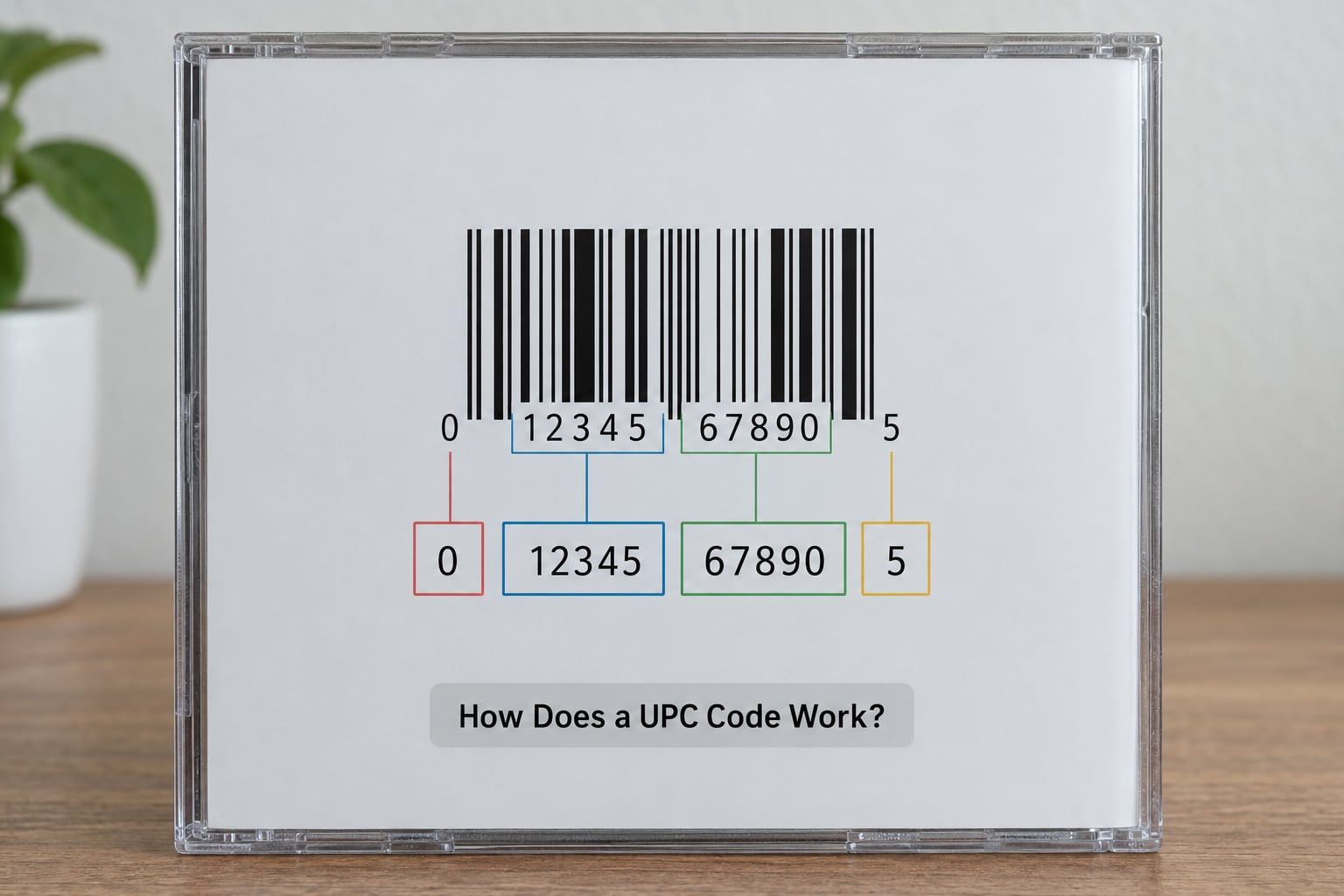
The UPC-A you see in music is a 12-digit number built from four parts, plus a check digit that validates the rest. Here is a fictional example so you can see the structure without borrowing a real company’s prefix:
0 12345 67890 5
- Number system (1 digit). The leading 0 in a UPC-A, usually. A 6 marks a restricted internal-use number, and UPC-E compressed numbers use 0 or 1 at the front.
- GS1 company prefix (5 digits here). Identifies the organisation that issued the code, in this case a distributor or label holding a GS1 membership. Longer or shorter prefixes exist depending on the organisation.
- Item reference (5 digits here). The part the issuer assigns to the specific product.
- Check digit (1 digit). Calculated from the first 11 digits using a standard weighted modular algorithm.
That check digit is worth a moment. Because the calculation is fixed, a made-up UPC is structurally detectable: anyone can verify whether the final digit matches the other eleven. This is the part people are asking about when they wonder whether a distributor genuinely registers codes or merely prints digits.
UPC-E is a compressed form that squeezes zeros and ones out of a UPC-A for smaller labels on packaging, and it converts back to the full 12-digit UPC-A. EAN-13 is the same GTIN family with one extra leading zero, which is why a music release’s barcode sometimes appears as 13 digits in some systems and 12 in others.
Finally, the code and the barcode are different objects. The number is the identifier. The barcode is the machine-readable pattern printed underneath it, and a store scanner reads the barcode to get the number.
How Does an ISRC Code Work?
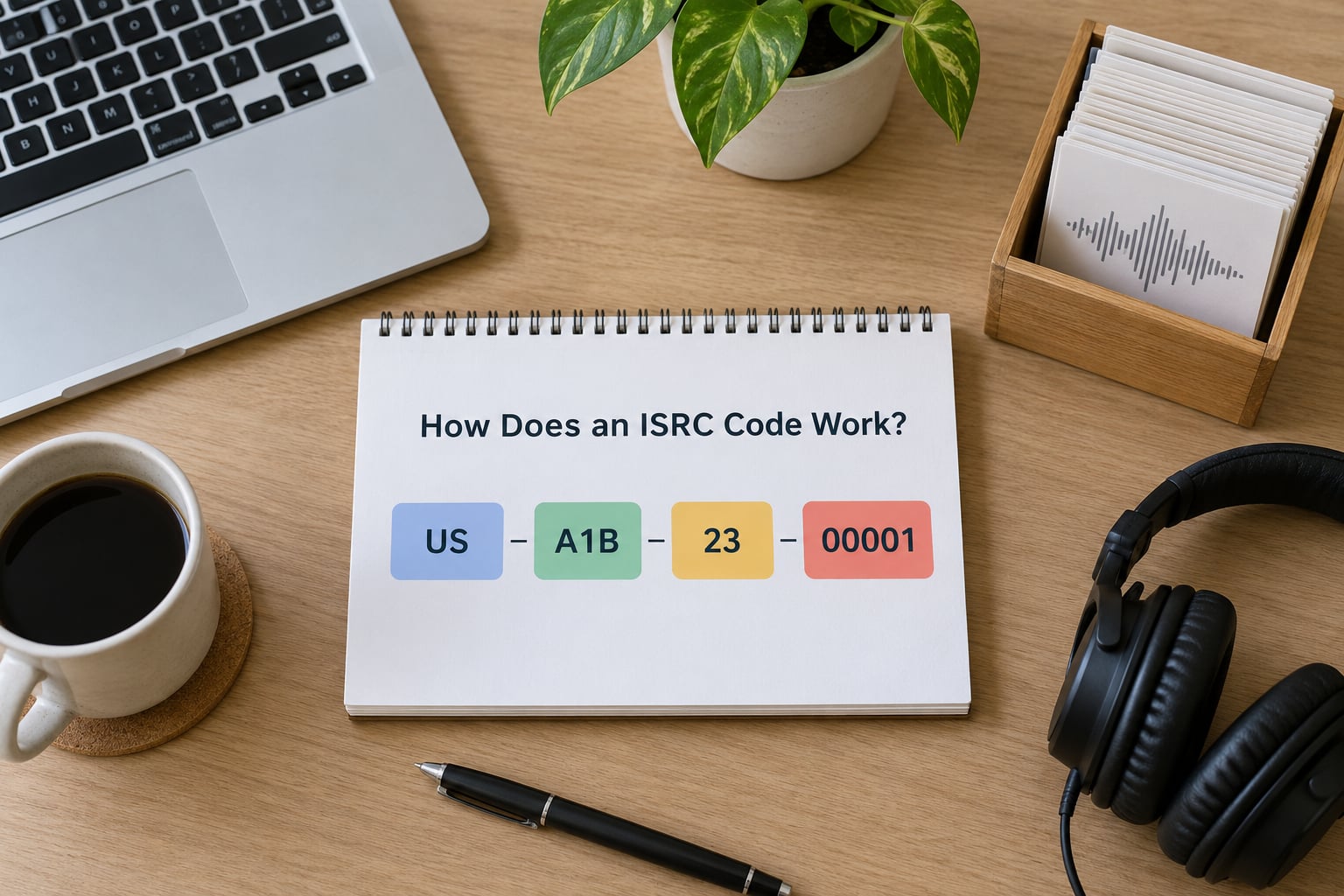
An ISRC has four segments and a fixed order, and it is often written with hyphens purely for readability. The stored version never has them. Here is a format-valid fictional example:
US-RC1-26-00001
- US is the country code of the country whose agency issued the code. Every ISRC begins with a two-letter country code, and the national agencies report back to IFPI.
- RC1 is the registrant code assigned to the label, artist or distributor that owns the recordings. A large label might have a four-character code; a one-off registrant might get a short one.
- 26 is the year of reference, the year the code was assigned to that registrant.
- 00001 is the designation code, a sequential number the registrant allocates to each new recording.
The year segment is the one people misread. It is the year the ISRC was assigned, not the year the song was written, recorded or released. An old recording registered for the first time this year carries this year’s year of reference.
Unlike a UPC, an ISRC has no check digit. That means a typo in an ISRC cannot be caught arithmetically, which is exactly why you should copy ISRCs from a source rather than retype them from memory into five different tools.
A track released with no ISRC at all is a different failure from a duplicated one. A duplicate merges two unrelated masters into a single stream and royalty bucket. A missing code leaves a recording that cannot be matched to anything, so the activity exists and nobody gets paid for it.
Where Is Each Code Used in Music?
Physical media is where UPCs still visibly earn their place. CD and vinyl manufacturing plants print the barcode on the disc or the sleeve, and retail scanners read it at the till. Chart data providers such as Luminate rely on the same number to group physical and digital sales into one product line.
Digital storefronts use the UPC as the release-level key and the ISRC as the track-level key in their metadata. When a royalty statement arrives from a digital service provider, those identifiers are how the service proves which master earned which stream.
Collection societies use the ISRC to register a sound recording, while neighbouring rights organisations use it to claim mechanical royalties on physical reproduction. A performer or producer registered with a society gets matched to a recording through that code, and publishers use it alongside composition-side identifiers when registering a release.
Sync licensing depends on it too. A music supervisor searching for a specific take needs a code that describes exactly that recording rather than the album it sat on. The same applies to sample clearance records, where the point is to prove that a particular master was involved in a particular use.
Radio play tracking and industry databases such as label and rights-management systems use both codes as primary keys, which is why mismatches surface as split reporting rather than as missing files.
How to Find the UPC and ISRC for a Release
You almost never have to request either code. Every mainstream distributor assigns both during your release upload, at no extra cost, and the fields are normally allowed to stay blank so the system fills them in.
To find codes for releases you already shipped, open the catalog view in your distributor dashboard. Most platforms list the UPC and each track’s ISRC on the release page, and several offer a CSV or Excel export of the whole catalog, which is the fastest way to build your own reference sheet. If a release is missing from the export, a support ticket usually resolves it.
For recordings released years ago under a different distributor or label, a public ISRC search database such as findmyisrc.com will often resolve a title and artist to the code, even when you no longer have account access.
Confirming a code belongs to the right release takes two checks. For a UPC, verify the digits match the specific edition you are describing rather than a deluxe version or a reissue. For an ISRC, verify the designation code is unique to that master and not shared by a sibling track.
Nobody should be inventing codes or assigning them from outside the proper process. A UPC without a real GS1 prefix will fail at retail or fail chart validation, and an ISRC assigned outside your registrant code collides with codes someone else already owns. Registrars and distributors exist precisely so you do not have to solve either problem alone.
Do UPC and ISRC Codes Work Together?
They cooperate cleanly, and the cleanest way to see it is to follow one recording across a catalogue.
Take a song you write and release as a single. That single is one product, so it gets UPC A. The recording gets ISRC X, and it keeps ISRC X forever.
Six months later you put the same song on an EP with four new tracks. The EP is a different product, so it gets UPC B. The original recording still carries ISRC X, and the four new tracks get four new ISRCs. One new UPC, five ISRCs on the release, one of them unchanged.
Then a deluxe edition adds two live takes and a remastered version of the song. The deluxe is a third product with UPC C. The remastered version is a new master, so it gets a new ISRC. The live takes are new masters too, so they get new ISRCs. The two new recordings now have two ISRCs attached to the same composition, and that is correct, because they are two different recordings.
Finally the song lands on someone else’s compilation. That compilation has its own UPC owned by whoever released it, and your recording arrives carrying the same ISRC X it has had since day one. This is the mechanism that keeps royalty attribution intact across a catalogue migration, and it is why a distributor asking for your existing ISRCs is not being bureaucratic.
Track a single ten-track album the same way and you get one UPC and ten ISRCs. Different scale, same rule.
One caution from the field: an artist on r/musicians deleted and re-uploaded a release through a new distributor with the same ISRC entered, and the play counts did not come back. Identifiers control attribution, not retention. They tell the system which recording a stream belongs to; they do not force a service to preserve historical data.
Common UPC and ISRC Code Mistakes
These are the errors that quietly scramble your reporting, roughly in order of how often they cause damage.
- Putting the ISRC in the UPC field, or the reverse. The most common upload error, and the reason “UPC vs ISRC code” questions come up so often. One number identifies a product, the other identifies a recording, and the systems downstream will not guess which you meant.
- Reusing one ISRC across two different masters. Two genuinely separate recordings, such as a studio version and a re-recorded take, sharing an ISRC merge into one bucket. Royalties get split between masters that have nothing to do with each other.
- Assigning a brand new ISRC to an identical re-release. If the audio did not change, the recording is the same recording and it keeps the code it had. Music vendors press the same rule from the other direction, requiring a fresh UPC for re-pressed physical product while allowing the ISRC to stay.
- Releasing with no code at all. Usually the result of a blank field being ignored rather than filled. The recording exists, streams exist, and nothing links them.
- Treating a label catalogue number as a UPC. Catalogue numbers like CAT-0042 are internal references. They are not barcodes and they will not resolve anywhere outside that label.
- Assuming UPCs are globally unique on their own. Uniqueness comes from the GS1 company prefix plus the item reference combined, and the same item number can exist under several prefixes. The whole string is the identity.
- Never recording the codes anywhere. Codes live in a distributor dashboard you may lose access to. Export them to your own spreadsheet the day a release goes live, alongside the audio files.
On the question that comes up most often in producer forums: distributors are GS1-prefixed registrants and licensed ISRC registrants, so the codes they assign are registered rather than fabricated. Some artists still buy their own allocation from the national agency, which costs a fee and comes with a minimum batch size. For one independent release that is money spent for nothing, since a distributor will hand you the same identifiers free. It starts making sense only if you run a label with a large catalogue you intend to keep outside any distributor.
One last disambiguation, because a question about “codes” usually hides four questions. An ISWC identifies a musical composition, the underlying song rather than any one recording. An ISNI identifies a person, which is how the ISRC gets attached to the right artist automatically. EAN and GTIN are not music codes at all: they are the barcode number family your UPC belongs to. A GRid identifies a recording group for rights societies, which is how several ISRCs for one commercial release get bundled.
Frequently Asked Questions
Is a barcode the same as a UPC or ISRC?
No, they are different objects. A UPC is the number that identifies a release as a product, and an ISRC is the number that identifies one recording. A barcode is the printed pattern of bars that a scanner reads in order to retrieve one of those numbers. A physical release shows a UPC barcode on the packaging. ISRCs are not barcoded; they travel as text in the metadata that digital services and royalty systems read.
Does every song need both a UPC and an ISRC?
Every release needs a UPC, and every distinct recording needs an ISRC. A single with one track needs one UPC and one ISRC. An album with ten tracks needs one UPC and ten ISRCs, because each track is a separate sound recording. Both codes are assigned by your distributor during upload, normally for free, and both fields can usually be left blank so the system fills them in for you.
Can one UPC cover several tracks on an album?
Yes, and it has to. A UPC identifies a product, not a track, so every track on the album shares the same release UPC. That is exactly what makes an album count as one item in a chart or a sales report. The tracks are separated from each other by their individual ISRCs instead. The one exception worth knowing is a deluxe edition, which is a different product and therefore needs its own UPC even though it contains the original tracks.
Why is the UPC or ISRC different between digital music services?
Usually it is not, and a mismatch is a metadata delivery error rather than a rule. Each service should receive the same identifiers from your distributor. What does vary between services is what you see in the interface, and older catalogue entries were sometimes uploaded with codes that have since been superseded. If two services genuinely show different codes for the same release, check the catalog view in your distributor dashboard first, since that is where the authoritative values live.
Do UPC and ISRC codes determine how much an artist earns?
No. Codes do not create activity, they only make activity count correctly. What they decide is whether a stream or a sale lands in the right bucket. The ISRC routes royalties to the right master and its owners, while the UPC rolls everything on a release into one chartable product. Duplicate or missing codes split or misattribute that activity, so a release can earn real numbers and still fail to receive credit for them.
Where to Start With UPCs and ISRCs
Leave both fields blank on your next upload and let the distributor assign them. That single habit removes the most common source of the exact confusion this guide exists to clear up.
Then do one thing most people skip: export the resulting UPC and every ISRC to a spreadsheet you own, on the day the release goes live. Those numbers are the permanent address of your work. Everything downstream, from royalty statements to sync clearances to the day you change distributors, depends on being able to find them again.