A beat becomes a classic when its drum pattern, its melodic idea, and the space around them are distinctive enough to be recognized without the artist attached, and built from materials that don’t date with the technology of their era. That is the short answer to how a beat becomes a classic. The longer answer involves craft, chemistry, and a discovery engine that keeps running long after release day.
Understanding the mechanism matters because most of it is a choice, not a gift. A producer can deliberately build for longevity, or chase whatever sounds current this quarter and watch the beat date itself on arrival.
On r/makinghiphop, one producer sent loops to a working professional who told him they’d be “fire in 2015.” He described it as a gut punch. It is the cleanest illustration of the trap: the sound of now is the sound of then, and “now” expires.
Table of Contents
- What Does It Take for a Beat to Become a Classic?
- How Does a Melody Make a Beat Memorable?
- Why Do Emotion and Storytelling Matter?
- How Do Production, Arrangement, and Sound Shape a Classic?
- How Do Collaboration and Performance Bring a Beat to Life?
- Can Promotion, Context, and Culture Make a Beat Timeless?
- What Can Producers Learn from Famous Beat-Making Trends?
- Frequently Asked Questions
- What makes a beat a classic rather than just a popular song?
- What is the most important quality of a beat that lasts?
- Should a producer make a beat simpler so it can become timeless?
- How do you know whether a beat has classic potential?
- Does a famous vocal performance make the underlying beat more iconic?
- Can an old beat become popular again years later?
- Conclusion
What Does It Take for a Beat to Become a Classic?
A classic beat is not the same thing as a good beat or a popular one. Good means well made. Popular means a lot of people heard it quickly. Classic means the beat’s identity detached from its moment and kept working years after the era that produced it moved on.
That separation is harder than it sounds, and the data is sobering about the first leg of the journey. An analysis of Spotify’s All Out decade playlists, paired with Billboard Hot 100 peak positions, found that roughly 70% of the songs sitting on those lists had charted when they were first released. Around three in ten arrived cold and were reassessed later, with the Velvet Underground standing as the textbook outlier.
So what do the surviving three in ten have in common? Three things, in practice.
1. An identity that works without the artist. Strip the vocal and the beat is still recognisable. The pattern, the chord movement, the texture. If a beat needs a specific voice to make sense, it is a song waiting to happen rather than a finished piece of music.
2. A performance that respects the space. The vocalist adds a second idea instead of covering the first. Overcrowding is the fastest way to lose an arrangement that was already working.
3. A discovery engine that outlives the release. Playlists, radio, sync licensing, and later rediscovery by other artists. A beat with no route back into circulation is a one-time transaction.
None of those three is a talent. All three are decisions, which is why the topic is worth taking apart beat by beat.
How Does a Melody Make a Beat Memorable?
Melody is the most durable element of a beat, and the reason is structural. Drums and bass are interchangeable across decades; a specific melodic contour is much harder to lift without sounding like a copy.
A hook earns its place by doing four things. It sits in a range a normal voice can actually reach. It makes sense on the first or second listen rather than the tenth. It repeats with enough variation that returning to it feels like recognition instead of obligation. And it lands with some rhythmic contrast, so the ear locks onto it instead of sliding past.
Contrast is where most weak beats fail. When a hook arrives exactly where the pattern predicts, it disappears into the grid. Move it a sixteenth early, let it resolve late, or let one word hang past the bar and the same melody suddenly has a shape.
Timbre does the other half of the work. A melody on a plain electric piano is pleasant; the same melody on a detuned upright with a room around it is a signature. Listeners rarely name the instrument, but they remember the colour.
Why Do Emotion and Storytelling Matter?
Technically strong beats get skipped. Emotionally specific ones get replayed. That is the blunt difference between a beat that works once and a beat that gets carried.
Specificity beats size every time. A large vague feeling in a beat reads as filler, and listeners skip filler instinctively. A narrow, precise mood reads as a point of view, and points of view survive fashion because the fashion changes around them.
The beat usually carries the mood and the vocalist carries the story. When both point the same direction, a record can be replayed in completely different situations without falling apart, which is a large part of why old records still get used in new scenes.
There is also an uncomfortable asymmetry for producers. A creator posting in r/WeAreTheMusicMakers put it plainly: about 90% of the time they don’t want to revisit their old work, and maybe 10% still stands up to their ears today. Nobody reliably identifies their own best material, which is exactly why a beat’s quality has to be legible to a stranger.
How Do Production, Arrangement, and Sound Shape a Classic?
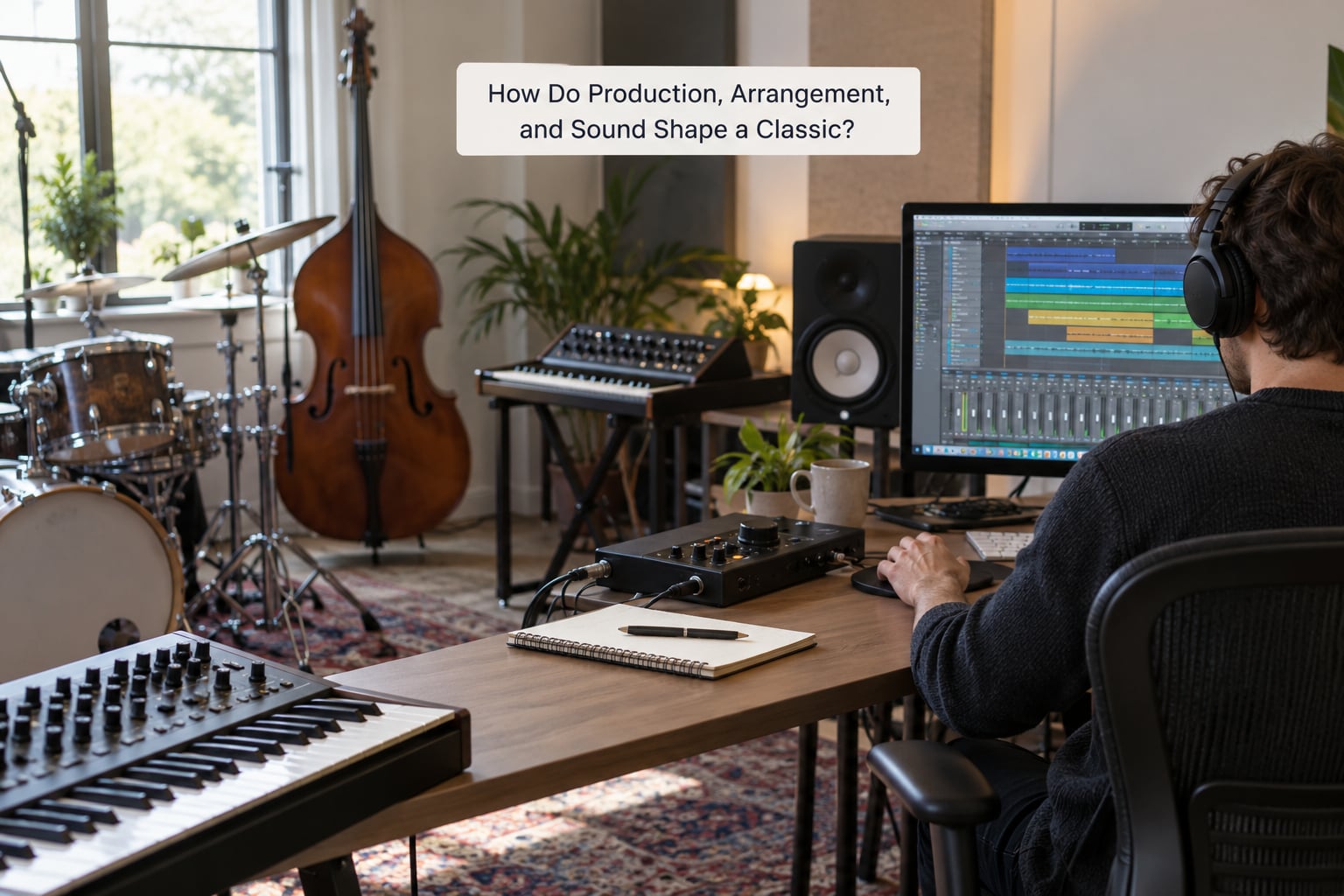
Production is where a beat either earns durability or quietly loses it. The four decisions that matter most are the drum pattern, the bass, the amount of space in the mix, and how the arrangement grows.
The drum pattern is the fingerprint
A repeating sequence of hits played in a set pattern is called a drum pattern. When that pattern locks against the bassline and develops a push and pull, it becomes a groove. The groove is the most identifiable thing in most beats, which is why producers chase it first.
Character comes from what you leave out. A kick that lands on 1 and 3 with nothing on the and of 3 is a decision. Hats at a specific rate, snares slightly behind the grid, a fill that arrives once per eight bars instead of every four, all of that is vocabulary a listener registers without being able to name it.
Space and restraint age better than density
Most dated production is not old, it is crowded. Layers stacked until nothing has a foreground, every element loud because the mix was competing with other mixes. Restraint is what ages well, because silence never becomes unfashionable.
Leave a hole where a hook could go and let the vocalist fill it later. Keep the low end narrow so it survives on a phone speaker. These are modest decisions that keep a beat playable for years.
Why 808s and 909s age differently
808 sub-bass belongs to a specific design with a specific decay, and it is stubbornly hard to copy without the weight turning to mud. 909s, by contrast, get re-sampled constantly, and a well-chosen 909 kit still sounds intentional decades on.
The 808 ages more slowly when it sits in a restrained arrangement and ages badly when it is pushed into the loudness war, where sub-bass collides with everything else and turns into a single unplaceable block. Long-term survivors tend to be the beats that left headroom on purpose.
That layering instinct shows up in how listeners describe the records they revere. On r/TheAlchemist, a longtime fan described first hearing the horns on “1st Infantry,” with “the little snippets of his previous beats blended perfectly with the tempo of the drums.” Layered self-sampling, a horn stab, everything tempo-locked. That is a listener describing craft, not nostalgia.
How Do Collaboration and Performance Bring a Beat to Life?
Most classic beats were not accidental, but plenty of them were accidents of pairing. A beat built around a specific voice, with the hook sitting exactly where that voice naturally leans, is doing something no quantised loop can do on its own.
Chemistry shows up in small decisions. The producer leaves a gap because the vocalist needs room to breathe. The verse drops a drum layer because the writing got sharper. The hook repeats one more time than feels necessary because the line was worth it.
Arrangement is where that chemistry becomes visible. The same beat can be a sparse, drum-forward record or a dense, layered one, and the choice changes which performances fit. Producers who last tend to leave the beat’s centre open and build around the performer rather than finishing the statement before anyone sings.
Can Promotion, Context, and Culture Make a Beat Timeless?
Reach does not make a beat timeless, but it decides whether anyone hears it long enough for time to work on it. A beat nobody plays never gets the chance to be reassessed.
The routes in and out of circulation are specific. Editorial playlists put a record in front of people who did not go looking for it. Radio testing decides whether a track gets repeated exposure or one spin and out. Sync licensing in film and television gives a beat years of passive presence that no single release can buy.
Revival is the reverse of discovery. A beat from an era nobody was buying returns when a new generation finds the source material, or when an artist reinterprets the style and listeners go back to the original to compare. The pattern is familiar enough to be reliable: new scene, old record, gap between them gets filled.
It also means canon is partly built by curators rather than discovered by listeners alone. What gets re-selected into decade lists, re-recorded, and written about is what becomes classic, and those choices have their own biases. Worth remembering when treating any era-defining verdict as settled.
What Can Producers Learn from Famous Beat-Making Trends?
Beat trends move fast and the durable patterns underneath them move slowly. The SP-1200 and MPC era defined chopping and swing. The 909 defined trap hats and rolls. Boom bap put drum programming at the centre. Each style dates quickly and each keeps contributing for a long time.
Studying those eras is useful for a specific reason. The hits that outlasted their trends all had a signature that could be described in one sentence without naming the year. A signature is portable. A trend is not.
Failure modes are easier to spot in hindsight. Power-ballad keyboards from the eighties sound dated. Bright, polished synthesizers borrowed from late-2000s dance music date the moment the fashion turned. Over-compressed mixes that chase loudness age worst, because the distortion baked into the master fights every later format.
The common thread in the last one is worth stating plainly: a beat built to compete with its moment is already dated the day it is finished. The sound of the era is a costume. Playing against it costs a little attention now and buys decades later.
Music criticism has a loose rule of thumb that a record is only fairly judged as a classic about 35 years after release. It is a heuristic, not a law, and 2026 beat producers can use it as a practical test: if your track still holds up when the reference points of its era are gone, you did something right.
Frequently Asked Questions
What makes a beat a classic rather than just a popular song?
A popular beat reached a lot of people fast, often because of a placement, a moment, or a promotion cycle. A classic beat keeps working after that cycle ends: its drum pattern, melodic idea, and texture stay recognisable without the artist, and listeners return to it years later. Popularity is a launch, longevity is the result.
What is the most important quality of a beat that lasts?
A recognisable identity built from materials that do not date. If a listener can identify the beat with the vocal removed, and the groove, timbre, and melody still make sense years after the era that produced it moved on, the beat has a chance at longevity. Everything else in the production supports that identity or works against it.
Should a producer make a beat simpler so it can become timeless?
Simplicity helps, but flatness does not. What ages well is restraint: leaving space for a performer, keeping the low end narrow, and repeating a hook with slight variation. A busy beat full of dated sounds will not survive, but neither will a thin one with no point of view. Complexity and datedness are not the same problem.
How do you know whether a beat has classic potential?
Test it without the context that made it. Hide the waveform, mute the vocal, and see whether the groove and melody still read on their own. Then remove every element that only made sense this year and check whether anything is left. Producers rarely recognise their own strongest work, so the test has to be run by strangers.
Does a famous vocal performance make the underlying beat more iconic?
Often, yes, and it works in both directions. A vocal that respects the beat’s space can give an instrumental an identity it did not have, and that performance is what people remember when they picture the record. A vocal that overwrites the arrangement usually buries it. The best-known versions of many beats are the ones where both halves are doing something.
Can an old beat become popular again years later?
Yes, and it happens regularly. A new scene rediscovers an era, a film or series places the record somewhere new, an artist reinterprets the style, and listeners go back to the original to compare. Short-form video gives old beats a second entry point entirely. The pattern is a new audience arriving before the old one finishes listening.
Conclusion
A beat becomes a classic when the groove, the melodic idea, and the silence around them are specific enough to be recognised without the artist, built from materials that won’t date, given a performance that leaves room, and then put back in front of people for long enough to be reconsidered.
If you are producing, prioritise the drum pattern first. It is the fingerprint everything else gets measured against, it survives a bad mix better than a melody does, and it is the one element listeners consistently describe when they explain why a record still sounds right. Get the pattern honest and durable, and the rest of the beat has something to build on for a very long time.