Trap drums took over pop music because they combined a long-decay 808 kick, a hard layered snare, fast rolling hi-hats and a half-time backbeat into a groove that survives both phone speakers and big systems. Producers could drop that four-part pattern under almost any pop melody, and from the mid-2010s onward most of them did.
The strange part is how recent it feels now. Trap rhythms have been the default drum language of mainstream pop for roughly a decade, yet they were still a regional club sound as late as the early 2000s. The gap between those two facts is the whole story.
Table of Contents
- The Short Version
- What Changed When Trap Drums Entered Pop?
- The Sounds That Make a Trap Drum Pattern
- How Trap Drums Took Over Pop Music
- The Milestone Records That Moved the Sound
- Why the Sound Worked Across Genres
- How Pop Producers Adapt a Trap Drum Pattern
- Do You Need an 808 to Make Trap Drums?
- The Mainstream Sound and How to Keep Trap Drums Original
- Frequently Asked Questions
- Conclusion
The Short Version
- Four elements, not one instrument. A trap drum kit is a long-decay 808 kick, fast triplet hi-hats, a hard snare or clap, and a backbeat that can sit in half-time or double-time.
- The hardware came first, the pattern came decades later. Roland released the TR-808 in 1980. The trap drum pattern assembled in 1990s Atlanta and Florida club music and did not exist in 1980.
- The crossover was slow, then sudden. Underground through the 2000s, boom through 2013, and full pop takeover between roughly 2014 and 2019.
- The pattern is drummer-free on purpose. Half-time backbeats let a programmed beat breathe under a vocal line that a drummer would otherwise crowd.
- By the 2020s it is the default, not the exception. The complaint producers now raise is saturation rather than imitation.
What Changed When Trap Drums Entered Pop?
Trap drums did not invent the 808 kick, the clap or the hi-hat roll. Every element existed long before 2000. What changed is that producers started treating those parts as one kit, and then started using that kit everywhere.
Before that shift, pop drums were usually built around a live kit or a realistic sample library: a tight kick with a fast decay, a backbeat in straight eighths, cymbals arranged for a song’s emotional lift. The trap pattern swaps that logic for weight and space. The kick is allowed to decay for a beat or more, so the bass carries the downbeat rather than the drum. Everything else thins out to make room for it.
That gave pop producers something they badly needed in a streaming era: a rhythmic signature that identifies a record in the first half-second, without a melody doing the identifying.
The Sounds That Make a Trap Drum Pattern
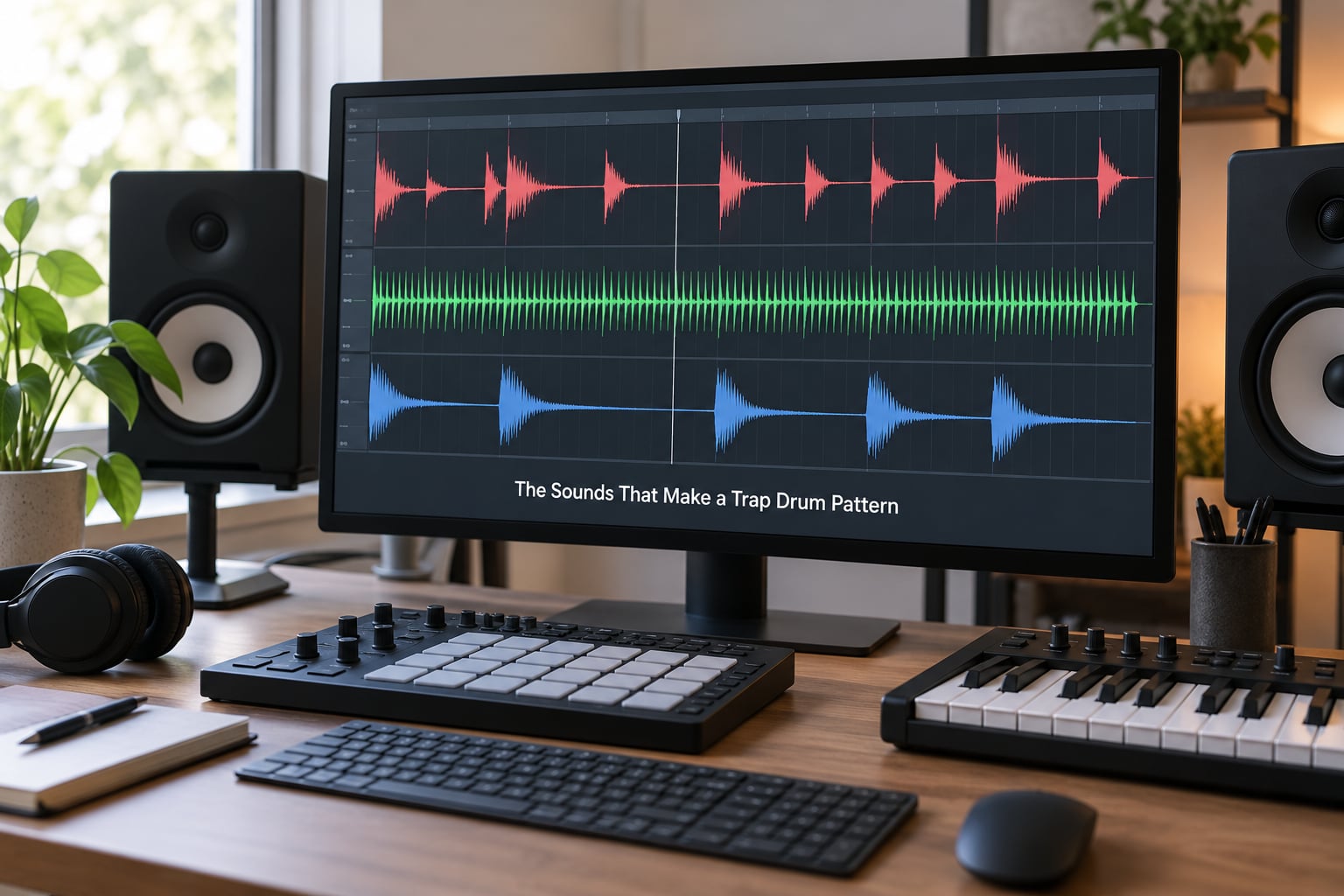
Here is the working definition, kept consistent throughout this article. Berklee Online describes trap as “characterized by busy hi-hats, heavy sub-bass, super rhythmic snares, and deep 808 kick drums,” which is about as compact a spec as you will find anywhere. Each part below does a specific job.
| Element | What it does | What it sounds like wrong |
|---|---|---|
| 808 kick | Sustains sub-bass across the bar so the low end reads on small speakers | A short, clicky kick that disappears the moment anything else plays |
| Hi-hats | Often triplet rolls at varying velocity, supplying forward motion over sparse arrangements | Evenly spaced eighths with no accent pattern |
| Snare or clap | Cuts through the low end on the backbeat, usually layered and saturated | A thin single-layer snare that gets buried under the kick |
| Backbeat feel | Half-time puts the snare on beat three; double-time pushes it into a busier grid | Committing to one feel for the whole song with no contrast |
| Tempo | Usually written at 130-150 BPM and cooked down to a half-time feel | Judging a beat as slow when the project tempo says otherwise |
One clarification worth making early, because pop listeners routinely get it wrong: an 808 is not a drum and a drum is not a bass. Every 808 is a bass sound, but most basses are not 808s. The 808 kick is the bass drum voice of the Roland TR-808 played so that it sustains, which is exactly the trait trap depends on.
How Trap Drums Took Over Pop Music
No single song or producer did this. The takeover is the sum of a hardware lineage, a regional club scene, a mixtape economy, and a streaming business model.
Before trap: the hardware years
Ikutaro Kakehashi built the Roland TR-808 Rhythm Composer in 1980, and it was close to a commercial failure. Programmable drum machines at the time promised realism, and the 808’s sine-wave bass drum and clattery transistor percussion were anything but. The custom chips became hard to get by the mid-1980s, and the machine was discontinued, which is exactly why surviving units now cost what they do.
Even in its commercial life, the 808 reached hip-hop and electro. Afrika Bambaataa and the Soulsonic Force’s “Planet Rock” in 1982 is the early canonical example, built on a Roland kit and a LinnDrum in the same session. 1980s electro and Miami bass carried the machine south and into clubs.
1990s: Atlanta builds the pattern
The trap drum pattern is an Atlanta and Florida story, not a hardware story. Organized Noize and the Dungeon Family crew in Atlanta, working with Miami bass and juke producers, assembled a faster, colder, more spacious variant of Southern hip-hop rhythm. T.I.’s Trap Muzik in 2003 gave the style its name in the title of a record that went platinum.
A word of caution about the name itself: “trap” as slang for drug-selling territory predates the genre by decades, and it is not the origin of the drum sound. The drum lineage is hardware and club-music history, not etymology.
2008-2013: the boom years
Kanye West’s 808s and Heartbreak in 2008 was the artistic turning point. Stripping the drums to almost nothing and letting a sustained 808 carry the emotion reframed the instrument from a hip-hop accent into the emotional centre of a record. Producers followed. Lex Luger’s hi-hat-heavy work through the early 2010s made the triplet roll as recognisable as the kick itself, and records by Future, Drake, Travis Scott and Lil Wayne turned that sound into a chart formula.
This is the era most competitor articles stop at, and it is the point where the pattern stops being regional.
How trap drums took over pop music, 2014-2019
By the mid-2010s the pattern had left the rap chart and entered the pop single. The economics mattered as much as the sound. A beat that is entirely programmed is cheap to re-time, truncate and version, which suits a streaming playlist economy where a song often surfaces before anyone hears the artist. Pop labels with no rap A&R could ship a record with this kit because nobody had to book a drummer.
Lil Nas X’s “Old Town Road” in 2019 is the most visible single moment, a country-rap hybrid that rode the pattern into a global mainstream record, but it is a marker rather than a cause. Behind it sat a decade of pop records that had already quietly adopted the kick, the rolls and the half-time snare.
2020s: saturation
The pattern is now assumed. A Gearspace thread titled “What will producers use after the 808 gets boring?” captures the current mood well: producers debating not whether the sound works but what could replace it. Regional scenes have absorbed and re-exported it too. UK drill, Afrobeats, corridos tumbados, reggaeton and K-pop all use variants of the same four elements.
The Milestone Records That Moved the Sound
| Year | Record | What the drums did |
|---|---|---|
| 1980 | Roland TR-808 Rhythm Composer | Supplied the sustained sine-wave kick that every later trap pattern depends on |
| 1982 | “Planet Rock” – Afrika Bambaataa and the Soulsonic Force | Put the machine in front of an audience in the electro and hip-hop pipeline |
| 2003 | Trap Muzik – T.I. | Named the sound and moved it out of club-music margins |
| 2008 | 808s and Heartbreak – Kanye West | Made the sustained 808 the emotional core of a record instead of a backdrop |
| 2011-2013 | Lex Luger productions | Established the triplet hi-hat roll as a signature rather than a flourish |
| 2013 | “Paradox” – Future | Half-time backbeat and long kick as a full arrangement strategy |
| 2016 | “Too Good” – Drake | Carried the pattern into radio pop while keeping it rap-adjacent |
| 2018 | Billboard-era pop singles with programmed trap kits | Normalised the sound for listeners who never followed rap charts |
| 2019 | “Old Town Road” – Lil Nas X | Pushed the pattern to the largest mainstream audience it had reached |
| 2020s | Drill, Afrobeats, corridos tumbados, K-pop | Regional variants that reworked the same four elements |
Why the Sound Worked Across Genres
The mechanical reasons explain more of the takeover than the cultural ones do.
Low-end impact survives translation. Streaming happened on earbuds, phone speakers and car systems, and a sustained kick is one of the few elements that still communicates weight on a small speaker. A bright acoustic snare does not translate; an 808 does.
The half-time backbeat leaves room. Placing the snare on beat three of a 140 BPM project feels like a 70 BPM groove. That gives a vocalist space without the record losing drive, which is why the pattern sat under pop melodies so easily.
Loudness normalisation rewards weight. When platforms level tracks toward a common perceived loudness, dense midrange percussion gets flattened. Weight at the bottom and space above it is a way around that.
It is entirely programmable. No session player, no room, no drummer. A beat can be re-timed and re-versioned for free, and royalty-free 808 kits made the parts available to anyone with a laptop.
It crosses styles without demanding a vocal change. A trap drum pattern under a country vocal, a reggaeton topline or a K-pop hook asks the listener to accept the rhythm, not to learn a new genre. That is a much smaller ask, and it is the single biggest reason the sound spread.
How Pop Producers Adapt a Trap Drum Pattern
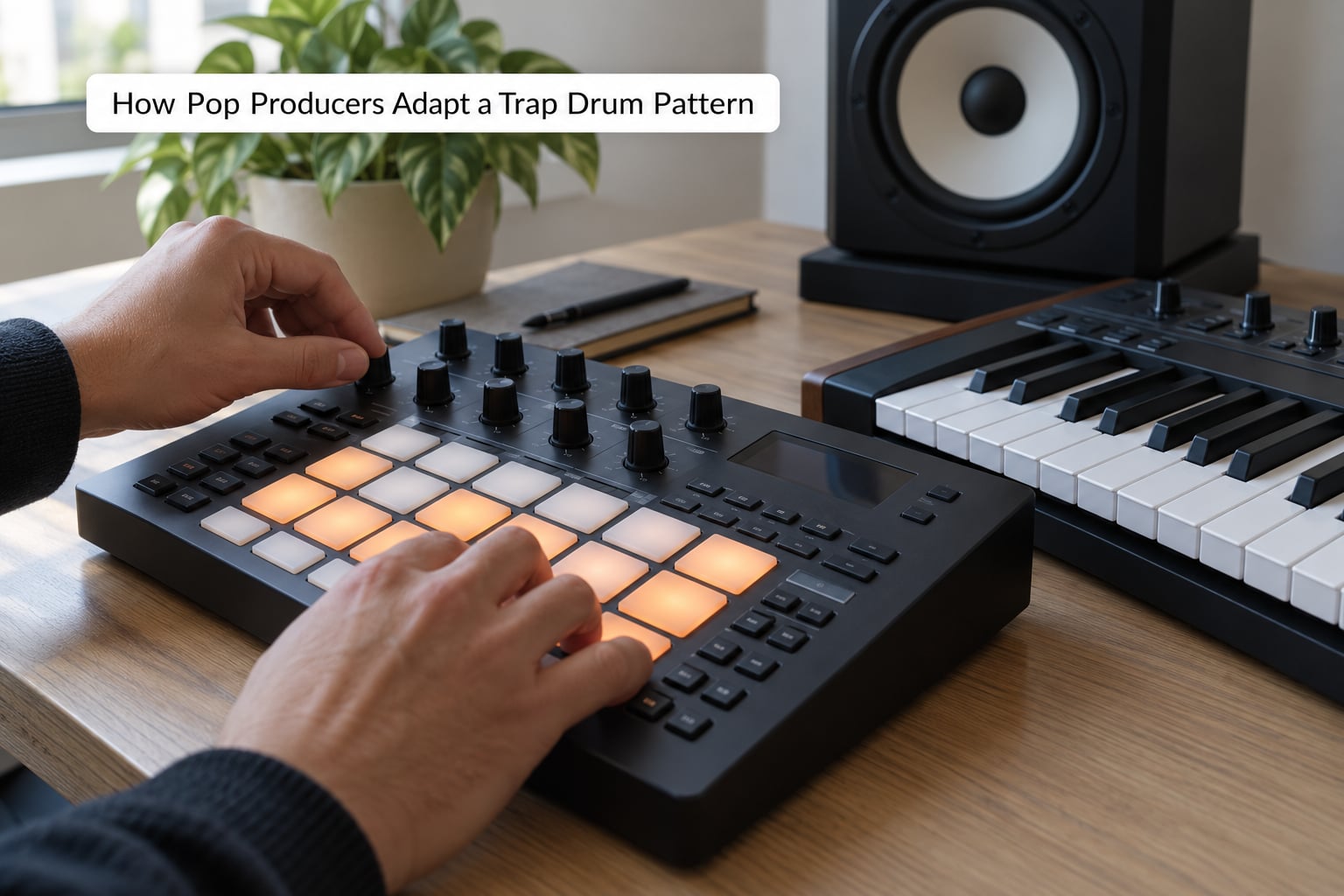
Pop producers rarely copy trap drums wholesale. They keep the kick and the half-time feel and soften the parts that fight a hook. Producers on forums describe the same two non-negotiables: a long 808 glide and a layered, saturated snare. Everything else is negotiable.
| Part | Classic 2010-era pop | Trap-adapted pop | What to change |
|---|---|---|---|
| Kick | Tight, fast decay, four-on-the-floor or 1 and 3 | Long decay, often sliding into the next bar | Let the tail ring and clear low-mid space around it |
| Snare or clap | Layered acoustic sample, backbeat on 2 and 4 | Hard, saturated layer, often only on beat 3 | Push the snare back and let the kick carry weight |
| Hi-hats | Straight eighths, static velocity | Triplet rolls with accent groupings | Vary velocity so the rolls breathe instead of machine-gunning |
| Low end | Bass guitar or synth bass doubling the kick | Sub-bass that functions as the kick | Add harmonics or light distortion so phone speakers catch it |
| Dynamics | Builds through the chorus | Often double-time in the final section | Use the tempo switch as the payoff instead of extra layers |
That last row explains a habit listeners complain about most. Doubling the tempo in the last third of a pop song adds energy without adding layers, which is efficient and often flattens the track. Critics have written about it as a loss of dynamics, and producers argue about the exact processing chain in the comments. Both sides agree on the effect, not on whether it is good.
Do You Need an 808 to Make Trap Drums?
No. An 808 sound is defined by a sustained low-frequency kick, not by a specific piece of hardware sitting in front of you. Roland rebuilt the TR-808 in later decades, and most modern producers never touch one.
Software is the normal route. Any DAW will do, and the kick is usually a sine wave with a pitch envelope, a long decay and a soft clipper on the end. Sample libraries supply the rest of the kit. Paid 808 instruments add pitch control, glide and MIDI handling; free ones are enough to learn the sound on.
Hardware is optional in the same way. A drum machine or sampler with editable pitch and decay covers it, and so does resampling any kick you like at a very low pitch.
One practical note that comes up constantly in producer threads: a pure sub-bass kick disappears on phone speakers. Adding a little saturation or a second harmonic layer gives the earbuds something to hold onto without turning the low end to mud on the club system.
The Mainstream Sound and How to Keep Trap Drums Original
The current default pop trap kit is easy to spot: a sliding 808 on the downbeat, triplet hats running the whole bar, a saturated snare on three, and a half-time chorus that jumps to double-time at the bridge. It works, and it is why so many records sound interchangeable.
Producers who want out of that monoculture tend to change something structural rather than cosmetic. Arrangement matters most: trap drums leave so much empty space that a real instrument, a guitar line or a live-feeling percussion layer reads clearly over them. Harmony and melody help too, since a distinctive top line does more for identity than any drum change. Tempo outside the usual 130-150 range, unusual time placement, and live or hybrid drumming all push against the template.
On forums, rock-leaning producers keep pointing out that the combination of live instrumentation with trap drums is largely unexplored. Forum listeners also describe the perceptual trick that makes the pattern work: when the snare and synth layers are tuned against the kick, a fully programmed beat stops reading as electronic. That is worth listening for on purpose. It explains why these records feel live and why the pattern translates so well to other genres.
Frequently Asked Questions
What makes a trap drum pattern different from other hip-hop beats?
A trap drum pattern combines four specific parts: a long-decay 808 kick that sustains sub-bass, fast triplet hi-hat rolls with shifting accents, a hard layered snare or clap, and a backbeat that often switches between half-time and double-time. Traditional hip-hop beats usually rely on a shorter kick, straight eighth-note hats and a steady snare on beats two and four. Trap trades decay length and rhythmic space for weight.
What BPM is trap music usually written at?
Most trap projects sit between 130 and 150 BPM, which produces a half-time feel around 65 to 75. Producers often push the project tempo up to 160 or beyond and then let the hats run in sixteenths or thirty-seconds for a busier variant. Pop records borrowing the pattern usually stay in the lower part of that range so the groove still breathes under the vocal.
What DAW or plugins can I use to make trap drums?
Any DAW can produce the sound. FL Studio, Ableton Live and Logic Pro are the most common choices, and each has dedicated drum and 808 instruments alongside large sample libraries. The kick itself needs almost nothing: a sine wave, a low pitch, a long decay and a soft clipper on the tail. Paid 808 instruments add pitch envelopes and MIDI control, but free plugins cover the basics well.
Why do trap drums sound so heavy and powerful?
The weight comes from two places. A sustained sine-wave kick keeps pushing energy through the lowest audible frequencies for most of a bar instead of stopping after a click, and the pattern deliberately removes midrange clutter so nothing competes with it. Physically you feel more than you hear: low-frequency energy is easier to perceive through the body and chest than higher frequencies, which is why 808-heavy tracks read as powerful even at low volume.
Did trap drum sounds replace live drummers in pop music?
They replaced them in the beat-making step, not on stage. Because a trap kit is entirely programmed, most pop records are tracked drum by drum in a DAW before any player is booked, which removed the drummer from the production process entirely. Live drummers still appear on tour and on records that deliberately contrast programmed drums with a real kit. The change was economic first: a programmed beat is cheaper, faster to re-time and easier to version.
Conclusion
Trap drums won on utility. A drum pattern that supplies weight on small speakers, leaves space for a vocal, costs nothing to re-time and crosses genres without asking the listener to change genre is hard to argue with, and once every pop label had access to it, the pattern became the default rather than a borrowing.
If you want to hear it clearly, play a mid-2000s pop single and then 808s and Heartbreak and let the sub-bass disappear. If you want to build it, start with one kick and one sub line matching on beat one, add a snare on beat three, put triplet hats on top at a comfortable tempo, and shape the low end around the vocal last. Everything else is decoration.