To budget as an independent artist, you track every payment that arrives, every cost that leaves, and every percentage you set aside for tax before you spend anything. Most artists skip that step and then plan a release off whatever is sitting in their personal account, which is how one good month turns into a bad winter. A working artist budget takes about two hours to build and ten minutes a week to maintain.
Irregular income is the reason this matters, not laziness. A month might bring a small royalty statement, a teaching gig and a sell-out show, and the next might bring almost nothing. Without a plan you are guessing, and guessing gets expensive fast.
Below is the system I would hand a new artist: what to gather, the five steps that turn a pile of receipts into a real budget, the mistakes that quietly drain accounts, and answers to the questions people actually ask.
Table of Contents
- What You Need
- Step-by-Step: How to Budget as an Independent Artist
- Common Mistakes
- Frequently Asked Questions
- How should an independent artist budget with irregular income?
- How much should independent artists set aside for taxes?
- Should I buy studio equipment or rent it when starting out?
- How do I budget for music promotion without overspending?
- What should I do if my artist income is low one month?
- How can streaming royalties fit into a monthly budget?
- Conclusion: Start With One Number
What You Need
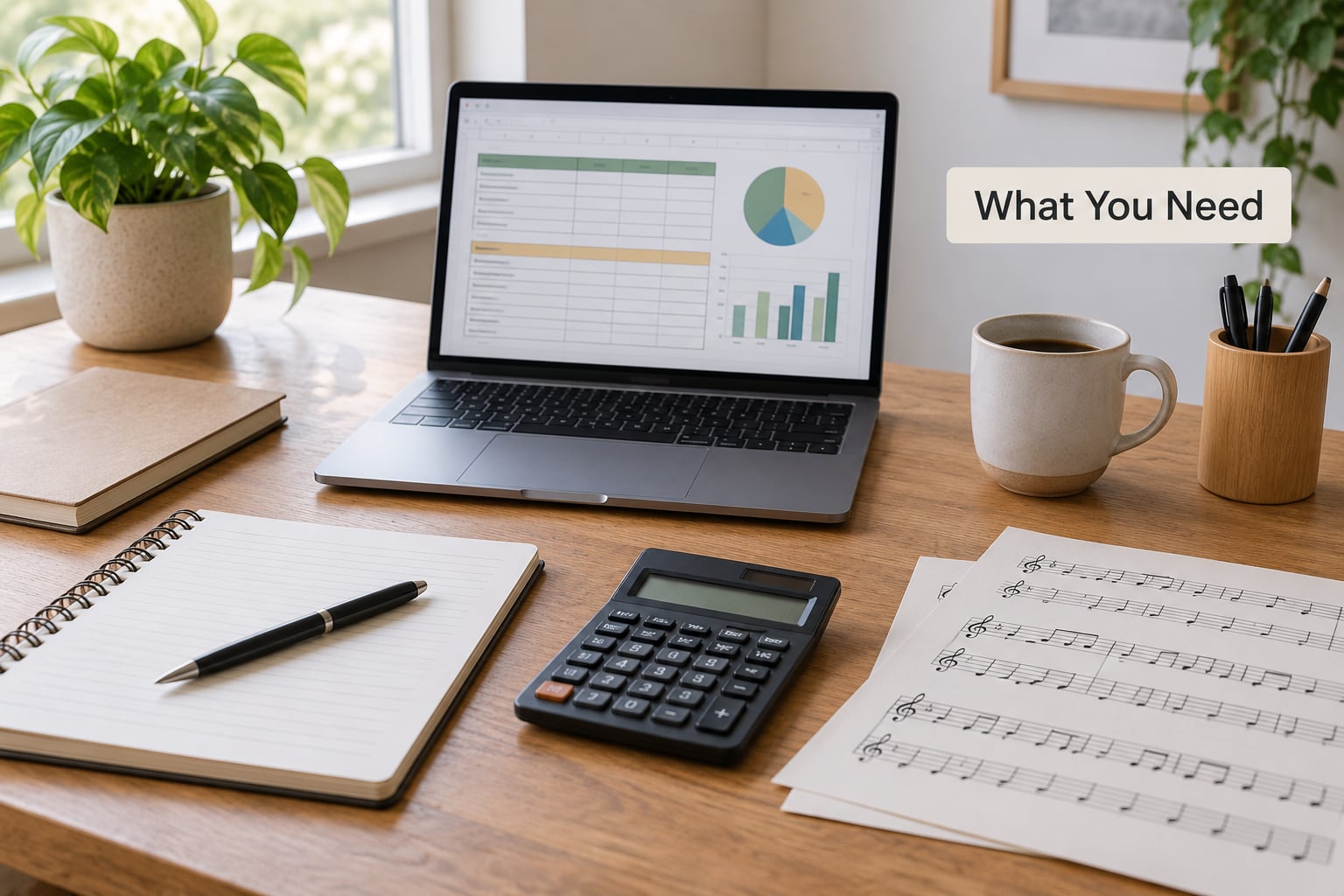
Start with five things. None of them cost money, and you probably have most of them already sitting in a drawer.
- Income records for the last six to twelve months: streaming statements from your distributor, show settlements, teaching income, sync and licensing payments, merch sales and any sponsorship or grant money.
- A list of fixed costs, the ones that do not change month to month, like rent, phone, insurance, storage for a rehearsal space and recurring software subscriptions.
- A list of variable costs, the ones that swing: studio hours, travel, fuel, merch production, session musicians, marketing spend.
- Your release goals, written as costs rather than hopes. A single, an EP and an album each have a different number attached to them, and the number is what the budget is built around.
- A tax savings figure and a place to keep it, plus either a separate business account or a single spreadsheet with clearly separated tabs.
If your records are a mess, do not let that stop you. Artists on music and production forums describe starting with one Google Sheet and adding categories as new costs turn up, which is exactly how most systems actually begin.
Separate bank accounts get mentioned more than any other single habit in those discussions, and the reason is simple: mixing personal and business spending makes both impossible to read.
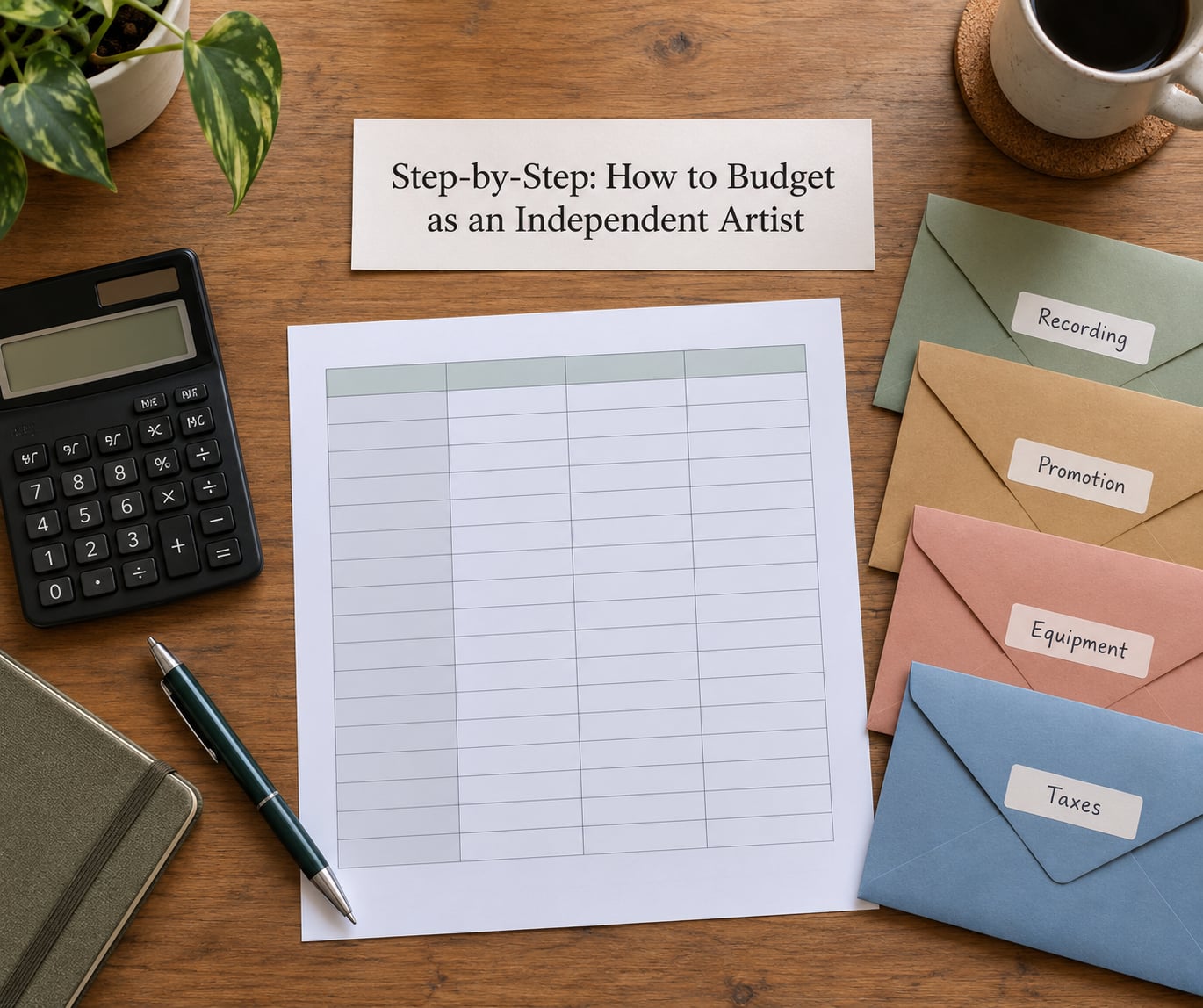
Step-by-Step: How to Budget as an Independent Artist
Step 1: Set Your Financial Priorities
Before assigning a single percentage, decide what the money is for. Sort everything into four buckets.
- Essential business costs that keep the career running: insurance, storage, distribution fees, a working phone, the software you actually use.
- Near-term release goals, with a target amount and a date attached.
- Long-term goals, such as an emergency fund and retirement contributions.
- Discretionary spending, which is whatever is left after the first three are funded.
Write the target for each bucket before you look at a bank balance. That ordering matters, because a balance is a result, not a plan.
For a self-employed artist with no employer pension or health coverage, the long-term bucket is not optional, it is a substitute for benefits other people receive automatically. Protect it the same way you protect rent.
Step 2: Track Every Dollar In and Out
Record each transaction the day it happens, with a date, an amount, a category and one note field. That is the whole system.
On the income side, independent artists usually earn from some combination of streaming and download royalties, live performance income, merchandise, teaching or session work, sync and licensing, and direct support through platforms or membership. Check each of those monthly, because they arrive on completely different schedules and none of them are reliable in the same way.
On the expense side, use the same categories every time so month-to-month comparisons mean something. A workable list: recording and production, gear and maintenance, marketing and promotion, travel and shows, software and subscriptions, merch production, professional services, and taxes.
Community threads on tracking tools turn up no consensus at all, spreadsheets, envelope budgeting apps, accounting software and Notion templates all get recommended. The tool matters far less than the rule that you log the same day.
Add a line for cost of goods sold on anything physical. Merch income looks healthy on a statement until you subtract what the shirts, the printer and the shipping actually cost.
Step 3: Separate Taxes, Business Costs, and Personal Money
The single most common failure is treating money in the business account as money you earned. It is not. A large share of it was never yours.
Move a fixed percentage out of every payment the day it lands, before anything else. In the United States, a self-employed artist also owes self-employment tax on top of income tax, so 25 to 30 percent is the working figure most artists in music communities use as a starting point. Your real rate depends on your situation and it changes.
Rules vary widely by country and by state, and self-employment registration, sales tax and estimated payment schedules are not universal. Treat the percentage as a placeholder and confirm the details with a qualified accountant or tax professional before you file anything.
Keep three pots separate: the tax pot, the business operating pot, and the personal pot you draw a salary from. Once money is in the personal pot, it is personal spending, and budgeting stops pretending otherwise.
Step 4: Create Monthly Spending Limits
Now build the month. Take your average monthly income across the last six to twelve months, not your best month, and work from that figure. If your last twelve months averaged 2,400 a month, that is your budget, no matter that one month hit 9,000.
A workable split of that average looks like this: 30 percent to taxes, 20 percent to recording and production, 15 percent to promotion, 10 percent to gear and maintenance, 10 percent to a buffer or emergency fund, 10 percent to subscriptions and professional services, and 5 percent to discretionary spending. Percentages are a starting point, not a rule, and the recording and promotion lines should move to match whichever release you are funding.
Then adjust for the month you are in. In a high month, move the surplus into the buffer and the retirement pot before anything else. In a low month, cut discretionary spending first, then promotion, and never touch the tax pot or the buffer. A release budget that survives one bad month is the only one that matters.
Give the buffer a number. Three to six months of essential costs is the usual target, built in small automatic transfers rather than saved from whatever is left over, because there is never anything left over.
Step 5: Review and Adjust the Plan
Budget at the end of each month, on a fixed date, and compare the plan to what actually happened. Spend twenty minutes on it.
Look for the categories where actual spending ran above the limit, and ask why. One bad month is noise. Three months in a row in the same category is a broken limit, not bad luck.
Also review quarterly, and once a year in full, because release schedules, income streams and tax rules all move. If you are releasing more often, promotion needs a bigger line. If tours are on the table, build a separate tour cash plan rather than trying to run a tour out of the monthly budget.
Then write the next month down with fresh numbers. A budget that is never rewritten is just a wish.
Common Mistakes
These are the errors that show up again and again, each with the fix that actually works.
Budgeting from a good month
A strong royalty month or a well-paid show is treated as normal. Fix: divide your actual income across the last six to twelve months and use that average as your number. The good month funds the bad ones; it does not get spent twice.
Ignoring taxes until the bill arrives
The classic January surprise. Fix: transfer the tax percentage on the day of payment, automatically if your bank allows it. Tax deadlines, thresholds and available deductions vary by country and state, so confirm the specifics with a professional.
Mixing personal and business money
Groceries sit next to session costs in one account and nothing can be read. Fix: open a second account for the artist business and pay yourself a fixed transfer from it each month.
Buying gear before the release
Money goes into a preamp or a second interface while promotion goes unpaid. Fix: gear is a planned purchase from the equipment line, not a response to a slow week. Rent or borrow what you need for a single project before you buy.
Skipping the buffer
Every dollar is committed the day it arrives. Fix: build to three to six months of essential costs through small transfers, and treat the buffer as untouchable.
Setting no promotion budget
The release launches and nothing was spent reaching anyone. Fix: decide the promotion figure before the release is announced, and hold it as a fixed amount rather than whatever is left.
Forgetting inventory costs
Merch profit looks like margin until production, printing and postage are counted. Fix: track cost of goods sold per item so the real margin is visible.
One last tip that covers most of these: pay yourself a fixed personal amount each month and let the rest stay in the business. Artists who pay themselves a steady figure report far less month-to-month anxiety, because their personal spending stops moving every time a statement is late.
Frequently Asked Questions
How should an independent artist budget with irregular income?
Budget from your average monthly income over the last six to twelve months rather than your best month. Track every payment in and every cost out, move a fixed percentage to taxes the day income arrives, and pay yourself the same personal amount each month. In slower months, cut discretionary spending and promotion before you touch the tax pot or your buffer.
How much should independent artists set aside for taxes?
Around 25 to 30 percent of every payment is a common starting point for self-employed artists in the United States, where self-employment tax sits on top of income tax. Your actual rate depends on your filing status, income and deductions, and it changes. Set the percentage aside first, then confirm what you owe with a qualified tax professional.
Should I buy studio equipment or rent it when starting out?
Rent or book studio time when you are starting out, and buy only what you use every week and cannot work around. Gear is the easiest line in a budget to inflate, because a slow month feels like a good excuse for a purchase. Plan equipment as a scheduled line item and fund it after taxes and promotion are covered.
How do I budget for music promotion without overspending?
Decide the promotion figure before you announce a release and hold it as a fixed amount. Track what each campaign costs per stream or per follower so you can judge whether the next one is worth repeating. When money is short, cut the lowest-performing channel rather than cutting all of them, and keep a small always-on budget running even between releases.
What should I do if my artist income is low one month?
Do not touch your tax savings or your emergency buffer, because both were built for exactly this month. Cut discretionary spending, then pause non-essential subscriptions, then delay planned gear purchases. Shift the difference from your personal transfer rather than from the release budget. If a slow stretch runs past two months, move to weekly rather than monthly tracking.
How can streaming royalties fit into a monthly budget?
Treat streaming income as a bonus line rather than a foundation, because statements usually arrive months after the listening happens and the amount varies. Record each statement separately from live and teaching income so you can see what each stream really covers. Budget the trailing average, never the best month, and keep paying yourself a fixed personal figure that does not depend on it.
Conclusion: Start With One Number
Knowing how to budget as an independent artist is not complicated, it is just unglamorous and repeatable: average your income, name your costs, protect taxes, pay yourself the same amount each month, and review it on a fixed date.
Do not build the whole system this week. Open one spreadsheet today, write down your average monthly income and one number for taxes, and set one priority expense. Add the second category next month, and the third after that.
A budget that you actually revise every month will do more for your career than a perfect one you never finish writing.