Learning how to freestyle rap for beginners comes down to one habit: rapping improvised bars over a beat for ten minutes a day and never stopping when a line goes wrong. Pick a simple instrumental, count 1-2-3-4 out loud until you feel the downbeat in your chest, then run four bars without pausing. Most people sound noticeably less stiff within two or three weeks of doing exactly that.
Freestyle rapping is improvising rhyming lines on the spot over a beat, with no script. That is different from writing a verse, where the bars already exist before you record. It is also different from a cypher, which is a circle where everyone takes a turn, and from a battle, which is head-to-head against one opponent with rules agreed in advance. All four use the same engine, though: keep the flow moving while you think.
Sounding bad early is not a warning sign. It is the normal first phase, and it is far less visible than you think as long as you never restart mid-bar.
What You Need
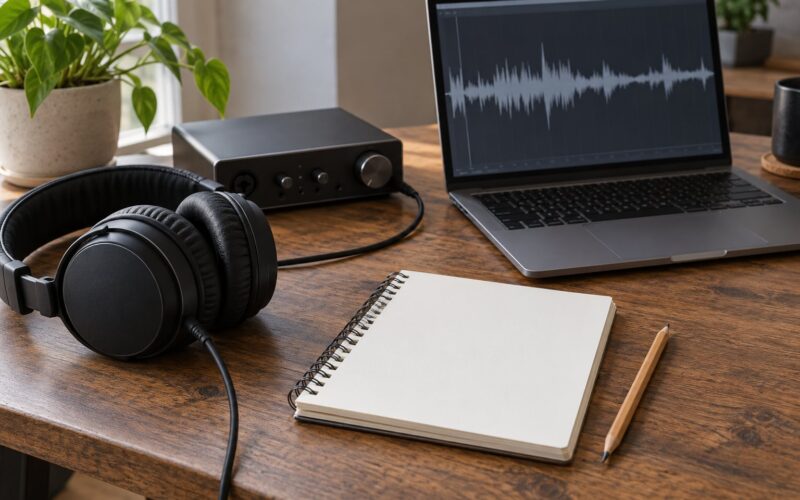
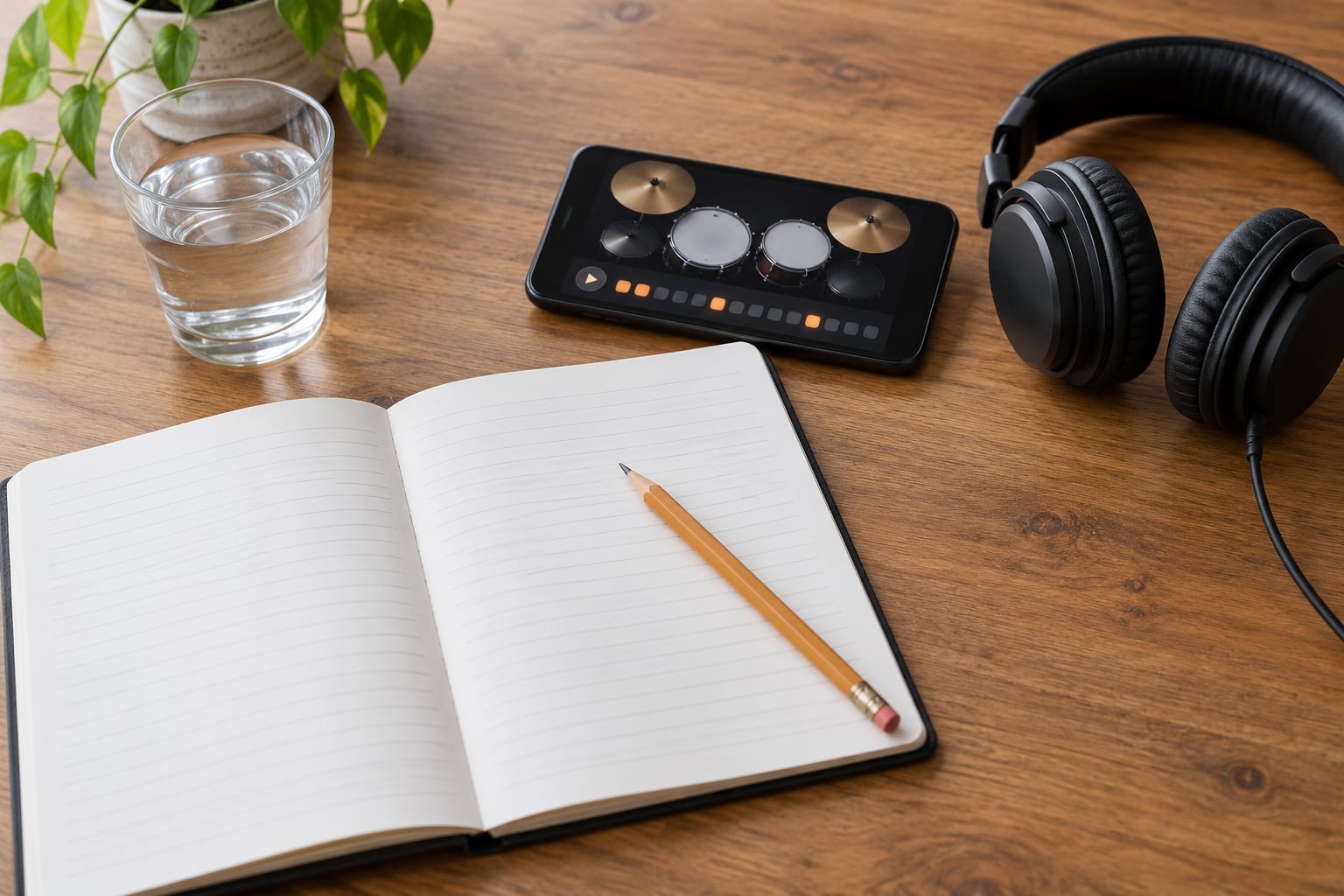
You need almost nothing, and that is the point. Here is the minimum setup that supports the whole routine.
- A quiet spot. A bedroom at night, a parked car, a walk down the block. Noise teaches you to shout, and shouting wrecks timing.
- A simple drum pattern or backing track. A plain boom-bap loop between roughly 85 and 95 BPM with a steady snare on beats 2 and 4. Nothing with a fast trap hi-hat pattern or a crowded melody yet.
- A notebook or phone. This is your rhyme bank. Every rhyme you collect goes into one running list, sorted later.
- A recorder. Optional for week one, near-essential by week three. Your phone’s voice memo is enough.
- Water. Freestyling dries your throat fast because you are projecting and improvising at the same time.
You do not need a microphone, a DAW, or an expensive interface. You also do not need other people. Private practice is where the skill actually builds.
Step-by-Step: How to Freestyle Rap for Beginners
Seven steps, in order, about ten minutes a day. Do them in sequence for the first two weeks, then loop back to the beginning whenever a step feels weak.
1. Learn the Pocket and Control Your Breath
Feel the beat first, before you try to say anything clever. The pocket is the space where the beat sits between the grid, and it is easier to find by body than by ear: tap your foot four times, then walk around the room with your hand hitting a wall on every fourth tap. The downbeat is count one, and it should land the heaviest.
Now the breathing drill. Breathe in on counts one and two, out on three and four, for eight counts. Breathe in on five and six, out on seven and eight. Repeat for two minutes while tapping the count under your breath. Do not force the voice or push into a rasp. That will show up later and cost you a week.
You know it worked when you can start a bar anywhere inside the loop and land your first syllable on the downbeat. If you cannot, keep drilling the count until you can.
2. Copy Short Rhythmic Patterns
Rhythm before words. Play a bare drum loop and speak a simple pattern over the snare, something like “one, two, three, four,” landing each number on a hit. Repeat it until the pattern is identical every time. Consistency matters more than accuracy here.
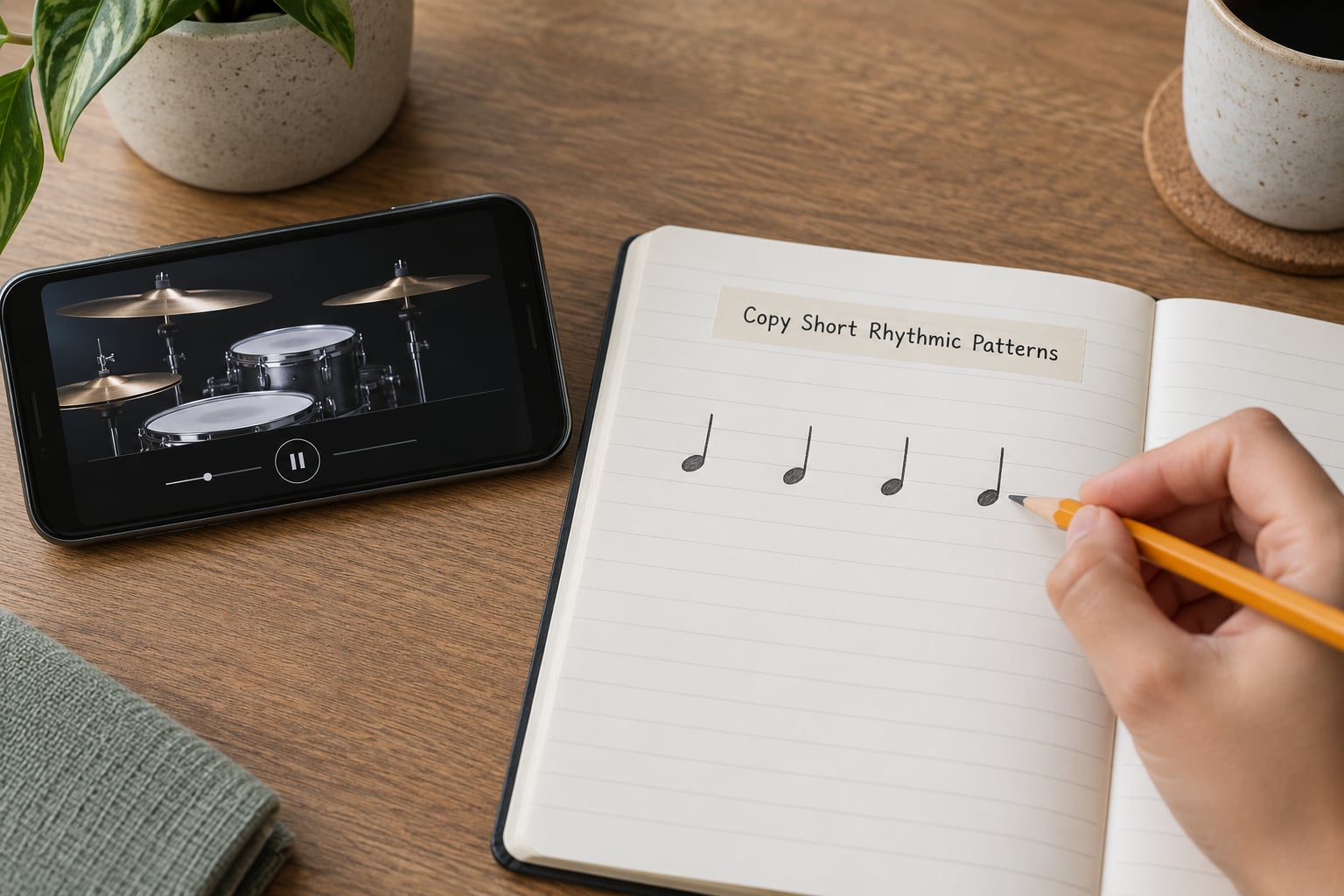
Then repeat the pattern, but swap in a two-syllable phrase with a made-up rhyme, like “back of the shop, take it to the top.” Say it out loud five times. You are training your mouth to fit syllables into a fixed number of beats, which is exactly what freestyling demands.
Copying is not cheating. It is how most working MCs learned: by borrowing someone else’s pocket, then gradually replacing their words with yours. A regular who has rapped for a decade still does this with a new flow.
3. Build a Simple Rhyme Bank
Collecting rhymes is the least glamorous part and the fastest payoff. Every time you hear a rhyme you like, write it down. Once a week, sort the list by vowel sound: all your long-A rhymes in one block, all your long-I rhymes in another.
Sort by syllable count next. A four-syllable rhyme like “electric, magnetic, intellectual” gives you more usable material per bar than four one-syllable rhymes crammed together. Beginners underestimate this completely.
Then write one line using only that block. Say it out loud over the beat. If the rhyme is forced and the sentence bends backwards to reach it, throw it away and try another word. A bad rhyme that fits the beat beats a perfect rhyme that leaves the grid.
Over a few weeks your bank stops being a list of words and starts becoming ready-made lines you can deliver without thinking. That is when freestyling feels manageable.
4. Practice Bars, Not Entire Verses
Never aim for a full sixteen-bar verse in week one. Split the beat into four-bar rounds and treat each one as a complete piece of work. At 90 BPM, four bars last about eleven seconds. Sixteen bars is nearly forty-five seconds, and a beginner who falls apart at bar nine learns nothing from the take.
Counting bars is easy once you know the drill. Set a timer or count loops out loud, and drop a marker in your phone notes at each four-bar mark so you can check yourself later. Four bars, take a breath, another four bars.
Once four bars feels comfortable, stretch to eight. When eight feels comfortable, try sixteen. That progression is the difference between a beginner who improves and a beginner who stalls.
5. Start Freestyling Over a Simple Beat
Play the loop and commit to one thing: begin within two beats of the loop starting. Beginners often stall for five or ten seconds, which is where a crowd tunes out and where you lose the thread yourself. One to two seconds is normal. Aim for two.
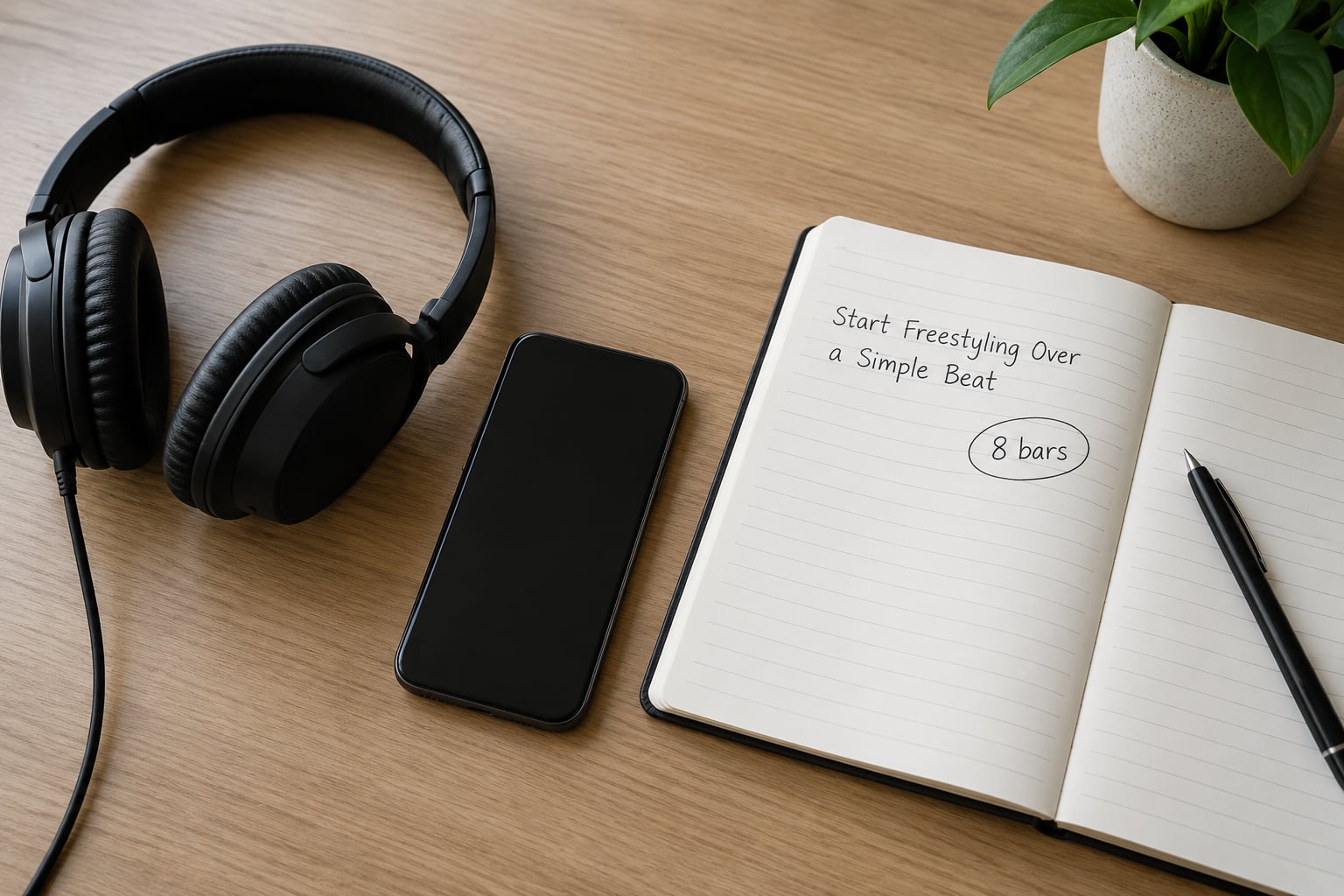
Then run this routine. First, listen for a full loop and tap the pocket. Second, mumble or talk over the beat for a full minute without rhyming at all, just describing your day out loud. Talking first wakes your mouth up and gives you words you can reuse later. Third, start on one rhyme you already know. Fourth, land that rhyme on the fourth beat of every bar, since the fourth beat is where the snare lands and where your listener’s ear is waiting.
When the loop comes back around, react to one word from your own first line. Use it, describe it, or rhyme with it. Then stop before the loop repeats. Finishing in time is a skill of its own.
If your mind goes blank mid-bar, do not stop. Repeat the last word, hum a scat syllable, or riff a simple melodic chorus over the top. The stumble does not matter as long as the flow never stops, because a flow that survives a bad line hides the bad line.
6. Record and Review One Take
Record at least one four-bar take per session, even on the phone. Your ear while rapping is unreliable; your ear on playback is not. Almost every beginner discovers that they are rushing, slurping their endings, or drifting behind the snare, and none of it was audible in the moment.
Listen back without judging the take as a verdict. You are not deciding whether you are good. You are checking five specific things: whether you started on time, whether your breath supported the whole bar, whether your diction was clear, whether your rhymes landed at bar ends, and whether your voice stayed on pitch.
Pick one of those five to fix in the next session. Fixing all five at once is how beginners get discouraged and quit.
7. Repeat With a Small Improvement Goal
Ten minutes a day, five or six days a week, is the routine that works. Not an hour on Saturday. Daily repetition builds the automatic recall that long sessions never do, because freestyling is a recall sport.
Give each session exactly one goal. Some days the goal is timing alone: no rhymes, just counting bars. Some days it is volume: sixteen bars without running out of breath. Some days it is recovery: freestyle a simple chorus every time your mind blanks, so the move becomes automatic. One goal per session means you know whether you did the work.
Once a week, freestyle the same beat for a full five minutes without stopping, recording it. That is the real test, and it is where you find out what still needs work. Track each weekly take in your notes with a date and one sentence about what happened.
Common Mistakes
Nearly every beginner hits the same six walls. Each one has a specific correction.
- Forcing rhymes. You pick a word before you pick a thought and end up saying something you would never say. Fix: start with the meaning, then find the rhyme to serve it. If the sentence bends backwards, discard it.
- Rapping too fast. Beginners cram forty syllables into a bar because silence feels like failure. Fix: slow down until your lines land clean on the fourth beat. Speed is the last thing you earn, never the first.
- Ignoring breath control. You get three lines into a bar and gasp, which breaks the pocket. Fix: plan two lines per breath early on and add a breath between every two bars rather than mid-bar.
- Copying entire songs. Learning someone else’s lyrics word for word feels like practice but teaches nothing about improvising. Fix: take a song you know cold and write filler lines between the real ones. You get the pocket without borrowing the writing.
- Judging fluency before finishing. You trip, feel embarrassed, stop, and restart. That teaches your body that stopping is normal. Fix: rule is no stopping, no matter how bad it gets. The silence is what listeners hear, not the mistake.
- Practicing without recording. You stay comfortable because you never hear yourself. Fix: one take per session, listened to once, with a single note written after.
One habit closes most of these gaps at once: rap about what is literally in front of you. This is the 8 Mile rule, and it works because specific detail is easier to improvise than abstraction. The steam from the coffee, the bus that was late, the neighbor’s dog. Specific nouns also generate rhymes faster than vague ones.
Frequently Asked Questions
What beat should a beginner use to freestyle over?
Start with a plain boom-bap loop between 85 and 95 BPM with a steady snare on beats two and four. Avoid anything with a fast trap hi-hat pattern or a busy melody, because beginners spend their attention on the beat instead of their own delivery. Loop one beat for a whole week before switching. Changing styles daily does help you stay flexible, but only after you are comfortable on one groove.
How do I freestyle rap for beginners without sounding bad at first?
Practice in private, out loud, and keep every attempt short. The first fifty takes anyone records are practice, not releases, and the ones that get posted come much later. Record for yourself, listen once, and judge only timing, breath, and clarity. Confidence shows up as a side effect of volume, so the fix is more reps in a locked room, not more thinking about how you sound.
Is freestyle rap harder than writing rap?
Freestyle is harder in the moment because nothing is pre-planned, but writing is harder to start because you sit alone with a blank page. Freestyling trains faster than writing alone because repeated improvisation builds vocabulary, timing, and recovery skills at the same time. The two work best together: freestyle daily to build the raw material, then write verses using lines that came out of your freestyles.
How long should I practice freestyling each day?
Five to ten minutes a day, most days of the week, beats a long session once a week. Freestyling is recall training, and recall improves through frequent short reps rather than marathons. Use the first three minutes to tap the beat and breathe, five minutes to freestyle four-bar rounds, and two minutes to record and review one take. Expect a noticeably less stiff delivery in two to three weeks.
What do I do when my mind goes completely blank?
Do not stop and do not restart. Repeat your last word, hum a scat syllable, or flip into a simple freestyle chorus, which is the recovery move most regulars fall back on. If you are truly stuck, describe what is literally in front of you for one bar. When you practice the blank moment on purpose, it stops being an emergency and becomes a transition you have already rehearsed.
How do I know I’m actually getting better?
Compare recordings, not feelings. Keep one take from the first week, one from week three, and one from week six, and listen back to back on the same speaker. Progress usually shows up as a shorter gap before you start, fewer dropped bars, longer stretches without a breath, and clearer rhymes at the ends of bars. If none of that moved, record more often rather than practicing longer.
Conclusion
Start tonight with the smallest possible version of this. Pick a simple beat, tap the pocket until you feel the downbeat, and finish one four-bar freestyle without trying to sound good. That is the whole task.
Then do it again tomorrow with one small goal, and record the take. Ten focused minutes a day, in private, with a notebook filling up and the flow never stopping, is how to freestyle rap for beginners actually gets solved. Raise the difficulty only after the current round feels easy.