Rap flow is where each syllable lands on the beat, a half-beat or a subdivision, and how those placements ride the drum pattern. If you want to know how to improve your rap flow, the answer is unglamorous: drill the pocket, plan your breaths, record takes and compare them, then repeat the same exercise daily. Most beginners improve in weeks, not years, because they practise with a measurable goal instead of just rapping along.
This guide is a seven-step progression. Each step has an action and a way to check that it worked, so you always know whether you actually got better or just rapped for twenty minutes.
Table of Contents
- What You Need
- Step-by-Step: How to Improve Your Rap Flow
- Step 1: Learn to stay in the pocket
- Step 2: Control your breath and phrasing
- Step 3: Practice how to improve your rap flow with subdivision
- Step 4: Strengthen diction and mouth positioning
- Step 5: Switch patterns without losing clarity
- Step 6: Record, compare, and isolate weak spots
- Step 7: Build a repeatable freestyle routine
- Common Mistakes
- Frequently Asked Questions
- How long should I practice rap flow each day?
- What tempo should I use when practicing rap flow?
- Are tongue twisters useful for improving rap flow?
- How long does it take to improve my rap flow?
- Should I practice flow while freestyling or writing lyrics?
- What exercises help rappers breathe better while rapping?
- Conclusion
What You Need
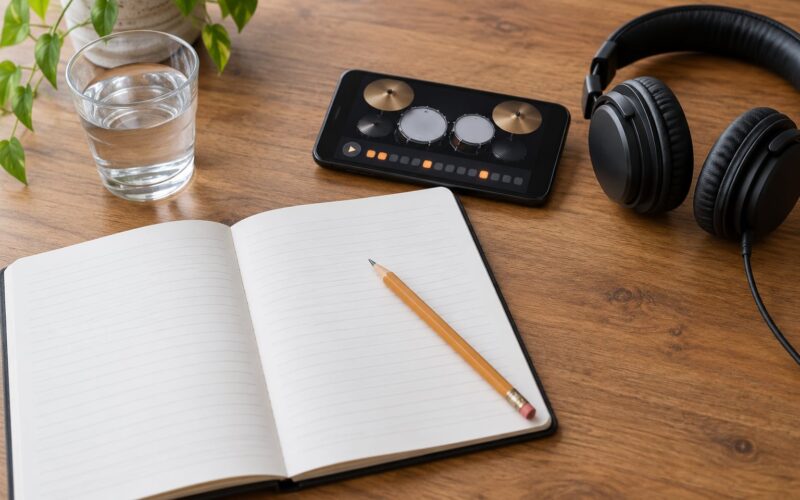
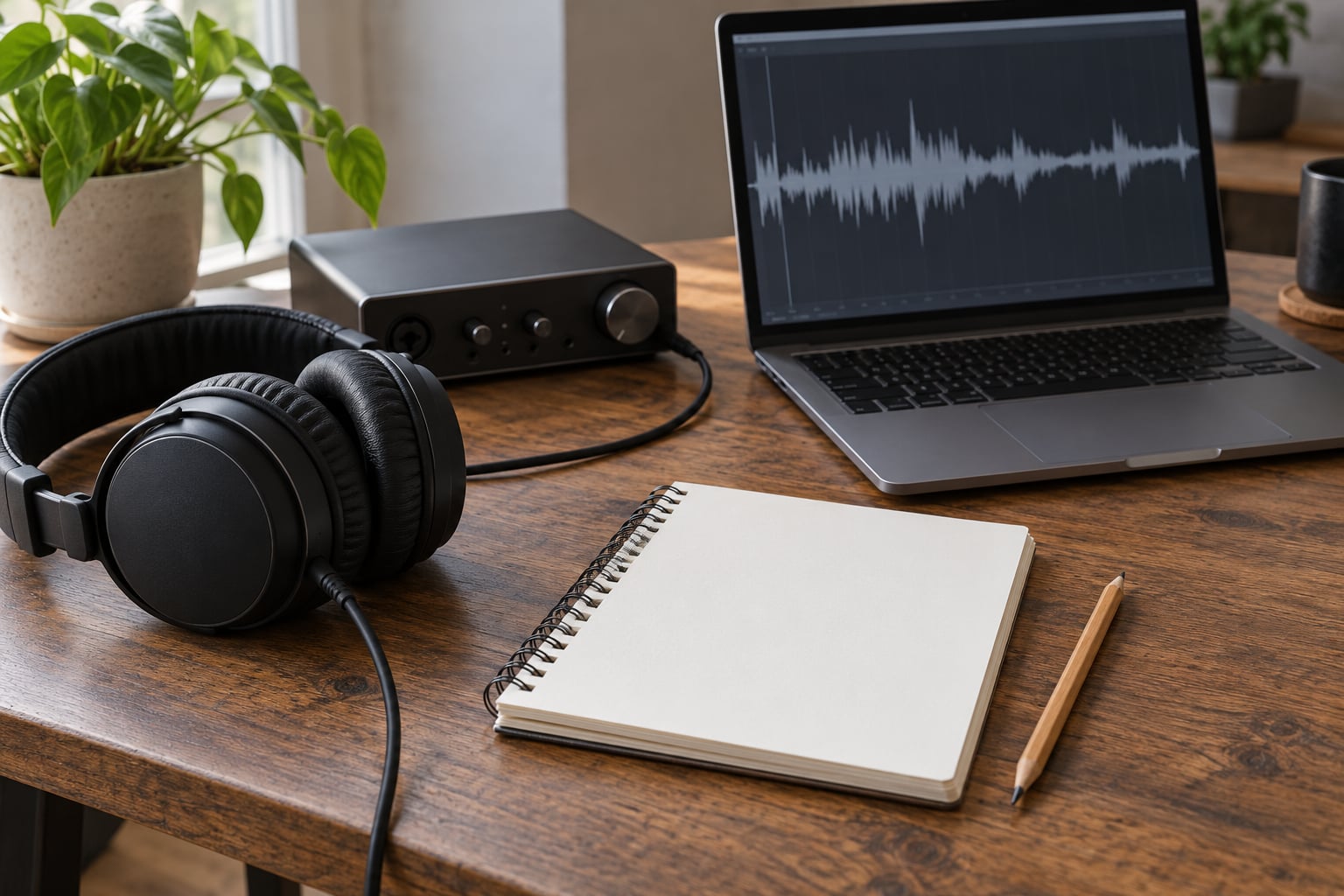
You need a beat you like, closed-back headphones, a timer or metronome app, a notebook or lyrics app, a phone recorder, and water. That is the whole list, and nothing on it is expensive.
The headphones are the one item that matters most, and only because they let you hear the track without the room. Cheap closed-back pairs work fine. If your beat has vocals, learn the exercise with an instrumental instead so the pocket is clearer.
The timer is what turns practice into practice. Most people have no idea they are rushing until they hear the last syllable of a bar landing early, and a recording will not lie to you the way your own memory does.
Optional: an audio interface and a condenser microphone once you are recording verses regularly. Skip everything else for now. Plugins, autotune and hardware are not what is holding your delivery back, and buying gear is the most common way beginners avoid practising.
Step-by-Step: How to Improve Your Rap Flow
Step 1: Learn to stay in the pocket
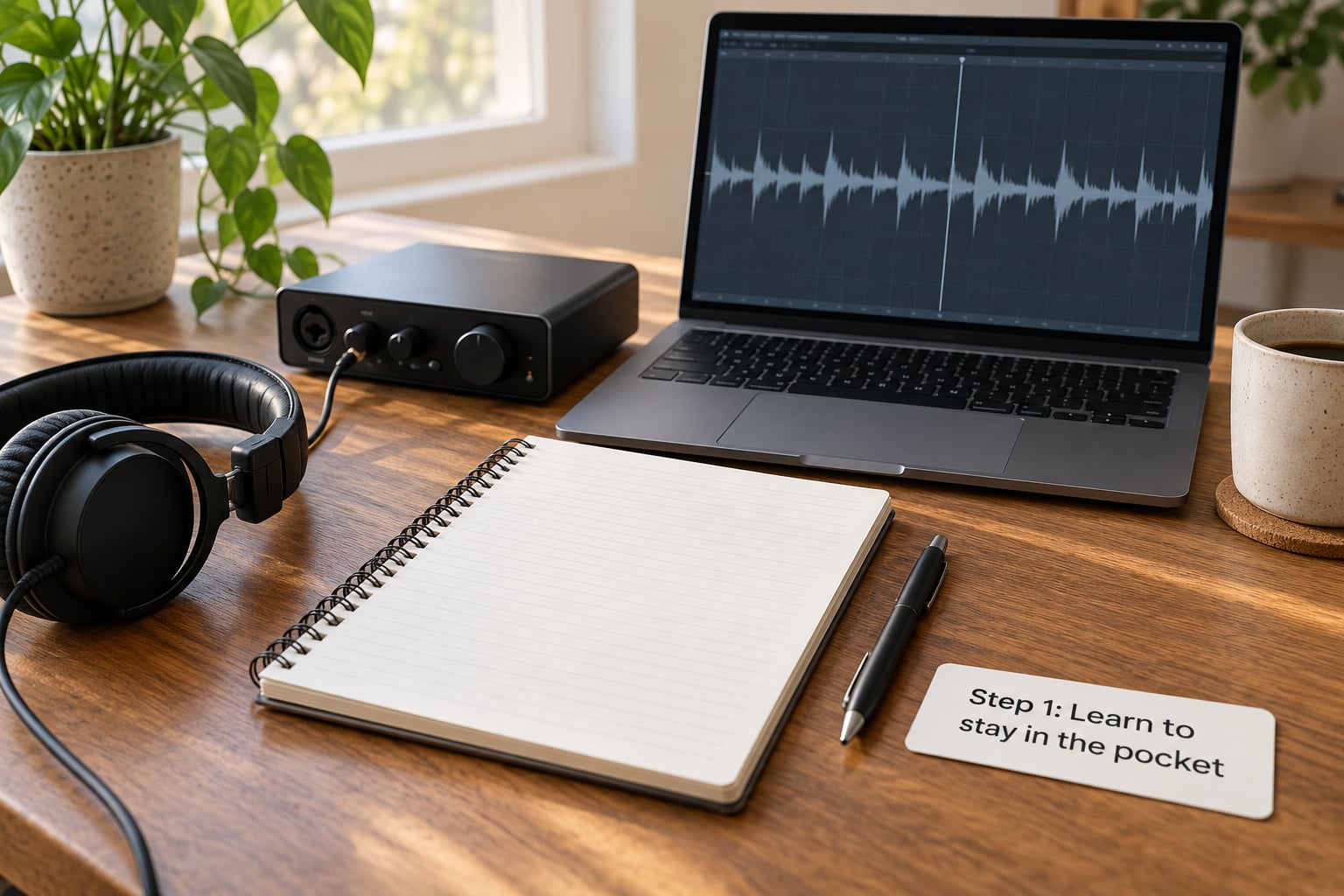
The pocket is the space the beat settles into. Your flow has to sit inside that space, not float above it, and you find it by listening to the drums before you try to rap over them.
Play the track and name what you hear: the snare usually lands on beats 2 and 4, the kick does most of the heavy lifting on 1 and 3, and the hi-hats carry the eighth notes in most modern production. Count out loud as 1-2-3-4 over the snare, then as 1-and-2-and when you are ready for more detail.
Now rap the same eight bars twice. First pass with the track at half speed, second at full speed. Third pass with the hi-hats or the percussion stripped out if you can, because a flow that holds up over a bare kick and snare is genuinely locked in.
You know it worked when you can nod your head without thinking about it and your head nod lands on the beat, not near it.
Step 2: Control your breath and phrasing
Rushing the last syllable of a bar is a breath problem far more often than it is a rhythm problem. You wrote one line too many for the space you had, so the ending gets squeezed and mumbled.
Mark your breaths in the lyrics before you ever open your mouth. A comma or a slash between phrases tells you where the breath goes, and you place it at a phrase boundary rather than mid-clause. If a line needs a breath in the middle, that line is doing too much work.
Try this drill: rap four bars, then stop. Breathe low into your belly, not up into your shoulders, and start the next four bars on the inhale rather than after it. Repeat ten times without adding any words.
You know it worked when the ends of your lines land at the same volume as the middles. If the last word of every bar is quieter, your breath is still running out.
Step 3: Practice how to improve your rap flow with subdivision
Once the pocket is steady, split it. Four beats become eight sub-beats when you count 1-and-2-and-3-and-4-and, and placing words on the ands is how a plain delivery starts to sound deliberate.
Take a simple four-bar verse and rewrite one bar so every word starts on an eighth note instead of a quarter. Say it at half tempo first, tapping the table for the ands. When the slow version is clean, run it back at full speed.
Then try the same bar with rests. Drop the word sitting on beat 3 and leave a gap instead. Silence on the beat is a real rhythmic choice, and beginners rarely make it because the bar feels empty until you get used to it.
You know it worked when you can play the subdivision quietly through the bar and nod exactly where each of your words starts.
Step 4: Strengthen diction and mouth positioning
Flow that is technically correct but unintelligible is not finished. Consonants need somewhere to go, and if your tongue, lips and jaw are lazy the syllables blur into each other at speed.
Run a few tongue twisters slowly, not fast, and exaggerate the mouth position. Red leather, yellow leather, unique New York. She sells seashells by the seashore. The goal is a clean consonant, not getting through the sentence, so slow is correct here even though it feels silly.
Next, find the vowels. Rap your eight bars and record them. Listen back and note which words lost their impact against the beat. My guess with most beginners is that the same two or three words disappear every take, usually fast consonant clusters in the middle of a bar.
Record that one bar ten times on its own. You know it worked when the previously weak word is as audible as the rest of the line.
Step 5: Switch patterns without losing clarity
Rapping every verse in the same cadence is the beginner’s version of sounding borrowed. Variation comes from note length, rests and where you let the bar end, and none of that requires complex triplet work.
Build a small library of four-bar patterns and keep them simple. One steady quarter-note pattern, one with eighth notes, one with a rest in the middle, one where you drag the last word of the bar across the beat. That is enough to rotate through.
Run them back to back over the same eight bars so your ear hears the switch. Then keep the diction test from step four in place: a new pattern that makes your words mushy is not an improvement.
You know it worked when a listener cannot predict where the fourth bar of your verse is going, but can still repeat every word after one listen.
Step 6: Record, compare, and isolate weak spots
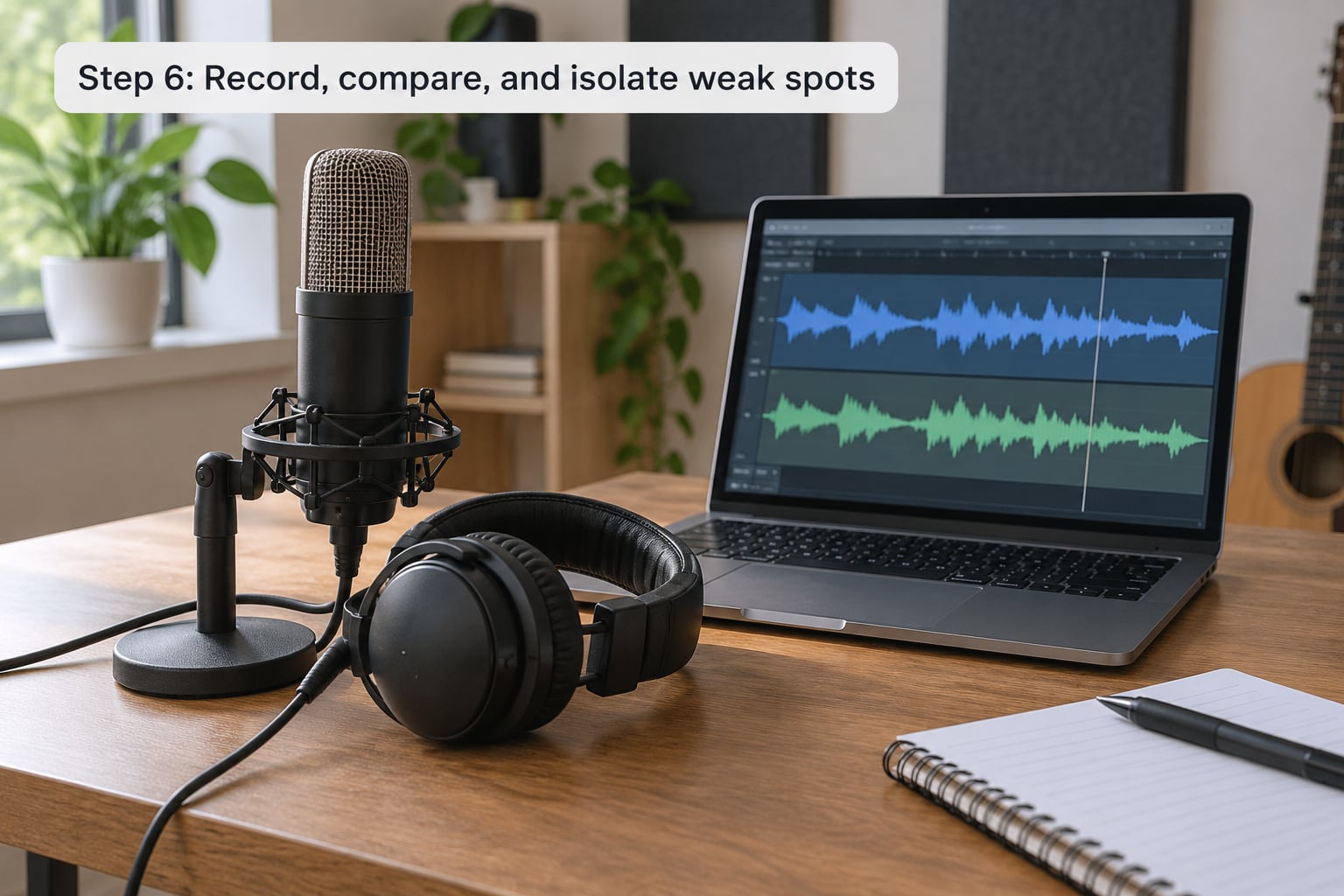
This is where the practice becomes progress. A recording shows you your timing, your breath and your intelligibility at the same time, and your ear in the moment is a much worse judge than your ear on playback.
Record three full attempts of the same eight bars without stopping. Keep all three, do not delete the bad ones, and listen back-to-back. Listen first for timing, then for breath, then for diction, in that order, because timing problems make the other two impossible to judge fairly.
Pick the best take and name one single thing to fix. Not three things. One issue per take is what makes this work, since a beginner who tries to fix six things at once usually fixes none of them and loses the thread.
You know it worked when take three is measurably tighter than take one on the thing you chose to fix, and you can say in one sentence what was different.
Step 7: Build a repeatable freestyle routine
Freestyle is a flow-training tool, not only a party skill. Because you cannot prepare the words, it forces you to fit language to a pocket in real time, which is exactly the skill written verses let you avoid.
Fifteen to twenty minutes is a complete session. Five minutes of pocket drills counting 1-2-3-4 over the beat. Three minutes of breath work with the four-bar-and-stop exercise from step two. Four minutes rotating through your pattern library. Five minutes freestyling on the spot. Two minutes recording one final eight bars.
Measure it week to week. Can you freestyle eight bars in a row without losing the pocket? Can you switch pattern mid-bar and stay clear? Keep one score per week and you will see the line move.
Drill volume matters more than session length. Daily short practice beats one long Sunday session, the same way scales beat full songs for a guitarist.
Common Mistakes
Rushing syllables to fit a bar. You wrote too many words for the space, so the delivery speeds up at the end. Cut words, move the line to a bar with more room, or accept a slower pocket for that verse.
Forcing complex patterns too early. Triplet syllables on day one train you to rush. Master a plain quarter-note flow first and add one variation at a time.
Ignoring breath placement. If you are not marking breaths in your lyrics, you are gambling with every take. Mark them in, then practise those marks.
Practising only at full speed. Everything difficult gets easier at half speed. Slow the track until the placement is unarguable, then bring it back up.
Copying one rapper’s cadence too closely. The r/makinghiphop consensus is to learn several artists and blend them, and the reason is simple: a single borrowed cadence reads as parody. Take a note pattern from one, a delivery feel from another, and write your own lyrics over the combination.
Recording without reviewing. You take twenty attempts and pick one on instinct. Play them back in order every time.
Keep sessions short and specific. Twenty minutes on pocket beats you far more than an hour of rapping along, because an hour of rapping along never tells you what to fix.
Frequently Asked Questions
How long should I practice rap flow each day?
Twenty focused minutes beats two unfocused hours. Split the session into pocket drills, breath work, pattern changes, a freestyle and one recorded take so every minute has a job. If you can only give fifteen, do steps one and two and record a single eight-bar attempt. Consistency is what builds the muscle memory, so a daily session you actually keep beats a long weekend session you skip.
What tempo should I use when practicing rap flow?
Start slow. Beats around 60 to 80 BPM let you hear each placement without rushing, which is where beginners build the habit of deliberate syllable placement. Once that feels easy, move to standard hip-hop tempo around 90 to 100 BPM, then test yourself on faster material. Practising every day only at one tempo makes your flow brittle when the beat changes.
Are tongue twisters useful for improving rap flow?
They help with diction rather than rhythm, which is still worth fixing because a technically correct flow that nobody can understand has failed. Run twisters slowly and exaggerate the mouth position instead of racing through them. The payoff shows up in the recording drill from step four, where previously mushy words become as audible as the rest of the line.
How long does it take to improve my rap flow?
A few weeks of daily practice gets you steady on a pocket you already half know. Genuinely new control over syllable placement usually takes a couple of months of consistent work, and speed to sound relaxed on unfamiliar beats takes longer again. Measure progress against your own three-take recordings from a month earlier rather than against anyone else.
Should I practice flow while freestyling or writing lyrics?
Both, for different reasons. Freestyling trains real-time adaptation because you cannot prepare the words, and it is the fastest way to stop defaulting to one borrowed cadence. Written practice is where you fix diction and breath planning, since you can mark breaths and count syllables before you record. Five minutes of each inside one twenty-minute session is a good split.
What exercises help rappers breathe better while rapping?
Breathe low into your belly rather than up into your shoulders, and start the next phrase on the inhale instead of after it. Practise it by rapping four bars, stopping, and resetting without adding any words. The test is simple: if the last word of every bar is quieter than the middle, your breath is still running out and the fix is more rest, not more air.
Conclusion
Start with one eight-bar pocket exercise today. Count 1-2-3-4 out loud over the snare, rap those eight bars at half speed, then record three attempts at full speed.
Play all three back and name the single weakest point, whether that is a rushed last syllable, a muddy consonant or a bar that drifts late. Fix only that in the next session. That loop, run daily, is how to improve your rap flow faster than any amount of rapping along ever will.