Last updated: October 2026
To mix 808s well, you do four jobs in this order: put the note in tune, clear space so it stops fighting the kick, add harmonic content so it survives on small speakers, then set the level so it does not swallow everything else. Get those four right and the low end stops turning to mud, whether you are working in a home studio or a club booth.
This takes about 30 minutes on a finished beat, and the first session will feel slow. That is normal. Almost every thread on mixing 808s online is the same argument about how many plugins to use, and the honest answer is that most 808 samples already arrive processed. Your job is balance and translation, not a stack.
Key takeaways
- Tune the 808 to the key of the track, then audition it an octave up to confirm the note.
- High-pass everything else around 35-40 Hz so only the 808 and kick own the sub range.
- Duck the 808 under each kick hit with sidechain compression, or cut gaps by hand in the bass.
- Add saturation so the note generates harmonics above its fundamental.
- Set the level last, around -3 to 0 on a K-20 scale, and leave headroom for mastering.
Table of Contents
- What You Need
- Step-by-Step
- Step 1: Set Up a Clean Mixing Session
- Step 2: Choose the Right 808 for the Track
- Step 3: Tune the 808 and Check the Bass Relationship
- Step 4: Balance the 808 Against the Kick and Drums
- Step 5: Add Saturation, Compression and EQ Carefully
- Step 6: Arrange or Automate Low-End Movement
- Step 7: Compare at Volume and on Multiple Systems
- Common Mistakes
- Frequently Asked Questions
- Conclusion
What You Need
None of this needs a big studio. You need a DAW you already know, one 808 sample or a synth preset, a kick, and a way to check the result outside your monitors.
- A DAW with a compressor that has a sidechain input. Ableton Live, Logic Pro, FL Studio and Pro Tools all qualify, and each handles the sidechain differently.
- An 808 source. A one-shot sample pitched to the key works fine. A synth like MASSIVE or Vital gives you more control over the pitch envelope later.
- A kick you are happy with. If the kick is fighting you, no amount of 808 processing fixes that.
- A reference track in the same genre, at a level you trust, so you have somewhere to point when you are guessing.
- Two playback systems. Headphones or monitors for detail, plus a phone or cheap laptop speakers. The second one tells you the truth about small-speaker translation.
- Meters. A K-20 or LUFS meter is ideal. Most DAWs ship with something adequate.
- Optional: a tuner for pitch, a spectrum analyser to spot competing low-end energy, and a soft clipper for glue.
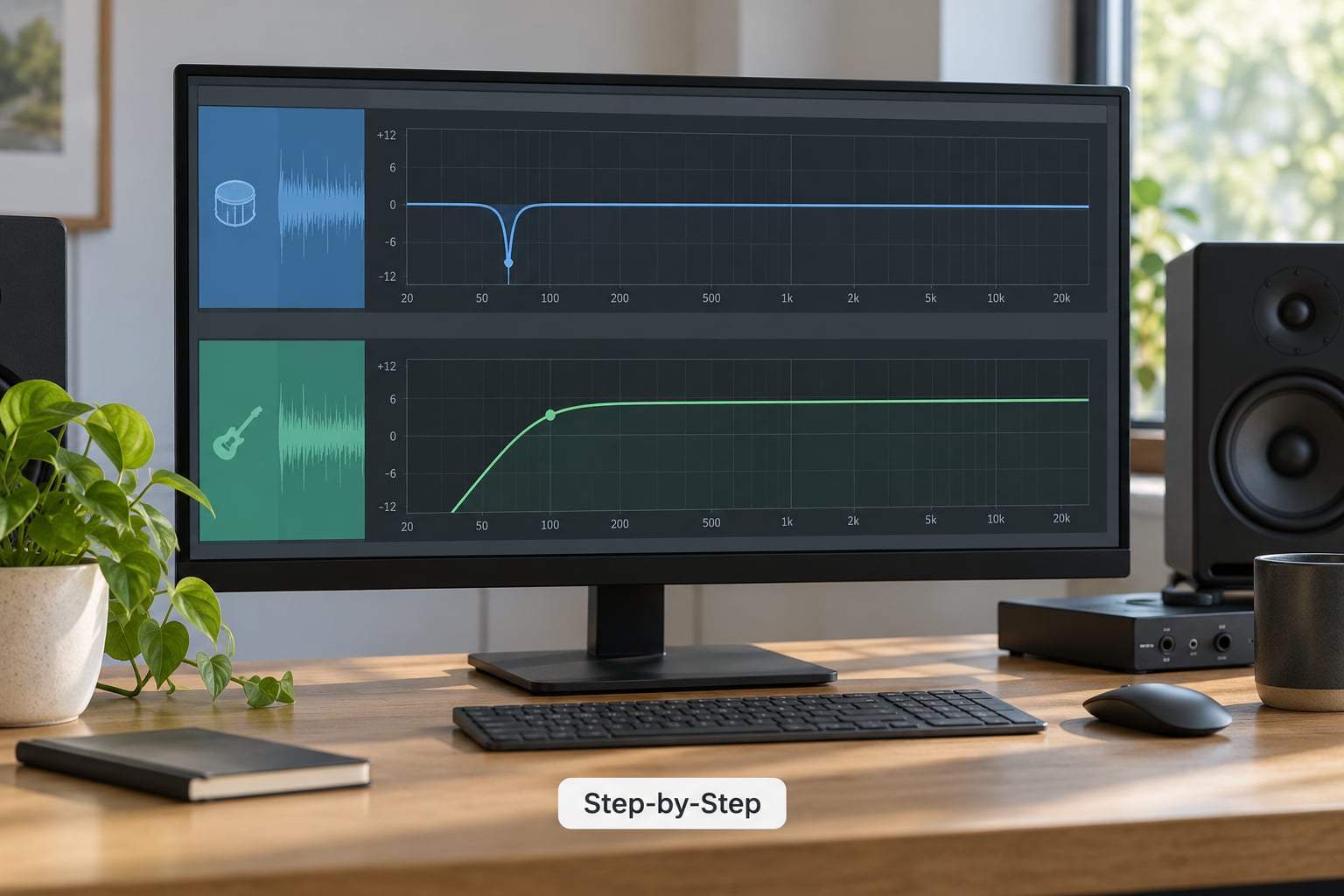
Step-by-Step
Run these in order. Each one assumes the step before it is finished, which keeps you from undoing work by moving level around later.
Step 1: Set Up a Clean Mixing Session
Open the session with the 808, kick, bass and reference on separate tracks, colour-coded so you can tell them apart at a glance. Bypass every plugin on every track so you start from the raw samples.
Set the tempo and key from the project, or import the tempo from your beat template. Make sure the 808 sample rate matches your session so nothing is being resampled and softened for no reason.
Now set a safe starting level. Pull the 808 and kick down so that a full-volume fader on each one stays inside zero, then bring them up together until the kick sits around -6 dB as a rough reference point. Mixing engineers on r/trapproduction still use that number as a starting anchor, not a finish line.
How to tell it worked: when you solo the kick alone, it should be clearly audible and nowhere near clipping. You should be able to add another 6 dB of volume later without digital clipping.
Step 2: Choose the Right 808 for the Track
An 808 sample has a length, a tuning range and a character, and those three things decide how much work your mix needs. Pick deliberately rather than grabbing the heaviest one in your folder.
Long decay suits hooks and sparse arrangements. Short decay suits dense patterns, fast trap hats and anything with a busy bassline, because the tail needs somewhere to go. The genre narrows it further: boom bap and drill want a mid-length note with more upper content, straight trap often wants a long sub, and R&B usually wants a shorter, warmer one that sits under a vocal.
Tempo and key matter because the sample’s original pitch sets the range it can reach. A sample that bottoms out at C1 has no room below that without pitching artefacts, so if your track’s root is lower, layer or transpose before you mix.
How to tell it worked: play the 808 alone for thirty seconds. If you get bored, it is too long or too plain for what the track needs.
Step 3: Tune the 808 and Check the Bass Relationship
Tune the 808 to the key of the track before you touch anything else. Out-of-tune 808s are hard to hear by ear below about 60 Hz, which is why mixes drift without anyone noticing. A line on FutureProducers that has ranked for a decade still says tuning is the biggest issue with 808s.
Use a tuner on the 808’s MIDI note or audio output, and confirm with the octave-up audition trick: pitch the sample up an octave and a little, then listen. Notes you could not judge down low become obvious up there, including whether two bass parts are pulling against each other. Then drop it back down and trust the tuner for the final setting.
Next, check the relationship with your other bass parts. If a synth bass and the 808 share the same root, they reinforce each other and you can duck the whole low end together. If the synth plays a different note at the same time, you have a choice: move one of them, or carve a gap where the two would overlap.
How to tell it worked: the low end stops wobbling against the track. If it drifts, it is a tuning issue, not a mixing issue.
Step 4: Balance the 808 Against the Kick and Drums
Give the low end one owner per frequency range. The kick and the 808 should share the sub region deliberately, and everything else should get out of the way.
Start with high-pass filters on everything except the 808 and kick. Around 35-40 Hz is a common starting point, and cutting inaudible rumble there buys you headroom for the notes you actually want to hear.
Then carve the kick out of the 808 with a sidechain compressor. Key the 808 channel to the kick bus, use a fast attack of roughly 1 ms and a medium release around 100-250 ms, and set the depth so the 808 dips 3-6 dB under each hit. Too fast a release and you get distortion on the recovery; too slow and the 808 never comes back.
A multiband compressor gives you more control: duck only the band that overlaps the kick fundamental, near 62 Hz, and leave the rest of the 808 alone. A dynamic EQ band sidechained to the kick does the same job without touching overall level. If you would rather not automate anything, cut the gaps by hand in the bass MIDI or waveform where the two collide. The arrangement-first advice on GearSpace still holds: put the 808 and kick in first, then write everything else around them.
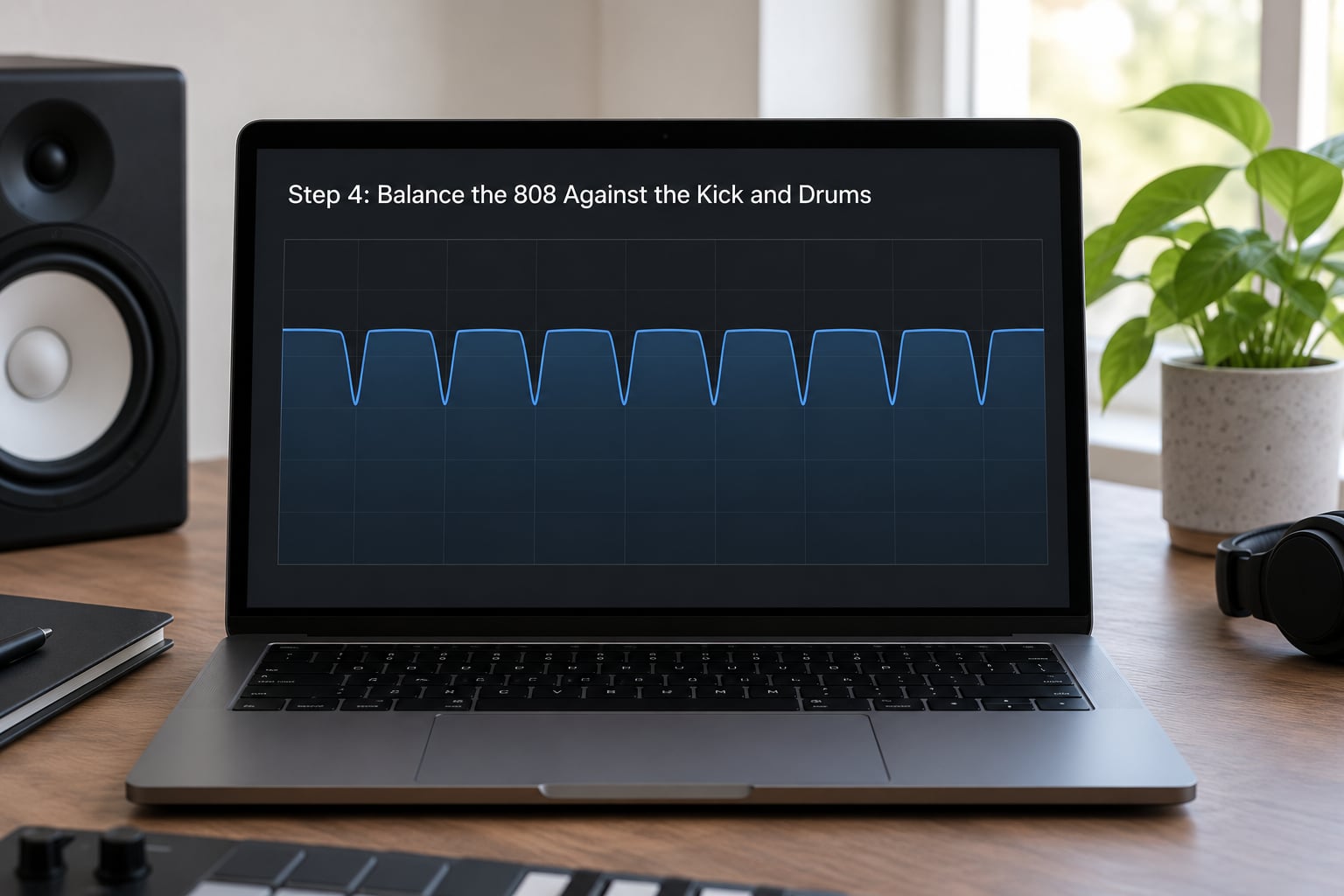
How to tell it worked: the kick cuts through on small speakers, and the 808 still reads as weight underneath it rather than a separate instrument fighting for attention.
Step 5: Add Saturation, Compression and EQ Carefully
These three tools do different jobs, and confusing them is what makes low ends sound lifeless.
Saturation adds harmonic content above the fundamental. A pure sine wave has no overtones, so a clean 808 is effectively inaudible on a phone speaker. Drive the signal lightly and generate a few upper harmonics, and your phone listener hears something even though the phone cannot reproduce the sub. Start with a soft clipper or a tube-style saturation at a low drive, raise it until you hear edges appear, then back off slightly.
EQ shapes tone. Use it to clear a resonant peak around 60-80 Hz, or to shelve a little weight at 100 Hz if the note needs definition. Avoid narrow cuts inside the fundamental range, because they make the note thin on big systems while sounding like a fix on small ones.
Compression controls volume, not colour. Set it up after the 808 level already sits where you want it, and keep the ratio gentle, around 2:1 to 3:1, with a few dB of gain reduction on the peaks. Compressing hard flattens the note and eats the transient that gives it attack. Compress the 808, not the kick: pumping the kick is a fast way to make a beat sound amateur.
As a general rule, apply EQ before compression and saturation last, so the compressor is reacting to the final tone.
How to tell it worked: on the phone, the 808 is now implied rather than missing. On the monitors, it is still a clean sine, not a crushed square wave.
Step 6: Arrange or Automate Low-End Movement
The most effective low-end processing is often a note that plays at a different time. Nothing fixes mud like removing energy.
Shorten the decay so notes do not overlap. If two tails ring into each other, the sub becomes a drone rather than a rhythm, and no EQ move recovers the definition. Cut the note, or add a fade at the tail.
Automate the volume so the 808 drops out in the quiet parts of a verse and comes up hard on the hook. Move the bassline up an octave while the sub holds the root, which opens space without thinning the track. Filter movement works too: a short high-pass sweep at the end of each phrase clears the room before the next bar.
If you want slides and glides, design the pitch envelope on a synth rather than pitching a one-shot. Draw a rising curve from the note below into the target note over a beat or two, set a long enough portamento time, and automate the destination. That is the technique that separates a held 808 from a moving one, and it does not work with a static sample.
How to tell it worked: the low end breathes. Some bars feel empty and some feel heavy, which is exactly what you want.
Step 7: Compare at Volume and on Multiple Systems
A finished 808 is not done until you have checked it somewhere other than where you made it.
Level-match your mix against the reference, not by eye but by ear and meter, so you are comparing the same loudness. Then check the mix in mono. Anything below about 100 Hz should be mono, because club systems and phone playback sum to mono and any stereo information down there cancels itself out.
Play it on a phone, a laptop and a car system if you have access to one. Phone speakers cannot reproduce much below 200 Hz and will tell you immediately whether your saturation is doing its job. A car system is the opposite test: it will tell you if you have overdone the sub and turned the whole track to a boom.
Look at the master meter for clipping and for headroom. If your loudness meter reads close to zero on the K-20 scale before mastering, you have nowhere to go. Most engineers in the r/trapproduction threads describe receiving mixes with the 808 pushed so hard that mastering engineers have to pull it back down.
How to tell it worked: the note reads as weight and punch on headphones, survives on a phone, and does not blur the kick anywhere in between.
Common Mistakes
1. Treating the 808 like any other instrument in the mix. It lives in the frequency range where everything else wants to live. Players on r/Logic_Studio describe making 808s hit like the pros as a plateau they never quite broke through, and it usually comes down to treating the low end as a shared resource rather than a single element.
Fix: build the low end first. 808 and kick together, then everything else.
2. Letting the 808 dominate and pushing everything else up to compete. This is the most common complaint in every producer forum on the topic. A mix where the bass is the loudest thing by a wide margin leaves no room for the rest.
Fix: pull the 808 until you can hear the bassline and the vocal without straining, then decide if you actually want it that prominent.
3. Stacking distortion, compression and EQ until the note is dead. The result is loud, flat and lifeless, and it is easy to do because each plugin felt helpful at the time.
Fix: start over from the raw sample if you have to. Fewer moves, each one deliberate.
4. Ignoring tuning. Below about 60 Hz you cannot reliably hear pitch, so an out-of-tune note feels like instability without an obvious cause.
Fix: use the octave-up audition and a tuner, every time.
5. Leaving notes overlapping into a continuous drone. Long tails blur the pattern and destroy the separation between beats.
Fix: shorten the decay or fade the tail so each note ends before the next begins.
6. Burning all your headroom before the mix is finished. A heavily limited 808 consumes the track’s entire loudness budget, and the mastering engineer has to undo your work.
Fix: leave around 6 dB of headroom and aim for roughly -3 to 0 on a K-20 scale while mixing, which is the figure that circulates most widely among working engineers.
Frequently Asked Questions
Should the 808 be louder than the kick?
Usually not by much. The kick carries the transient and the 808 carries the weight, so if the 808 sits well above the kick, the kick stops reading. Pull the 808 down until the kick is clearly in front, then judge from a metre away and from a phone. If the kick disappears on small speakers, add harmonics to the 808 rather than turning it up.
Do 808s need to be tuned to the key of the song?
Yes, and this is the step most beginners skip. An 808 that is a semitone off is nearly impossible to hear by ear below about 60 Hz, but the whole low end feels loose because of it. Tune the sample to the key of the track, then check it by pitching it up an octave and listening for drift. Tune it before any compression, because compression locks in whatever interval you give it.
Is sidechain compression necessary when mixing 808s?
Not always, but it solves the most common problem, which is the 808 and kick occupying the same space. A sidechain compressor keyed to the kick ducks the 808 under every hit, usually 3-6 dB, with a fast attack around 1 ms and a release of 100-250 ms. If you prefer no automation, cutting small gaps in the bass MIDI where the two collide works just as well, and some engineers prefer it.
How much compression should I use on an 808?
Less than you think. Use a gentle ratio of around 2:1 to 3:1 and let the peaks pull down only a few dB. Heavy compression flattens the note and removes the attack that makes it feel powerful, which is the opposite of what you want. Compress the 808 rather than the kick, and always set the fader level before you compress so the compressor is only evening out a level you already chose.
Should I EQ the 808 before or after compression?
Before, in almost every case. EQ decides the shape of the tone, compression then reacts to that final shape. If you compress first and EQ afterwards, the compressor will have already made its decisions based on frequencies you have since changed. The usual order is tuning, high-pass filtering, EQ, sidechain compression, saturation, then level. Saturation goes last because it adds upper harmonics you want to hear.
When should I leave the 808 alone during mixing?
More often than most people expect. Good 808 samples come pre-processed and already balanced, so a lot of mixes are ruined by well-meaning plugins on a sound that needed nothing. Leave it alone when the note is in tune, sits well against the kick, translates to a phone speaker and sits at a sensible level. Add processing only when you can name the specific problem you are trying to fix.
Conclusion
Start with the 808 and the kick alone. Tune the note, high-pass the rest of the arrangement around 35-40 Hz, duck the 808 under each kick hit, add light saturation for small speakers, set the level at the end and check it on a phone before you call it finished. That is the whole method, and every plugin beyond it has to earn its place.