What does a music producer actually do? A producer turns a raw idea into a finished record: they shape the sound, make the creative calls on arrangement and performance, run the sessions, and sign off on the final delivery. The job sits between art direction, engineering and admin, and no two producers do the same slice of it.
Most people picture a producer behind a mixing console, and that is half the picture. The other half happens days before anyone plugs in a microphone: choosing reference tracks, building a session plan, hiring players, agreeing what the song is supposed to feel like. Get that wrong and the tracking day is wasted.
Table of Contents
- What Does a Music Producer Actually Do?
- How Is a Music Producer Different from a Writer or Engineer?
- What Does a Producer Do During Each Stage of Making a Song?
- How Producers Shape an Artist’s Sound
- What Does a Music Producer Do in the Studio?
- Do Music Producers Edit and Mix the Song?
- What Does a Producer Do Before and After the Release?
- How Much Does a Music Producer Do on a Record?
- How Can You Become a Music Producer?
- Frequently Asked Questions
- Is a music producer the same person as a sound engineer?
- Do music producers need to play every instrument?
- What does a music producer get paid?
- How do I know a producer’s exact role on a song?
- Do music producers work only in recording studios?
- What software and equipment does a beginner music producer need?
- Conclusion
What Does a Music Producer Actually Do?
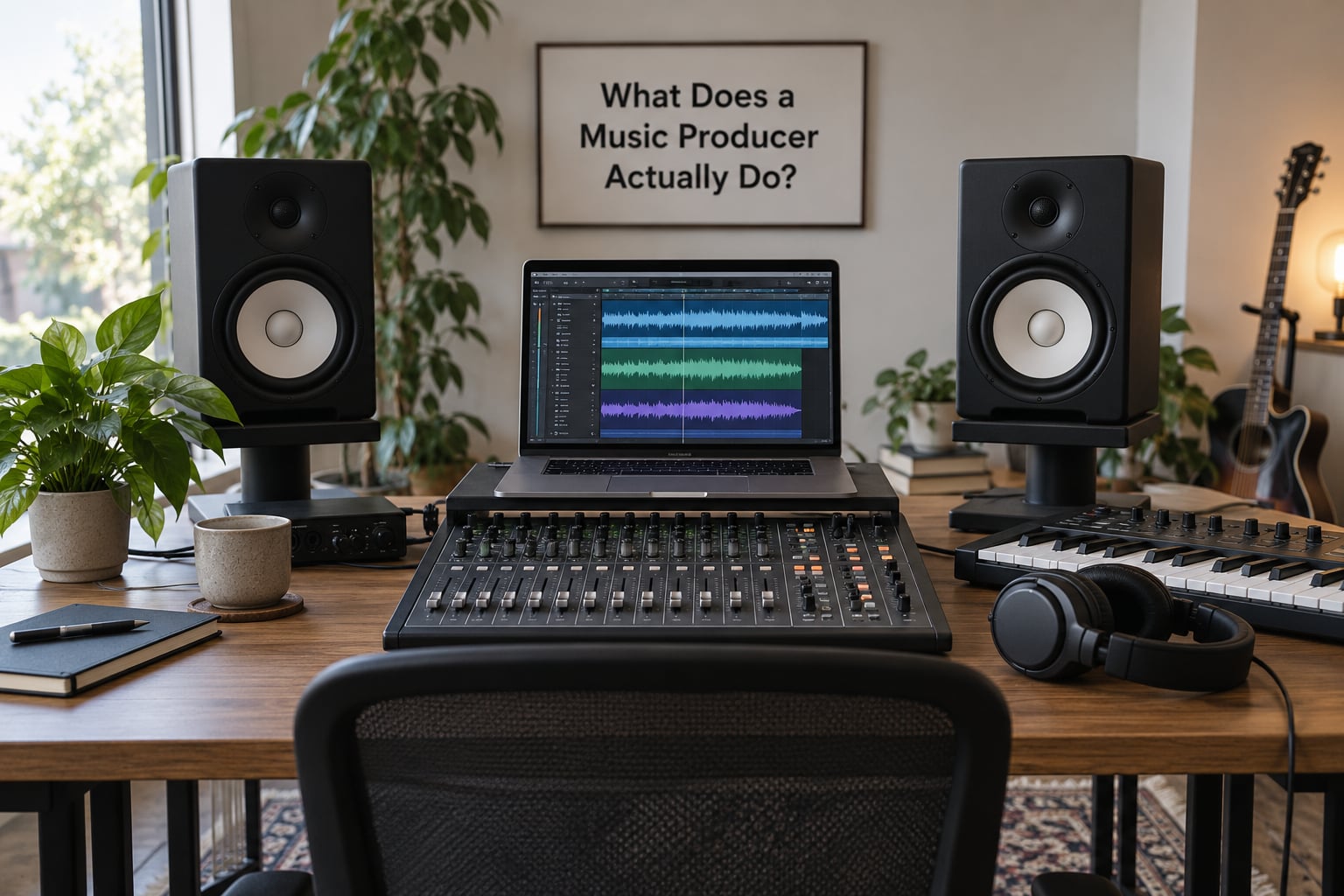
The short version: a producer owns the decisions. Someone has to decide what the chorus sounds like in year one of a career, and on most records that someone is the producer.
Five responsibilities cover nearly every job description I’ve seen:
- Creative direction: deciding the genre, tempo, instrumentation and overall mood, then holding that line across dozens of micro-decisions.
- Songwriting and arrangement: shaping structure, sometimes writing or co-writing the hook, and deciding which instrument plays what part.
- Performance coaching: getting a vocalist or band to the take they did at home, which is usually three quarters of a producer’s studio time.
- Project management: booking studio time, keeping the budget, hiring session musicians, tracking who owns what.
- Technical supervision: overseeing recording, edits, mix and mastering, and signing off on the delivered files.
How much of that you actually do depends on the setup. In hip-hop, “producer” usually means beat-maker, someone who delivers an instrumental and often does nothing else. On a small indie record, one person may produce, engineer, mix and master the whole project from a bedroom in 2026.
Traditional studio producer vs bedroom producer
The older model put a producer between the artist and a room full of specialists: an engineer on the desk, a mix engineer later, a mastering house after that. Producers made records for other people’s labels and their income depended on getting signed artists. That world still exists, but cheap DAW licenses and good preamps have emptied it out.
A bedroom producer today writes, records vocals, mixes and masters, often for artists who are friends. Faster and cheaper, yes, but nobody is there to say the bridge is too long. Whether that is a problem depends entirely on the record.
How Is a Music Producer Different from a Writer or Engineer?
They do different parts of the same job. The confusion is understandable because on most small records one person holds several titles, but the division of labour is worth knowing before you hire anyone.
| Role | Main job | Delivers |
|---|---|---|
| Songwriter | Writes the words and melody | Lyrics, topline, chord chart |
| Producer | Creative and technical supervision of the record | Arrangement, sessions, sonic decisions, sign-off |
| Recording engineer | Captures audio: mics, preamps, gain, levels | Clean multitrack recordings |
| Mixing engineer | Balances and processes everything into one record | A mix, plus stems on request |
| Mastering engineer | Final polish and loudness for release | A mastered file at release specs |
| Executive producer | Oversight, budget and greenlight, sometimes uncredited | A funded, approved project |
| Music director | Chooses repertoire and arranges performances, often live or for film | A score or an arranged set |
Two clarifications worth keeping. A music director arranges music that already exists; a producer makes records where nothing exists yet. And in film and television the term “producer” means something else entirely, which is a large part of why this search page looks the way it does.
Recording versus mixing is the one engineers themselves get asked about constantly: the recording engineer captures a performance with nothing added, while the mixing engineer decides how every element sits together and how loud the whole thing is.
What Does a Producer Do During Each Stage of Making a Song?
A record moves in a predictable order, and the producer has a different job at every stop.
Pre-production. Listening to demos, choosing the songs, agreeing tempo and key, building a reference folder of two or three tracks that describe the destination. This is also where the producer pushes back. If a song is not ready to record, a good producer says so in week one rather than week six.
Tracking. Laying down the rhythm section or the scratch vocal first, because everything after it depends on that foundation. The producer listens for performance problems the musician cannot hear, and decides when a take is done rather than when the musician is.
Overdubs and editing. Patching, comping, tightening arrangements, replacing weak notes. Often the point where a song stops sounding like a demo.
Mixing. Balance first, then effects, then automation, then the small moves nobody can name but everybody feels. A producer reviews the mix, asks for specific changes, and stops the revisions at a point where further tweaks cost more than they add.
Mastering and delivery. Sending the approved mix to an engineer who makes it competitive on streaming and radio without wrecking it, then checking what comes back.
How Producers Shape an Artist’s Sound
A record’s sound is a set of choices that are technically available and artistically right. A producer’s job is mostly narrowing that list.
Genre and tempo. Often a deliberate step away from what the artist does best. Producers often slow a track down a few BPM because a performer rushing is the most common thing amateur demos get wrong.
Instrumentation. Leaving space is the recurring instruction. Half of all “make it bigger” notes are really a request to remove something.
Arrangement. Energy across a song has to rise and fall on purpose. A producer who cannot write the arrangement writes the parts.
Vocal presentation. Tone, phrasing, breath, how close the mic should be. Most of this is coached rather than processed.
References. Two or three named tracks do more work than any amount of adjectives, and they cut argument time in a session.
Aesthetic. Saturation or clean digital, old drum machines or live players, lo-fi or glossy. That choice tends to be the most recognisable thing about a producer’s records.
What Does a Music Producer Do in the Studio?
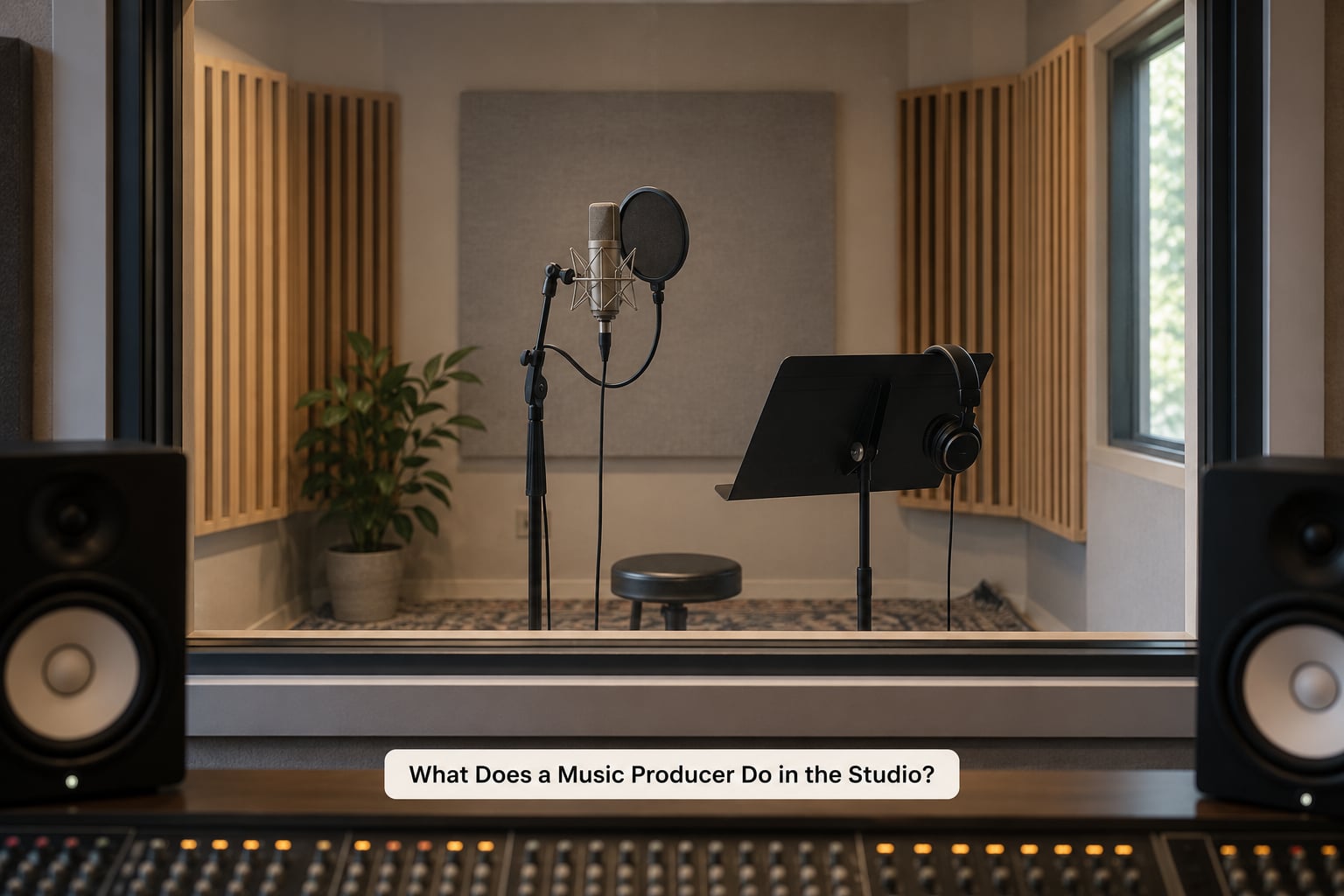
Before the session: the producer confirms the song list, tells the engineer what the record should sound like, checks that everyone has the parts, and writes down what each track is meant to be. Missing preparation is the usual reason a day gets wasted.
During it, the producer talks more than anyone else in the room. Direction tends to be specific and repeatable: sing again but stop before the beat, do the last line quieter, try it half tempo, or let me hear how you’d say it to one person. Vague notes like “more energy” waste takes.
They also stop performances that are good but unusable, protect the artist from running out of voice, and make the call on takes when an engineer would happily keep recording.
What does a music producer actually do while the band plays? Almost nothing visible. They listen, they count, and they keep one eye on the clock and one on the artist’s mood.
After the session: naming and organising files, marking comps, writing down what still needs recording, and telling the engineer what happens next. Producers who label nothing spend a day a week hunting for things they know they have.
Do Music Producers Edit and Mix the Song?
Often yes, though the split varies wildly. Editing comes first and is rarely disputed: comping the best vocal moments into one take, tightening timing, removing mistakes, cleaning up an arrangement. Producers talk about riding vocals, which means automating the fader so quiet syllables stop vanishing under the beat.
Mixing is where roles blur. A producer who built the record will usually mix it or mix it with the engineer, because they know what every sound was supposed to do. A producer who arrived late may hear it cold and hand it over instead. Tuning, compression and effects choices may sit with either of them.
The forum complaint worth taking seriously is that a producer changed a mix without explaining it. That happens, and it is usually the producer’s fault for not agreeing scope first. What a producer is allowed to change should be written down at the start: arrangement and performance are fair game, the artist’s voice and lyrics need a conversation, and mastering someone else’s mix because you thought it needed it is not your call.
What Does a Producer Do Before and After the Release?
The unglamorous half of the job is where projects actually succeed or stall.
Before: writing the budget, checking contracts, agreeing splits and points in writing, booking studio time, and finding players when the artist cannot play the part themselves. A producer spending three weeks of admin on a small record will produce three records a year; one rushing the paperwork runs out of money by the second single.
After: approving the master, checking metadata and credits, delivering stems and session files, and keeping the paperwork for years. Producers who hand over a folder with named, tidy tracks and a short written note are the ones artists recommend to friends.
Pay is layered too. A flat fee or day rate covers time, points cover a share of the recording’s revenue, and a producer who writes has publishing. The “50 percent of the song” idea that circulates online is not a standard and rarely offered, because a song is not a fixed pie to divide.
How Much Does a Music Producer Do on a Record?
Somebody produces a record as its creator, playing most instruments and writing most of it. Somebody else directs a singer over a beat they did not touch. Both are real producers, and the credit on the sleeve tells you almost nothing about the hours involved.
That vagueness creates real problems. A credit is a statement that the person shaped the record’s sound, so it should reflect substantial creative involvement. An executive producer overseeing a label budget, a project manager handling logistics and an unpaid favour for a friend are different contributions and should be described honestly rather than all called production.
If you are an artist reading a producer’s list of past work, the useful questions are simple: which tracks, what was your part on each, can I hear it, and will you explain one decision in detail. Producers who can do that are usually the good ones.
How Can You Become a Music Producer?
Start with listening, not gear. Play finished records in the genre you want to make and write down what each one does. Two years of that teaches more than a month of tutorial videos.
Then learn one digital audio workstation properly. Pro Tools, Logic Pro and Ableton Live all cover the job, and every feature is not required. Recording, editing, arranging and exporting is the whole starting toolkit.
After that, build small and finish things. A finished rough track teaches arrangement and revision, and a folder of ten of them teaches you more than a folder of fifty loops. Play musicians, record them, fix problems you did not create, and get used to the admin, because the admin is half the job.
Collaborate early, even with people at your level. Producing alone teaches you your habits and nobody else’s. Most working producers got their breaks by making someone else’s record better, and there is no age limit on starting, which is the single most common question in beginner forums.
Frequently Asked Questions
Is a music producer the same person as a sound engineer?
Usually on small projects, rarely on large ones. A producer decides what the record should sound like and directs the people making it. An engineer is responsible for capturing and shaping the audio itself: microphones, preamps, levels, signal flow. Many producers can engineer, and plenty of engineers produce, so check what someone is actually doing before you hire them.
Do music producers need to play every instrument?
No. They need enough instrument knowledge to write and arrange parts, to communicate with players, and to hear what is missing in a mix. That usually means functional competence on one or two instruments plus the ability to sketch ideas by ear or on a MIDI keyboard. The hip-hop beat-maker is a separate route that mostly does not require this at all.
What does a music producer get paid?
It varies by project. A flat fee per song or a day rate covers time and is most common. Larger records pay points, a percentage of recording revenue, or a share of publishing when the producer wrote the song. Fees rise with the producer’s track record and the size of the sessions. Always agree fee, points, ownership and delivery in writing before anyone records.
How do I know a producer’s exact role on a song?
Ask them directly, per song. A producer co-producing one track on your record may have written the hook and arranged nothing on the next. Credits are vague by convention. The quickest check is to ask them to walk you through three decisions they made on the record, and to say which parts were entirely yours.
Do music producers work only in recording studios?
Rarely now. Studios are still used for tracking with live players, but a lot of production happens in home studios, bedrooms and treated spare rooms. Vocal production, editing and mixing work well in a treated room. Producers also spend real time on pre-production, paperwork and reviewing mixes remotely, so only part of the job happens in a control room.
What software and equipment does a beginner music producer need?
A computer, headphones, a decent USB or audio interface, one microphone, and a DAW. Add a MIDI keyboard if you write melodies, and treat the room before buying a second microphone. Plugins can wait, since stock plugins on Pro Tools, Logic Pro or Ableton Live cover most of what a first record needs.
Conclusion
A producer guides the musical and technical creation of a record, making the creative calls and holding the project together from demo to delivery. Everything from tempo to take selection to who gets paid falls under that one heading.
So the best first step is to take a finished track you like and analyse it end to end: pick apart the concept, the arrangement, every mix decision, and map who likely made each one. That exercise teaches more in a weekend than a month of watching tutorials, and it builds the ear the job actually runs on.