A neighboring rights royalty is money paid to the performers on a sound recording and to the owner of that master recording when the track is played on radio, television, cable, or in a public place. It is separate from the songwriting royalty that goes to writers and publishers, and for many working musicians it is the only royalty they can claim on somebody else’s song.
That distinction confuses more people than any other part of the royalty system. Artists hear a song on a playlist, assume the songwriter earned from it, and never realize a different payment was sitting there with their name on it. Understanding what a neighboring rights royalty is, and more importantly who collects it, is worth real money.
Table of Contents
- What Is a Neighboring Rights Royalty?
- Who Gets Paid a Neighboring Rights Royalty?
- What Kind of Music Use Can Trigger Payment?
- How Is a Neighboring Rights Royalty Calculated?
- How Do Artists and Musicians Get Paid?
- What Is the Difference Between Neighboring Rights and Other Music Royalties?
- Does Every Country Handle Neighboring Rights the Same Way?
- How Can a Musician Check or Claim These Royalties?
- Frequently Asked Questions
- Do neighboring rights cover songwriting or the sound recording?
- Can a musician claim neighboring rights without joining a performing rights organization?
- Are neighboring right royalties the same as producer royalties?
- How long does it take to receive neighboring rights payments?
- What should I do if my neighboring rights income is missing from a statement?
- Key Takeaways
What Is a Neighboring Rights Royalty?
A neighboring rights royalty is a payment to performing artists and master recording owners when a sound recording is played publicly or broadcast. Copyright law gives those two groups their own rights in the recording itself, separate from the rights in the song. The payment arrives when a radio station, a TV channel, a streaming service, or a venue such as a bar or a gym uses the track.
In France the same idea is written as droits voisins, and UK sources spell it neighbouring rights. Both refer to the same bundle of rights: performers’ rights for the musicians who played on the recording, and producers’ rights for whoever financed and owns the master.
Three other payments sit next to it and are easy to mix up. Performance royalties go to songwriters and publishers when the composition is played publicly. Mechanical royalties follow the reproduction of the composition, usually a download or a physical sale. Sync money comes from putting the song in a film, an advert, or a game. A neighboring rights royalty is the only one of the four that is triggered purely by the recording being heard.
Who Gets Paid a Neighboring Rights Royalty?
Two groups qualify. The performers are the musicians, singers, and featured artists who can be heard on the recording. The master owner is the person or company that owns the sound recording itself, often the label, sometimes the producer, frequently an independent artist who self-released it.
Most countries split that money roughly 50/50 between the two sides. That is a headline split, not a guarantee. The performing half is often divided again between everyone credited on the track according to a split sheet or a contractual agreement, which is why a drummer on a track with three other players receives a fraction of a fraction.
An artist who both performed and owns the master is in the unusual position of collecting both halves. Several community members on music business forums describe this as the practical win for independent artists: one registration that reaches the performer pool and one that reaches the master pool, often with two different administrators.
Session musicians come out ahead here. As RouteNote puts it, neighbouring rights are the one royalty a session player can claim even when they wrote nothing. Nothing else on the royalty sheet pays a player for playing.
What Kind of Music Use Can Trigger Payment?
What counts as a protected use is set nationally, so the list below is a general pattern rather than a legal guarantee. What it shows clearly is that the trigger is always the same: somebody uses the recording in public, without asking, and the usage is reported or estimated.
| Use of the recording | What triggers payment | How the usage is usually tracked |
|---|---|---|
| On-demand streaming, where a listener picks the track | A set portion of the subscriber fee is allocated to recordings | Per-song reporting from the service |
| Non-interactive streaming and internet radio | A fixed monthly payment from the platform | Platform logs, or market share allocation when logs are missing |
| Terrestrial radio broadcast outside the United States | An annual fee paid by the broadcaster to a collection society | Station logs, sometimes spot-checked by the society |
| Television and cable transmission | A fee based on the broadcaster’s use of music | Broadcast logs |
| Public performance in shops, bars, gyms, and cafés | A venue licence or a per-track fee paid by a music supplier | Reported by the supplier or the venue |
| Private copying, including blank media and downloads | A levy collected on blank media or hardware | Market-level levy, spread by a formula rather than per song |
| Live shows and covers in a small venue | Usually not a neighboring rights payment at all | Live work is handled through performing rights and venue rules instead |
| User-generated clips and short-form video | Varies sharply by platform and by country | Platform matching systems, with a growing volume of disputes |
The last two rows catch people out. A cover performed in a bar is a live performance, which belongs to the performing rights side of the ledger rather than to neighboring rights. And a fifteen-second clip of a song in a social post may or may not generate anything, depending on where the viewer is and which platform is involved.
How Is a Neighboring Rights Royalty Calculated?
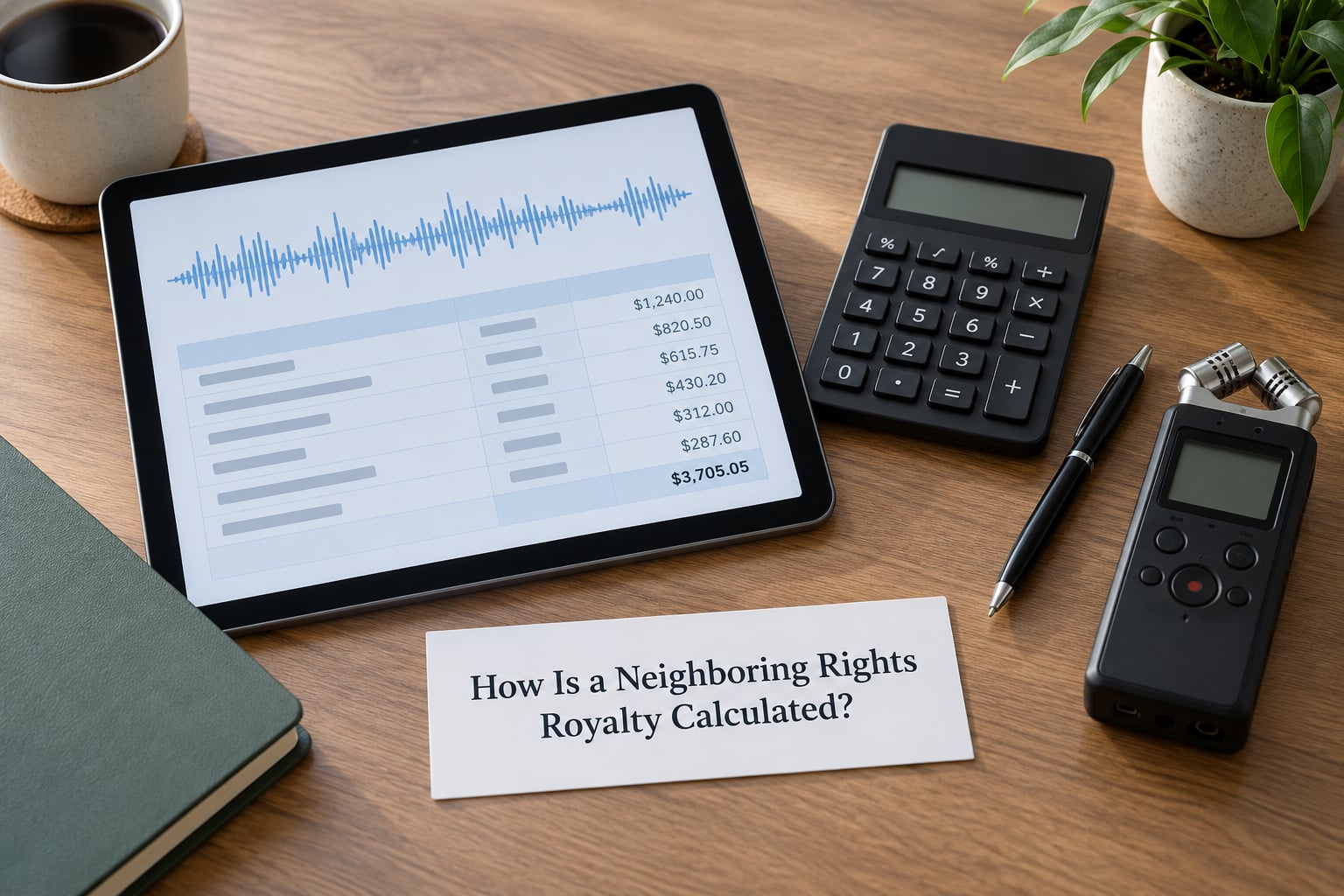
There is no single formula you can apply yourself, because the rate comes from a tariff, a licence deal, or a court decision in your country. What you can do is understand the four moving parts: the revenue, the rate, your share of the recording, and what gets taken out in administration.
Start with revenue. A platform or broadcaster pays a fixed sum into a collective pot for a period, usually a calendar year. That pot is not per track, because nobody streams one song to one listener and splits a fee on the spot.
Next comes the rate or statutory formula. Instead of a percentage, many tariffs express the split directly: this share of the fee for performers, that share for master owners, with the balance covering administration. Elsewhere it works as a percentage of a defined revenue base, which is why two neighboring countries can pay very different amounts for the same airplay.
Then your ownership share, which is where the math gets personal. Your slice of the performer half depends on your split sheet, and the slice of the master half depends on how many masters share that recording credit line. A record with twenty credited performers divides the performer half twenty ways before anything is left for costs.
Finally, administration costs are deducted, along with any unmatched money that gets redistributed across members by market share. A fictional example makes the shape clearer: if a society’s annual pool for a category is 100,000, a 50/50 tariff assigns 50,000 to the performer side, your 10 percent split of that side gives you 5,000, and administration takes a documented percentage before distribution. If only 60 percent of the pool was claimed, the unclaimed remainder is often spread by market share, so members who did register may receive more on the same statement without earning an extra stream.
How a Neighboring Rights Royalty Gets Calculated
Step by step, a qualifying use of your recording turns into a number on a statement. The broadcaster or platform reports the use, or the society estimates it from market share figures. The society matches your recording to that usage through identifying codes, title, and contributor credits. The tariff then divides the pot between the performer side and the master side.
Your share is applied next, using the split you registered. Administration and distribution costs come off, and the result is what lands in your account. That final figure is often lower than the headline rate, mostly because of the split, the deductions, and the fact that some of the pot was never claimed by anyone at all.
How Do Artists and Musicians Get Paid?
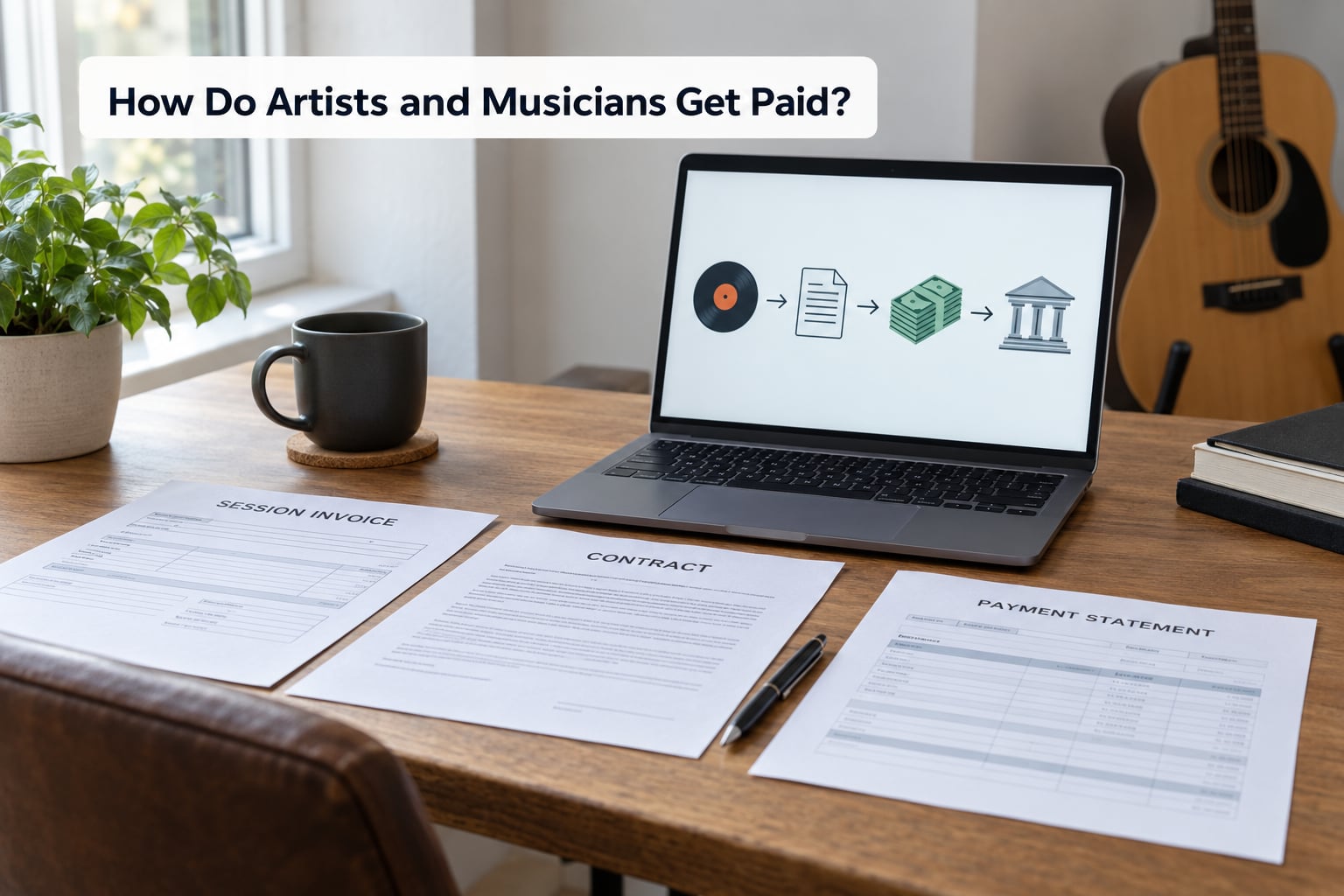
The chain has more steps than most artists expect, and every handoff is a place where money can stop. Platform or broadcaster revenue goes to a collection society or administrator. The society identifies the recordings and pays out to members or to an authorized agent. The money then has to travel through whatever agreements sit between the label, the distributor, the publisher, the manager, and you.
That middle section causes the most confusion. Artists on music business forums keep asking why a label collects through a distributor and through a neighboring rights agency at the same time. Nothing is being double counted; they are two different revenue pools with different reporting. The problem is that many statements present them as a single blended line, so nobody can tell which is which.
What you should actually receive is documentation: a statement naming the usage period, the works or recordings included, your share, and the deductions. Ask the society for your member statement, and ask the label or distributor for the breakdown that feeds into it.
Timing matters too. Registration, matching, and distribution run on their own schedule, and payments arrive for usage that happened well before you were wired. Forum members describe lags of a year or more as normal. Treat any first payment as a signal that your metadata is clean, not as a forecast of the next one.
Registration with a performing rights organization does nothing for this. People on these forums recommend treating them as two separate registrations with two separate societies, because one pays for your compositions and the other pays for your performance and your master.
What Is the Difference Between Neighboring Rights and Other Music Royalties?
The confusion is mostly about wording. Performers’ rights are neighboring rights; a performing rights organization is a different thing entirely, and the two terms get used interchangeably by people who should know better. This table lines the categories up.
| Royalty type | What is protected | What earns payment | Who is paid | How it is administered |
|---|---|---|---|---|
| Neighboring rights | The sound recording itself | Public use or broadcast of the recording | Performers on the record and the master owner, usually 50/50 | Collection societies and digital performance administrators, by territory |
| Performance royalties | The composition, the song and lyrics | Public performance, broadcast, or streaming of the song | Songwriters, composers, and publishers | Performing rights organizations such as ASCAP, BMI, or SESAC |
| Mechanical royalties | The composition | Reproduction, such as downloads and physical sales | Songwriters and publishers | Statutory rates and blanket licences |
| Sync and master use | Both composition and recording, licensed together | A specific placement in film, television, advertising, or games | Negotiated between the parties, often with a publisher and a master owner | Direct licensing, sync agents, and paperwork |
A useful test: if the earning event is somebody listening to the record, it is neighboring rights. If the earning event is somebody singing the words, it is publishing.
Does Every Country Handle Neighboring Rights the Same Way?
No, and the differences are large enough to change how you register. Eligibility rules, the list of protected uses, rate levels, collection systems, and even whether the right exists at all vary by country. The legal backbone is international, through the Rome Convention and the WIPO Performances and Phonograms Treaty, with related obligations in the TRIPS Agreement, but national law fills in the numbers.
The United States is the odd one out for terrestrial radio. Most countries owe performers and master owners a payment when a recording airs on AM or FM. The United States does not, which surprises people who hear their track on commercial radio and assume a check is coming. Digital and satellite services are handled separately, largely through SoundExchange, which administers digital performance royalties for eligible US recordings.
That split makes US claims geography-dependent in a way other countries are not. If your audience is in the United States, terrestrial airplay produces nothing; satellite and streaming can. If your audience is in Europe, Canada, Australia, or Japan, foreign terrestrial airplay is exactly where neighboring rights money comes from.
Registration also happens per territory rather than once for the world. One membership covers one country. Check the current rules for your market with the collecting society directly before you register, since tariffs and administration change regularly through 2026.
How Can a Musician Check or Claim These Royalties?
Work through this list in order. Most unclaimed money dies at step one or two.
Start with recording and release metadata. Get the identifier code for the recording attached to the master correctly, check every spelling of your name and every guest credit, and make sure the release matches the credits on the session paperwork.
Then read your contracts. Label agreements and producer agreements often assign or waive some of these rights, sometimes without much explanation. Know which permissions you signed away and which ones you kept.
Join the collection society for each territory where your music is heard. In the United Kingdom that is PPL for performers, in Canada Re:Sound, in Australia PPCA, in France organizations such as ADAGP or SACEM for the writing side, and in Japan JASRAC. In the United States, use SoundExchange for the digital performance stream it handles.
Lock down your split sheets while it is cheap to do so. A signed split sheet at the end of a session removes the single most common reason a payment stalls later.
Check every statement you receive and query anything that looks wrong. Unmatched revenue is often a spelling problem rather than a real absence of plays.
One warning worth repeating from the forums: artists have reported third parties filing bogus claims against their own SoundExchange records. Stick with the collecting body’s own registration, and treat any service promising to claim royalties on your behalf for a percentage of everything as a sales pitch, not a shortcut.
Frequently Asked Questions
Do neighboring rights cover songwriting or the sound recording?
Neighboring rights cover the sound recording and the people who performed on it, not the composition. If you wrote the song and played every instrument yourself, you are collecting two separate streams from the same recording: the publishing share through the society that handles your compositions, and the neighboring rights share for your performance and your master.
Can a musician claim neighboring rights without joining a performing rights organization?
Yes. The two registrations cover different rights and sit with different administrators. A performing rights organization collects for your songwriting and publishing, while a neighboring rights society or a digital performance administrator pays you for the recording itself. Registering with one does nothing for the other, so artists who skip the second step often collect only part of what they are owed.
Are neighboring right royalties the same as producer royalties?
Not exactly. A producer royalty is whatever your contract says for producing a track, often a flat fee or an album point paid by the label. A neighboring rights royalty comes from public use of the finished recording and is set by law or tariff, then split between performers and master owners. A producer can earn both, and a producer point can reduce what reaches the master share.
How long does it take to receive neighboring rights payments?
Plan on a year or more from first registration to first meaningful payment. Usage has to be reported by broadcasters or platforms, collected by the society, matched to your recording through metadata, and then distributed to members. Regular distributions cover a period that has already passed, which is why a statement rarely matches the quarter you were expecting money for.
What should I do if my neighboring rights income is missing from a statement?
Start with metadata, because most unmatched money dies there. A split sheet, an identifier code, a performer credit, or a legal name is spelled differently across your contract, your distributor, and the society. Compare your registration details with every source that touches the track, then query the society for that distribution period and ask what share of the pool was claimed versus allocated by market share.
Key Takeaways
A neighboring rights royalty pays the performers on a sound recording and the owner of that master when the recording is played on radio, television, cable, or in a public venue. It is not songwriting income. Publishing money follows the words and the melody; neighboring rights money follows the recording and the players on it, usually split about half and half between the two sides.
The first action is simple: fix your metadata. Confirm the recording identifier, every performer credit, and a signed split sheet on the track, then register with the collecting society for each territory where your music actually gets played. Everything downstream, from matching to payment, depends on those details being right.