If you have searched for what is music publishing and how does it work, the short answer is this: music publishing is the business of acquiring, protecting, and promoting song composition copyrights and collecting the royalties those copyrights generate. A publisher does not create the music. They make sure the song is registered correctly, licensed everywhere it gets used, and that the money from those uses reaches the people who wrote it.
Here is the honest version for a new artist. Every song you make creates two separate assets: the composition (the words and melody you wrote) and the sound recording (the actual audio file). Your distributor pays you for the recording. Nobody pays you for the composition until you set up a publishing side, which is where a lot of first-time artists quietly leave money on the table.
Six ideas explain almost everything else in this business:
- Copyright attaches the moment your work is fixed in a tangible medium, and it covers the composition separately from the master.
- Composition rights and master rights are different copyrights with different owners, different collectors, and different paydays.
- Royalties come in named categories: performance, mechanical, sync, print, and digital performance.
- Collection organizations gather the money. PROs, The MLC, The Harry Fox Agency, and SoundExchange each handle a different slice.
- Your PRO membership determines whether you collect the writer’s share only, or the writer’s share plus the publisher’s share.
- Publishing deals come in three shapes, full, co-publishing, and administration, and each one leaves you a different slice.
The rest of this guide walks through each of those in plain language, including what a publisher actually does all day and where the publisher’s share comes from.
Table of Contents
- What Is Music Publishing and Why Does It Matter?
- Who Needs Music Publishing?
- Who Does What in a Music Publishing Deal?
- What Rights Can a Song Have?
- How Do Songwriters Earn Music Royalties?
- Music Publishing and Recording Revenue at a Glance
- What Is a Music Publishing Agreement?
- How Do You Register a Song?
- Can a Song Have More Than One Publisher?
- What Happens During Contract Negotiation?
- Can You Publish and Release a Song Yourself?
- Common Music Publishing Mistakes to Avoid
- Frequently Asked Questions
- Do I need a music publisher if I release songs independently?
- How much money can a songwriter make from publishing royalties?
- Does a music streaming distributor handle publishing rights for me?
- Can I own the words and music but not the master recording?
- What should I do if I used music I did not create in my song?
- Start With Your Rights and Paperwork
What Is Music Publishing and Why Does It Matter?
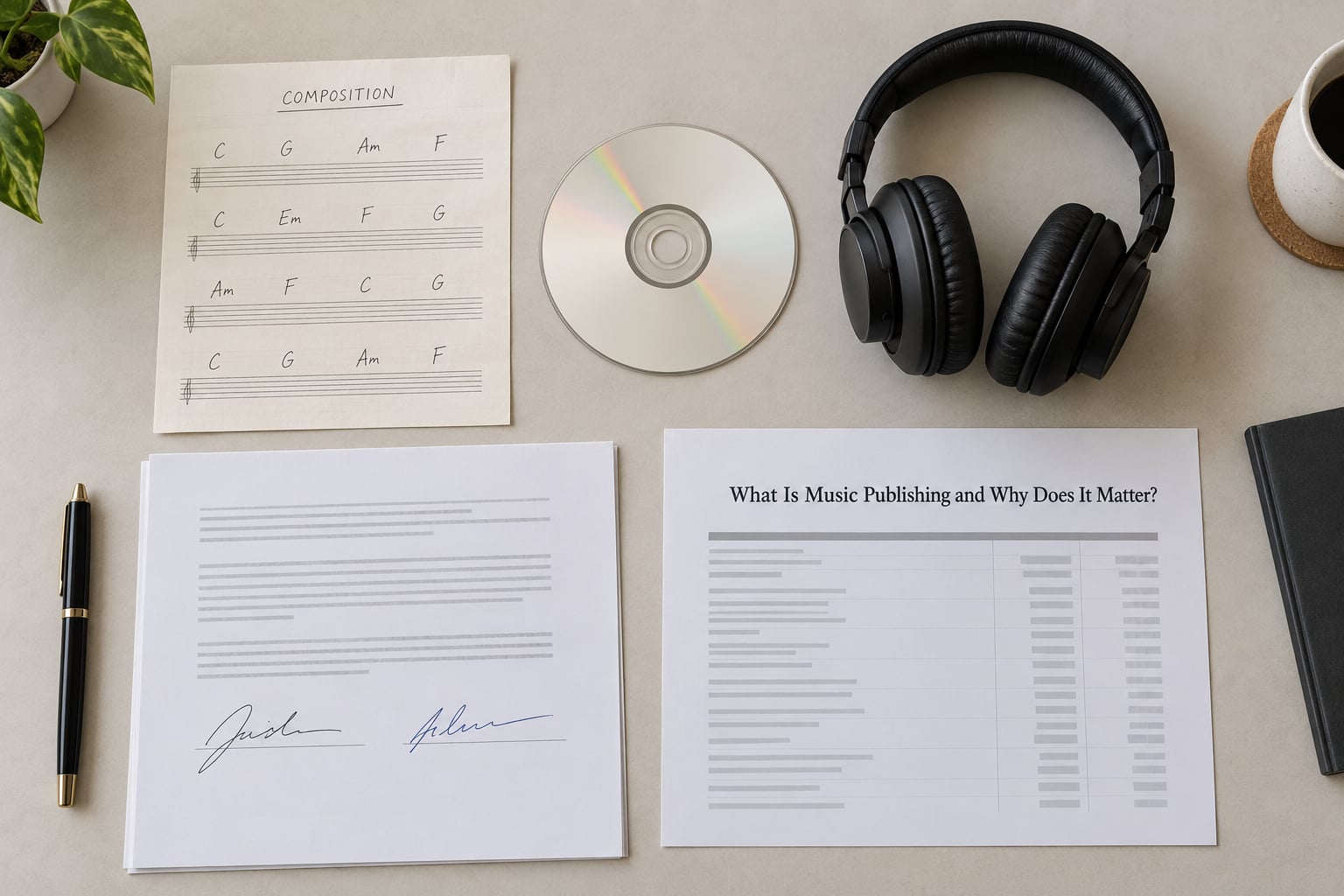
Music publishing is the business of acquiring, protecting, and promoting song (composition) copyrights and collecting the royalties those copyrights generate. A publisher tracks where a song gets used, licenses it for money, chases payment, and splits the income with the writers who own the copyright.
It matters because the money is real, it is separate from your streaming income, and nobody pays it automatically. A song can earn a few dollars from an ad in a streaming series and almost nothing from the same song played on a playlist, and the reverse happens constantly. Publishing is the layer that catches the placements you did not expect.
The reason it confuses people is the vocabulary. Master, composition, publisher, administrator, PRO, MLC, and sync license all get used in the same conversation even though they describe different jobs. Once those words are separated, the system turns out to be fairly simple.
How Music Publishing Actually Works
Follow one song from a bedroom demo to a bank account. A writer named Ana finishes a three-minute song on a Friday, records a rough demo with her bandmate, and keeps the file. Two weeks later they upload the finished master through a distributor and set up PRO memberships.
The distributor delivers the recording to streaming services and the composition metadata goes out alongside it. Nothing emails Ana, and that silence is normal: a song only starts generating publishing income once someone uses it in a way that pays a fee.
Eight months later, a television show uses the song for a two-second end card. A music supervisor finds the song through a publisher’s sync catalog, sends a cue sheet to the performing rights organization, and the show pays a synchronization fee. That fee is split with the co-writer, and the public performance of the episode generates a performance royalty routed through the PRO.
Meanwhile the streaming plays accumulate. Streaming services pay mechanical royalties for the composition through The Mechanical Licensing Collective, and the PROs collect public performance royalties from radio, TV, and live venues. At the end of the half-year, Ana receives a statement listing each source, each work, and the money each one generated.
That is how music publishing works: the song is identified, its owners are known, its uses are logged, and the money is routed back along the chain. Any link in that chain being wrong is why a royalty goes missing.
Who Needs Music Publishing?
Anyone who owns part of a composition needs it, which is a wider group than most people expect. Songwriters, co-writers, and composers hold composition rights by writing the work. Producers and beatmakers hold them when they wrote or built the underlying music rather than only performing on top of someone else’s.
Performers, featured artists, and background singers usually do not hold composition rights unless they contributed to writing.
Labels and distributors are the other common owners. A label that signs an artist often takes or administers the composition as well as the master. A distributor that offers a publishing administration service becomes the publisher of record for the compositions it handles, though it is not the same thing as owning them.
One point trips up nearly everyone starting out: a musical idea on its own is not protected. Copyright attaches to a work fixed in a tangible medium, which in practice means a recording, a lead sheet, or sheet music. Hum a melody in a voice memo and you have evidence of a date, but the copyright itself belongs to the work you commit to paper or tape.
So if you co-write with a beatmaker who sends a track and nothing else, clarify who wrote the music before release. That conversation, in writing, is the whole job at that stage.
Who Does What in a Music Publishing Deal?
The songwriter writes the song and owns the copyright the moment it is fixed. The composer is the same role in classical and film work, where the score is treated separately from the lyrics. A music supervisor places music in film, television, advertising, and games, and licenses it on behalf of the network or brand.
The publisher owns or administers the composition and handles registration, licensing, collection, and payment. A publishing administrator does that paperwork and accounting for a publisher who would rather spend time finding songs. The label controls the master recording rather than the song, though it often takes publishing rights as well.
Then there are the organizations that do not create money, only move it. Performing rights organizations such as ASCAP, BMI, and SESAC collect public performance royalties from venues, radio, television, and bars. The Mechanical Licensing Collective collects mechanical royalties tied to recordings. The Harry Fox Agency handles mechanical and sync licensing administration for its members, and SoundExchange collects digital performance royalties on the recording side. Collection management organizations run the same work outside the US.
Here is who actually collects each stream of publishing income, and where the money lands.
| Royalty type | Where it comes from | Who collects it | Who is paid |
|---|---|---|---|
| Performance | Radio, TV, live venues, bars, background music in stores and restaurants | PRO (ASCAP, BMI, SESAC) or CMO outside the US | Writer’s share and publisher’s share of the composition |
| Mechanical | Recordings sold, streams, permanent downloads, interactive streams | The MLC, HFA, or a publisher’s blanket license | Writers and publishers of the composition |
| Synchronization | Film, TV, ads, video games, trailers, online video | Publisher or sync agent negotiating the license | Share of the fee per the split, sometimes one-time |
| Sheet music, lyrics, chord books, lead sheets | Publisher, music printer, or a print-on-demand service | Writers of the composition | |
| Digital performance | Satellite, internet, and cable radio plays | SoundExchange (recording side only) | Performers and master owners, not the writers |
Mix up digital performance with performance and you will expect money from the wrong organization, then assume you were underpaid. They are separate claims with separate owners.
What Rights Can a Song Have?
Owning a copyright means holding six exclusive rights: reproducing the work, preparing derivative works, distributing copies, publicly performing the work, displaying the work, and making sound recordings of the work. For a song, the first four do the practical work.
Reproducing covers a beatmaker selling the same instrumental to a second rapper. Public performance covers your song playing in a restaurant. Derivative works cover translations, adaptations, and new verses built on the original melody.
Those rights attach to two different works, and people constantly merge them into one sentence.
| Aspect | Composition (the song) | Sound recording (the master) |
|---|---|---|
| What it is | Words and melody, written as music | The specific audio performance captured on a file |
| Who owns it | The writers who contributed to it | Often the artist, producer, or label who paid for the session |
| Who collects the money | PROs, The MLC, HFA, sync licensors | SoundExchange for digital performance, the distributor for the rest |
| Income source | Performance, mechanical, sync, print | Streaming, download, physical sales, neighboring rights |
| Who usually signs | A publisher or administrator | A label or distributor |
A cover song makes the difference obvious. An artist records a new version of a song written decades ago, and the new master belongs to the artist and the label. The composition still belongs to the writers of the original, and the cover pays a mechanical license plus public performance royalties to them, not to the person singing it in the new version.
That is also why sampling sits across both lines. Using a few seconds of an existing master touches the sound recording copyright. Using the underlying melody or lyrics touches the composition. Both have to be cleared, and the two clearances go to different people.
How Do Songwriters Earn Music Royalties?
Each royalty category pays for a different right, and the categories do not always pay the same person. Performance royalties pay for the song being heard, are collected by your PRO, and split into a writer’s share and a publisher’s share.
Mechanical royalties pay for the song being recorded, downloaded, or streamed, and are collected by The MLC or a blanket license. Synchronization royalties pay for the song being paired with a picture, and they are negotiated one deal at a time rather than collected by an organization.
Print royalties pay for sheet music and lyric books, which still earn in niches like theatre and worship music. Digital performance royalties pay for the master being played on satellite, cable, or internet radio, and go to performers and the master owner.
Two things decide whether you actually receive any of it: registration and metadata. If your song is not registered with the PROs, the work has no owner of record and royalties generated for it are unclaimed. If the title, the writers’ names, or the splits do not match across your PRO, your publisher, and your distributor, payments stall or land in the wrong account.
Getting the writer’s share only happens when you are signed with a PRO as a writer member. Members who also register their own publishing entity, or who appoint an administrator, receive both shares. That single distinction explains most of the confusion in the r/musicindustry and r/musicbusiness threads where new artists compare notes about why two people with identical streaming numbers report wildly different income.
Music Publishing and Recording Revenue at a Glance
Your distributor and your publishing setup pay you for different things. Knowing which line a payment belongs to keeps you from assuming you were shortchanged when you were simply paid on the other side.
| Question | Composition income | Master recording income |
|---|---|---|
| What is being sold | The song itself | One particular performance of it |
| Typical source | Performance, mechanical, sync, print royalties | Streaming, downloads, sales, neighboring rights |
| Common payer | PRO, The MLC, HFA, a sync license buyer | Your distributor, DSPs, SoundExchange |
| Controlling rights holder | Writers and their publisher | Artist, producer, or label |
| How you get paid | Quarterly or semiannual statements from a publisher or PRO | Monthly or quarterly statements from the distributor |
| Does it survive a new recording? | Yes, the composition keeps earning | No, each master is a separate asset |
The last row is the one producers and beatmakers underestimate. Write the beat, sell it to two artists, and you now hold two masters and one composition. The composition pays twice, from two different sources, for as long as both versions circulate.
What Is a Music Publishing Agreement?
A publishing agreement is a contract that moves or shares control of your composition copyright, usually in exchange for a share of the income and often an advance. Common provisions cover the percentage of the copyright transferred, what the publisher may license and on what terms, the writer’s share, the publisher’s share, administration rights, advances and how they are recouped, permitted expenses, the territories covered, the term of the agreement, termination rights, reversion of rights, and audit rights.
The clause that surprises people most is reversion. Many agreements return the rights to the writer after a set period or after the songwriter reaches a specified age, sometimes automatically and sometimes only if the writer pays to buy them back. If reversion matters to you, it needs to be stated plainly, not left to a general termination provision.
Another common surprise is that publishing agreements cover the composition, not the master. A publishing contract does not give anyone the right to take your recording. Reading an offer as though it were a record deal is a costly reading error, and I would check every publishing agreement against that question before signing anything.
Contract language varies by deal and by jurisdiction, and this is not legal advice. Anyone considering an exclusive publishing agreement should have a qualified entertainment attorney or manager review it before signature.
How Do You Register a Song?
US registration is mostly paperwork with deadlines, and the order matters. Work through it in this sequence.
- Create the paper trail. Write a clean lead sheet with the title, lyrics, chord symbols, and your full legal name on every page, and save a dated demo file of the composition.
- Settle the splits in writing. A split sheet listing every writer and their percentage, signed by all of them, prevents the most common payment failure. Undisputed splits move; disputed ones stall for years.
- File the copyright record. Register the work with the US Copyright Office, submitting the lead sheet and, where a sound recording is submitted, a copy of that recording. Registration also matters in a dispute, because the legal framework gives a registered work a clearer position.
- Join a performing rights organization. Sign up with ASCAP, BMI, or SESAC as a writer member. Each songwriter and each publisher joins separately, which is why a song often needs two memberships to be fully covered.
- Set up the publishing side. Either register your own publishing entity with the PROs so you can receive the publisher’s share, or appoint a publishing administrator or publisher to collect it for you.
- Get the right identifiers. Record your IPI number, the ISWC for the composition, and the ISRC for the recording, and make sure they travel to your distributor with matching names and splits.
- Review statements. When payment begins, compare the works listed on each statement against your catalog. Unclaimed royalties are real and common, and the only way to recover them is to make a claim with correct identifiers.
Steps four and five are where most independent artists stop, and that is exactly where the publisher’s share sits. A DSP publishing add-on can cover step five for a fee, and writers already in a PRO debate on forums whether that duplicates what their membership already does. The honest answer is that it addresses a different half, and a self-administered publishing company on a PRO can do it without a percentage fee.
Can a Song Have More Than One Publisher?
Yes, in a specific sense: ownership and administration are separate. A song can have co-publishers who each own part of the copyright, and it can have one administrator handling the paperwork for all of them.
Co-publishing means two or more parties each hold a percentage of the composition, usually in a 50/50 or another agreed split, and each is free to administer their own share. Full publishing means you have assigned or licensed your entire share to one publisher for a set term. Administration means you keep the copyright but hand the paperwork to someone who registers, collects, and accounts for a fee.
| Deal type | What you keep | What the other side takes | What you end up with |
|---|---|---|---|
| Full publishing | Nothing but your writer’s share during the term | All ownership and control for a defined period | Typically 50% of performance income, plus the publisher’s share of everything else |
| Co-publishing | Part ownership of the copyright | A share, usually 25% of the whole | Often around 75% of total publishing income |
| Administration | 100% ownership and control | A percentage of collections, often in the 10% to 25% range of the publisher’s share | Close to 85% to 90% of publishing income |
Those percentages are typical US ranges, not legal or financial guarantees, and rates change with deal, territory, term, and bargaining position. Administration fees in the 10% to 25% band of the publisher’s share are the industry benchmark worth comparing against.
Sub-publishing is the international layer. A US publisher signs a sub-publishing agreement with a collection society in another territory so local societies there collect the money.
A blanket license is different again. A streaming service or a venue pays an organization a flat fee and gets the right to use a large catalog, and that organization’s members are paid pro rata from the pot.
What Happens During Contract Negotiation?
Most offers are read by artists who are looking for the advance figure. The advance is the least important line in the document. These are the parts that determine what you have afterward.
Ask where the copyright goes, whether it is exclusive, and when it comes back. Read the share percentages and ask what each one is a percentage of, because a percentage of performance income and a percentage of total publishing income are very different numbers.
Confirm reversion terms, the term length, and whether an advance is recoupable from your share and from any other songs in the same deal. Cross-collateralization, where a loss on one song is recovered from another, is worth understanding before you sign rather than after. Check audit rights, since without them a statement is the only evidence you will get.
Look at credit, so your name appears where listeners and future licensees can find it. And find out who handles neighboring rights, digital performance, and sub-publishing, or whether that work is simply not being done.
On red flags, the r/musicindustry and r/WeAreTheMusicMakers threads are consistent: an offer of 50/50 on everything with no advance and heavy recoupment reads to experienced writers as a company monetizing a songwriter rather than a partnership. An advance that is large relative to realistic income, vague wording about what it is recouped against, no termination rights, and pressure to sign quickly are all reasons to slow down.
None of that makes a deal good or bad on its own. It means the terms deserve a qualified set of eyes, which is cheap compared with what a bad term costs later. Get a lawyer or an experienced manager to read the contract, not a fan page.
Can You Publish and Release a Song Yourself?
Yes, and most independent releases are self-published. You register the composition, set up the PRO memberships, decide whether to appoint an administrator, and keep the copyright.
Some songwriters run a small publishing company under their own name and register it with the PROs, which lets them receive the writer’s share and the publisher’s share without giving up ownership. That is the structure behind most micro-publishing companies.
The mistake to avoid is confusing digital distribution with music publishing. A distributor’s core job is getting your recording into streaming stores and stores’ search systems, and the publishing add-on is a separate, optional product on top of that. It is not a publisher in the traditional sense, and it does not replace a PRO membership.
The same applies to anyone whose main offering is getting music in front of listeners. A playlist company, a marketing agency, or a sync agent cannot collect your publishing royalties, and a service that also wants your publishing rights is asking for two different businesses in one contract. Keep them apart so you can exit one without losing the other.
Common Music Publishing Mistakes to Avoid
Most publishing problems trace back to paperwork rather than talent. These are the ones that cost writers money.
- No signed split sheet. A handshake over a 50/50 split is unenforceable in practice, because one party has to place a claim with the PRO on behalf of the other. Get signatures while the collaboration is still friendly.
- Wrong or missing identifiers. A misspelled name, a title in the wrong format, or a missing IPI means your royalties cannot be matched to you. Include alternate title spellings and confirm the exact writer names as they appear on the registration.
- Treating a distributor as a publisher. Distribution handles the master. It does not handle your composition income unless you specifically hire a publishing service.
- Ignoring samples. A lifted beat or a recognizable melody touches both copyrights. Undisclosed samples surface in claims and takedowns, usually years after release.
- Forgetting foreign performance income. Your PRO is your US collection point only. If your song is licensed overseas, collection depends on the publisher’s sub-publishing network.
- Outdated tax and payout details. A W-9 with the wrong entity, a closed bank account, or a stale mailing address stops payments quietly, and they are not always reissued.
- Not reading statements. The first statement after a catalog starts earning is where problems are still cheap to fix. Skipping it is how a wrong split becomes a five-year argument.
Frequently Asked Questions
Do I need a music publisher if I release songs independently?
No. Independent songwriters publish their own compositions every day. You need a PRO membership as a writer, a decision about the publisher’s share, and accurate registration. A publisher or administrator is worth it when a song starts travelling, when sync placements appear, or when you would rather not chase statements yourself. Early on, self-administering costs nothing and teaches you where the money comes from.
How much money can a songwriter make from publishing royalties?
Less than most people expect early on, and more than most people collect. Composition income is separate from streaming income and accrues quietly for years. A modest catalogue can produce a few hundred a year in mechanical royalties, while one placement can pay a flat sync fee that dwarfs months of streaming. The variable is not plays, it is whether the song gets used somewhere that pays a licence fee.
Does a music streaming distributor handle publishing rights for me?
Only if you buy its optional publishing administration add-on. Core distribution handles your recording: delivery, store placement, and master recording income. Composition royalties come from PROs, The MLC, and sync licences, and a distributor does not collect those by default. Writers in r/musicbusiness describe these tools as duplicative when they already run a publishing company through their PRO, and useful when they do not.
Can I own the words and music but not the master recording?
Yes, and it is common. The songwriter usually owns the composition, while the label, artist, or producer who paid for the session owns the master. That split appears on every deal where a label pays for production. It also happens in reverse when a beatmaker sells an instrumental and keeps the underlying music, leaving the artist with a master and the beatmaker with a composition.
What should I do if I used music I did not create in my song?
Stop releasing it and figure out exactly what you used. Borrowing a few seconds of a master touches the sound recording copyright; using an existing melody or lyrics touches the composition. Both owners have to give permission, and sampling an existing song usually triggers a master-use fee from the master owner. Clearing early is cheaper than removing a released track later.
Start With Your Rights and Paperwork
What is music publishing, in one line? It is the system that pays songwriters for the use of their songs, and it runs on documentation rather than talent. Once you understand that the composition and the master are two different assets, most of the confusion dissolves.
If you do nothing else this month, do these things in order:
- Write down what you contributed to every song in your catalogue, with dates.
- Get a signed split sheet from every collaborator on every track.
- Keep your agreements, dated, in one folder you can actually find later.
- Register the compositions and join a PRO as a writer.
- Decide how the publisher’s share will be collected, and check your metadata on every release.
- Get qualified advice before you sign anything exclusive.
None of it takes more than a weekend. It is the difference between a catalogue that earns quietly for years and one that earns nothing because no one can match the payments to a name.