If you’re asking what is a music supervisor looking for, the short answer is this: a track that carries one clear emotion, can be cut to picture without breaking, and can be licensed before the edit locks. A music supervisor is the professional who chooses, clears and manages every piece of music in film, television, advertising, video games and any newer visual platform. They are not shopping for a favourite song. They are solving a production problem, and your track is one candidate among several hundred.
The Guild of Music Supervisors, the industry body whose definition everyone quotes, describes the role as overseeing all music-related aspects of film, television, advertising, video games and other visual media. That sentence sounds tidy. The work is messier: a supervisor reads a script, marks the beats that need music, briefs a director, spends two days auditioning catalogues, negotiates licenses with publishers and labels, and delivers a locked cue sheet.
So what is a music supervisor looking for, exactly? Every candidate song passes through the same four filters:
- Can it be cleared in time, with rights someone can answer for on a single call?
- Does it carry a specific emotion that serves the scene?
- Is it structurally editable, with clean entry and exit points?
- Does it arrive with usable metadata, alternate versions and a delivery package?
Fail any one of those and a great song gets deleted in seconds. Here’s how the whole process actually works, and where you can realistically improve your odds.
Table of Contents
- What Is a Music Supervisor Looking For?
- What Does a Music Supervisor Do in Film, TV, and Advertising?
- How Music Supervisors Evaluate Songs
- Which Musical Qualities Make a Song Easier to Place?
- How Clear, Editable, and Memorable Should the Track Be?
- What Lyrics, Vocals, and Genre Can Work in a Scene?
- What Makes a Song Easier to Clear and License?
- How Can Artists Submit Music to a Music Supervisor?
- What Common Mistakes Can Make a Song Easier to Miss?
- Frequently Asked Questions
- Do music supervisors only look for songs that match the genre in a brief?
- How much of a song should an artist send to a music supervisor?
- What makes a song stand out during a supervisor’s first listen?
- Should independent artists pay to submit music to supervisors?
- Do music supervisors only listen to music sent to them directly?
- What Should You Do First?
What Is a Music Supervisor Looking For?
What a music supervisor is really looking for is emotional clarity first and paperwork second, though never in that order for long. Before they press play a second time, they need to know three things: does this song do a specific job, can they cut it to fit the shot, and can they get permission to use it this week.
That third question surprises most artists. A supervisor working on a scripted drama may have a temp track standing in while the edit takes shape, and a window of roughly 48 hours where the final cue has to be cleared or the editor has to fall back on something else. A track that is perfect but sits with three layers of rights nobody can answer for is dead on arrival. A track that is slightly less distinctive but one-stop and instant moves up the list.
The traits that survive that first screen fall into three groups:
- Creative fit: emotional clarity, narrative appropriateness, a hook inside the first five to ten seconds, and a structure with visible seams for editing.
- Technical readiness: one-stop rights or a clear rights map, stems and instrumentals on request, alternate and clean versions, high-resolution files.
- Searchability: metadata written the way editors and AI search tools actually query, rather than artist-name tags.
The rest of this guide walks each one of those in order, from the evaluation habits to the paperwork that decides whether a placement survives the week.
What Does a Music Supervisor Do in Film, TV, and Advertising?
A supervisor turns a creative problem into a shopping list and then defends that list to a director who already has a favourite. The sequence is roughly the same on every production, whether it’s eight episodes of a streaming drama or a thirty-second brand spot.
They read the script or watch the rough cut and flag the beats that need music: the first reveal, the argument, the montage, the end card. A music editor sits alongside them and shapes the sequence at the frame level, trimming and layering cues so transitions do not fight the cuts. A music coordinator handles research and administration, chasing down records and reference tracks. Then the search begins, usually inside production music libraries first, then commercial catalogues, then unpublished music sent directly to the supervisor’s inbox.
Once a track is chosen, the supervisor moves from taste to clearance. Two licenses are usually involved: a synchronization license for the composition, which covers its use in a particular visual work, and a master use license for the specific sound recording. Those two can sit with different companies, and chasing them separately is where weeks disappear.
The job title matters, because the scope changes with it. Music supervision decides what plays and why. Sync licensing decides what it costs and under what terms. The same person sometimes holds both hats, and the split is blurrier in advertising and games than in features.
Where the four main segments differ
| Segment | Editing pressure | Musical profile that gets used | Budget behaviour |
|---|---|---|---|
| Film trailer | Extremely fast; cues hit picture every few seconds | Trailer music: big drops, no long intros, strong rhythmic edits | Higher fees, but budget still caps everything |
| TV drama | Slow and deliberate; scenes breathe | Instrumentals that sit under dialogue, or a lyrical song used at an emotional peak | Tight; budget dictates the library tier |
| Advertising | One or two hero moments per spot | Tracks with a recognisable identity, clean vocal or a strong instrumental chorus | Brand-driven; higher fees for established records |
| Video games | Loopable; hours of play | Adaptive layers: loops, stems, intensity variants | Mid-range, but stems are mandatory rather than optional |
Budget reality deserves a sentence of its own. Supervisors routinely pass on perfect tracks because the fee does not work for the production, then find a near-equivalent in an independent catalogue or a production music library. Nothing personal is being said about your song. It is a spreadsheet decision, and it happens constantly.
How Music Supervisors Evaluate Songs
The evaluation is faster and more physical than most artists expect. Many supervisors audition on a laptop, some on a phone, often while doing something else. Your track has about three seconds to identify itself.
The first listen tests whether the song communicates instantly. If a supervisor cannot tell within seconds whether it is warm, tense, triumphant or wry, there is nothing to react to. Then comes the emotional test: does it match the moment, or does it merely sound nice? Supervisors are listening for narrative fit, not taste.
Next is structure. An editor needs somewhere to put the in point and the out point. A track with a clear intro, build, climax and resolution gives them handles. A track that wanders for ninety seconds before it starts becomes a problem they may not have time to solve.
Vocals get a specific check. If there is singing over a dialogue scene, every word has to be intelligible and nothing can compete with the actor. That is the frequency problem instrumentals exist to solve: most songs occupy the same range as human speech, so under a conversation they turn to mud.
The mix gets tested at low volume and on phone speakers, because that is how it may be heard. Compressed, squashed tracks fall apart there, and so do tracks with a wall of reverb. Balance matters more than loudness.
Finally there is the music note: the short written description a supervisor attaches to a candidate, naming the scene, the beat, and the feeling. Reading those is genuinely useful. Music Jobs shows the format as a quoted block with the scene reference, the emotional read and the specific moment it fits. It tells you exactly how a supervisor thinks about a track, in their own words.
Which Musical Qualities Make a Song Easier to Place?
Nine traits come up repeatedly. They are not a style guide, and nothing on this list means your music has to sound like anything in particular.
- Clear identity. The listener can name what the song is doing within a few seconds.
- Emotional precision. One dominant feeling, not three competing moods in four minutes.
- A strong opening. Something happens in the first five to ten seconds, not a fade-in from silence.
- An adaptable structure. Obvious seams: intro, build, climax, resolution.
- A memorable hook. A melodic or rhythmic idea worth coming back to.
- Lyrical flexibility. Themes that transfer to a scene, and no unavoidable first-person details that tie it to one situation.
- A clean, usable mix. Balanced, unclipped, and understandable at low volume.
- Relevant context. Something in the track that fits the world of the production, not just the mood.
- Credible metadata. Rights, credits and descriptors that are accurate and searchable.
| Criterion | What good looks like | Instant disqualifier |
|---|---|---|
| Clearability | One-stop, or a rights map you can explain in a sentence | An uncleared sample nobody will confirm |
| Emotional fit | One specific feeling the scene needs | A track so generic it could go anywhere |
| Opening seconds | Movement and identity immediately | Twenty seconds of fade-in |
| Structure | Clean edit points and a clear arc | No usable ending for a montage |
| Vocals under dialogue | Instrumental version supplied | Full vocal version pitched into a spoken scene |
| Mix | Balanced and clean at low volume | Clipping, distortion, muddy low end |
| Explicit content | A clean edit ready to send | An explicit master with no alternative |
| Metadata | Mood, energy, tempo, key, instrumentation, use case | Other artists’ names pasted into the tags |
| Delivery | 24-bit 48kHz WAV, sensibly named files | A streaming link to a lossy master |
How Clear, Editable, and Memorable Should the Track Be?
There is a real tension here, and understanding it is the difference between a song that gets used and a song that gets admired. Push every element for maximum impact and you may build something an editor cannot cut. Play it safe and it will work everywhere, which means it will not be remembered anywhere.
What a music supervisor hears in the first seconds
The opening has one job: announce itself. That does not mean a snare hit at frame zero. It means the first musical event lands soon enough that an editor has something to grab. Plenty of placements start three seconds into a track because the fade-in was too polite to build around.
Edit points
Editors cut to musical events: a chord change, a drum entrance, a vocal phrase. A track with clear events every eight to sixteen bars gives them plenty of options. A track that holds one texture for two minutes gives them one option and a problem.
Structure also has to survive being shortened. If the only interesting part starts at three minutes, a thirty-second montage has nothing. Building a chorus or a lift inside the first forty seconds makes your track usable in a length range, which matters more than the fact that it works at full length.
Mix flexibility
Heavy compression and limiting flatten dynamics so a cue cannot swell under a scene or drop away quietly. A flat master works as a demo and fails as a film cue. Stems make this fixable, which is why supervisors increasingly treat them as a baseline expectation rather than a favour.
The dialogue range is worth understanding. Speech occupies roughly the midrange where guitars, keys and most vocals live. Under conversation, those elements mask intelligibility unless they are pulled back. An instrumental with space carved out for dialogue is not a lesser version of your track. It is the version that gets the placement.
What Lyrics, Vocals, and Genre Can Work in a Scene?
Lyrical perspective matters more than most songwriters expect. A first-person narrative with heavy specifics tends to lock a track to one story, while lyrics about distance, leaving, starting over or coming back to yourself travel well. That is not a rule about subject matter. It is a note about transferability.
Supervisors also read lyrics for tone. Explicit content is not disqualifying in most contexts, but it needs a clean edit ready to go. A scene that ends on an unresolved moment is often the exact moment a song about open endings is used.
Vocal tone carries as much information as the words. A detached, conversational delivery can underscore an intimate scene; a full-throated chorus works for a reveal or a montage. Screamed vocals under dialogue rarely work, and neither do heavily processed vocals that occupy the whole spectrum.
Genre is a starting point, not a filter. Supervisors search outside the requested genre when a track offers a better emotional or narrative fit, as long as it serves the tone and the audience. A string arrangement in a scene about grief can beat a piano piece. An upbeat indie track can undercut a scene and work beautifully, when the undercutting is the point.
Scene types do lean different ways. Montages favour instrumental builds with rhythmic events. Quiet conversations favour low-frequency-range instrumentals with room for speech. Confessions favour intimate vocals at low volume. Endings and title sequences favour anything with a memorable first and last eight seconds.
What Makes a Song Easier to Clear and License?
This is where most independent artists lose placements they had already won creatively. The song fit, the director said yes, and then it could not get through clearance in the window available.
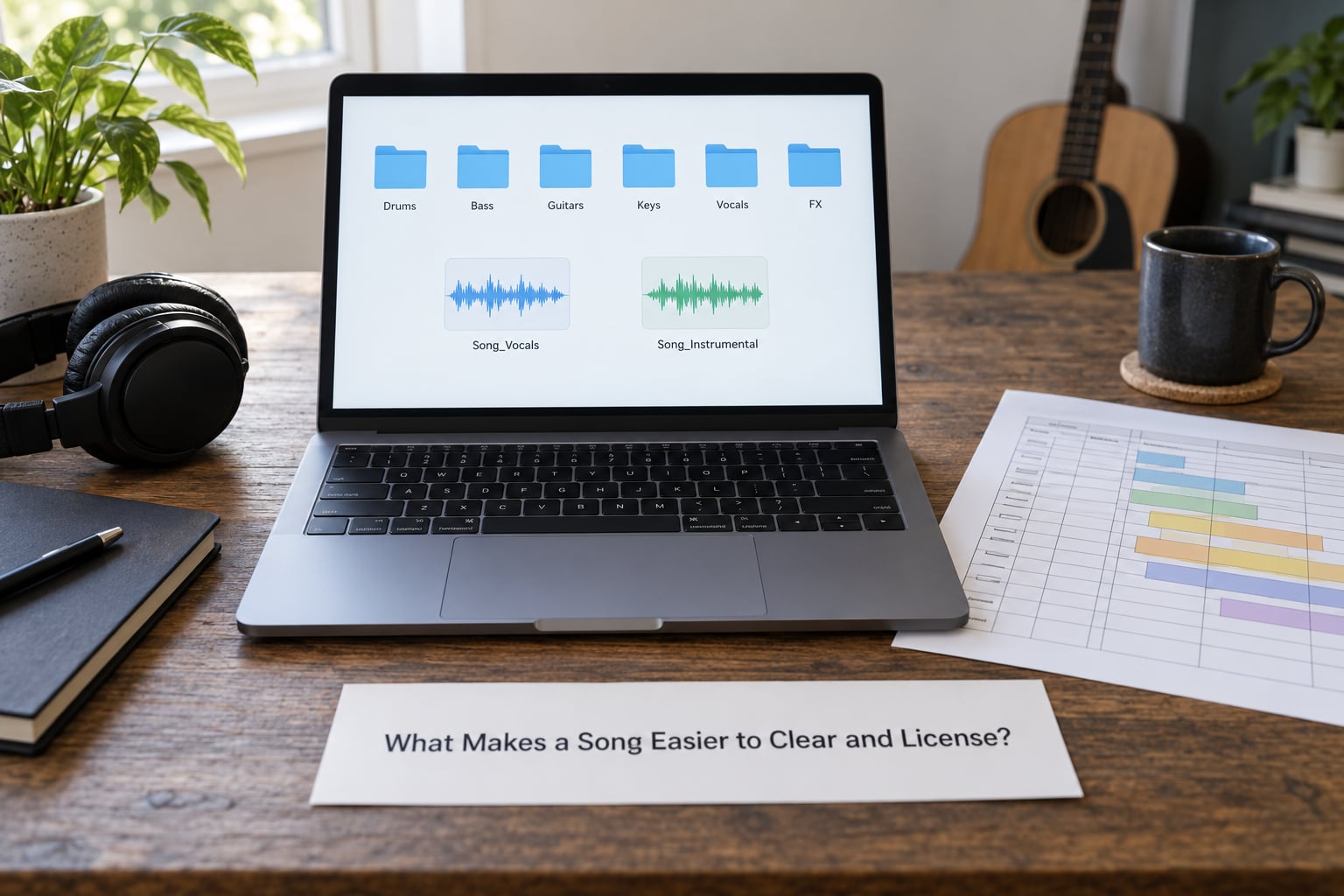
The basics first. One-stop means you control both the master and the publishing, so a supervisor can negotiate with one party instead of two. It is a genuine competitive advantage and it is achievable through publishing administration rather than magic.
If you are not one-stop, the next best thing is a split sheet. Signed documentation showing who wrote and owns each percentage is the difference between a license that clears in a day and one that stalls for a fortnight. Include your PRO registration details and your ISRC so the cue sheet can be completed without a follow-up call.
Collaborator credits matter too. A featured artist who is not signed to a work-for-hire agreement needs a release on file before the track can be used commercially. Interpolations need their own sample clearance, separate from your own.
The delivery package is what most artists under-prepare. Build it once and reuse it:
- Full mix at 24-bit 48kHz WAV
- Instrumental version
- Clean edit if any lyric is explicit
- Stems or submixes for the core parts
- A short edit, thirty to sixty seconds, for quick montage use
- Accurate filenames, in a consistent scheme such as
Artist_Title_Instrumental_24bit48k.wav - Lyric sheet and a note of who appears on the track
Metadata matters more than most artists expect, because searching has changed. Supervisors increasingly rely on AI-assisted catalogue tools, and those tools query function rather than genre. Functional language is what gets found: quiet piano building to hopeful release, three minutes, sparse instrumentation, no vocals. Tagging your track with other artists’ names, or writing vibes and nothing else, means your track is invisible to both a person and a machine.
A short glossary of terms you will hear
- Sync license — permission to use the composition in a specific visual work.
- Master use license — permission to use the specific sound recording.
- One-stop — one party controls both master and publishing.
- Cue sheet — the document listing every piece of music used in a production, with title, writer, publisher and ISRC.
- PRO — a performing rights organisation collecting royalties on your behalf.
- ISRC — the international code identifying a specific recording.
- Temp track — licensed placeholder music standing in before final clearance.
How Can Artists Submit Music to a Music Supervisor?
Cold submissions mostly fail on logistics, not on taste. Here is the process that works.
- Research the project. Know the show, the network, the studio and who supervises the music. Supervisors work on specific shows; a general email to
info@goes nowhere. - Target one supervisor. Find the person with a catalogue lane that matches your music. IMDbPro credits and Guild of Music Supervisors member directories are the reliable sources.
- Send one song. Not the whole folder. One track, matched to one use case you can describe in a sentence.
- Write the subject line and body carefully. Name the project, the song, the moment it could serve, and what you control. Short and specific beats long and enthusiastic.
- Send a private streaming link, not an attachment. No MP3s, no zip files. Supervisors use mobile devices and limited storage.
- Include the rights facts. One-stop status, PRO, ISRC, split sheet status, explicit flag. That block of text is half the pitch.
- Follow up once, after two or three weeks. Then stop. Artists in sync communities say consistently that silence usually means archived rather than rejected, because supervisors save tracks for future projects.
Representation is worth thinking about early. Forum consensus across sync communities favours a smaller, actively pitching agent over a large library that sits on unreleased music. Community members put it plainly: you want someone who will actually wake up and pitch your track.
There is a second question people ask constantly: should you go through a music library, a publisher, or straight to supervisors? The honest answer is that all three work, and they work differently. A library gives you reach and takes a cut. A publisher registers your work and pushes it, usually for new writers. Direct pitching keeps you in the relationship and leaves you doing the admin.
What Common Mistakes Can Make a Song Easier to Miss?
These are the things that get a track deleted rather than filed.
- Uncleared samples. One uncleared loop can end the conversation regardless of how well the track fits.
- No instrumental version. Many placements need one immediately, and asking for it adds a day to the clock.
- Attached files. An MP3 or zip in the email body is a hard technical stop for a lot of supervisors.
- Mislabelled metadata. Wrong key, wrong tempo, artist names in the tags, or a mood description that contradicts the track.
- Sending the catalogue. Twenty tracks in one email guarantees nothing gets listened to properly.
- A flat, over-compressed mix. Usable in a playlist, unusable under a scene.
- An explicit master with no clean edit. A 48-hour window does not allow for remixing.
- A slow or empty opening. Nothing to cut to in the first few seconds.
- Pitching music nobody asked for. Genre mismatch is survivable. Ignoring the brief is not.
- Multiple genres across a small catalogue. Community advice from a session keyboardist with fifty instrumentals was to focus on one style, because spreading thin leaves nobody able to place you.
Most of that list is fixable in an afternoon of admin. That is the useful part of knowing it.
Frequently Asked Questions
Do music supervisors only look for songs that match the genre in a brief?
No. A music supervisor may search beyond the requested genre when a song offers a better emotional or narrative fit. The genre in a brief describes the neighbourhood, not the walls. What does not work is a track that pulls the production somewhere the tone and the audience cannot follow.
How much of a song should an artist send to a music supervisor?
Send the strongest version that fits the briefing, usually a full clean track for creative review plus an instrumental when one is required. A short edit helps too, because editors audition against montage lengths. Avoid making the supervisor do basic assembly work before they can even judge the song.
What makes a song stand out during a supervisor’s first listen?
The first listen reveals whether a track identifies itself quickly. A strong opening, a distinct melodic or rhythmic idea, clear emotion and a mix that survives low volume or phone speakers all help. Generic but pleasant tracks rarely get a second listen, regardless of production quality.
Should independent artists pay to submit music to supervisors?
Representation, submission services and direct outreach all carry costs, but no reputable supervisor should guarantee placement in exchange for a fee. If an offer promises a specific placement for a payment, treat it as a scam. Legitimate relationships are built on rights clarity and consistent follow-through.
Do music supervisors only listen to music sent to them directly?
No. Most searching happens inside production music libraries, publisher catalogues and internal session pools, often assisted by search tools that query descriptive metadata. Direct pitches reach the inbox too, but they compete with hundreds of others, so the track and the rights information need to be immediately usable.
What Should You Do First?
Four steps, in order. Play your track as a stranger would: on a phone, at low volume, with no context. If you cannot say what it feels like within a few seconds, fix the opening before anything else.
Then write down the single scene type it serves best. One track, one use case. Build the delivery folder from scratch if you have to: full mix, instrumental, clean edit if needed, stems, a short edit and a completed rights block with PRO, ISRC and split sheet status.
Finally, research one supervisor who works on shows like the one you have in mind, and send one song with a private link and a short note naming the moment it fits. Follow up once after two or three weeks. Then start the next one, because nothing in this process happens in a single email.
What a music supervisor is looking for never changes: a specific feeling, a structure they can cut, and rights they can clear. Everything else is detail.