If you have seen both words used loosely online, here is the clean version: a distribution deal is a service agreement that gets your finished music onto streaming platforms and into stores while you keep ownership, and a record deal is a business partnership where a label invests money in your career in exchange for a share of your masters and a say in what gets released. One costs you a small fee or a percentage. The other costs you ownership and control, at least for a while.
That single difference explains almost everything else people argue about. A distribution deal is a logistics and payments service. A record deal is a financing arrangement, and the finance comes attached to rights. Get clear on which one you are actually holding before you sign anything, because the word “distribution deal” gets used for agreements that are nothing of the sort.
What Is a Distribution Deal vs a Record Deal at a Glance
| What you are comparing | Distribution deal | Record deal |
|---|---|---|
| Who you sign with | A music distributor that delivers your files to streaming services and stores | A record label that signs you as an artist and runs the commercial side |
| Ownership of the masters | Yours, unless the contract quietly assigns them | Usually assigned to, or licensed by, the label for a set term |
| Who funds the recording | You do | The label, out of the advance |
| Money you receive | A small commission is deducted, the balance is paid to you | An advance, recouped from your royalties before you earn anything |
| Creative control | Release dates, artwork, singles versus album, all yours | Shared, with approval rights and delivery commitments |
| Marketing and promotion | You run your own campaign; some distributors pitch on your behalf | Label-funded campaigns, PR, radio and playlist work |
| Term and exit | Usually a rolling annual term you can cancel | Multi-year, with option periods that can extend it by years |
| Best fit | First releases, producers, and artists building a catalogue | Artists with proven traction who need money and industry access |
One more difference that trips people up: a distribution deal normally gives you a partner who handles delivery and reporting, while a record deal gives you an employer who handles the business. Those are not the same job, even when both companies end up on your credits.
What Each Deal Actually Covers
What a distribution deal actually covers
A distribution deal is an agreement where a music distributor uploads your finished recordings to streaming platforms and digital and physical stores on your behalf, usually for a flat annual fee or a small commission, while you keep the master recordings. The distributor’s job is delivery, metadata handling, statement reporting and takedown support. In practice you still write your own marketing plan, book your own shows and decide what the artwork looks like.
Distributors exist because the streaming services do not accept direct uploads from individuals. Once a track is live, the distributor is mostly out of the picture, which is exactly what most independent artists want.
What a record deal actually covers
A record deal is an agreement where a label invests money in your recording, marketing and career in exchange for a share of your masters and royalties plus contractual control over releases and delivery commitments. In return for that investment, the label typically handles recording budgets, release scheduling, pitching, publicity, and touring support, and it expects a certain number of records delivered inside the term.
You are trading an asset for infrastructure. That trade can be a good one, but only if the infrastructure is worth more to you than the rights you are giving up.
The three types of thing called a distribution deal
Not every agreement sold as a distribution deal is a delivery service. Music lawyers tend to split them into three groups, and knowing which one you are holding is the most useful thing you can do before signing.
- Platform access. The straightforward version. A flat annual fee, you keep the masters and the majority of revenue, no exclusivity, and you can leave with your catalogue.
- Royalty cut with strings attached. The distributor keeps a percentage, often in the 10-30% range, and attaches exclusivity plus a long option period that can keep you locked in for a decade. It is a financing deal dressed as a service deal.
- Legacy physical distribution. The old model where a distributor shipped records to record stores and paid for manufacturing. Largely obsolete, and worth recognising if someone pitches it today.
Read the terms, not the marketing. A percentage cut, exclusivity and a multi-year option are the three words that turn a service into a commitment.
Ownership and Control of Your Music
Who owns the masters in practice
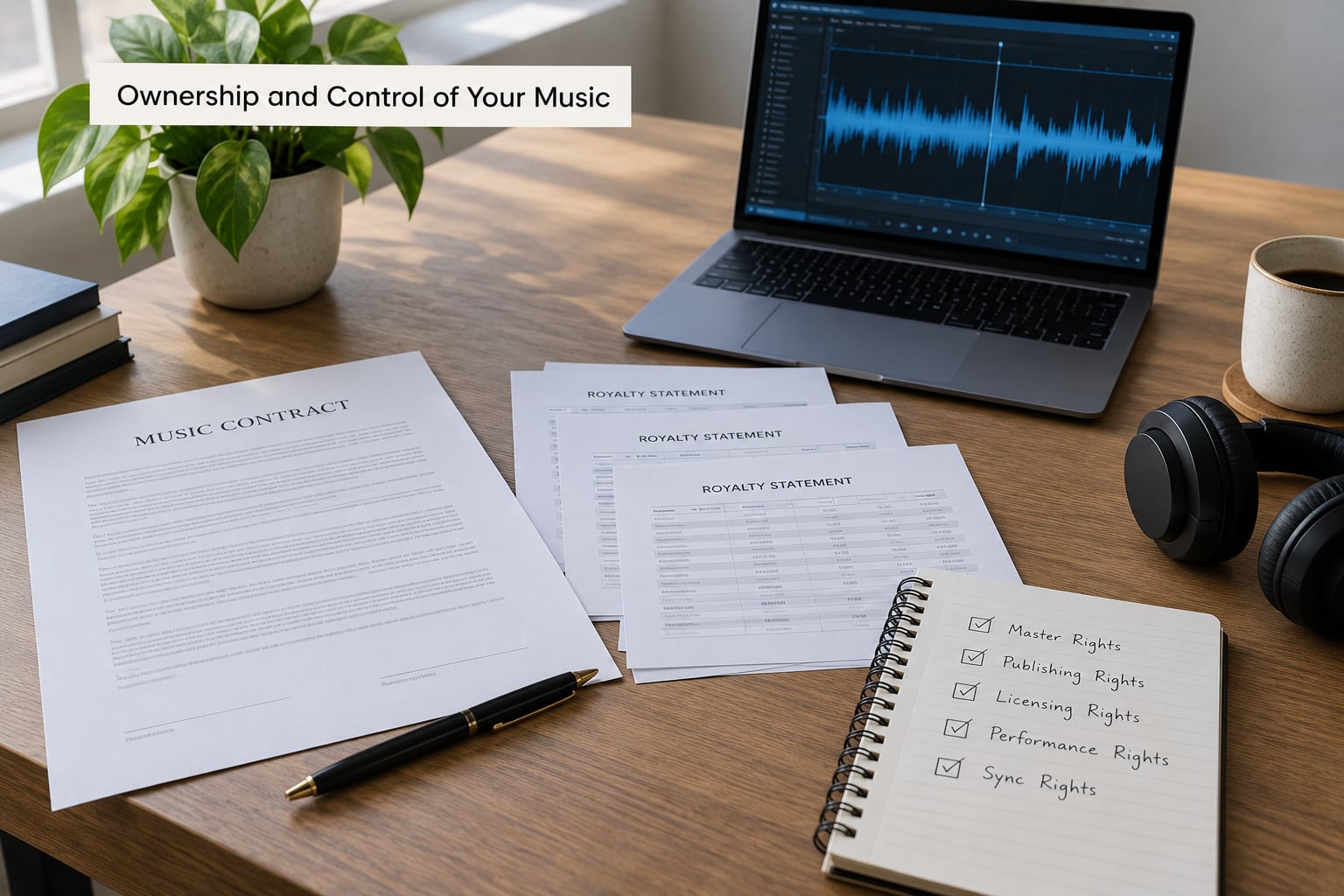
With a standard distribution deal, you own the sound recording copyright and you license the recording to the distributor for delivery. With a record deal, masters are usually assigned outright or licensed exclusively for the term, which is why artists spend so much time negotiating the reversion clause that brings them back after a set number of years.
Publishing is a separate layer. Many artists assign or co-assign their song writing rights to a publisher, and that publisher may be owned by the same label. Two rights, two separate pieces of paper, and a contract that mentions only one of them is a reason to slow down.
How ownership differs in a distribution deal vs a record deal
With a distribution deal, sync licensing, remix approvals and sample clearances stay with you, and nobody can approve a new version on your behalf. With a record deal, the label usually controls approvals, which is how a single you did not want becomes a streaming priority, and how a sample clearance becomes a two-month delay.
The trade is deliberate. Control is part of what the label is paying for.
What happens when the agreement ends
Ask about three things: a clean break clause so your music comes down with you or stays up under a new distributor, whether streams and playlist placements survive a switch, and how long the distributor keeps taking a percentage after you leave. Artists report that the last item is where friction shows up, so it belongs in the contract conversation rather than in the small print.
Advances, Royalties, and Recoupment
What a distribution deal pays
Most distribution deals work in one of two ways. A flat annual fee means the distributor takes a fixed amount and you keep the rest, which is simple arithmetic. A revenue-share model means they take a commission first, often in the 0-15% range for paid tiers, and pay you the balance on a monthly or quarterly statement.
With a flat fee, the economics are straightforward: the fee is covered by a few thousand streams and everything after that is yours. With a percentage model, the cost scales with your success, which is exactly the point where artists start complaining that the distributor takes more than it gives.
How label money actually works
A record deal usually starts with an advance, an upfront payment against future royalties. That advance is recouped, meaning the label recovers recording, video and marketing costs from your royalty balance before paying you anything further. The advance is not extra money. It is a loan against the income stream, and most artists who feel shortchanged after a label deal are reacting to recoupment rather than to the split.
Royalty accounting is also worth ten minutes of attention. Net revenue is what reaches the artist after distributor and platform deductions; gross revenue is what came in before them. A royalty rate quoted on gross and a rate quoted on net are very different numbers in practice.
The percentage question, answered plainly
What percentage does a music distribution deal take? The honest answer is that it depends entirely on which of the three types you signed. Flat-fee plans take a fixed annual amount, usually in the low tens of dollars, and take no further percentage. Premium and services plans take a commission in the single digits to mid-teens. Free tiers and revenue-share models commonly take 10-25%, sometimes more, and those are the ones paired with exclusivity.
On the label side, a headline royalty rate on recorded music often lands in the high teens as a share of net receipts, after which the label deducts its costs. Read the definition of net in the contract, because that single word moves more money than the percentage does.
Deliverables, Support, and Promotion
What a distributor actually delivers
Delivery to streaming services and digital stores, artwork and metadata handling, UPC and ISRC codes, royalty statement reporting, and takedown support. Some distributors also run editorial pitching, sync representation and physical fulfilment through partner vendors. Whether they pitch your track to playlists and radio, and whether that is included or sold separately, varies widely and is worth asking directly.
The workflow after upload matters more than it sounds. Your file goes to the distributor, it is formatted and reviewed, it is delivered to each service, and each service takes its own time to ingest it. Release dates need to be set far enough ahead to absorb that, and an incorrect metadata entry can delay or remove a release entirely.
What a label adds on top
A label adds money and people: recording budgets, video, a publicist, a radio plugger, an A&R person who argues for you in rooms, tour support, and a team that can run a release properly. The trade is that these people also decide the priority order of your releases and report to the business side, not to you.
Where a publishing deal fits
Publishing sits beside both of these rather than against them. It covers the composition rather than the recording, covers performance and mechanical income through your PRO, and can be signed separately from a record deal. Artists often sign publishing with one company and a record deal with another, and a label that owns your publishing has an interest in how your songs are pitched everywhere.
Which Should You Choose?
If you are releasing your first record
Start with a distribution deal. You keep the masters, you learn how releases work, and you keep the upside. Nobody sensible signs a licensing or rights transfer before the first release, because you have no leverage and no idea yet what the catalogue is worth.
If you already have an audience and a body of work
A distribution deal plus your own campaign keeps the economics clean. Release consistently, pitch directly, and let the numbers build. This is the stage where an artist can honestly evaluate whether an advance would fund something specific, like a record, a tour, or a video.
If a label offers you money
A record deal makes sense when you have proof, and when the offer funds something you could not fund yourself. Advances in the low six figures are not unusual for a developing artist, but the number matters far less than the recoupment cap, the term and the option period. Community discussion on music business forums keeps landing on the same point: contract specifics, not reputation, decide whether a deal is good.
The trap that catches experienced artists
Signing a distribution deal and then signing a label deal creates a double cut unless the contracts address it. A common resolution is a change-of-control clause that lets the artist move their existing catalogue to the label’s distributor on agreed terms, or an explicit waiver of the old commission. Ask for that in writing before you sign either document.
One practical note before you decide
Community consensus on artist forums is blunt about this: get an entertainment lawyer to read the terms and conditions before you sign anything. Lawyers cost far less than five years of a bad contract, and the clauses that matter most, reversion, option periods, exclusivity and net definitions, are exactly the ones people skim past.
Frequently Asked Questions
Can a distribution deal make me an independent artist?
Yes, because a distribution deal does not make you an artist of any company. It is a service agreement: the distributor delivers your music to streaming services and stores, and you remain the owner and the decision-maker. Most artists releasing their own music, including signed ones who keep their own catalogue, operate this way.
Do artists own their music with a distribution deal?
Usually yes, and that is the main reason artists choose one. You keep the master recording copyright and license it to the distributor purely so your files can be delivered. The exception is a royalty-cut agreement with exclusivity and a long option period, which behaves more like a record deal despite the name. Check the assignment clause before you upload.
Is a record deal the only way to get radio and playlist support?
No. Editorial pitching to playlists is part of what some distributors do, and the bigger labels tend to pitch through their own teams. Independent artists also pitch directly, run their own press and radio campaigns, and use small independent labels that pitch on a shared basis. What a label adds is a dedicated plugger and budget, not access that is otherwise locked.
What does a label usually take from streaming royalties?
A label typically keeps the majority of streaming income during the recoupment period, and a headline royalty rate on recorded music often lands in the high teens as a share of net receipts. Net means after platform and distributor deductions, and the label subtracts recording, video and marketing costs until the advance is repaid. What you receive is whatever remains.
Should a new artist sign a distribution deal before releasing music?
Yes, and you cannot practically release on the major streaming services without one. Choose a flat-fee plan with no exclusivity, read the terms and conditions in full, and set your release date far enough ahead to cover delivery and service ingestion times. Keep every royalty statement, because that reporting becomes the evidence for your next negotiation.
Conclusion
The difference comes down to what you are selling. A distribution deal sells a small percentage of income in exchange for access to platforms, and it leaves you owning the masters. A record deal sells a share of ownership and control in exchange for money, infrastructure and industry access. Neither is better in the abstract; the right one depends on your release history, your budget, your goals and how much control you actually want to keep.
Before you sign anything, list the rights you are giving up, the money you are receiving, the length of the term and the length of any option period, and who can approve a release. Then have an entertainment lawyer read it with you. That single step catches more bad deals than any amount of research online will.