If you are searching for what is acoustic treatment vs soundproofing, here is the short version: acoustic treatment controls how sound behaves inside a room, so recordings and playback sound accurate. Soundproofing controls how much sound crosses between rooms or buildings, so a neighbour or the street cannot bleed into your take and your take cannot bleed out.
They are not competing options. They attack different problems, and buying the wrong one is the most common way people spend good money on a room that still sounds wrong. Here is how to tell which one your space actually needs.
Table of Contents
- What Is Acoustic Treatment vs Soundproofing at a Glance?
- What Does Acoustic Treatment Control?
- What Does Soundproofing Control?
- How Do They Differ in Materials and Installation?
- Which Problem Are You Trying to Solve?
- Which Should You Choose?
- Frequently Asked Questions
- Can acoustic treatment replace soundproofing?
- Is acoustic foam effective for soundproofing?
- What is the difference between sound isolation and sound absorption?
- Do I need both acoustic treatment and soundproofing?
- What is the most effective soundproofing for a home studio?
- Should I install acoustic treatment before soundproofing?
- Conclusion
What Is Acoustic Treatment vs Soundproofing at a Glance?
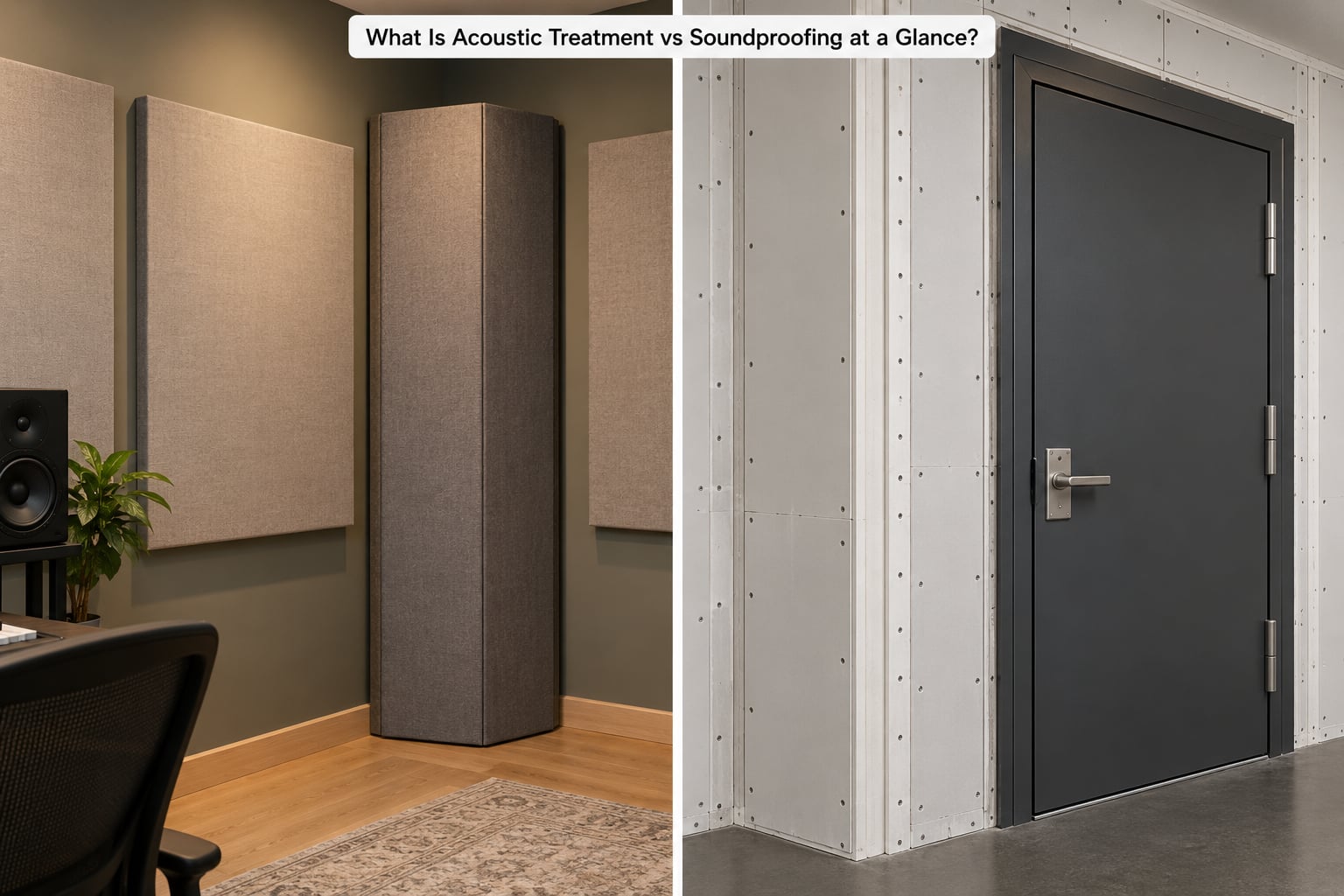
The difference is easiest to see in one table. The left column is what a recording engineer actually installs inside the room; the right column is what a builder does to the room shell.
| Criterion | Acoustic treatment | Soundproofing |
|---|---|---|
| Goal | Accurate sound inside the room | Less sound crossing the boundaries |
| Also called | Room tuning, sound absorption, diffusion | Sound isolation, sound transmission control, noise isolation |
| Where it acts | Inside the listening space | Walls, ceiling, floor, doors, windows, vents, outlets |
| How it works | Absorbs and scatters reflections so energy dies out faster | Adds mass, decouples surfaces, seals every gap |
| Typical materials | Fabric-wrapped broadband panels, mineral wool, broadband foam, bass traps, diffusers, ceiling clouds | Mass-loaded vinyl, double stud walls, resilient channels, isolation clips, dense drywall, door sweeps, acoustic sealant |
| What you measure | RT60, decay time, early reflection energy, bass response | Transmission loss, STC, noise floor difference in and out |
| What it does not fix | Traffic noise, a chatty neighbour, a leaky door | Echo, flutter echo, boxy tone, muddy bass |
| Typical spend | Low to moderate, room by room | Moderate to high, and it is construction work |
| Can a renter do it? | Mostly yes, especially portable pieces | Only partially, with seals and portable booths |
One line covers the physics. Soundproofing materials must reflect sound, because a barrier works by refusing to pass energy. Acoustic treatment materials must absorb sound, because a panel works by swallowing it. Swap them and you get worse results, not better ones.
What Does Acoustic Treatment Control?
Acoustic treatment controls sound after it has entered the room. That includes reflections, echo, reverberation and the uneven bass you hear between seats.
Reflections and the first reflection point
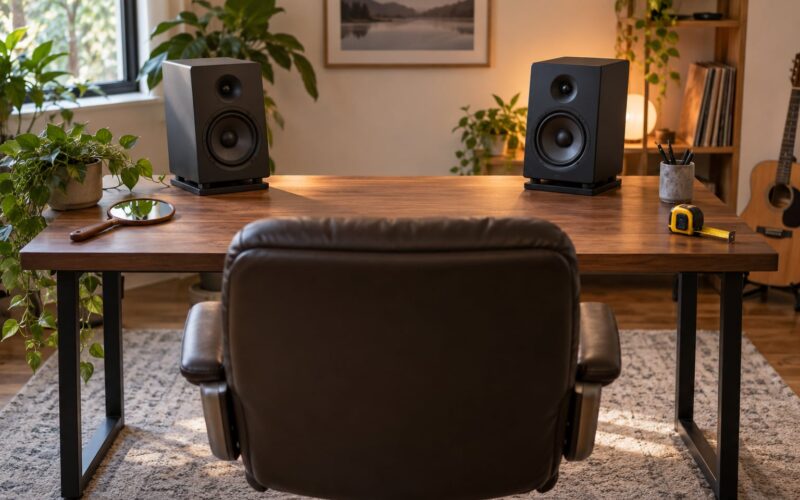
A speaker sends sound in a straight line to your ear and a second line to a side wall, which bounces back into the same ear. That second arrival smears the transient and makes a bright mix sound dull and vague. Find the first reflection point by asking a helper to hold a mirror on the side wall while you sit at your listening position; you will see your speaker in it. Put absorptive panels just behind that spot.
Flutter echo and reverberation time
Parallel hard surfaces facing each other, such as bare walls, a glass window and a bare ceiling, produce flutter echo, a rapid ringing or metallic smear that a room EQ cannot fix. Softer, mismatched surfaces and absorptive panels break it up. The number that tracks this is RT60, the time for the room to decay by 60 decibels, and a untreated living room often runs well past half a second where a mixing room wants to be much shorter.
Bass buildup and corner modes
Low frequencies pool in corners and along walls where dimensions reinforce a particular wavelength. Broadband foam is thin and air-permeable, so it is roughly half as absorbent at low frequencies as thicker, denser mineral wool panels, which is why the same panel that tames a vocal hiss leaves a boom untouched. Tall corner bass traps give the low end a porous mass to work against. Treat the corners first, because that is where the energy sits.
Diffusion and the dead-room problem
Absorption is not the only tool. A diffuser scatters reflections across many angles so the room stays lively instead of flat. A common rule of thumb in listening circles is covering 10 to 20 percent of the room surface with absorption, then using diffusion for the rest of the energy.
Overdoing broadband absorption is the classic mistake. A room stuffed with panels can sound boxy, lifeless and fatiguing, and users on r/audioengineering and r/Acoustics describe exactly that result after covering every surface. Some reflection is what makes a room sound like a room.
What Does Soundproofing Control?
Soundproofing controls sound transmission, meaning how much energy passes through a wall, ceiling, floor, door or window. Engineers increasingly call this sound isolation, and on r/Acoustics people make that correction often because soundproofing sounds like a promise it cannot keep.
The three mechanisms that work
- Mass. Heavier barriers are harder for sound energy to push through. The mass law says each doubling of a barrier’s weight buys roughly 6 decibels of reduction, which sounds generous until you notice the frequency it applies to.
- Decoupling. If two drywall layers are bolted to the same studs, vibration bridges the gap and structure-borne sound walks straight through. Resilient channels or isolation clips let one layer float on clips, so the two surfaces no longer share a rigid path.
- Sealing. Sound takes the easiest route available, and a 3-inch gap under a door or an uncaulked outlet box leaks more than most people expect. Acoustic sealant, door sweeps and continuous gaskets close those paths.
Why low frequencies defeat most builds
Here is the honest part that vendor pages tend to skip. A standard single drywall wall gives roughly 5 to 6 decibels of reduction at 63 Hz and about 12 decibels at 125 Hz, and close to nothing at the very bottom of the range. Low frequencies are long, and long wavelengths push through lightweight assemblies by flexing them rather than by pushing air. Getting real isolation at 40 Hz means serious mass, real decoupling and usually an air gap between two independent structures.
As engineers on r/Acoustics put it, soundproofing a wall requires a lot of work and materials. That is why a well-isolated but untreated studio still sounds like a box. Isolation and room sound are separate problems.
Noise you cannot control
Low-frequency rumble from traffic, aircraft, HVAC and appliances is often structure-borne, travelling through the floor joists and the building itself. Sealing the wall in your room will not stop a jet overhead. On apartments and condos this is the realistic limit, and it is worth knowing before you start a rebuild.
How Do They Differ in Materials and Installation?
Absorbers, bass traps and diffusers
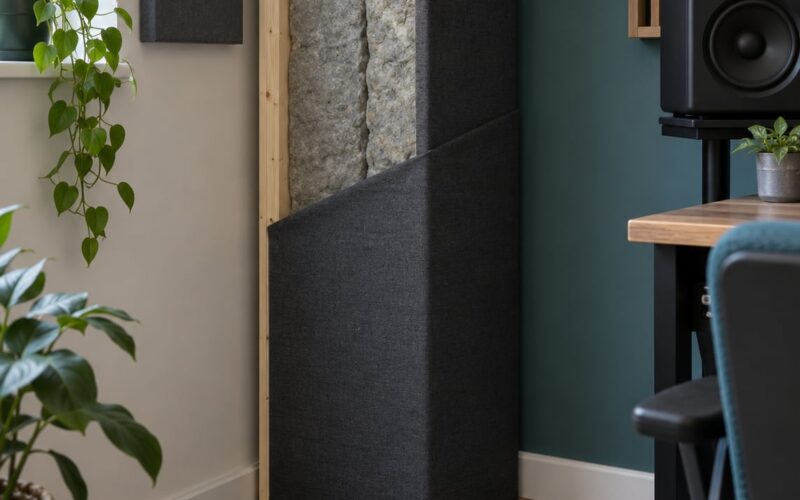
Treatment is mostly surface-mounted, needs no structural work and can start at a single corner. Broadband panels use a mineral wool, fiberglass or polyester core behind breathable fabric. Bass traps are the same idea scaled up for low frequencies, and a cylindrical corner trap works when sound actually reaches it. Foam wedges are the cheapest and least effective option, fine for high frequencies and decoration, misleading the moment a listing calls them soundproofing.
Mass, air gaps and seals
Isolation usually means demolition. Typical assemblies combine a dense inner layer such as mass-loaded vinyl, a resilient channel or clips, a second drywall layer and an air gap before the existing wall. Doors are replaced or heavily gasketed, windows get laminated glass or secondary panes, and vents get lined or bypassed. None of that is a weekend project in a rented apartment.
Why the ratings on the box mislead you
Retail panels advertise an NRC rating, which measures how much sound a material absorbs inside a room. Soundproofing assemblies are described with STC, which measures how much sound a wall blocks passing through it. Two different properties. Worse, the NRC retailers print is often measured at a single 1 kHz frequency, the band where thin foam looks best, and it says nothing about the 63 Hz problem that annoyed you in the first place. Read the test method, not the number.
Which Problem Are You Trying to Solve?
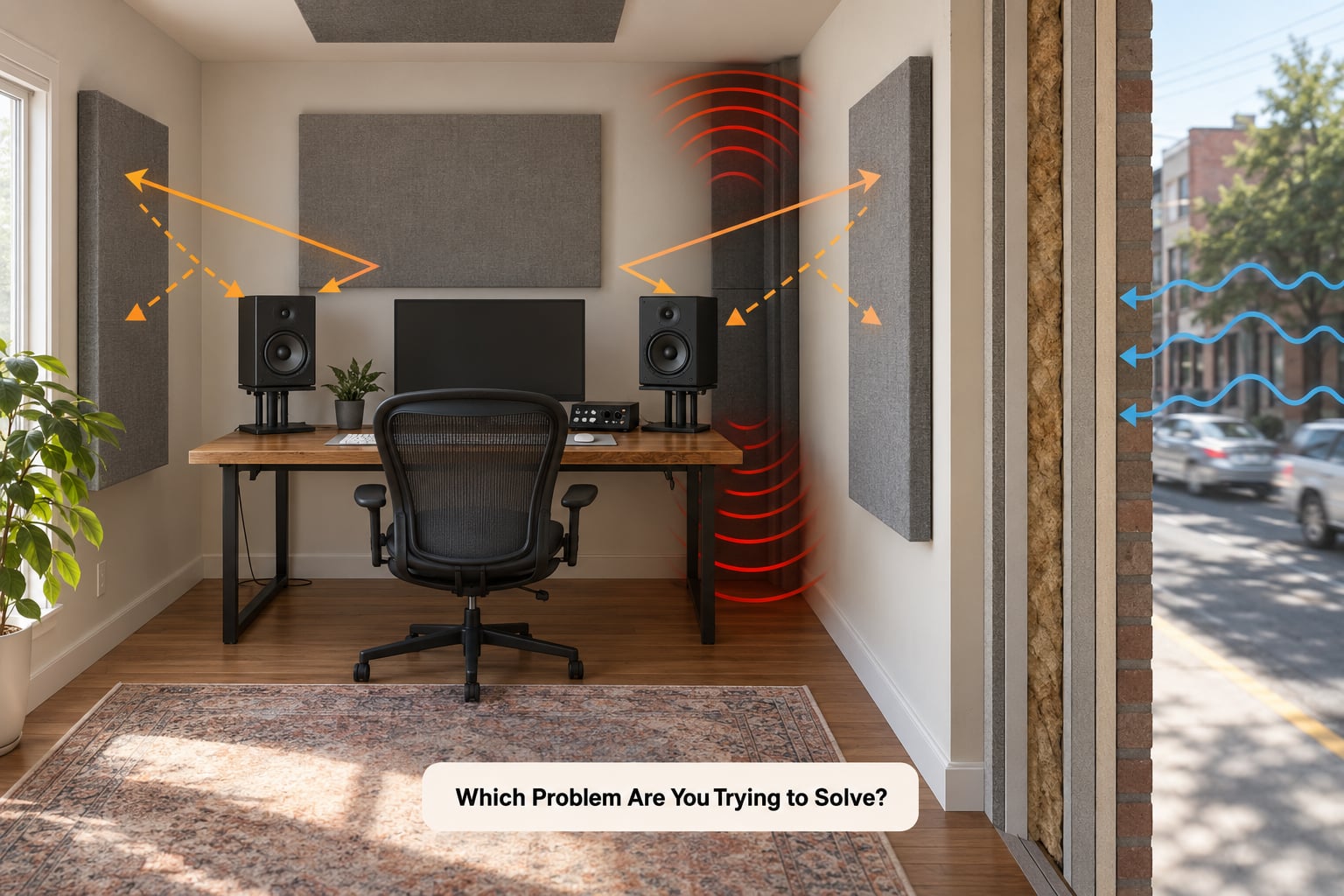
Match the symptom and the answer follows. Most rooms need one column, some need both, and the ones that need both are rarer than the industry would like you to believe.
| What you hear | What is happening | What fixes it |
|---|---|---|
| Traffic, voices or a neighbour through the wall | Transmission through shared surfaces and gaps | Soundproofing: seal gaps first, then add mass and decoupling |
| Slap-back echo on vocals | Reflections off bare parallel walls | Acoustic panels at the first reflection points |
| A ringing or metallic tail | Flutter echo between hard parallel surfaces | Broadband absorption plus diffusion |
| Boom on kick drum and bass | Low-frequency buildup in corners | Bass traps in the corners, thicker dense panels |
| Mix sounds dull or bright only in one spot | Early reflections from a side wall | Panels behind the mirror spot, then recheck the mix |
| Everything is quiet but the room still sounds bad | Isolation done, room sound ignored | Acoustic treatment, starting with corners |
| Your vocals are clean but neighbours complain | Isolation done, reflection control partial | Add treatment for your ears, isolation for everyone else |
Two tests you can run before spending anything
Play white or pink noise in the room, stand outside the door with one ear covered, and listen for where the sound leaks. A thin spot in the leakage means an unsealed gap, which is the cheapest fix in this entire article.
For reflections, sit in your listening position with a mirror on each side wall and move it until you spot the speaker. That distance is your first reflection point, and it is where panels pay for themselves first.
Which Should You Choose?
Bedroom producers on a budget
Start with treatment. Thick fabric panels, a heavy rug, a bookcase acting as a diffuser, and two corner traps placed where the bass actually is will fix most of what is wrong with a small room. Seal the door while you are at it. Expect a modest spend and a large improvement in how the room sounds, not in how much leaks.
Project studios and mixing rooms
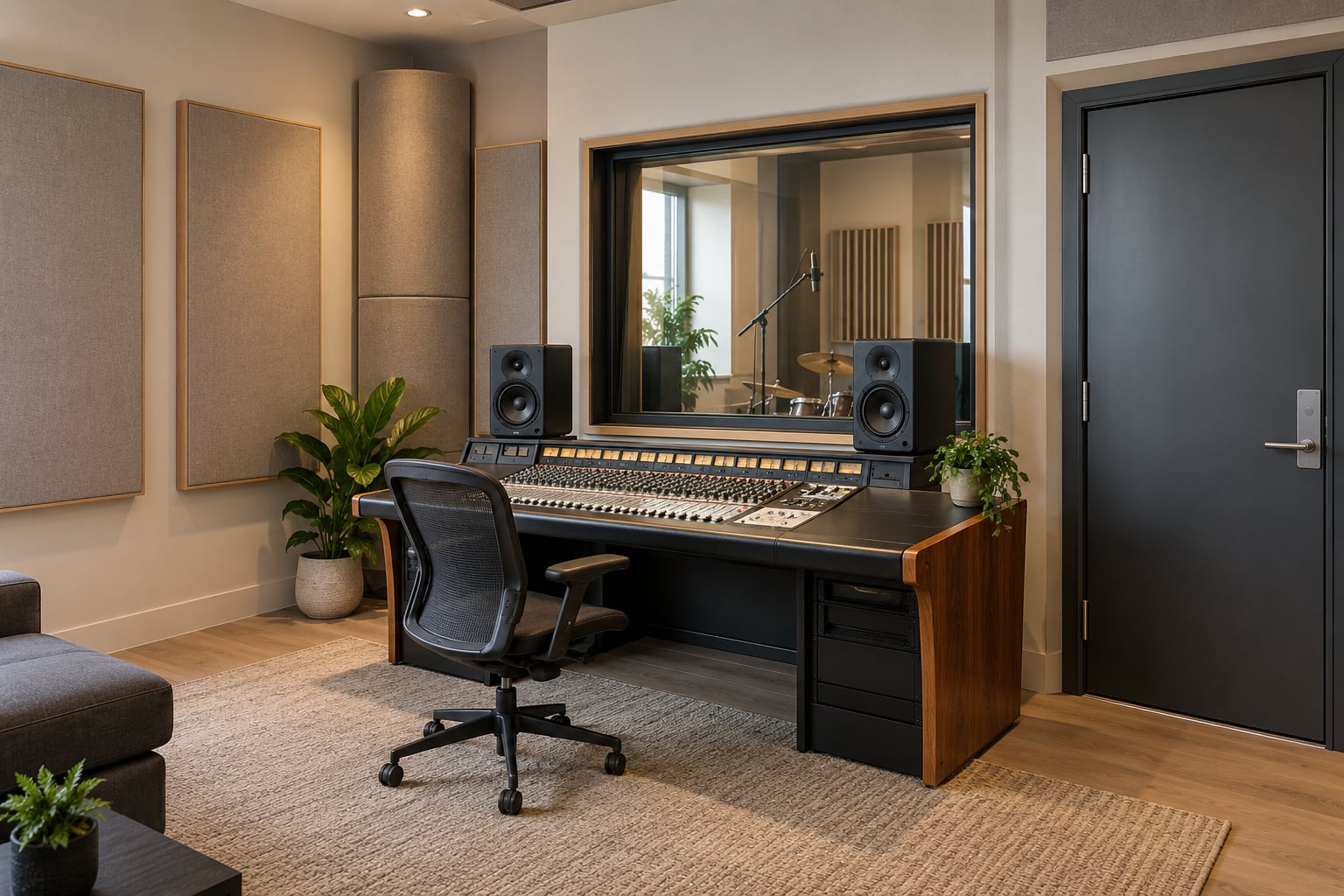
Treatment first again. A treated mid-size room beats an untreated one with better monitors, which is the point most vendors quoting big speaker prices miss. Add bass traps in all four corners, broadband panels at the first reflection points, and a ceiling cloud if the ceiling is pulling your imaging around.
Shared walls, apartments and neighbours
Soundproofing, and accept the ceiling on results. Door sweeps, weather stripping and acoustic sealant along trim and outlets are inexpensive and remove real leaks. Beyond that, portable vocal booths and thick blankets over the wall help with mid and high frequencies and do very little at the very bottom. On r/audiophile the consensus is blunt: foam and panels control reverberation inside the room and do very little to stop transmission in or out.
Rehearsal rooms and live tracking
Usually both. Isolation keeps the neighbours and the street out of the microphones, treatment keeps the drums from smearing into every take. If only one is possible, isolating first is right, because bleed into the microphones ruins takes in a way a slightly live room does not.
Renters and anyone with a lease or HOA
Read your lease before anything structural. Common rules cover drilling, wall changes, and anything touching shared or structural walls. Portable booths, rugs, curtains, door seals and clip-in panels cover most of what treatment can do without a single hole in the wall.
The order that works
Seal gaps, then add isolation where it matters most, then treat the room for reflections and bass. People on r/audioengineering describe the two as sequential rather than alternative, which matches how it goes in practice: once you finally quiet the transmission, you can hear the room problems you had been blaming on the neighbours. Watch for over-treatment once you reach the panels stage, and re-check with the same mix you use now, not a new one.
Frequently Asked Questions
Can acoustic treatment replace soundproofing?
No. Treatment absorbs and scatters reflections inside the room so it sounds accurate. Soundproofing stops sound crossing walls, doors and windows. Panels on your walls will not reduce traffic noise coming through a shared wall, and a sealed, heavy room still echoes badly without treatment. Each solves the problem the other cannot touch.
Is acoustic foam effective for soundproofing?
Barely. Foam is thin and air-permeable, so it absorbs high frequencies and is roughly half as absorbent at low frequencies as thicker, dense mineral wool panels. It does help reduce echo inside the room. As a barrier against sound passing through a wall it does close to nothing. Foam sold as soundproofing is usually just absorption in a louder package.
What is the difference between sound isolation and sound absorption?
Absorption removes energy from inside a room by letting it enter a porous material and converting it to heat. Isolation prevents energy from passing between spaces using mass, decoupling, air gaps and airtight sealing. Isolation is about transmission, absorption is about reflections and reverberation. Good rooms need both, because isolation without absorption leaves a boxy room.
Do I need both acoustic treatment and soundproofing?
Most working studios do, but not every home room. If outside noise is a problem you need isolation. If your room sounds boxy, boomy or unclear but is already quiet, you need treatment. Doing the cheaper missing half first usually delivers more improvement than a full job on the wrong half. Leaky, noisy rooms need sealing before anything else.
What is the most effective soundproofing for a home studio?
A room inside a room works best: two independent walls with mass-loaded vinyl or dense layers, resilient channels or isolation clips, and a real air gap between them, plus a gasketed heavy door and no untreated vents. Mass law gives roughly 6 decibels per doubling of weight, and low frequencies remain the hard limit. Effectiveness depends more on airtightness and decoupling than on weight alone.
Should I install acoustic treatment before soundproofing?
Seal gaps first, since a dollar of acoustic sealant in a door gap beats a room full of panels. Then add isolation where it matters, then treat the room. One exception: if you track live sources and bleed ruins your takes, isolating first is the priority. Either way, expect to adjust the treatment afterwards once you can finally hear the room.
Conclusion
Start by naming the problem honestly. If recordings and playback sound wrong inside an otherwise quiet room, you need acoustic treatment, beginning with the first reflection points and the corners. If you can hear the street, a neighbour or your own take on the other side of a wall, you need soundproofing, beginning with gaps, doors and vents.
Seal first, isolate second, treat third. That order solves what is acoustic treatment vs soundproofing in practice, and it stops you from filling a room with panels that were never going to stop the noise you actually hated.