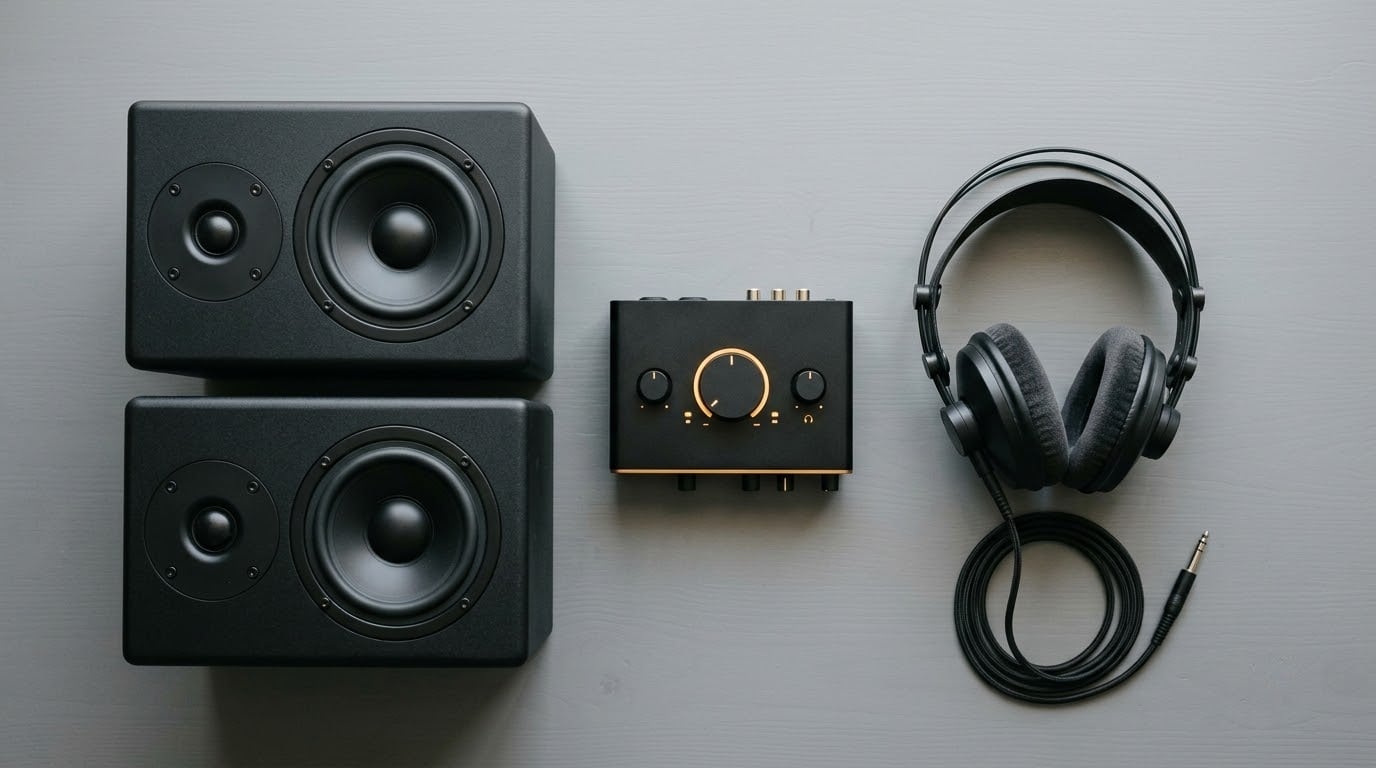
Studio monitors vs headphones for mixing comes down to what your room can do. Speakers give you real spatial cues, physical low-end impact and a level that matches how the track will be played, but they only work properly in a treated space. Headphones give you a consistent, isolated signal with more detail than most people expect, and no room to fix. Neither wins outright.
Short version, the way engineers actually talk about it:
- Studio monitors: flat frequency response, natural crossfeed between the speakers, physical sub-bass you can feel, and honest reverb and delay decisions. The catch is that everything depends on acoustic treatment and correct placement.
- Studio headphones: room-independent consistency, strong isolation, sharp micro-detail for spotting clicks and edits, and far less setup. The catch is an exaggerated stereo image, no physical bass sensation and faster ear fatigue.
- Which should you choose? Monitors if you can treat the room and work at a reasonable level. Headphones if the room is untreated, shared, small or noisy. Most working producers end up owning both and cross-checking between them.
If you have been mixing on headphones and everything sounds fine until you play the track on speakers, the low end is the usual culprit. That is a translation problem, not a gear problem, and it is fixable.
Table of Contents
- Studio Monitors vs Headphones for Mixing at a Glance
- How Studio Monitors Change the Mixing Process
- Studio Monitors vs Headphones for Mixing: What Sound Changes
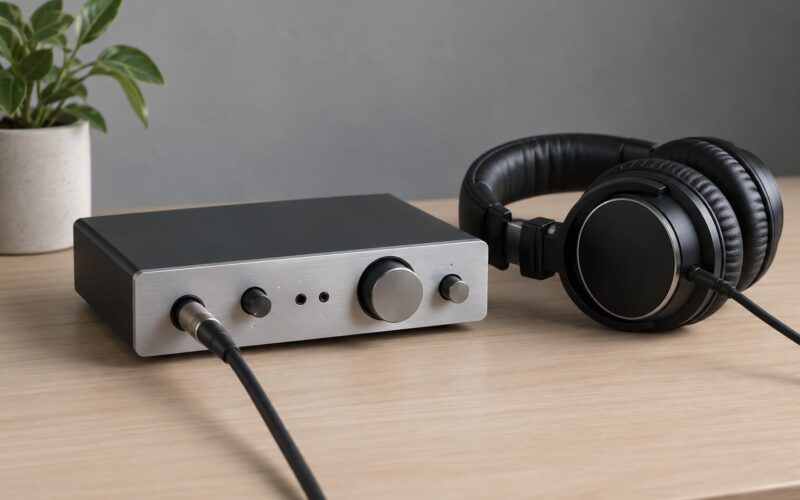
- How Headphones Change the Mixing Process
- Room Acoustics and Setup Requirements
- Which Option Is Better for Different Producers?
- Which Should You Choose?
- Frequently Asked Questions
- Conclusion
Studio Monitors vs Headphones for Mixing at a Glance
Here is the side-by-side comparison of the two systems. Read the right-hand column as the deciding factor for your situation rather than a quality score.
| Factor | Studio monitors | Studio headphones |
|---|---|---|
| Frequency response accuracy | Flat when treated and positioned correctly | Flat on paper, but proximity shapes the result |
| Stereo imaging | Natural, with real crossfeed between channels | Hard-panned left and right, minimal crossfeed |
| Depth perception | Front-to-back placement reads naturally | Weak, so reverb depth is easy to overdo |
| Low end | Physical sub-bass impact you can feel | Detailed but no sensation in the room |
| Room dependence | High. Treatment and placement decide everything | Almost none |
| Isolation | None. Sound leaves the speakers | Good to excellent |
| Detail retrieval | Good for arrangement, weaker on tiny artifacts | Excellent for clicks, pops and edit points |
| Listening level | Often constrained in apartments or at night | Any level at any hour |
| Fatigue over a long session | Lower, since volume can stay moderate | Higher, from a fixed level at the ear |
| Space and setup | Needs desk depth, stands and treatment | A pair of cups and an amp |
| Where it wins | Balances, low-end and space decisions | Untreated rooms, editing, late nights, portability |
How Studio Monitors Change the Mixing Process
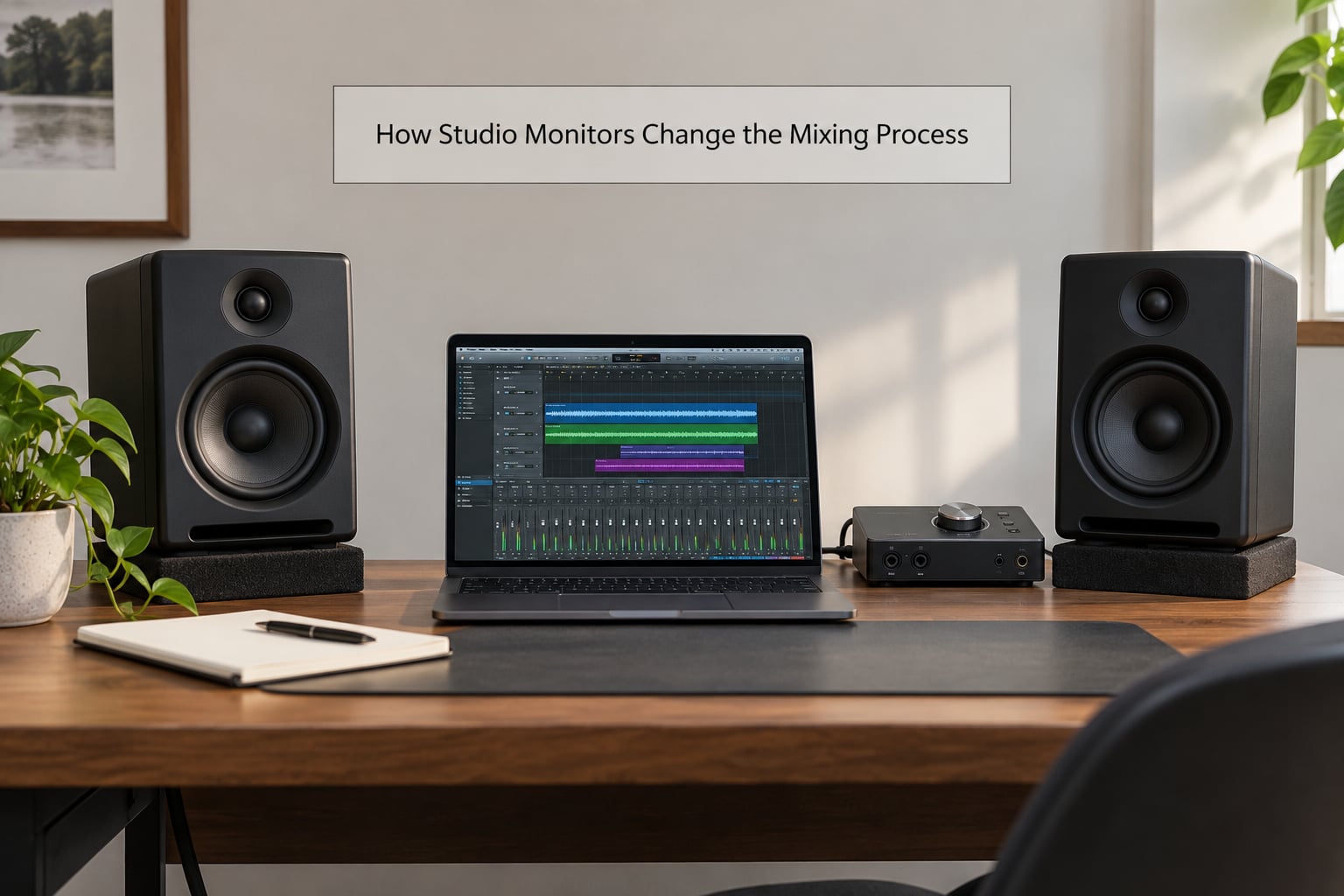
Speakers send sound through the air across a distance, and that distance is doing real work. Each ear receives slightly different timing and level information from each speaker, which your brain reads as a soundstage. Headphones bypass all of it.
Low frequencies behave differently in a room
A 5-inch nearfield monitor in a treated room will reproduce a kick fundamental and let you feel the pressure of the low end. On headphones, that same frequency is reproduced accurately in isolation but produces no physical sensation at all, so there is no feedback loop telling you the bass is too heavy.
That is why headphone-balanced mixes frequently arrive at a speaker playback with bass that feels bloated. The mix was balanced by ear against an absence.
Spatial imaging becomes a usable reference
On speakers you can close your eyes and judge whether a vocal sits in front of a guitar or behind it. Depth cues come from level, timing and the room. Headphones give you left, right and little else, so panning decisions are made almost entirely by ear-memory and habit.
Playback level changes judgement
Mixes are relative decisions. If you mix quietly, the loudest element in the track becomes your loudest reference and everything gets compressed to fit under it. Working at a consistent, moderate level for the entire session is one of the quiet advantages of nearfield monitoring.
You are checking the deliverable
Speakers reproduce the conditions your listener will actually hear, including the shared low end of a phone speaker or a kitchen Bluetooth unit, because the physics of small drivers still apply in those spaces. Headphones never tell you about that constraint directly.
Placement decisions change the sound
The most common mistake is not buying bad speakers. It is putting them where the desk fits instead of where the acoustics work. Ear height, distance from the front wall, angle and toe-in all move the image and the bass balance. Get those wrong and the monitors are guessing.
Studio Monitors vs Headphones for Mixing: What Sound Changes
Frequency response is the least interesting difference and the one people argue about most. Both systems can be flat. The bigger changes are in how the two deliver sound to your ears.
Imaging and crossfeed
Speakers give each ear input from both channels, with a small delay and level difference on the far speaker. Headphones feed one channel to each ear and isolate it from the other. Everything from instrument separation to reverb depth depends on that difference, which is why headphone mixes tend to be wider and less firmly focused than speaker mixes of the same session.
Low-end translation
This is the single biggest gap. Speakers move air in a room; headphones move a membrane against your skull. Below roughly 40 Hz, headphones can show you what is there, but you cannot judge how much of it is appropriate. Sub-bass-heavy genres fail in the opposite direction too, because without the physical cue engineers can leave too much in and assume it will read.
Stereo perception and the headphone curve
Driver proximity changes what a headphone reproduces. Most studio headphones carry a deliberate low-shelf lift and a gentle dip in the presence region, designed so the bass sounds balanced against bone conduction from the skull. Learn to hear that curve rather than fighting it, or you will cut bass you should have left alone.
Open-back, closed-back and noise-isolating designs
Open-back headphones sound the most natural and leak sound in both directions, which makes them poor roommates and poor tracking headphones. Closed-back designs isolate well but build up low end in the sealed volume, so bass balance decisions are less reliable. Noise-isolating in-ears sit at the other extreme: excellent isolation and portability, with a narrower soundstage and a fit that changes the bass between ears.
How Headphones Change the Mixing Process
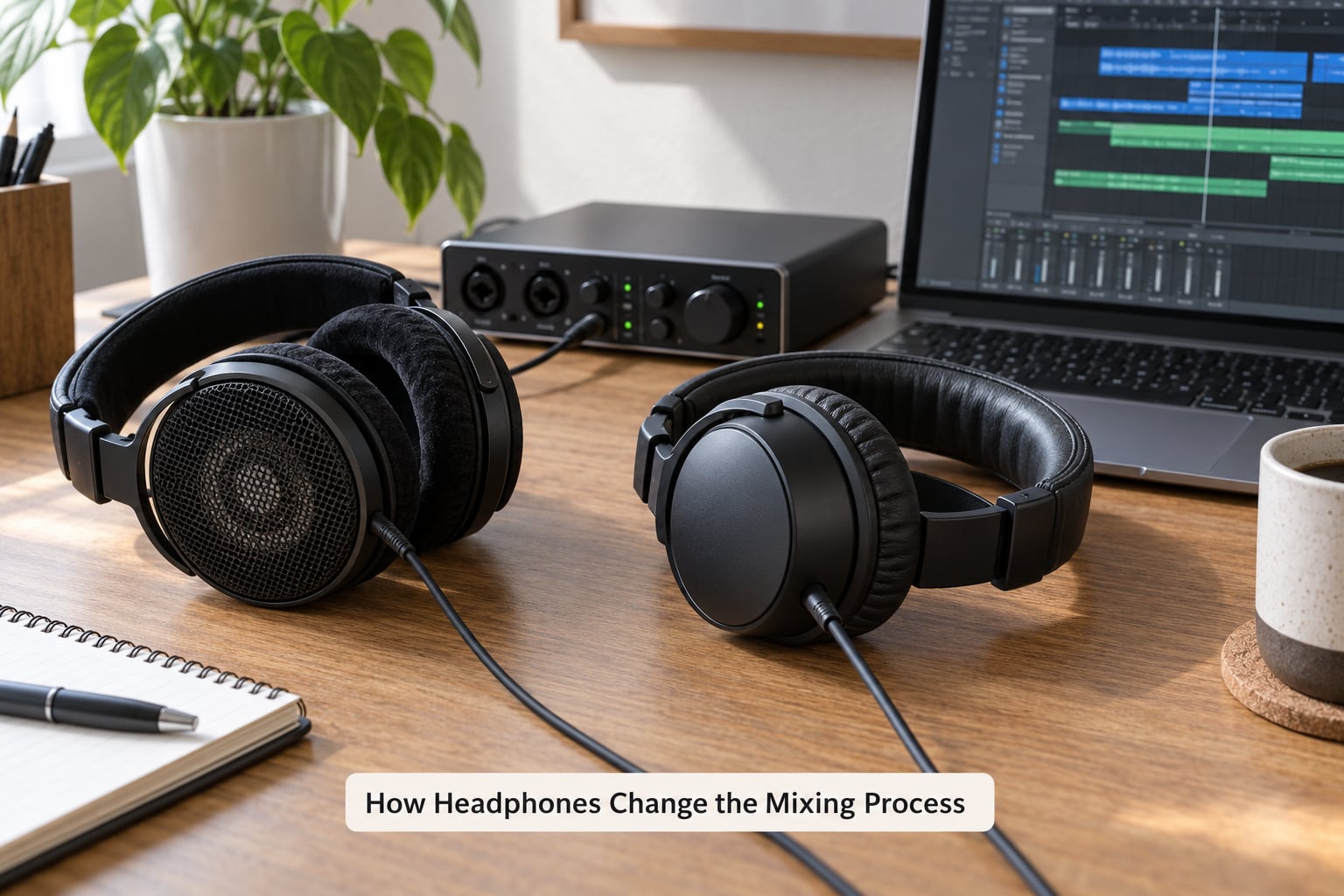
Headphones change the process less by making things louder and more by removing variables. Once the signal is sealed to your ears, the room stops mattering, which is exactly what an untreated bedroom needs.
Emulated crossfeed and virtual monitoring
Crossfeed plugins feed a small amount of each channel into the opposite ear to soften the hard left-right split. Head-tracking or binaural plugins add head-related cues so panning reads more three-dimensionally. They help, but they are a filter over the problem, not a solution to it.
The 60-60 rule
The 60-60 rule says keep your volume at no more than 60 percent of the headphone’s maximum and listen for no more than 60 minutes at a stretch. It is a rough guardrail, not a law, but it targets the two things that actually damage mixing decisions: over-loud listening and ear fatigue.
Habits that quietly ruin a headphone mix
Reach for a treble boost because the mix feels dull in the cans, or push the low shelf because the headphones feel thin, and you have changed the balance rather than the mix. The other common habit is skipping the mono check. Sum your mix to mono regularly, since many listeners will hear it that way, and any element that disappears was never really there.
Editing is where headphones are hard to beat
Click removal, fade timing, sample edits and noise floors all hide in an untreated room and show up clearly on headphones. For that work, headphones are not a compromise. They are simply the better tool.
Room Acoustics and Setup Requirements
The room matters more than the speakers, and this is the point people resist most. A treated room with modest monitors beats an expensive pair in an untreated bedroom, every time.
What monitors demand from a room
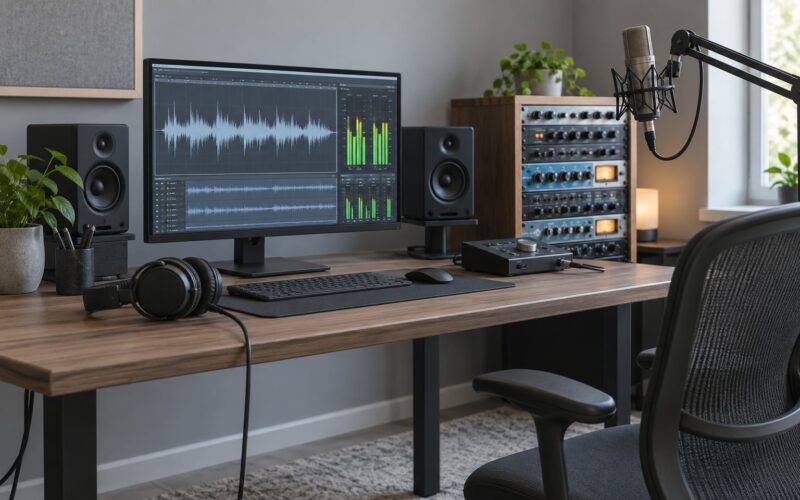
You need depth behind the speakers for the equilateral triangle, speakers at ear height on stands or isolation pads, soft furniture or absorbers at the first reflection points, and bass trapping in the corners. Skip those and you are not hearing the monitors, you are hearing the monitors plus the room.
The 38% rule is the placement shortcut most people know: set your speakers so they sit roughly 38 percent of the room’s length back from the front wall, which tends to land you between the worst room modes and gives a more even low-end response. It is a starting position, not an answer.
What headphones demand from you
A decent amp, a known pair, and a level reference you return to every session. No desk space, no furniture arrangement, no neighbours to consider. That simplicity is the reason many producers ship finished work from headphones alone.
Calibration is the bridge
Set a reference level for both systems and check it with the same familiar tracks each time. Set a consistent moderate loudness, keep it there for the whole session, and the two systems will argue far less. If your headphones and monitors routinely disagree on balance, that disagreement is almost always a level-matching problem, not a gear problem.
Which Option Is Better for Different Producers?
Match the system to the situation you actually work in, not the situation you imagine you will be in.
Beginners building a first room
Start with headphones. They will teach you balance, editing and level judgement without a room to mislead you, and they cost a fraction of speakers plus treatment. Add monitors once the room is workable.
Producers working in untreated or shared spaces
Headphones, clearly. Apartments, small bedrooms and rooms with an open doorway will fight any pair of monitors you put in them. Keeping the volume low is also what makes late-night work possible.
Engineers in a partly treated small room
Nearfield monitors with a subwoofer you can often switch in for the low-end check. Nearfields keep the direct-to-reverberant ratio high enough to stay honest in a room that is not a facility.
Tracking engineers
Closed-back headphones or in-ears. Isolation during recording is a different requirement from accuracy during mixing, and you cannot play to a performer through speakers you have not yet treated.
Mixers who need reliable low-end reference
Monitors in a treated room, checked with headphones. If your genre lives below 60 Hz, this is where you need real acoustic information, and no headphone curve substitutes for it.
Which Should You Choose?
Choose monitors when you can treat the room, work at a moderate level and commit to one reference for the whole session. That is a real investment of time and money, and it buys you reliable low-end and spatial decisions. Choose headphones when the room is untreated, shared or noisy, when you work at odd hours, or when you mostly need editing precision and consistency.
If budget allows for both, the sensible order is: headphones now for editing and detail work, then treatment, then monitors. Treating first is the advice forum engineers keep repeating, and it holds. Spending on more expensive speakers in a bad room mostly buys a more expensive wrong answer.
The best workflow is a fixed primary system and a fixed secondary one. Mix the balance and low end on monitors, use headphones for edits and for catching translation problems, and do not switch mid-session expecting a fresh perspective. Different systems disagreeing is information; the habit of constantly changing rooms for a different opinion is not.
Frequently Asked Questions
Can you mix a song entirely on headphones?
Yes, provided you cross-reference and know your headphone curve. Plenty of working engineers ship headphone-balanced mixes without incident. The risk is concentrated in the low end and in stereo width, so check the bass and a mono sum against a speaker system or a trusted reference before you call it finished.
Are studio monitors always better than headphones for mixing?
No. Monitors are better for balances, spatial decisions and sub-bass, but only in a treated room. In an untreated bedroom, good headphones will beat mediocre monitors every time. The comparison that matters is your room and workflow against the other system, not the spec sheet.
What type of headphones is best for mixing music?
Open-back headphones are usually best for mixing because they sound the most natural and neutral, though they leak sound both ways. Closed-back designs isolate better for tracking but can build up bass in the sealed volume. Choose based on whether your priority is accurate balance or isolation from outside noise.
Do I need studio monitors if I use headphones?
Not immediately. If your room is untreated, shared or small, headphones will serve you better for most work. You will want monitors eventually for sub-bass and depth decisions, and for checking how the mix behaves outside headphones. Treat the room before upgrading the speakers.
Should I use both monitors and headphones when mixing?
That is the most common professional setup. Pick one as your primary reference for balances and low end, then use the other for detail work, edit points and translation checks. Keep a consistent reference level on each, and avoid switching systems mid-mix purely for reassurance.
Conclusion
Studio monitors vs headphones for mixing is a question about your room, not your taste. Monitors win where the space is treated and you need honest low end and depth. Headphones win everywhere the room is not, and they win on detail and cost. The first thing to do is audit your listening space honestly, set a repeatable reference level on the system you own now, and stop switching systems mid-mix. That consistency teaches you far more than another piece of gear.