Selling beats online comes down to four jobs: package the audio properly, attach clear license terms, put it where artists already browse, and deliver the files fast enough that nobody hesitates. Most producers who stall are not short on beats. They are short on a system.
There are two ways to do it. Sell through a marketplace such as BeatStars or Airbit, where the traffic already exists and the store takes a cut, or run your own store on something like Shopify or Wix and keep more of every sale. Plenty of producers start on a marketplace, learn which beats convert, and move their best sellers to their own site later.
Here is how to sell beats online, in the order that actually works, from picking which beats are ready through to reading your numbers and scaling. Most people can finish the setup in a weekend. Earning from it takes longer, and I’ll be honest about that in the last section.
Table of Contents
- What You Need
- How to Sell Beats Online: Step-by-Step
- 1. Choose the beats you are ready to sell
- 2. Set licenses, prices, and usage terms
- 3. Prepare masters, stems, and previews
- 4. Create a professional producer storefront
- 5. Publish on beat-selling marketplaces
- 6. Write a plain-language sales page for each beat
- 7. Promote beats online: how to sell beats online past your storefront
- 8. Deliver the purchase and protect the agreement
- 9. Follow up, improve, and scale your catalog
- Common Mistakes
- Frequently Asked Questions
What You Need
You need far less than most beginners think. The expensive part of this business is not software, it’s having finished beats worth paying for. Everything else is process.
Rights-cleared instrumentals. If a beat contains a sample, a loop from someone else’s pack, or a melodic phrase lifted from a song, you cannot honestly sell it as exclusive. Keep a note of where every sample came from and what the license allows. An uncleared sample is the fastest way to lose a sale and, occasionally, a lot more than that.
Two exports of every beat. A tagged MP3 for streaming and previews, with your producer tag audible, and a clean untagged WAV for delivery. Stems or trackouts for the higher tiers. The tagged version is what people audition; the untagged version is what they pay for.
A short bio and a real contact method. One paragraph on how you make music, the genres and moods you actually work in, and a way to reach you. Artists are buying a person as much as a loop.
A selling channel. A marketplace account for discovery and instant delivery, or a hosted store. Pick one to start. Running three half-finished stores beats running one finished store every time.
License wording. A plain-language agreement for each tier that states what the buyer gets, how many copies they may distribute, whether they can use it in music videos, and whether the beat can still be resold. You can write this yourself; it does not need to be lawyer-drawn to be useful, though a lawyer is worth it once exclusives are landing regularly.
A payout method. Every marketplace handles the payment, deducts its commission, and sends the money to a bank account or connected payment service. Set that up before you list anything, not after a buyer checks out.
Do you need an LLC to sell beats online? No. Most producers start as a sole proprietor, report income on their tax return, and form a company later when the money justifies the admin. What you genuinely need is a record of every sale, which is exactly what the marketplace dashboard and your bank statement already give you.
How to Sell Beats Online: Step-by-Step
1. Choose the beats you are ready to sell
Audit your catalog and pick the tracks that hold up without you defending them in the notes. Play each one on a phone speaker, in a car, and on decent headphones. If the low end disappears or the hook needs explaining, it is not ready.
Fix what is broken. Re-balance the drums, clean up mud in the midrange, check that the master peaks without clipping, and make sure the loudness is in a sane place for streaming. A modest master at a consistent level beats a hot master that distorts on every phone.
Then choose a batch rather than your entire archive. Twenty to fifty polished beats is a workable starting catalog, according to producers discussing this on Reddit, and that is a lot more effective than three hundred unreviewed uploads.
How you know it worked: you can listen to any beat in your batch for thirty seconds and describe the vibe out loud without notes. If you can’t, it needs more work.
2. Set licenses, prices, and usage terms
Every beat needs at least two tiers, and the tiers are about rights, not sound quality. A basic non-exclusive lease usually means a tagged MP3 and a set distribution cap. A premium lease adds the untagged WAV and often stems or trackouts. An exclusive removes the beat from your catalog permanently, so it carries a much higher figure and a signed agreement.
Pricing is where most people learning how to sell beats online lose momentum, and the mistake is almost always the same one. You price on how good the beat feels to you. Price on what the buyer gets and how much of your catalog the sale removes. A lease that lets you resell the same beat to other artists is recurring value; an exclusive is one sale and then nothing. Set the exclusive figure so that one win still beats a realistic number of leases over the same period.
Write your usage terms down. Specify distribution and streaming caps, whether the buyer can put the beat in a music video or live set, what happens to publishing, and how long the agreement runs. Vague or contradictory terms are the single most common source of disputes I hear about.
How you know it worked: an artist who has never heard of you can read one tier and know exactly what they are buying, without messaging you first.
3. Prepare masters, stems, and previews
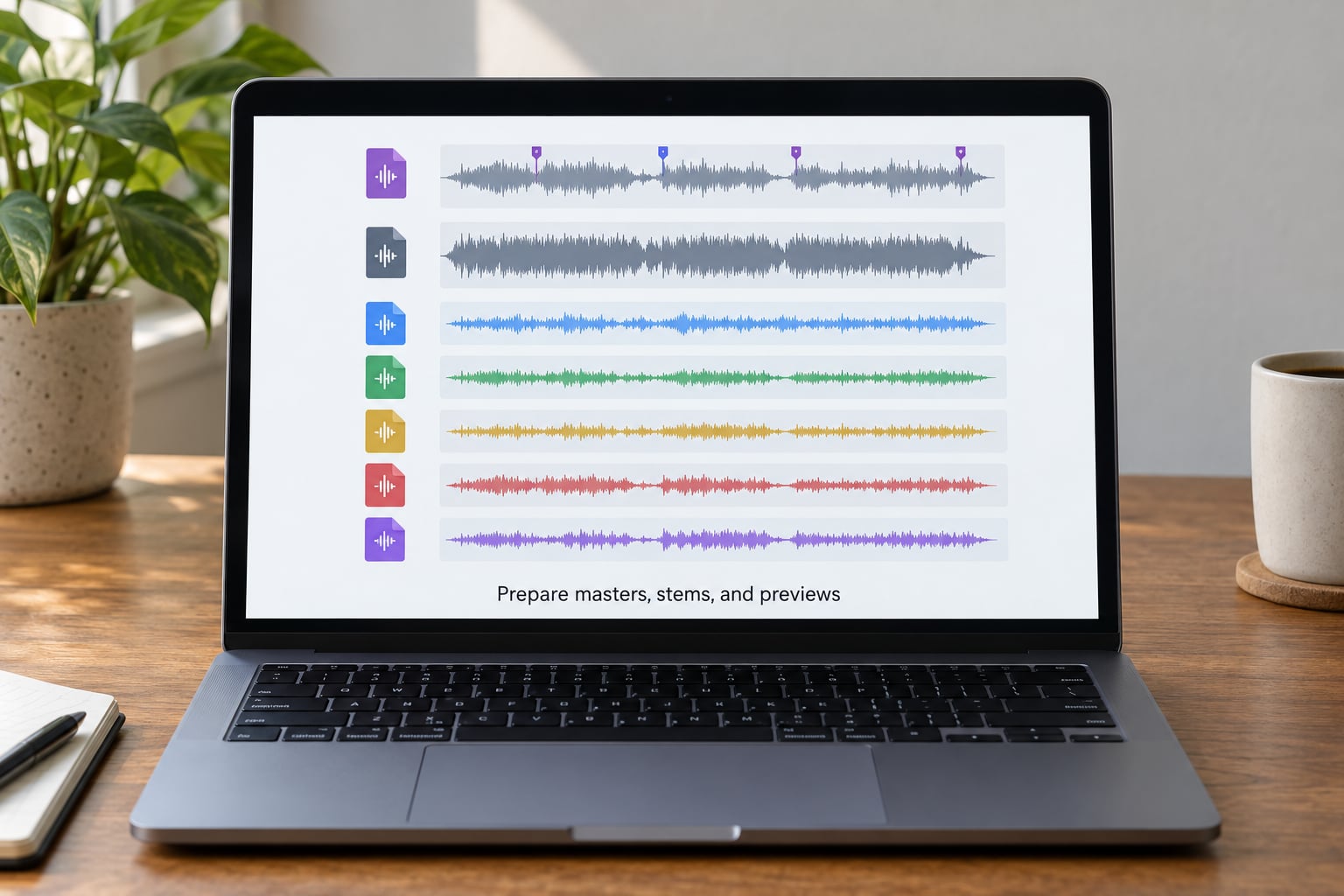
Export a tagged MP3 for the preview and a clean untagged WAV for delivery, both at the standard 44.1 kHz sample rate the streaming platforms expect. Bounce stems from the same session as the master so everything lines up, and name every file with a consistent scheme: beat name, tier, file type.
A short preview clip helps too. Somewhere around thirty seconds of the hook, delivered in a format a phone plays immediately. Buyers audition on their phone half the time, and a file that will not play is a lost sale with no warning.
Keep artwork simple and readable at thumbnail size. A clean cover with the beat title, your name, and no clutter works better than a busy design that turns into noise on a small screen.
How you know it worked: a prospect can audition the beat and pull the right file for their tier from any device, without asking you a question.
4. Create a professional producer storefront
Your storefront is a sales page, not a museum. Put your one-paragraph biography near the top, name the genres and moods you work in, list a few credits where you have them, and show a small selection of commercial-ready beats with their license choices visible.
On a marketplace, this means a filled-out profile, a profile image, a banner that says what you make, and a catalog organized so the best work is not buried. On your own site, it means a clean landing page with a player, clear tiers, and a checkout that does not require an account.
Ask yourself the buyer’s question: after ten seconds on this page, do I know what you sound like and how to buy? If the answer is no, fix the top of the page before you do anything else.
How you know it worked: a visitor who never contacts you still understands your sound and finds your pricing without scrolling twice.
5. Publish on beat-selling marketplaces
Open a store on BeatStars, Airbit, Traktrain, or Soundclick, upload your batch, and turn on instant delivery so the files reach the buyer the moment payment clears. BeatStars and Airbit carry the largest share of beat-search traffic, which is why most producers list there first.
Fill in every metadata field the platform offers: genre, mood, BPM, key, and the instruments present. Buyers filter by those fields, so an incomplete listing is a listing nobody finds. Consistent metadata across the catalog also makes your own catalog easier to browse later.
Organize by genre and mood rather than by creation date. A visitor looking for something dark and cinematic should land on something dark and cinematic, not on whatever you finished last week.
How you know it worked: your listings appear in search and filter results for the moods and genres you actually make.
6. Write a plain-language sales page for each beat
Each beat listing should answer five things without the buyer opening another tab: what the beat sounds like, what it suits, which files come with each tier, what the license allows, and how delivery works.
Describe the sound concretely. “Dark piano loop, 140 BPM, minor key, sparse drums” tells an artist more than “fire beat, made for the culture.” Vague sales claims waste space and lower trust, because everyone writes them.
Put the price next to the tier name rather than hiding it behind a button, and say plainly whether the beat stays available for lease after an exclusive sale. Buyers are deciding whether they can move fast on it, and that depends on you.
How you know it worked: someone can describe the license terms accurately after reading the listing once, with no messages exchanged.
7. Promote beats online: how to sell beats online past your storefront
The store does not sell itself. Post short clips of your hooks on Instagram Reels and TikTok, run type beat videos on YouTube with a link in the description, and send direct messages to artists who fit your sound. A producer on Reddit described reaching sales largely by posting consistently on short-form video, which is the cheapest test available.
Personalize every message. Reference something specific about the artist’s recent release, name the beat you think fits, and give them the link. Copy-paste outreach is easy to spot and gets ignored, and it can get your account flagged.
Build an owned list while you do it. Every clip, every video, every post points back to one place where people can hear more. Platforms change their reach rules constantly, and a list you collected yourself does not.
Track what actually gets replies rather than what gets views. Ten direct messages to the right artist will outperform a thousand views on a clip with no call to action.
How you know it worked: your posts produce store visits and direct messages, not just plays with no clicks through.
8. Deliver the purchase and protect the agreement
Instant delivery handles the files. Your job is everything around it: a receipt, a signed license agreement, a stored record of the transaction, and a backup of what went out.
Keep dated copies of every agreement and a versioned archive of the project files. If a dispute ever comes up about what was sold, which tier it was, and when, those two things settle it faster than memory does.
Upload timestamped copies of your beats to a separate archive so you can prove creation dates if a beat is ever released by someone else without your permission. It takes an afternoon once and settles arguments that would otherwise take months.
When an exclusive closes, remove that beat from every listing immediately. Leaving a sold beat purchasable creates refund requests and confusion that damage a store faster than a quiet week does.
How you know it worked: for any past sale, you can produce the agreement, the file list, and the delivery record within a minute.
9. Follow up, improve, and scale your catalog
Every marketplace dashboard gives you views, saves, purchases, and conversion. Read them once a month and write down what you noticed. Which beats get saves but no sales, meaning a pricing or trust problem? Which get plays but no clicks, meaning the preview or the title is wrong?
Then act on one thing at a time. Rewrite the weak listings, retire the beats nobody touches, adjust pricing, and release more material in the styles that convert. A catalog is a portfolio, and portfolios get edited.
Raise prices as your reputation grows, slowly. A jump that prices you out of your market costs more than the extra you would have earned on the sale you kept. Test a new figure on new beats first and watch the conversion change before applying it to your back catalog.
How you know it worked: you can point to a specific change you made because the numbers showed a problem, and the numbers improved after.
Common Mistakes
Pricing by how good the beat sounds. Price on rights and market position instead. Fix: set one base price for your entry tier, one for stems, one for exclusive, and stop deciding per track by mood.
License terms that contradict themselves. A listing promising unlimited streams next to a contract capping them is how disputes start. Fix: one agreement document, reused across every tier, with the tier differences isolated in a short table.
Selling beats with uncleared samples. You cannot grant exclusive rights to material you do not own. Fix: audit every sample before it enters the sellable batch and keep the receipts.
Low-quality previews. A muddy phone export loses the buyer before they hear the hook. Fix: master properly, export fresh files, and audition the preview on a phone before uploading.
Inconsistent metadata. Half your catalog missing BPM and key buries the half that filled them in. Fix: treat metadata fields as required, and fill them in the same session you upload.
A storefront with no clear offer. Beautiful banner, no prices, no tiers. Fix: show the license options and the price on the first screen a visitor lands on.
Mass outreach. The same three sentences to two hundred artists. Fix: send fewer, better messages, and mention something specific about the person you are writing to.
Slow or partial delivery. A buyer waiting days for stems has usually already found another option. Fix: turn on instant delivery, and check the file list before each listing goes live.
No record of the agreement. If it was never written down, you are relying on recollection when money is involved. Fix: store the agreement, the date, and the delivered file list with every sale.
If you only fix one thing this month, fix delivery. Fast, correct, well-documented delivery is what separates a store people come back to from one they quietly stop opening.
Frequently Asked Questions
What is the best platform to sell beats online?
BeatStars and Airbit are the two most commonly recommended starting points, because both have active artist traffic, tiered licensing, and automatic file delivery. Traktrain and Soundclick suit producers who want cheaper terms or unlimited uploads. There is no single best answer, because the platform that fits a beginner’s budget is rarely the one that fits an established catalog. Pick one, list twenty polished beats, and judge it on traffic and conversion after a month rather than on reputation.
How much should I charge for a beat?
Charge based on what the buyer receives, not on how the beat feels to you. Entry tiers with a tagged MP3 sit at the low end, premium tiers with untagged WAV and stems in the middle, and exclusives at a multiple of a lease since they remove the beat from your catalog forever. Raise your figures gradually as reviews and repeat buyers build up. Underpricing attracts buyers who disappear after one track.
Should I sell beats with a lease or exclusive license?
Offer both, because they serve different buyers. Leases generate recurring revenue from a single beat while the artist keeps their song rights and you keep the right to resell. An exclusive pays far more per track but closes the beat permanently. Most catalogs need leases to stay healthy, since the same beat can be leased repeatedly, with exclusives reserved for tracks that test consistently well.
Can I sell beats online without a record label?
Yes, and almost everyone selling beats online does exactly that. A label is not required to sell a license to an independent artist, collect payment, or deliver files. What you do need is correct copyright ownership of your own production, written license terms, and a clear business and tax setup. That last part is where most beginners get stuck, so set up records and payment details before listing beats for sale.
How long does it take to start selling beats online?
Most producers can finish the full setup in a weekend: select beats, write license terms, export files, and publish listings. Earning takes longer. Producers on Reddit describe months of dry spells with occasional sales, and they consistently say the same thing: post consistently, keep releasing, and treat early results as data rather than a verdict. Plan for a few months of steady output before judging whether the channel works for you.
Start with one action tomorrow: pick twenty beats, finish two license tiers, and publish them with complete metadata. That is the entry point to how to sell beats online, and everything after it, pricing, promotion, delivery, improvement, gets easier once a catalog exists and traffic has somewhere to land.